3G Network Technology — UMTS, WCDMA, CDMA2000, TD-SCDMA, HSPA & IMT-2000
3G (Third Generation) wireless network technology was the defining mobile telecommunications leap of the early 2000s. Standardised under the ITU's IMT-2000 framework, 3G introduced simultaneous voice and mobile broadband data to more than 2.7 billion subscribers worldwide at its peak. Unlike 2G (GSM/CDMA) which relied on narrowband TDMA or CDMA for voice-only circuits, 3G used wideband CDMA spread-spectrum techniques (5 MHz channel bandwidth) to deliver packet-switched data at 384 kbps for mobile users — later enhanced to 14.4 Mbps downlink and 5.76 Mbps uplink with HSPA (High Speed Packet Access). 3G networks enabled video calling (3G videophone), mobile email, mobile internet browsing, location-based services and the first mass-market smartphone ecosystems. The dominant 3G standard globally is UMTS with WCDMA radio access, deployed by operators in Europe, Asia-Pacific, India (Airtel, Vodafone, Idea, BSNL) and Africa. North America and South Korea deployed CDMA2000 / EV-DO, while China adopted the home-grown TD-SCDMA standard for its three national operators.
Key 3G Network Topics Covered on This Page
- 3G cellular standards — UMTS, WCDMA, CDMA2000, TD-SCDMA
- 3G network architecture — UTRAN, NodeB, RNC, Core Network
- IMT-2000 standardisation and ITU approval process
- 3G patents — Qualcomm, Ericsson, Nokia, InterDigital
- 3G frequency spectrum and band allocation worldwide
- HSPA, HSDPA, HSUPA and HSPA+ evolution
- 3G vs 4G LTE comparison — technology, speed, latency
- 3G network security — AKA, KASUMI, integrity protection
- 3G radio resource management — power control, handover
- 3G simulation tools — MATLAB, NS2, NS3, OPNET, QualNet
3G Network Architecture — UMTS / WCDMA
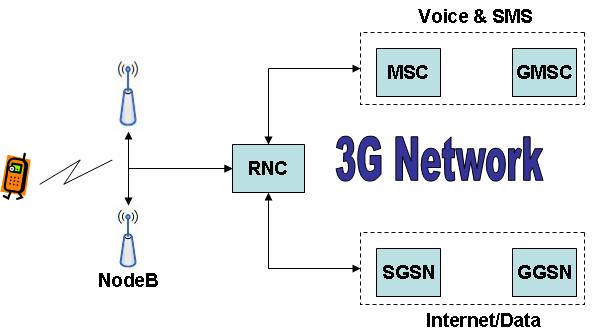
The 3G UMTS network comprises three domains: User Equipment (UE), the UMTS Terrestrial Radio Access Network (UTRAN) with NodeB base stations and Radio Network Controllers (RNC), and the Core Network (MSC for circuit voice, SGSN/GGSN for packet data). The UTRAN-CN interface (Iu) separates radio and core functions, enabling operator flexibility in deploying and upgrading each domain independently.
3G Cellular Standards — UMTS, WCDMA, CDMA2000 & TD-SCDMA
The three ITU-approved IMT-2000 radio interface families that define the global 3G cellular landscape — each optimised for different spectrum environments, operator legacies and regional regulatory requirements.
UMTS / W-CDMA
Universal Mobile Telecommunications System using Wideband CDMA (W-CDMA) radio access. Developed by 3GPP (3rd Generation Partnership Project), UMTS uses a 5 MHz FDD channel, spreading factor 4–512, and QPSK modulation. It supports 384 kbps data for pedestrian/slow vehicular users. Deployed in Europe, Japan (NTT DoCoMo), India and most of Asia-Pacific. The standard evolved through 3GPP Release 99 (first commercial 3G), Release 5 (HSDPA), Release 6 (HSUPA) and Release 7 (HSPA+).
3GPP · FDD · 2100 MHz / 900 MHzCDMA2000 / EV-DO
An evolution of IS-95 (cdmaOne) CDMA technology, standardised by 3GPP2 and ITU. CDMA2000 1× (1xRTT) offers 153 kbps data, while EV-DO (Evolution Data Optimised) Rev 0 provides 2.4 Mbps downlink and Rev A achieves 3.1 Mbps downlink and 1.8 Mbps uplink. Widely deployed by Verizon and Sprint (USA), SK Telecom and KT (South Korea), KDDI (Japan) and Reliance Communications (India on 800 MHz band). The standard operates in 1.25 MHz channels in the 800 MHz and 1900 MHz bands.
3GPP2 · CDMA · 850 / 1900 MHzTD-SCDMA
Time Division Synchronous CDMA — China's proprietary 3G standard co-developed by CATT (China Academy of Telecommunications Technology) and Datang Mobile. Uses TDD (Time Division Duplex) with synchronous CDMA and smart antenna technology in 1.6 MHz channels. Deployed exclusively in China by China Mobile on 2010 MHz band. TD-SCDMA was China's strategic investment in IMT-2000 to own SEPs and reduce dependence on Qualcomm and Ericsson royalties. It later served as the conceptual precursor to TD-LTE (4G) and TD-NR (5G).
TDD · Smart Antenna · 2010 MHzIMT-2000 Framework
IMT-2000 (International Mobile Telecommunications-2000) is the ITU specification for 3G wireless systems. It defined minimum 3G requirements: 144 kbps for high mobility (vehicular), 384 kbps for low mobility (pedestrian), 2 Mbps for fixed/stationary environments; global roaming capability; interoperability with 2G networks; multimedia services (voice, data, video) and quality of service guarantees. Five radio interface families were approved: IMT-DS (W-CDMA), IMT-MC (CDMA2000), IMT-TC (TD-SCDMA), IMT-SC (UWC-136/EDGE) and IMT-FT (DECT).
ITU · Radio Interface · Global RoamingHSPA — 3.5G Evolution
High Speed Packet Access is the 3GPP enhancement of UMTS that dramatically improved 3G data throughput. HSDPA (3GPP Release 5, 2002) introduced shared downlink channels using 16QAM modulation and adaptive modulation and coding (AMC) to deliver up to 14.4 Mbps downlink. HSUPA (3GPP Release 6, 2004) enhanced uplink to 5.76 Mbps. HSPA+ (Release 7–8) added MIMO, 64QAM and dual-carrier operation to achieve 42 Mbps downlink and 22 Mbps uplink — bridging the gap toward 4G LTE performance.
HSDPA · HSUPA · 14.4 Mbps DLWCDMA Radio Interface
WCDMA (Wideband Code Division Multiple Access) is the radio interface technology underlying UMTS. It spreads each user's signal over a 5 MHz bandwidth using a unique orthogonal spreading code, enabling all users to transmit simultaneously on the same frequency. Key features: variable spreading factor (4–512), soft handover using RAKE receivers, closed-loop and open-loop power control with 1500 Hz update rate, 10 ms / 20 ms radio frames and flexible bit rates from 12.2 kbps (AMR voice) to 2 Mbps (3GPP Release 99 maximum).
5 MHz Channel · RAKE Receiver · Soft HO3G Standard Specifications — Technical Comparison
Side-by-side technical parameters of the three major 3G IMT-2000 radio interface standards and their HSPA evolutions.
| Parameter | UMTS / W-CDMA | CDMA2000 1× / EV-DO | TD-SCDMA | HSPA / HSPA+ |
|---|---|---|---|---|
| Standard Body | 3GPP | 3GPP2 / TIA | 3GPP / CCSA | 3GPP Rel. 5–10 |
| Duplex Mode | FDD (Paired) | FDD (Paired) | TDD (Unpaired) | FDD (UMTS evolution) |
| Channel BW | 5 MHz | 1.25 MHz | 1.6 MHz | 5 MHz (+ DC-HSPA) |
| Multiple Access | DS-CDMA | MC-CDMA | TDD-CDMA + TDMA | DS-CDMA + OFDM |
| Peak DL Data Rate | 384 kbps (Rel. 99) | 3.1 Mbps (EV-DO Rev A) | 2.8 Mbps | 14.4 Mbps / 42 Mbps |
| Peak UL Data Rate | 64 kbps (Rel. 99) | 1.8 Mbps (EV-DO Rev A) | 2.2 Mbps | 5.76 Mbps / 22 Mbps |
| Chip Rate | 3.84 Mcps | 1.2288 Mcps | 1.28 Mcps | 3.84 Mcps |
| Modulation (DL) | QPSK | QPSK / 8-PSK | QPSK / 8-PSK | 16QAM / 64QAM |
| Spreading Factor | 4–512 | 64 (fixed voice) | 1–16 | 4–256 (adaptive) |
| Frequency Bands | 900 / 2100 MHz | 800 / 1900 MHz | 2010 MHz | 900 / 2100 MHz |
| Handover Type | Soft / Hard | Soft / Hard | Hard (Baton HO) | Soft / Hard |
| Power Control | Inner + Outer Loop (1500 Hz) | Closed Loop (800 Hz) | Closed Loop | AMC replaces fast PC |
| Deployment Region | Europe, Asia, India, Africa | N. America, Korea, Japan | China only | Global (UMTS upgrade) |
3G UMTS Network Architecture — UTRAN, NodeB, RNC & Core Network
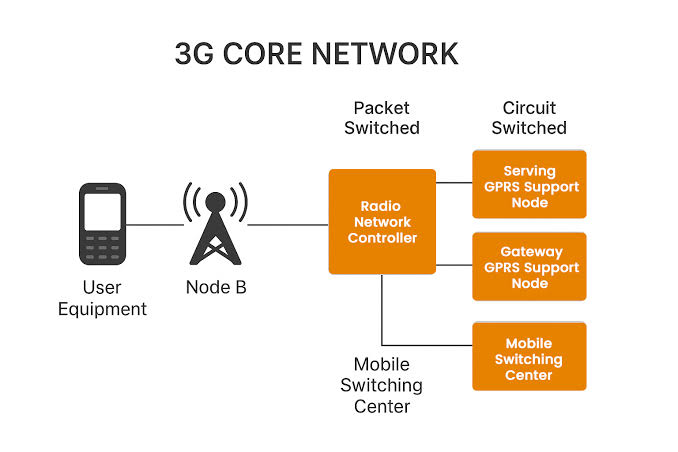
The 3G UMTS network is divided into three logical domains interconnected by standardised open interfaces — enabling multi-vendor deployment and independent domain evolution.
3G NodeB Radio Access — The Air Interface
The NodeB is the 3G base station that manages the Uu radio interface between User Equipment and the UTRAN. Each NodeB houses the RF transceiver chains, power amplifiers, antenna arrays and baseband processing units for WCDMA spreading/despreading, RAKE receiver combining and fast closed-loop power control at 1500 Hz update rate. NodeBs are connected to the RNC via the Iub interface over E1/ATM or IP transport.
Radio Network Controller (RNC)
The RNC is the intelligent controller node of the UTRAN. It manages radio resource allocation, handover decisions (intra-RNC soft handover, inter-RNC relocation via Iur interface), radio bearer setup/teardown, outer-loop power control, admission control and load balancing across NodeBs. Each RNC connects to the Core Network via the Iu-CS interface (to MSC for voice) and Iu-PS interface (to SGSN for data).
Iub / Iur / Iu Interfaces · ATM / IP3G Core Network — CS & PS Domains
The 3G Core Network has two parallel domains: the Circuit-Switched (CS) domain using Mobile Switching Centre (MSC) and Visitor Location Register (VLR) for voice calls and SMS; and the Packet-Switched (PS) domain using Serving GPRS Support Node (SGSN) and Gateway GPRS Support Node (GGSN) for mobile internet and multimedia. Both share the Home Location Register (HLR) and Authentication Centre (AuC) for subscriber management and security.
MSC · SGSN · GGSN · HLR / AuCHistory of 3G Network — From IMT-2000 to HSPA+
Key milestones in the standardisation, deployment and evolution of 3G mobile network technology worldwide from 1992 to 2012.
3G Cellular Standards with Patents — Key IP Holders
The 3G standards ecosystem is underpinned by thousands of Standard Essential Patents (SEPs) held by major telecommunications companies. These patents must be licensed on FRAND (Fair, Reasonable and Non-Discriminatory) terms to all implementers.

3G Cellular Standards — Standard Essential Patents (SEP) Landscape
The 3G SEP landscape is dominated by a handful of major patent holders whose inventions are technically essential to implementing the UMTS/WCDMA, CDMA2000 and TD-SCDMA standards. FRAND licensing of these SEPs became the foundation of the global mobile royalty economy and triggered landmark litigation including the FTC v. Qualcomm antitrust case and Ericsson v. Samsung licensing disputes.
CDMA Core Technology & Power Control SEPs
Qualcomm holds the largest 3G SEP portfolio — estimated 1,000+ essential patents covering fundamental CDMA multiple access techniques, closed-loop power control, soft handover, rake receivers, vocoders (EVRC, CELP) and CDMA2000 EV-DO. Qualcomm's royalty of 5% of device price (FRAND disputed) generated billions annually from every 3G smartphone sold globally.
CDMA · Power Control · Soft HOWCDMA NodeB Architecture & RAN Patents
Ericsson contributed foundational WCDMA radio access patents covering NodeB transceiver architecture, RNC algorithms, Iub interface protocols, antenna beam forming for UTRAN, macro diversity combining in soft handover and HSDPA scheduling. Ericsson's licensing revenue from 3G/4G SEPs exceeds $1B annually and has been at the centre of landmark FRAND cases against Samsung, Apple and HTC.
UTRAN · NodeB · Soft HO · SchedulingUMTS Protocols, Codec & Security Patents
Nokia contributed essential UMTS RLC/MAC layer protocol patents, AMR (Adaptive Multi-Rate) codec patents for voice quality in WCDMA, KASUMI block cipher for 3G security, HSDPA channel quality indicator feedback mechanisms and release management. Nokia's SEP portfolio was partially retained in Nokia Technologies after the Nokia mobile device sale to Microsoft, and continues to generate significant FRAND licensing revenue.
AMR Codec · KASUMI · HSDPA CQICDMA Synchronisation & Handoff Technology
InterDigital holds over 700 3G/4G SEPs covering synchronisation of CDMA base stations, pilot signal design, power control signalling and handoff algorithms. InterDigital is a non-practising entity (NPE) that derives its entire revenue from patent licensing. Major 3G patent cases include InterDigital v. Nokia, InterDigital v. Samsung and InterDigital v. Huawei at the ITC and in US district courts.
CDMA Sync · Pilot Signals · ITC LitigationW-CDMA Specification & IMT-2000 Contribution Patents
NTT DoCoMo co-developed the W-CDMA radio interface specification and holds essential patents in spreading code design, WCDMA frame structure (10 ms radio frame, transport channel multiplexing), variable spreading factor operation and quality of service differentiation. DoCoMo licensed its foundational W-CDMA patents to all UMTS equipment manufacturers and device OEMs globally.
W-CDMA Frame · Spreading Codes · QoSTD-SCDMA Standard SEPs
China Academy of Telecommunications Technology (CATT) and its commercial arm Datang Mobile hold the essential patents for the TD-SCDMA 3G standard — covering TDD frame structure (5 ms subframe, 7 timeslots), synchronous CDMA operation in TDD mode, joint detection algorithms, smart antenna (beam steering) techniques and baton handover. These patents gave China its first domestic 3G SEP position.
TD-SCDMA · Smart Antenna · Joint Detection3G Network Spectrum — Frequency Bands & Allocation
3G networks operate in licensed spectrum bands allocated by national regulators under ITU Radio Regulations. Band allocation varied significantly by region — complicating global device roaming and driving the need for multi-band 3G chipsets.
| 3G Band | Uplink (UL) | Downlink (DL) | Bandwidth | Standard | Region |
|---|---|---|---|---|---|
| Band I (2100) | 1920–1980 MHz | 2110–2170 MHz | 60 MHz FDD | UMTS | Europe, Asia, India, Africa |
| Band II (1900) | 1850–1910 MHz | 1930–1990 MHz | 60 MHz FDD | CDMA2000UMTS | North America |
| Band IV (AWS) | 1710–1755 MHz | 2110–2155 MHz | 45 MHz FDD | UMTS | North America (AT&T, T-Mobile) |
| Band V (850) | 824–849 MHz | 869–894 MHz | 25 MHz FDD | CDMA2000UMTS | USA, Australia, LatAm |
| Band VIII (900) | 880–915 MHz | 925–960 MHz | 35 MHz FDD | UMTS | Europe, India, Africa, ME |
| Band IX (1700) | 1749.9–1784.9 MHz | 1844.9–1879.9 MHz | 35 MHz FDD | UMTS | Japan (NTT DoCoMo, SoftBank) |
| Band A (TD-SCDMA) | 1900–1920 MHz (TDD) | 20 MHz TDD | TD-SCDMA | China only (China Mobile) | |
| Band E (TD-SCDMA) | 2010–2025 MHz (TDD) | 15 MHz TDD | TD-SCDMA | China only | |
HSPA Evolution — From 3G to 3.75G Mobile Broadband
High Speed Packet Access (HSPA) is the family of 3GPP enhancements to UMTS that transformed 3G from 384 kbps to 42 Mbps — enabling real mobile broadband without requiring a new spectrum licence or complete infrastructure replacement.
HSDPA (3GPP Release 5) — 14.4 Mbps DL
Introduced in 2002, deployed 2005–2006. Key innovations: shared downlink channel HS-DSCH with 2 ms TTI (vs 10 ms WCDMA); Node B-based fast scheduling (replaces RNC scheduling); Adaptive Modulation and Coding (AMC — QPSK/16QAM/64QAM); Hybrid ARQ (HARQ) with chase combining and incremental redundancy; up to 15 parallel HS-DSCH codes. Peak theoretical: 14.4 Mbps (Cat 14); typical: 1.8–7.2 Mbps depending on category.
Rel. 5 · HS-DSCH · HARQ · AMCHSUPA (3GPP Release 6) — 5.76 Mbps UL
Enhanced Uplink (E-DCH/HSUPA) standardised in 2004, deployed 2007. Introduced Node B-controlled scheduling for uplink, 2 ms TTI for low-latency uploads, HARQ on the uplink E-DCH channel and per-UE rate management. Peak UL: 5.76 Mbps (Cat 6). Together HSDPA + HSUPA = HSPA (branded "3.5G"), dramatically improving mobile upload for video, email attachments and social media.
Rel. 6 · E-DCH · UL HARQ · 5.76 MbpsHSPA+ (3GPP Release 7–8) — 42 Mbps DL
HSPA+ (marketed "4G" by many operators including AT&T and T-Mobile USA) introduced 64QAM downlink (21 Mbps), 2×2 MIMO (21 Mbps), combined MIMO + 64QAM (28 Mbps), Dual-Carrier HSDPA (42 Mbps DL, DC-HSDPA) and Dual-Carrier HSUPA (11.5 Mbps UL). HSPA+ also added Continuous Packet Connectivity (CPC) for reduced latency on always-on smartphone connections and RLC unacknowledged mode for multicast.
Rel. 7–8 · MIMO · DC-HSDPA · 42 Mbps3G vs 4G LTE — Technology, Speed & Architecture Comparison
A comprehensive comparison of 3G UMTS/HSPA and 4G LTE technologies across radio access, core network, performance, spectrum and service delivery.
| Parameter | 3G UMTS / HSPA+ | 4G LTE / LTE-Advanced |
|---|---|---|
| Generation | 3rd Generation (IMT-2000) | 4th Generation (IMT-Advanced) |
| Standard Body | 3GPP (Release 99 – Release 10) | 3GPP (Release 8 – Release 16) |
| Radio Access Technology | WCDMA / DS-CDMA (FDD) or TD-CDMA (TDD) | OFDMA (DL) + SC-FDMA (UL) |
| Channel Bandwidth | 5 MHz (fixed) | 1.4 / 3 / 5 / 10 / 15 / 20 MHz (flexible) |
| Peak Download Speed | 384 kbps (UMTS) / 42 Mbps (HSPA+) | 150 Mbps (LTE Cat 4) / 1 Gbps (LTE-A) |
| Peak Upload Speed | 64 kbps (UMTS) / 22 Mbps (HSPA+) | 50 Mbps (LTE Cat 4) / 500 Mbps (LTE-A) |
| Latency (Round-Trip) | 100–150 ms (UMTS) / 50–80 ms (HSPA) | 10–30 ms (LTE) |
| MIMO Support | Optional (HSPA+ Rel. 7, 2×2) | Mandatory (2×2 baseline, up to 8×8) |
| Voice Mode | Circuit-switched (CS) voice over dedicated channel | VoLTE (Voice over LTE) — fully packet-switched |
| Core Network | MSC (CS) + SGSN/GGSN (PS) — dual architecture | Evolved Packet Core (EPC) — all-IP flat architecture |
| Handover | Soft handover (WCDMA), HARQ retransmission | Hard handover only (X2 interface), faster re-establishment |
| Spectrum Efficiency | 0.3–0.6 bps/Hz (WCDMA) / ~1.5 bps/Hz (HSPA+) | 3–5 bps/Hz (LTE) / up to 30 bps/Hz (LTE-A with CA) |
| Security | KASUMI (f8/f9), AKA, integrity protection on RRC only | 128-EEA / 128-EIA (AES/Snow 3G), integrity on all bearers |
| Carrier Aggregation | DC-HSDPA (2×5 MHz same band) | Up to 5 carriers (100 MHz) — intra/inter-band CA |
3G Network Security — AKA, KASUMI & Integrity Protection
3G networks introduced significantly stronger security than 2G GSM — including mutual authentication, stronger encryption and radio link integrity protection, addressing key GSM vulnerabilities such as fake base station attacks.
AKA — Authentication and Key Agreement
3G uses the UMTS AKA (Authentication and Key Agreement) protocol — a significant improvement over 2G GSM one-way authentication. AKA provides mutual authentication: both the network authenticates the UE and the UE authenticates the network, preventing IMSI catchers and rogue NodeB attacks. AKA generates a 128-bit session key (CK for encryption, IK for integrity) using MILENAGE functions on the USIM and HLR/AuC, replacing the vulnerable A3/A8 SIM algorithms of GSM.
Mutual Auth · USIM · MILENAGE · 128-bit KeysKASUMI Block Cipher — f8 & f9 Algorithms
3G uses the KASUMI 64-bit block cipher (derived from MISTY1) for both confidentiality (f8 stream cipher mode over RLC/MAC) and integrity protection (f9 HMAC-like mode over RRC signalling). KASUMI uses 128-bit keys and operates with a 64-bit plaintext block in 8 rounds of Feistel structure. While KASUMI has theoretical weaknesses (Dunkelman et al. 2010 related-key attack), the cryptographic keys' short lifetime in practice prevents exploitation. A5/3 (used in EDGE/3G) is the GSM-equivalent KASUMI mode.
KASUMI · f8 (Ciphering) · f9 (Integrity)Radio Link Integrity & Confidentiality
Unlike 2G GSM which only provided optional air interface encryption with no integrity protection, 3G UMTS mandates both ciphering (applied to user data and signalling on the Uu interface) and integrity protection (applied to all RRC signalling messages to prevent man-in-the-middle tampering). The RNC manages the START counter for KASUMI, and periodic re-keying prevents counter wrap-around. Network domain security between NEs (MSC, RNC, SGSN) uses IP Security (IPsec) in 3GPP Release 9+.
Ciphering · Integrity · IPsec NDS3G Network Simulation Tools & Platforms
Software tools and simulators used for 3G WCDMA / UMTS / CDMA2000 network modelling, performance analysis, link-level simulation and HSPA throughput optimisation for final year BE, MTech and PhD projects.
MATLAB for 3G WCDMA Link-Level Simulation
MATLAB's Communications Toolbox provides WCDMA spreading code generation (Walsh-Hadamard, Gold codes), RAKE receiver modelling, HSDPA AMC and HARQ block-level simulation, channel modelling (AWGN, Rayleigh, ITU-T Vehicular/Pedestrian multipath), BER vs Eb/N0 curves, soft handover combining simulation and CDMA capacity analysis. Simulink models the entire NodeB/UE transceiver chain including pulse shaping, matched filtering and power control loops.
WCDMA · RAKE Receiver · BER AnalysisNS2 for 3G Network-Level Simulation
NS2 with the UMTS/3G patch (NIST, EURANE) enables system-level simulation of 3G RAN scenarios — modelling NodeB, RNC, multiple UEs, HSDPA scheduler (round-robin, proportional fair, maximum throughput), handover between NodeBs, channel conditions, QoS classes (conversational, streaming, interactive, background) and end-to-end TCP/UDP throughput analysis. Suitable for BE and MTech projects on 3G QoS, scheduling and handover performance.
UMTS Patch · HSDPA Scheduler · TCP QoSVienna UMTS Link-Level Simulator (LLS)
The open-source Vienna UMTS LLS (TU Wien) is a MATLAB-based link-level simulator for HSDPA and HSUPA physical layer performance evaluation. It models channel estimation, turbo coding/decoding, HARQ combining, MIMO spatial multiplexing for HSPA+ and AMC selection. Widely used for academic research on HSDPA throughput, MIMO capacity and 3G receiver algorithm development for MTech dissertations and IEEE paper publication.
HSDPA · Turbo Code · MIMO HSPA+Frequently Asked Questions — 3G Network Technology
Common questions from engineering students, researchers and professionals on 3G network standards, architecture, patents and simulation.