ai Native 6G Networks
— The Sixth Generation of Wireless Communication (IMT-2030)6G (Sixth Generation) network technology is the next evolutionary leap in wireless communications, being developed under the ITU-R IMT-2030 framework for targeted commercial deployment around 2030. Building upon 5G's foundation of enhanced mobile broadband (eMBB), ultra-reliable low-latency communications (URLLC) and massive IoT (mMTC), 6G introduces entirely new capability pillars: Integrated Sensing and Communication (ISAC), AI-native air interface design, Integrated Terrestrial and Non-Terrestrial Networks (TN+NTN), Semantic and Task-Oriented Communications and Holographic-Type Communications (HTC). 6G will operate across a dramatically wider spectrum — from sub-6 GHz through sub-terahertz (sub-THz) at D-Band (110–170 GHz) and H-Band (220–325 GHz) to frequencies above 300 GHz — enabling contiguous bandwidths of 10–100 GHz per carrier and supporting peak data rates of 1 Tbps, end-to-end latency below 0.1 milliseconds and device densities of 10 million per km². Intelligence in 6G is not an overlay add-on as in 5G — it is architecturally native, embedded in every protocol layer from the physical layer waveform design through MAC scheduling, RAN management and core network slicing.
6G Technology Topics Covered on This Page
- 6G speed, latency, reliability and KPI targets (IMT-2030)
- 6G terahertz spectrum — D-Band, H-Band, J-Band, WRC-23 allocation
- AI-native 6G network architecture — RAN, Core, O-RAN evolution
- Intelligent Reflecting Surfaces (IRS) / Reconfigurable Intelligent Surfaces (RIS)
- Integrated Sensing and Communication (ISAC / JCAS)
- Semantic communications and goal-oriented networking
- 6G use cases — holographic XR, digital twin, tactile internet, V2X
- 6G vs 5G — speed, latency, spectrum, architecture, sensing
- Global 6G research programmes — Hexa-X, B5GS, RINGS, 6G flagship
- 6G security — post-quantum cryptography, physical layer security
- 6G waveforms — OCDM, OTFS, AiFSK, DFT-s-OFDM evolution
- Cell-free massive MIMO and distributed RAN for 6G
6G Network — The Terahertz & AI-Native Wireless Future
6G networks will harness terahertz (THz) spectrum (100 GHz – 3 THz), ultra-massive MIMO antenna arrays, AI-embedded protocol stacks and reconfigurable intelligent surfaces to deliver 1 Tbps peak data rates — enabling experiences impossible on 5G: real-time holographic telepresence, zero-latency XR collaboration, autonomous vehicle swarm coordination and fully immersive digital twin environments.
6G Network Speed
Latency & KPI Targets — IMT-2030The ITU-R IMT-2030 framework defines the key performance indicators (KPIs) that distinguish 6G from 5G. These targets represent 10–1000× improvements over IMT-2020 (5G NR) specifications and are designed to support entirely new application domains.
ai Native 6G Architecture
Understanding 6G Peak Speed: Why 1 Tbps?Shannon Capacity in THz Channels
6G's 1 Tbps peak is theoretically achievable through Shannon's capacity theorem C = B·log₂(1+SNR). With a 100 GHz bandwidth channel in the D-Band at SNR of 10 dB, theoretical capacity approaches 332 Gbps per antenna stream. With 8-stream spatial multiplexing (8×8 ultra-massive MIMO) and 64QAM, achievable peak rates exceed 1 Tbps within 10 m short-range links — realistic for intra-datacenter, XR headset tethering and kiosk-type 6G deployments.
Shannon · 100 GHz BW · 8×8 MIMOPractical 6G Throughput by Scenario
Real-world 6G throughput will depend heavily on distance, environment and mobility. Indoor hotspot (<10 m, LOS): 100 Gbps–1 Tbps. Dense urban microcell (<100 m): 10–50 Gbps. Suburban macro (<500 m): 1–10 Gbps. Rural/satellite NTN: 100 Mbps–1 Gbps. High-speed mobility (train, aircraft): 1 Gbps. Typical user experience for 6G is specified at 1 Gbps in all scenarios — equivalent to downloading a 4K movie in under 1 second.
Hotspot · Macro · NTN · MobilitySub-1ms Latency — Enabling Real Haptics
6G's 0.1 ms air interface latency (compared to 5G's 1 ms URLLC target) is the critical enabler for tactile internet and teleoperated surgery — where kinesthetic feedback must arrive within the human perception threshold of 1 ms total round-trip. Achieving 0.1 ms requires ultra-short TTI (Transmission Time Interval) of ~1–4 symbols, predictive pre-caching using AI, and edge computing co-located within 100 km of the user.
0.1 ms TTI · Tactile Internet · Edge AI6G Terahertz Spectrum — Sub-THz Bands, WRC-23 & Propagation
6G's defining spectral frontier is the terahertz (THz) region — offering bandwidths 100× wider than 5G mmWave. Understanding THz propagation characteristics, molecular absorption peaks and ITU spectrum allocation is essential for 6G system design.
6G Terahertz Spectrum — D-Band & H-Band
The D-Band (110–170 GHz) and H-Band (220–325 GHz) offer 60 GHz and 105 GHz of contiguous bandwidth respectively — enough to support Tbps links. WRC-23 allocated 17.1 GHz of new spectrum for IMT in these sub-THz bands including 275–296 GHz, 306–313 GHz and 318–333 GHz, though molecular absorption from water vapour at 183 GHz and 325 GHz creates attenuation peaks that constrain link range to <300 m in humid environments.
THz Propagation Challenges
THz signals suffer from severe free-space path loss (FSPL = 20·log₁₀(4πd·f/c) — at 300 GHz and 10 m, FSPL = 122 dB vs 98 dB at 28 GHz), molecular absorption (water vapour O₂ peaks at 60 GHz, 183 GHz, 325 GHz), near-zero diffraction (highly directional, LOS-dominated), rough surface scattering and rain/fog attenuation (1–10 dB/km at D-Band). Overcoming these requires high-gain antenna arrays, AI-driven beam management, IRS-assisted NLOS links and dense small-cell deployment at <50 m inter-site distance.
FSPL · Molecular Absorption · IRS-NLOSWRC-23 6G Spectrum Allocation
The ITU World Radio Conference 2023 (WRC-23) made landmark decisions for IMT-2030 (6G): identified 17.1 GHz of additional IMT spectrum in the 4–16 GHz range (upper mid-band) including 6425–7125 MHz, 10.0–10.5 GHz and 12.75–13.25 GHz for terrestrial IMT; and identified sub-THz bands 275–296 GHz, 306–313 GHz and 318–333 GHz for land-mobile IMT applications — the first-ever THz spectrum identified for mobile standards.
WRC-23 · Upper Mid-Band · 275–333 GHz| 6G Spectrum Band | Frequency Range | Available BW | Propagation Range | Key Use |
|---|---|---|---|---|
| Sub-6 GHz (FR1 ext.) | 0.4–7.125 GHz | Up to 100 MHz | 1–100 km | Coverage, IoT, mMTC, NTN |
| Upper Mid-Band | 7–24 GHz | 500 MHz–2 GHz | 0.1–10 km | Capacity, XR, V2X, ISAC |
| mmWave (FR2) | 24–100 GHz | Up to 2 GHz | 10–500 m | Hotspot, eMBB, backhaul |
| D-Band (sub-THz) | 110–170 GHz | Up to 60 GHz | 1–100 m | Tbps hotspot, XR, kiosk |
| H-Band (sub-THz) | 220–325 GHz | Up to 105 GHz | 1–50 m | Tbps indoor, nano-networks |
| THz (above 300 GHz) | 300 GHz–3 THz | >100 GHz | <10 m | Nano-com, body-area, chip-to-chip |
| Optical / VLC | 300 THz – 700 THz | Hundreds of THz | <10 m (LOS) | Indoor VLC, LiFi, optical RAN |
AI-Native 6G Network Architecture
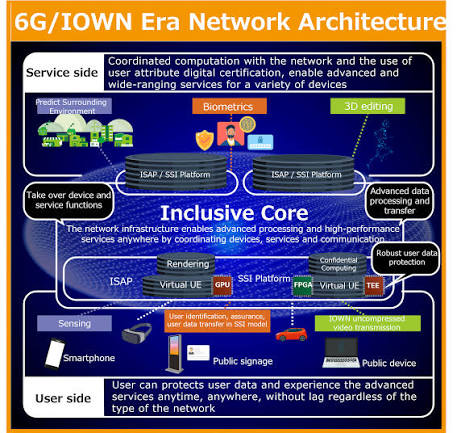
Unlike 5G where AI was retrofitted as an optimisation overlay, 6G is AI-native — artificial intelligence is embedded at every protocol layer, from the physical waveform design through MAC scheduling, RAN management, core network orchestration and service delivery. This architectural shift fundamentally changes how 6G networks self-configure, self-optimise and self-heal.
6G AI-Native Architecture — From the Physical Layer to Intelligent Core
The 6G network architecture integrates AI decision-making at the UE (device), Access (RAN/gNB), Edge (MEC), Transport and Core layers. Each layer hosts AI agents that share compressed learning models rather than raw data — enabling distributed federated intelligence without centralised privacy risks. The 6G core uses a Service-Based Architecture (SBA) evolved from 5G with native support for semantic data models, AI model repositories and intent-based network management.
AI-Embedded Physical Layer
In 6G, AI replaces hand-crafted signal processing blocks with learned neural network equivalents: autoencoder-based end-to-end channel coding (replacing turbo/LDPC codes for THz channels), AI channel estimation (replacing pilots with learned implicit representations), deep learning beam prediction (replacing CSI feedback for massive MIMO), AI waveform shaping (learned pulse shapes robust to THz molecular absorption) and AI-driven HARQ retransmission decisions. The Vienna 6G simulator and NVIDIA Sionna toolkit provide open platforms for AI PHY research.
AutoEncoder · AI Channel Estimation · DL BeamCell-Free Distributed MIMO
6G moves beyond cellular base stations to cell-free massive MIMO — a distributed RAN architecture where hundreds of radio access points (APs), each with a few antennas, are connected to a central processing unit (CPU) via a fronthaul network. All APs jointly serve all users using coherent joint transmission (JT) and receive processing — eliminating cell-edge effects, inter-cell interference and handover, providing uniformly high throughput across the coverage area. Cell-free networks use Level 4 (Centralised MMSE precoding) processing and require fronthaul of 1–10 Gbps per AP.
Distributed MIMO · No Cell Edge · JT MMSENon-Terrestrial Networks (NTN) as Native 6G RAN
6G integrates LEO satellites (altitude 200–2000 km, e.g. Starlink Gen2, Kuiper), Medium Earth Orbit (MEO) satellites, High-Altitude Platforms (HAPs/HAPS at 20 km) and UAV-mounted base stations as native 6G RAN nodes — not as overlays but as first-class access nodes sharing the same 6G protocol stack (NTN-gNB). This provides seamless 6G coverage over oceans, deserts, polar regions and disaster areas, supporting maritime V2V, aviation broadband and emergency communications with 1 Gbps user throughput.
LEO · HAPs · NTN-gNB · Maritime 6GO-RAN Evolution for 6G
The Open RAN (O-RAN) architecture evolves significantly in 6G: the Near-Real-Time RIC (xApps) and Non-Real-Time RIC (rApps) become AI model deployment platforms; the O-DU and O-RU interface (Open Fronthaul) is upgraded to support THz cell-free distributed MIMO; and a new AI Model Training and Inference framework standardises how ML models are trained (centralised/federated), deployed, updated and monitored across vendors in the O-RAN ecosystem. This ensures multi-vendor AI interoperability — a key 6G standardisation challenge.
xApp/rApp · AI Model Repo · Open FronthaulIntelligent Reflecting Surfaces (IRS / RIS) — 6G's Programmable Wireless Environment
Reconfigurable Intelligent Surfaces (RIS), also called Intelligent Reflecting Surfaces (IRS), are among the most distinctive enabling technologies of 6G — transforming passive radio environments into actively controlled, programmable scattering media.
What is an RIS / IRS?
An RIS is a planar array of sub-wavelength passive reflecting elements (meta-atoms), each loaded with a tunable element (PIN diode, varactor, liquid crystal, MEMS switch or graphene actuator). By controlling the phase, amplitude and polarisation of each element via a smart controller, the RIS collectively shapes the reflected wavefront to steer, focus, null or scatter incident electromagnetic waves in a desired direction — without any active RF chains, amplifiers or power-hungry signal processing. A 256-element RIS at 28 GHz occupies only 30 cm × 30 cm yet can provide 20–30 dB signal enhancement to a target receiver in NLOS conditions.
Meta-Atoms · Phase Control · NLOS EnhancementRIS Benefits for 6G THz Links
At THz frequencies (above 100 GHz), the near-LOS propagation constraint severely limits 6G coverage in urban environments. RIS panels deployed on building facades, ceilings and road furniture create intelligent relay paths that circumvent blockages — providing NLOS 6G coverage without additional base stations. RIS also enables precise beam focusing for sub-cm spatial multiplexing in dense XR environments, physical layer security by null-steering eavesdroppers, and simultaneous communication and radar sensing using reflected waveforms — dramatically expanding 6G's effective coverage and capacity.
THz NLOS · Beam Focus · PLS · ISAC-RISActive RIS vs Passive RIS
Traditional (passive) RIS can only reflect without amplification — suffering from multiplicative path loss (BS→RIS→UE path loss product). Active RIS integrates low-power amplifiers at each element, overcoming this limitation and extending effective range by 5–10×, at the cost of modest power consumption (milliwatts per element). Hybrid active-passive RIS architectures balance coverage gain and energy efficiency. Simultaneous Transmitting and Reflecting RIS (STAR-RIS) splits the incident wave into reflected and transmitted components — enabling full 360° 6G coverage from a single RIS panel deployed on glass facades or smart windows.
Active RIS · STAR-RIS · Energy EfficiencyIntegrated Sensing and Communication (ISAC) — 6G's Dual Purpose
ISAC (also called Joint Communication and Sensing / JCAS) is one of the six IMT-2030 usage scenarios. In 6G, the same waveform, spectrum and hardware simultaneously delivers data communication and radar-quality environmental sensing — a paradigm impossible in previous generations.
How ISAC Works in 6G
In ISAC, the 6G base station transmits a carefully designed waveform that simultaneously carries data bits for communication users and acts as a radar probe signal for environmental sensing. OFDM signals with embedded radar pilots (OFDM-DFRC) allow estimation of target range (via IFFT of frequency-domain reflections), velocity (via STFT / Doppler), angle-of-arrival (via spatial matched filter) and reflectivity — with sub-centimetre range resolution at 100 GHz bandwidth. The sensing information feeds back into the AI-native RAN for beam prediction, mobility management, traffic control and environment mapping.
OFDM-DFRC · Range/Velocity/AoA · Sub-cmISAC Applications in 6G
6G ISAC enables a rich set of applications: Automotive — vehicle radar integrated with V2X communication sharing the same 77/140 GHz waveform; Smart city — pedestrian counting, traffic density and crowd flow sensing via urban 6G base stations; Indoor positioning — sub-cm 3D localisation for AR/VR headset tracking, robot navigation and asset management; Industrial automation — simultaneous machine communication and contactless vibration/deformation sensing; Healthcare — 6G-based vital sign monitoring (respiration, heartbeat) through walls without wearables; and Environmental monitoring — rainfall estimation and wind profiling using 6G network backscatter.
V2X · Smart City · XR Tracking · HealthcareISAC Waveform Design Tradeoffs
Designing a 6G waveform that simultaneously optimises communication capacity and radar sensing performance requires carefully balancing: Peak-to-Average Power Ratio (PAPR) — low PAPR is good for communications amplifier efficiency but radar sensing benefits from constant-envelope waveforms; Ambiguity function — radar resolution in range and Doppler must be balanced against OFDM subcarrier orthogonality; Sensing vs communication resource allocation — fraction of power, bandwidth and time slots dedicated to radar vs data; and Mutual interference — echo clutter from sensing must be suppressed before communication demodulation. Optimal ISAC waveforms use dual-function radar communication (DFRC) precoding with SIC (successive interference cancellation) at the receiver.
DFRC Precoding · PAPR · SIC · AmbiguitySemantic Communications — Transmitting Meaning, Not Bits
Semantic communication is a paradigm shift from conventional bit-pipe communication towards meaning-aware transmission — where the network transmits only the task-relevant semantic content rather than the raw data, dramatically reducing bandwidth and latency requirements.
What is Semantic Communication?
Traditional (Shannon) communication maximises bit accuracy regardless of content. Semantic communication extracts and transmits only the meaning needed for a specific task. A 6G semantic video codec for autonomous driving transmits "pedestrian at position (x,y,z) with velocity v" — a few hundred bits — instead of a 100 Mbps raw video stream. Deep joint source-channel coding (DeepJSCC) uses transformer-based neural networks to encode source semantics directly into channel-robust representations, eliminating the source–channel separation assumption. 6G semantic systems can achieve the same task accuracy at 100–1000× lower bit rates than conventional communication.
DeepJSCC · Transformer · 100× Compression6G Knowledge Base & Reasoning
6G semantic networks maintain shared Knowledge Bases (KB) at both transmitter and receiver — ontological representations of the environment, application context and user intent. When transmitting, the 6G encoder references the shared KB to identify what semantic information is novel (not already known at the receiver) and only transmits the delta. A 6G XR headset that already has a 3D model of a room only needs to receive updates to moving objects. This knowledge-graph-driven selective transmission reduces 6G network load by 90%+ in contextually rich environments such as smart factories and intelligent transportation systems.
Knowledge Graph · Context-Aware · Delta TX6G Use Cases — IMT-2030 Usage Scenarios
ITU-R IMT-2030 defines six usage scenarios that motivate 6G's performance requirements — spanning immersive communications, connected intelligence, integrated sensing, industrial automation, non-terrestrial coverage and sustainability.
6G Use Cases — Holographic XR, Digital Twins, Tactile Internet & Connected Intelligence
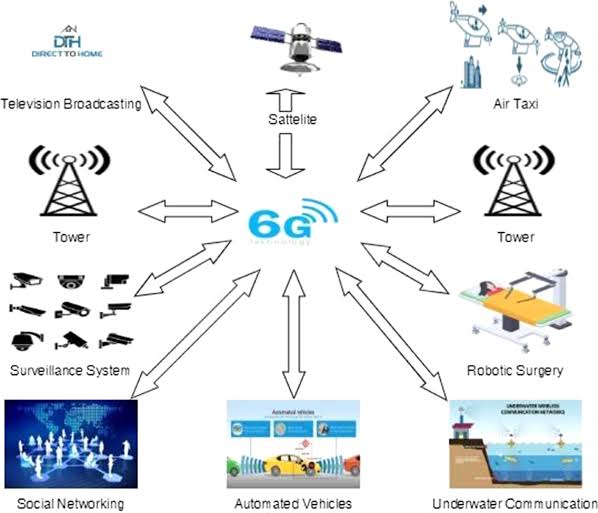
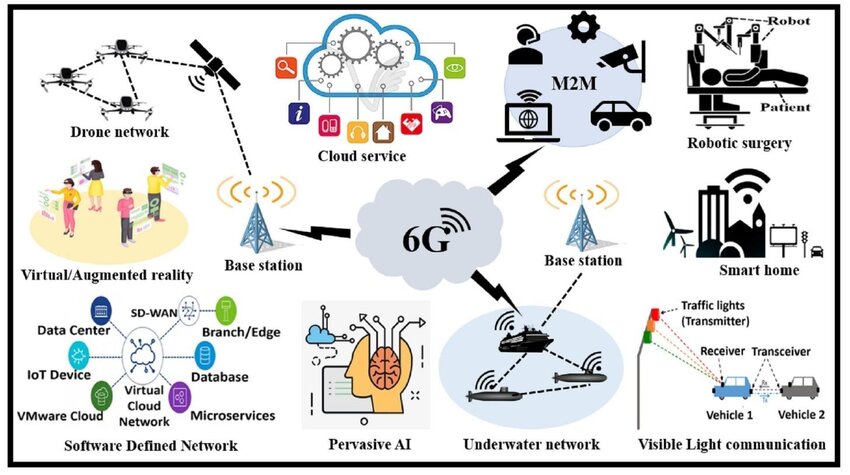
6G's six IMT-2030 usage scenarios encompass the full spectrum of 2030-era human-machine interaction: immersive holographic communications requiring 1 Tbps per headset, connected autonomous vehicle swarms requiring 0.1 ms V2X latency, digital twin synchronisation requiring 99.9999% reliability, smart city ISAC sensing networks, satellite-integrated global coverage and AI-native network self-management. No single application defines 6G — its value lies in simultaneously supporting all of these.
Immersive XR & Holographic Communications
Extended Reality (XR) — encompassing AR, VR and MR — will evolve from today's tethered 5G XR to fully wireless, untethered holographic 6G experiences. A 16K stereo holographic display requires 1–5 Tbps raw data rates; with semantic compression this reduces to 10–100 Gbps, still far beyond 5G. 6G enables real-time holographic telepresence for remote surgery, education, architecture review and social interaction with <1 ms motion-to-photon latency and sub-mm positional accuracy using ISAC-enabled spatial tracking.
Holographic · 16K · <1ms M2P · ISAC TrackingConnected Intelligent Transport
6G will enable Level 5 autonomous driving through vehicle-to-everything (V2X) communication with 0.1 ms latency and 99.9999% reliability — allowing a vehicle moving at 200 km/h to receive critical safety warnings within 5 mm of travel. 6G ISAC enables vehicles to share radar perception data with the network infrastructure, creating a collective environmental awareness far exceeding individual vehicle sensor ranges. Urban air mobility (UAM / air taxis) depends on 6G NTN for 3D traffic management and control link redundancy beyond VLOS.
V2X · 0.1ms · ISAC · UAM / Air TaxiDigital Twin Networks
6G will enable network digital twins (NDT) — real-time virtualised replicas of physical network infrastructure, spectrum environment, user mobility and application traffic, updated synchronously with the physical world at millisecond granularity via ISAC. Network AI agents train and validate policies on the digital twin before deploying to the live network — eliminating trial-and-error optimisation risk. Physical digital twins of cities, factories and power grids synchronised over 6G will reduce energy consumption, optimise logistics and enable autonomous infrastructure management at a scale impossible today.
NDT · AI Policy Training · Real-Time SyncIndustry 5.0 & Tactile Internet
6G will power Industry 5.0 — the human-centric evolution of Industry 4.0 — where wireless-connected cobots (collaborative robots), haptic gloves, exoskeletons and teleoperated assembly arms work alongside humans in flexible smart factories. The tactile internet requires 1 ms round-trip latency for kinesthetic feedback (force/torque) and 0.1 ms for cutaneous feedback (texture, temperature) — only achievable with 6G's sub-0.1 ms air interface combined with MEC computing co-located on the factory floor. A 6G-enabled surgeon can feel tissue resistance while performing remote robotic surgery across continents.
Haptics · Teleoperation · Industry 5.0 · MECUbiquitous Connectivity via NTN
6G NTN integration (LEO/MEO satellites, HAPs, UAVs) extends seamless connectivity to 100% of the Earth's surface — oceans, polar regions, deserts, mountains and airspace. 6G NTN delivers 1 Gbps to ships at sea, 1 Gbps to aircraft at 35,000 ft and broadband to rural communities — with the same device, same SIM and seamless 6G TN/NTN handover invisible to users. Direct-to-device 6G LEO satellite (DtD-6G) enables smartphones to connect directly to satellites without specialised terminals — extending Starlink/Kuiper Gen3 concepts to IMT-2030 native architecture.
LEO DtD · HAPs · Seamless TN-NTN HOSustainable 6G — Green Connectivity
6G targets 10× better energy efficiency than 5G (bits per Joule) despite delivering 100× more capacity, addressing the telecom industry's growing carbon footprint. Key 6G energy innovations: cell-free RAN eliminates always-on macro cell transmissions by activating APs only when users are nearby; AI-native power amplifier control (deep reinforcement learning) continuously optimises PA bias at each antenna element; RIS-assisted coverage replaces active amplifiers; ambient backscatter IoT eliminates battery maintenance for 10 billion sensors; and solar/RF energy harvesting on RIS panels enables self-powered network nodes in remote deployments.
Green 6G · 10× EE · Backscatter · RF Harvest6G vs 5G — Complete Technology Comparison
A comprehensive side-by-side comparison of 5G NR (IMT-2020) and 6G (IMT-2030) across every major technical dimension — from physical layer to applications.
| Parameter | 5G NR (IMT-2020) | 6G (IMT-2030 Target) |
|---|---|---|
| Peak Data Rate | 20 Gbps downlink / 10 Gbps uplink | 1 Tbps downlink / 1 Tbps uplink |
| User Experience Rate | 100 Mbps (typical) | 1 Gbps (all scenarios) |
| Air Interface Latency | 1 ms (URLLC) | 0.1 ms (10× improvement) |
| E2E Latency | 5–10 ms | 1 ms (MEC co-located) |
| Reliability | 99.999% (five nines) | 99.9999% (six nines) |
| Connection Density | 1 million devices/km² | 10 million devices/km² |
| Area Traffic Capacity | 10 Mbps/m² | 10 Tbps/m² |
| Spectrum | Sub-6 GHz + mmWave (24–100 GHz) | Sub-6 GHz + mmWave + sub-THz (100–300 GHz) + THz |
| Channel Bandwidth | Up to 400 MHz (FR2) | Up to 100 GHz (D-Band) |
| MIMO | Massive MIMO (64–256 antennas) | Ultra-massive MIMO (1024+ antennas) + Cell-free |
| Radio Access Tech | OFDMA / SC-FDMA (NR-OFDM) | OCDM / OTFS / AI-waveform / OFDM evolution |
| AI Integration | AI as add-on (SON, network analytics) | AI-native — embedded at every protocol layer |
| Sensing | Separate radar systems (not integrated) | ISAC — native joint communication and sensing |
| Programmable Environment | Not available | RIS/IRS — reconfigurable wireless environment |
| Communication Paradigm | Bit-pipe (Shannon capacity) | Semantic + task-oriented + bit-pipe hybrid |
| Non-Terrestrial Network | NTN add-on (Rel. 17 onwards) | NTN native — LEO/HAPs as first-class 6G RAN nodes |
| Positioning Accuracy | 1–10 m (5G NR positioning, Rel. 16/17) | <1 cm (sub-THz ISAC + dense RIS arrays) |
| Mobility | 500 km/h (HSR, NR-V2X) | 1000 km/h (aerospace, drone, LEO handover) |
| Security | AES-128/256, 5G-AKA, ZUC | Post-quantum cryptography (CRYSTALS-Kyber), PLS, ZT |
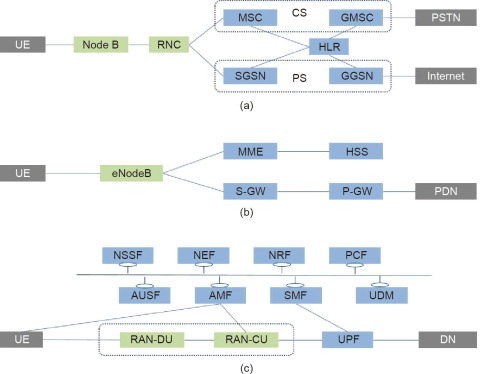
| Core Network | 5GC / SBA (Service-Based Architecture) | 6GC — SBA+ with AI model repo, semantic NF, intent-based |
| Commercial Target | 2019–2020 (deployed) | 2030–2031 (ITU IMT-2030 target) |
| Standards | 3GPP Release 15–18 | 3GPP Release 21+ (expected 2028–2030) |
Global 6G Research Programmes & Standardisation
6G is the subject of the largest coordinated global wireless research effort in history — with national governments, industry consortia and universities investing over $10 billion collectively across more than 40 countries.
6G Physical Layer — Waveforms, Coding & Modulation
The 6G physical layer must simultaneously satisfy contradictory requirements: ultra-wide THz bandwidth, low PAPR for THz power amplifiers, robustness to Doppler spread in high-mobility scenarios and compatibility with ISAC ambiguity function requirements.
OTFS — Orthogonal Time Frequency Space
OTFS modulates information in the delay-Doppler domain rather than time-frequency (OFDM). It inherits the channel sparsity of the delay-Doppler representation — where multipath reflectors appear as a small number of compact points — providing 3D channel equalization with O(NM) complexity vs O(N²M) for OFDM-MIMO in doubly-dispersive THz channels. OTFS delivers 5–10 dB BER gain over OFDM at 1000 km/h Doppler spread — critical for 6G aerospace and high-speed rail scenarios. OTFS also has a compact ambiguity function ideal for 6G ISAC waveform design.
Delay-Doppler · Doubly Dispersive · ISACAI-Based Waveform Design
6G autoencoder-based waveforms use deep neural networks to jointly learn the optimal transmitter (modulator+encoder) and receiver (demodulator+decoder) as an end-to-end system, trained over simulated THz channel models. Unlike OFDM which was analytically designed for AWGN/Rayleigh channels, AI waveforms learn pulse shapes, constellation geometries and coding automatically optimised for THz molecular absorption profiles, beam squinting effects in ultra-massive MIMO and real hardware non-linearities (IQ imbalance, phase noise at 300 GHz). Leading frameworks include NVIDIA Sionna and the DeepMIMO dataset for AI PHY research.
Autoencoder · End-to-End · THz-OptimisedPolar Codes & Neural Channel Coding
Polar codes (adopted in 5G NR control channels) approach Shannon capacity theoretically and are a strong 6G candidate due to their successive cancellation list (SCL) decoding and flexibility. For 6G's extreme reliability (10⁻⁹ BLER at 6 nines availability), neural augmented polar codes use lightweight neural networks to improve SCL path selection, achieving 0.5–1 dB coding gain over standard 5G NR polar codes at short block lengths relevant for 6G URLLC and tactile internet payloads. LDPC codes evolved with graph-neural-network-based belief propagation decoders also compete for 6G data channel coding standardisation.
Polar + NN · SCL · 10⁻⁹ BLER · GNN-BP6G Network Security — Post-Quantum, Physical Layer & Zero Trust
6G's AI-native, THz-connected and semantically aware architecture introduces entirely new threat surfaces — from quantum computing attacks on 5G/6G cryptography to adversarial AI attacks on AI-native protocol layers and privacy risks in ISAC sensing. 6G security is designed from the ground up to address these emerging threats.
Post-Quantum Cryptography (PQC) in 6G
Current 5G security relies on RSA-2048 and ECDH key exchange — both vulnerable to Shor's quantum algorithm running on a sufficiently large fault-tolerant quantum computer (expected post-2030). 6G standardises NIST-approved post-quantum algorithms: CRYSTALS-Kyber (lattice-based KEM for key encapsulation), CRYSTALS-Dilithium (lattice-based digital signatures), FALCON and SPHINCS+ (hash-based signatures). 6G-AKA (Authentication and Key Agreement) will use Kyber-1024 for session key establishment, providing 256-bit post-quantum security level. 3GPP Release 19/20 is expected to introduce PQC into 5G-Advanced as a precursor to 6G PQC.
Kyber · Dilithium · PQC · 256-bit PQPhysical Layer Security (PLS)
6G leverages information-theoretic physical layer security — exploiting the wireless channel's spatial and temporal randomness to provide provable secrecy without relying on computational hardness assumptions. RIS-assisted directional modulation focuses the 6G signal beam precisely onto the intended receiver while nulling the eavesdropper's direction, achieving positive secrecy capacity even when the eavesdropper has better channel conditions than the legitimate receiver. THz beam's extreme directionality (<0.1° beamwidth at 300 GHz with 256-element array) provides inherent physical security — an eavesdropper must physically intercept the beam within millimetres of the intended path.
Secrecy Capacity · RIS Beamforming · THz PLSZero Trust Architecture for 6G
6G adopts the Zero Trust Architecture (ZTA) principle: no device, user, network function or AI agent is implicitly trusted regardless of location (inside or outside the 6G core network perimeter). Every 6G transaction requires continuous authentication, authorisation and integrity verification using AI-driven behaviour analytics that detect anomalous patterns (adversarial ML attacks on AI-native RAN, ISAC data poisoning, semantic communication manipulation). 6G ZTA is particularly important given the open O-RAN architecture's multi-vendor trust boundaries and the proliferation of NTN access nodes (LEO satellites, HAPs) with limited tamper-resistance.
ZTA · AI Anomaly · O-RAN Trust · NTN Security6G Research & Simulation Tools
Software tools, open datasets and hardware platforms used for 6G physical layer simulation, AI/ML research, THz channel modelling and system-level performance evaluation for MTech and PhD projects in Bangalore.
Frequently Asked Questions — 6G Network Technology
Common questions from engineering students, researchers and professionals on 6G speed, architecture, terahertz spectrum, AI-native design and IMT-2030 standardisation.