2026 IEEE Paper on 6G
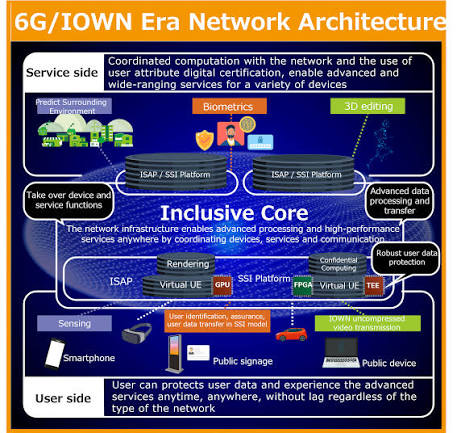
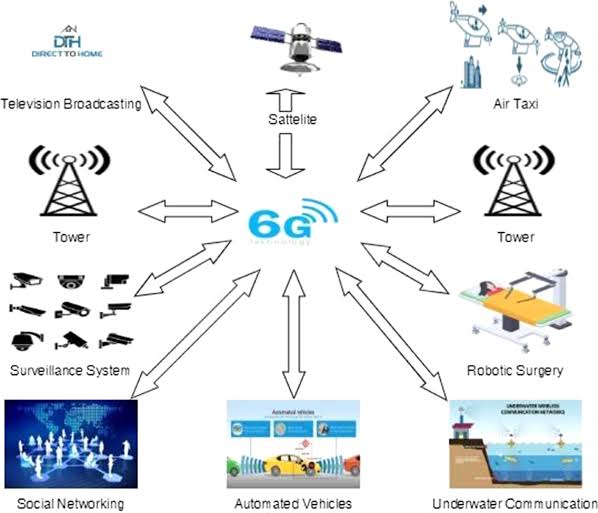
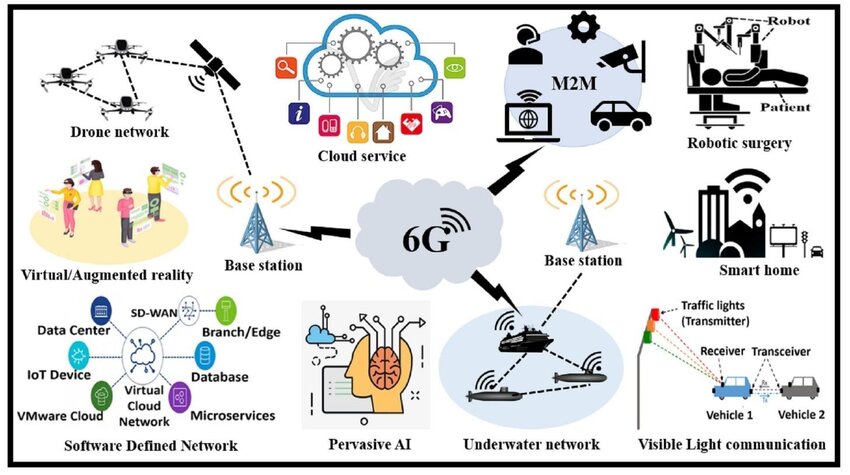
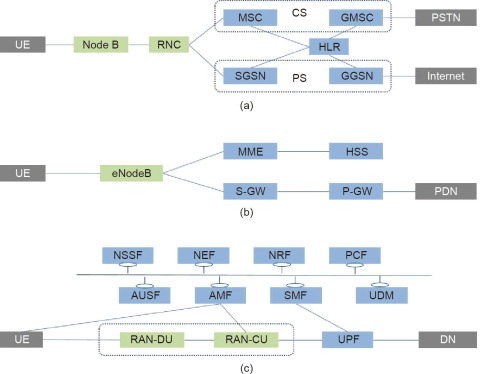
What is 6G? Speed, Specs & Why It Matters for Final Year ProjectsSixth-generation (6G) wireless technology is the successor to 5G, expected to be commercially standardised by the ITU and 3GPP around 2030. 6G operates across three spectrum tiers — sub-6 GHz (legacy coverage), mmWave (24–100 GHz), and the entirely new Terahertz (THz) band (0.1–10 THz) — enabling peak data rates of 1 Tbps, end-to-end latencies below 10 microseconds, and connection densities exceeding 10 million devices/km². Unlike 5G which is primarily a communication technology, 6G is envisioned as a convergence of communication, sensing, computation and AI — making it a uniquely rich domain for final year IEEE project ideas.
Key 6G innovations driving project research in 2026 include: Reconfigurable Intelligent Surfaces (RIS) that programme the propagation environment, Holographic MIMO for near-field spatial multiplexing, ISAC (Integrated Sensing and Communication) for joint radar-communication waveforms, AI-native air interface design with deep learning channel estimation, semantic and goal-oriented communication, energy harvesting and blockchain-secured 6G slices.
Generation Speed Comparison
 6G THz Antenna Design
 AI-Native 6G Network
 RIS for 6G Coverage
 Holographic MIMO / ISAC
IEEE Paper on 6G Wireless Technology
Six high-impact research domains that define the 6G landscape — each a rich source of IEEE final year project ideas for ECE, MTech and PhD scholars.
| # | 6G IEEE Project Title | Tools / Tech | Level |
|---|---|---|---|
| 01 | Graphene-Based Terahertz Patch Antenna for 6G Communication at 0.3 THz — HFSS Simulation and SPP Wave Analysis | ANSYS HFSS, CST | MTech/PhD |
| 02 | Deep Learning-Based Channel Estimation for 6G THz OFDM Systems using CNN-BiLSTM Architecture | Python, TensorFlow | MTech |
| 03 | RIS-Assisted 6G mmWave Network Coverage Optimisation using Deep Reinforcement Learning (DQN) | Python, PyTorch, MATLAB | MTech/PhD |
| 04 | ISAC Dual-Function Waveform Design for 6G: Joint Radar Sensing and OFDM Communication | MATLAB, Python | MTech |
| 05 | AI-Native 6G Autoencoder-Based End-to-End Communication System over THz Fading Channel | Python, TensorFlow | MTech |
| 06 | Holographic MIMO Beamforming for 6G Near-Field Communication — Capacity Analysis and Precoder Design | MATLAB, CVX | PhD |
| 07 | 6G NOMA-Assisted Massive IoT with Power Allocation using Multi-Objective Genetic Algorithm | MATLAB, Python | BE/MTech |
| 08 | Semantic Communication System for 6G Image Transmission using Variational Autoencoder (VAE) | Python, PyTorch | MTech/PhD |
| 09 | 6G THz Channel Modelling using Ray-Tracing and Machine Learning for Indoor Propagation Scenarios | MATLAB, Remcom WirelessInSite | PhD |
| 10 | Energy Harvesting SWIPT for 6G IoE Networks — Power Splitting Optimisation using Convex Programming | MATLAB, CVX | MTech |
| 11 | Federated Learning for Privacy-Preserving 6G Network Slice Management with Differential Privacy | Python, PySyft, TensorFlow | PhD |
| 12 | 6G Reconfigurable Intelligent Surface Phase Optimisation for Multi-User MIMO using ADMM Algorithm | MATLAB, Python | MTech/PhD |
| 13 | OFDM Waveform Design for 6G Sub-THz (100–300 GHz) — Peak-to-Average Power Ratio Reduction using SLM | MATLAB | BE/MTech |
| 14 | Blockchain-Based Spectrum Sharing for 6G Cognitive Radio Networks — Dynamic Spectrum Access and Trust Management | Python, Solidity, Ethereum | PhD |
| 15 | 6G Physical Layer Authentication using Deep Neural Network Fingerprinting for IoT Device Identity Verification | Python, Keras, SDR | MTech |
ⓘ All topics include IEEE 2025-2026 base paper, MATLAB/Python source code, simulation results, university-format report, PPT and viva Q&A support. WhatsApp +91 95919 12372 for abstracts.