Complete Technical Paper Content — Ad Targeting Machine Learning
1. Executive Abstract, Problem Formulation & Background
These datasets are used in machine learning (ML) research and have been cited in peer-reviewed academic journals. Datasets are an integral part of the field of machine learning. Major advances in this field can result from advances in learning algorithms (such as deep learning), computer hardware, and, less intuitively, the availability of high-quality training datasets. High-quality labeled training datasets for supervised and semi-supervised machine-learning algorithms are usually difficult and expensive to produce because of the large amount of time needed to label the data. Although they do not need to be labeled, high-quality unlabeled datasets for unsupervised learning can also be difficult and costly to produce. Many organizations, including governments, publish and share their datasets, often using common metadata formats (such as Croissant). The datasets are classified, based on the licenses, into two groups: open data and non-open data. The datasets from various governmental-bodies are presented in List of open government data sites. The datasets are ported on open data portals. They are made available for searching, depositing and accessing through interfaces like Open API. The datasets are made available as various sorted types and subtypes.
The data portal is classified based on its type of license. The open source license based data portals are known as open data portals which are used by many government organizations and academic institutions.
The data portal sometimes lists a wide variety of subtypes of datasets pertaining to many machine learning applications.
The data portals which are suitable for a specific subtype of machine learning application are listed in the subsequent sections.
**RTP set** – 35,087 stationary-point geometries (reactant, transition state and product) drawn from 11,961 elementary reactions, each labeled with density-functional energies, atomic forces and full Hessian matrices at the ωB97X-D/6-31G(d) level. **IRC set** – 34,248 structures along 600 minimum-energy reaction paths, used to test extrapolation beyond trained stationary points. **NMS set** – 62,527 off-equilibrium geometries generated by normal-mode sampling to probe model robustness under thermal perturbations. The collection underpins the study Does Hessian Data Improve the Performance of Machine Learning Potentials? and was used to train and benchmark the machine-learning interatomic potentials reported therein. The dataset itself is distributed under a CC licence via Figshare.
OpenML: Web platform with Python, R, Java, and other APIs for downloading hundreds of machine learning datasets, evaluating algorithms on datasets, and benchmarking algorithm performance against dozens of other algorithms. PMLB: A large, curated repository of benchmark datasets for evaluating supervised machine learning algorithms. Provides classification and regression datasets in a standardized format that are accessible through a Python API. Metatext NLP: https://metatext.io/datasets web repository maintained by community, containing nearly 1000 benchmark datasets, and counting. Provides many tasks from classification to QA, and various languages from English, Portuguese to Arabic. Appen: Off The Shelf and Open Source Datasets hosted and maintained by the company. These biological, image, physical, question answering, signal, sound, text, and video resources number over 250 and can be applied to over 25 different use cases.
Active learning is a special case of machine learning in which a learning algorithm can interactively query a human user (or some other information source) to label new data points with the desired outputs. The human user must possess expertise in the problem domain, including the ability to consult authoritative sources when necessary. In statistics literature, it is sometimes also called optimal experimental design. The information source is also called teacher or oracle. There are situations in which unlabeled data is abundant but manual labeling is expensive. In such a scenario, learning algorithms can actively query the teacher for labels. Since the learner chooses the examples, the number of examples to learn a concept can often be much lower than the number required in normal supervised learning. However, there is a risk that the algorithm is overwhelmed by uninformative examples. Recent developments are dedicated to multi-label active learning, hybrid active learning and active learning in a single-pass (on-line) context, combining concepts from the field of machine learning (e.g. conflict and ignorance) with adaptive, incremental learning policies in the field of online machine learning. Using active learning allows for faster development of a machine learning algorithm, when comparative updates would require a quantum or super computer. Large-scale active learning projects may benefit from crowdsourcing frameworks such as Amazon Mechanical Turk that include many humans in the active learning loop.
2. Related Work, Literature Survey & Algorithmic Foundations
T K , i {\displaystyle \mathbf {T} _{K,i}} : Data points where the label is known.
T U , i {\displaystyle \mathbf {T} _{U,i}} : Data points where the label is unknown.
T C , i {\displaystyle \mathbf {T} _{C,i}} : A subset of TU,i that is chosen to be labeled. Most of the current research in active learning involves the best method to choose the data points for TC,i.
Balance exploration and exploitation: the choice of examples to label is seen as a dilemma between the exploration and the exploitation over the data space representation. This strategy manages this compromise by modelling the active learning problem as a contextual bandit problem. For example, Bouneffouf et al. propose a sequential algorithm named Active Thompson Sampling (ATS), which, in each round, assigns a sampling distribution on the pool, samples one point from this distribution, and queries the oracle for this sample point label. Expected model change: label those points that would most change the current model. Expected error reduction: label those points that would most reduce the model's generalization error. Exponentiated Gradient Exploration for Active Learning: In this paper, the author proposes a sequential algorithm named exponentiated gradient (EG)-active that can improve any active learning algorithm by an optimal random exploration. Uncertainty sampling: label those points for which the current model is least certain as to what the correct output should be. Query by committee: a variety of models are trained on the current labeled data, and vote on the output for unlabeled data; label those points for which the "committee" disagrees the most Querying from diverse subspaces or partitions: When the underlying model is a forest of trees, the leaf nodes might represent (overlapping) partitions of the original feature space. This offers the possibility of selecting instances from non-overlapping or minimally overlapping partitions for labeling. Variance reduction: label those points that would minimize output variance, which is one of the components of error. Conformal prediction: predicts that a new data point will have a label similar to old data points in some specified way and degree of the similarity within the old examples is used to estimate the confidence in the prediction. Mismatch-first farthest-traversal: The primary selection criterion is the prediction mismatch between the current model and nearest-neighbour prediction. It targets on wrongly predicted data points. The second selection criterion is the distance to previously selected data, the farthest first. It aims at optimizing the diversity of selected data. User-centered labeling strategies: Learning is accomplished by applying dimensionality reduction to graphs and figures like scatter plots. Then the user is asked to label the compiled data (categorical, numerical, relevance scores, relation between two instances). A wide variety of algorithms have been studied that fall into these categories. While the traditional AL strategies can achieve remarkable performance, it is often challenging to predict in advance which strategy is the most suitable in a particular situation. In recent years, meta-learning algorithms have been gaining in popularity. Some of them have been proposed to tackle the problem of learning AL strategies instead of relying on manually designed strategies. A benchmark which compares 'meta-learning approaches to active learning' to 'traditional heuristic-based Active Learning' may give intuitions if 'Learning active learning' is at the crossroads
🚀 AI-Powered Customer Conversion Prediction System An end-to-end Machine Learning project designed to optimize digital marketing campaigns by predicting customer conversions using demographic, behavioral, and campaign engagement data. This project demonstrates a complete industry-standard ML workflow including: Data preprocessing pipeline Business-focused EDA Feature engineering Ensemble model training Hyperparameter tuning Threshold optimization Interactive Streamlit dashboard Deployment-ready modular architecture 📌 Problem Statement Digital marketing campaigns generate large volumes of customer interaction data, but identifying high-conversion customers remains a challenge. The goal of this project is to build a robust machine learning system capable of predicting whether a customer will convert based on: demographic attributes campaign engagement behavioral activity historical purchase behavior This enables businesses to: ✅ improve campaign targeting ✅ increase conversion rates ✅ reduce customer acquisition cost ✅ maximize Return on Advertising Spend (ROAS) 🎯 Business Objectives Predict customer conversion probability Identify high-performing marketing channels Discover customer segments with high purchase intent Optimize campaign spending Improve marketing ROI through data-driven targeting 🧠 Machine Learning Workflow Raw Data ↓ Data Cleaning ↓ Context-Aware Imputation ↓ Feature Engineering ↓ Outlier Treatment ↓ Encoding + Scaling ↓ Ensemble Model Training ↓ Hyperparameter Tuning ↓ Threshold Optimization ↓ Model Evaluation ↓ Streamlit Dashboard 📂 Project Structure ai-sme-solutions/ │ ├── README.md │ ├── data/ │ ├── raw/ │ ├── processed/ │ └── sample_data.csv │ ├── notebooks/ │ ├── 01_data_exploration.ipynb │ ├── 02_feature_engineering.ipynb │ ├── 03_model_training.ipynb │ ├── 04_model_evaluation.ipynb │ └── 05_business_insights.ipynb │ ├── src/ │ ├── data_loader.py │ ├── preprocessing.py │ ├── model.py │ ├── evaluation.py │ └── utils.py │ ├── app/ │ ├── app.py │ └── requirements.txt │ ├── reports/ │ ├── business_insights.pdf │ └── screenshots/ │ ├── models/ │ ├── final_model.pkl │ └── data_preprocessor.pkl │ └── requirements.txt 📊 Dataset Description Demographic Features Feature Description CustomerID Unique customer identifier Age Customer age Gender Male/Female Income Annual income Marketing Features Feature Description CampaignChannel Marketing channel CampaignType Campaign objective AdSpend Advertising spend ClickThroughRate CTR ConversionRate Campaign conversion rate Engagement Features Feature Description WebsiteVisits Website visits PagesPerVisit Avg pages per session TimeOnSite Avg time on site SocialShares Social shares EmailOpens Email opens EmailClicks Email clicks Historical Features Feature Description PreviousPurchases Prior purchases LoyaltyPoints Loyalty score Target Variable Feature Description Conversion 1 = Converted, 0 = Not Converted ⚙️ Data Preprocessing Pipeline The preprocessing pipeline includes: ✅ duplicate removal ✅ datatype correction ✅ context-aware missing value imputation ✅ outlier capping (99th percentile) ✅ feature engineering ✅ categorical encoding ✅ numerical scaling ✅ reusable sklearn pipeline serialization 🛠️ Feature Engineering Created advanced business-driven features such as: EngagementScore CustomerValue EmailCTR DeepEngagement Spend_per_Click ValuePerVisit These engineered features significantly improved model performance. 🤖 Models Used Base Models XGBoost LightGBM Random Forest Final Model Soft Voting Ensemble Combines: XGBoost LightGBM Random Forest for robust prediction performance. 🔍 Hyperparameter Tuning Implemented using: RandomizedSearchCV Stratified K-Fold Cross Validation ROC-AUC optimization 📈 Model Evaluation Evaluation metrics include: Accuracy Precision Recall F1 Score ROC-AUC Confusion Matrix Precision-Recall Curve Threshold Optimization 🎯 Threshold Optimization Business-aware threshold optimization was used instead of relying on the default 0.5 threshold. This improved: recall precision balance marketing decision quality 📊 Streamlit Dashboard Interactive dashboard features: ✅ Dataset overview ✅ Business insights ✅ Visual analytics ✅ Model evaluation ✅ Real-time conversion prediction 🚀 Running the Project 1️⃣ Clone Repository git clone https://github.com/your-username/ai-sme-solutions.git cd ai-sme-solutions 2️⃣ Create Virtual Environment Windows python -m venv venv venv \S cripts \a ctivate 3️⃣ Install Dependencies pip install -r requirements.txt 4️⃣ Run Preprocessing python src/preprocessing.py 5️⃣ Train Model python src/model.py 6️⃣ Run Evaluation python src/evaluation.py 7️⃣ Launch Streamlit Dashboard streamlit run app/app.py 📦 Tech Stack Languages & Libraries Python Pandas NumPy Scikit-learn XGBoost LightGBM Matplotlib Seaborn Streamlit Joblib 📌 Key Business Insights ✔ Customers with higher engagement scores are more likely to convert ✔ Email clicks strongly influence conversion probability ✔ Certain campaign channels outperform others significantly ✔ Customer loyalty strongly correlates with repeat conversions ✔ Optimized thresholding improves campaign targeting efficiency 📈 Future Improvements Real-time prediction API MLflow experiment tracking Docker deployment CI/CD integration Cloud deployment Drift monitoring Automated retraining pipeline Project Summary AI-Powered Customer Conversion Prediction System Developed an end-to-end machine learning system to predict customer conversions for digital marketing campaigns using ensemble learning techniques. Built a modular preprocessing and training pipeline with feature engineering, hyperparameter tuning, threshold optimization, and interactive Streamlit dashboard deployment. Achieved high ROC-AUC performance using XGBoost, LightGBM, and Random Forest ensemble models. 📬 Contact Feel free to connect for: Machine Learning Data Science AI Engineering Analytics Projects GitHub ( https://github.com/ShaunakKathavate )
An end-to-end Machine Learning project designed to optimize digital marketing campaigns by predicting customer conversions using demographic, behavioral, and campaign engagement data.
Digital marketing campaigns generate large volumes of customer interaction data, but identifying high-conversion customers remains a challenge.
3. Dataset Ingestion, Preprocessing & Stochastic Augmentations
The goal of this project is to build a robust machine learning system capable of predicting whether a customer will convert based on:
✅ improve campaign targeting ✅ increase conversion rates ✅ reduce customer acquisition cost ✅ maximize Return on Advertising Spend (ROAS)
Raw Data ↓ Data Cleaning ↓ Context-Aware Imputation ↓ Feature Engineering ↓ Outlier Treatment ↓ Encoding + Scaling ↓ Ensemble Model Training ↓ Hyperparameter Tuning ↓ Threshold Optimization ↓ Model Evaluation ↓ Streamlit Dashboard
ai-sme-solutions/ │ ├── README.md │ ├── data/ │ ├── raw/ │ ├── processed/ │ └── sample_data.csv │ ├── notebooks/ │ ├── 01_data_exploration.ipynb │ ├── 02_feature_engineering.ipynb │ ├── 03_model_training.ipynb │ ├── 04_model_evaluation.ipynb │ └── 05_business_insights.ipynb │ ├── src/ │ ├── data_loader.py │ ├── preprocessing.py │ ├── model.py │ ├── evaluation.py │ └── utils.py │ ├── app/ │ ├── app.py │ └── requirements.txt │ ├── reports/ │ ├── business_insights.pdf │ └── screenshots/ │ ├── models/ │ ├── final_model.pkl │ └── data_preprocessor.pkl │ └── requirements.txt
✅ duplicate removal ✅ datatype correction ✅ context-aware missing value imputation ✅ outlier capping (99th percentile) ✅ feature engineering ✅ categorical encoding ✅ numerical scaling ✅ reusable sklearn pipeline serialization
Business-aware threshold optimization was used instead of relying on the default 0.5 threshold.
✅ Dataset overview ✅ Business insights ✅ Visual analytics ✅ Model evaluation ✅ Real-time conversion prediction
4. Neural Network Backbone, Layer Specifications & Loss Formulations
✔ Customers with higher engagement scores are more likely to convert ✔ Email clicks strongly influence conversion probability ✔ Certain campaign channels outperform others significantly ✔ Customer loyalty strongly correlates with repeat conversions ✔ Optimized thresholding improves campaign targeting efficiency
Developed an end-to-end machine learning system to predict customer conversions for digital marketing campaigns using ensemble learning techniques. Built a modular preprocessing and training pipeline with feature engineering, hyperparameter tuning, threshold optimization, and interactive Streamlit dashboard deployment. Achieved high ROC-AUC performance using XGBoost, LightGBM, and Random Forest ensemble models.
This project improves digital marketing campaigns by predicting customer conversions using machine learning. It analyzes demographic and engagement data to identify likely converters, enabling better targeting, higher conversion rates, and improved return on ad spend (ROAS).
AdRecommendationSystem A machine learning-based Ad Recommendation System designed to deliver personalized advertisement categories based on user profiles. Built using classification models and clustering techniques, this system improves ad targeting, user engagement, and digital experience. 📌 Project Overview In the era of digital marketing, generic ad targeting results in poor user engagement. Our system leverages user demographic and interest data to recommend ads that are most likely to be clicked, using supervised machine learning and unsupervised clustering techniques. 🎯 Problem Statement Traditional ad systems rely on basic data like demographics or browsing history. This project aims to overcome such limitations by: Analyzing deeper features: interests, age, gender, location. Using machine learning classifiers to personalize ad suggestions. Enhancing user experience and advertiser ROI with smart recommendations. 📊 Dataset Description Format: CSV Size: ~1000 records Source: Public dataset Target Variable: click (Binary: 0 = No click, 1 = Click) 📌 Key Features Feature Description age Age of the user gender Gender of the user location City/Country of the user interests Space-separated keywords indicating interests click Whether the ad was clicked (0 or 1) 🛠️ Methodology 🔄 Data Preprocessing Removed null or irrelevant columns (e.g., user_id) Label encoding and one-hot encoding for categorical features Normalized numerical features using Min-Max Scaling Handled class imbalance using SMOTE (if needed) 🤖 Model Building Model Used: Random Forest Classifier Techniques: GridSearchCV for hyperparameter tuning Multi-label classification for assigning ads across multiple categories Input: Combined text vector of interests, gender, location, and age using TF-IDF 🧪 Evaluation Metrics: Accuracy, Precision, Recall, F1-score Tools: Confusion Matrix, Feature Importance Plot 📈 Clustering Analysis Applied PCA + K-Means for user segmentation into 3 clusters: Cluster 1: Tech/Gaming Cluster 2: Fashion/Lifestyle Cluster 3: Education/Finance 🖥️ GUI Built using Tkinter for local use. Features: User input form for age, gender, location, interests Display of recommended ad categories Clean, user-friendly layout 📁 Project Structure ├── ad_users.csv # Input dataset ├── model.py # Unified model code ├── ad_recommendation.py # Training & prediction script ├── gui_tkinter.py # Tkinter-based interface ├── requirements.txt # Python dependencies └── README.md # Project documentation 💡 Future Improvements ✅ Add advanced models like XGBoost and Deep Neural Networks ✅ Deploy real-time system via Flask or Streamlit ✅ Include Clickstream behavior for enhanced targeting ✅ Automate feedback loop to improve model accuracy Installation & Usage Clone the repository git clone https://github.com/your-username/ad-recommendation-system.git cd ad-recommendation-system Install dependencies pip install -r requirements.txt Run the model training python ad_recommendation.py Launch the GUI python gui_tkinter.py
A machine learning-based Ad Recommendation System designed to deliver personalized advertisement categories based on user profiles. Built using classification models and clustering techniques, this system improves ad targeting, user engagement, and digital experience.
In the era of digital marketing, generic ad targeting results in poor user engagement. Our system leverages user demographic and interest data to recommend ads that are most likely to be clicked, using supervised machine learning and unsupervised clustering techniques.
Traditional ad systems rely on basic data like demographics or browsing history. This project aims to overcome such limitations by: Analyzing deeper features: interests, age, gender, location. Using machine learning classifiers to personalize ad suggestions. Enhancing user experience and advertiser ROI with smart recommendations.
5. Training Protocol, Convergence Behavior & Experimental Evaluation
Format: CSV Size: ~1000 records Source: Public dataset Target Variable: click (Binary: 0 = No click, 1 = Click)
Feature Description age Age of the user gender Gender of the user location City/Country of the user interests Space-separated keywords indicating interests click Whether the ad was clicked (0 or 1)
🔄 Data Preprocessing Removed null or irrelevant columns (e.g., user_id) Label encoding and one-hot encoding for categorical features Normalized numerical features using Min-Max Scaling Handled class imbalance using SMOTE (if needed)
🤖 Model Building Model Used: Random Forest Classifier Techniques: GridSearchCV for hyperparameter tuning Multi-label classification for assigning ads across multiple categories Input: Combined text vector of interests, gender, location, and age using TF-IDF
🧪 Evaluation Metrics: Accuracy, Precision, Recall, F1-score Tools: Confusion Matrix, Feature Importance Plot
📈 Clustering Analysis Applied PCA + K-Means for user segmentation into 3 clusters: Cluster 1: Tech/Gaming Cluster 2: Fashion/Lifestyle Cluster 3: Education/Finance
Features: User input form for age, gender, location, interests Display of recommended ad categories Clean, user-friendly layout
Model Figures & Evaluation Curves (4 Images)
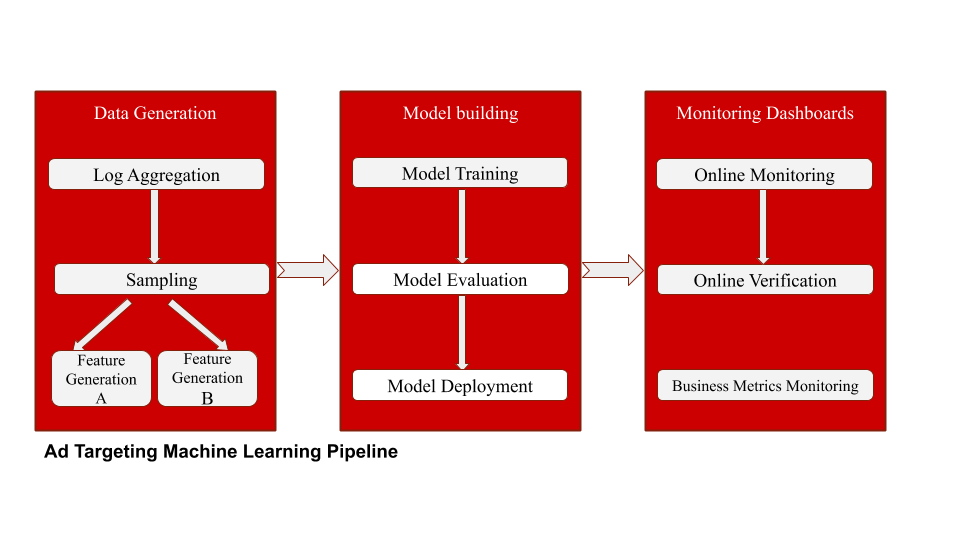
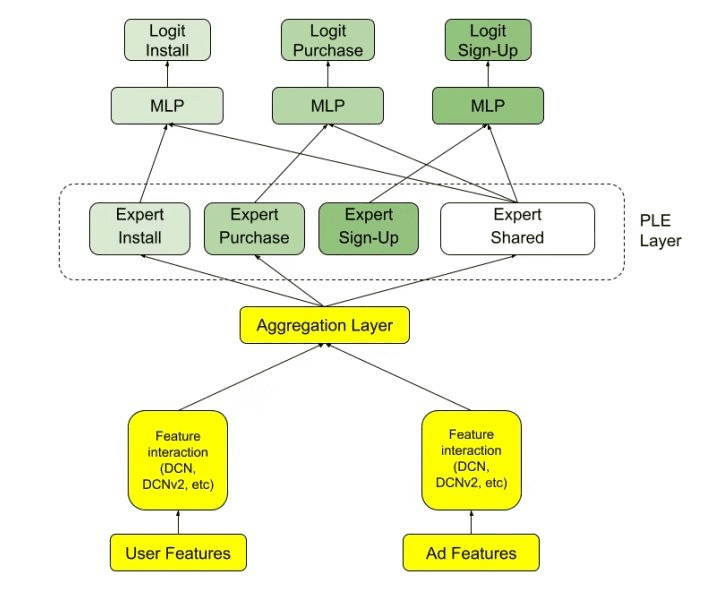
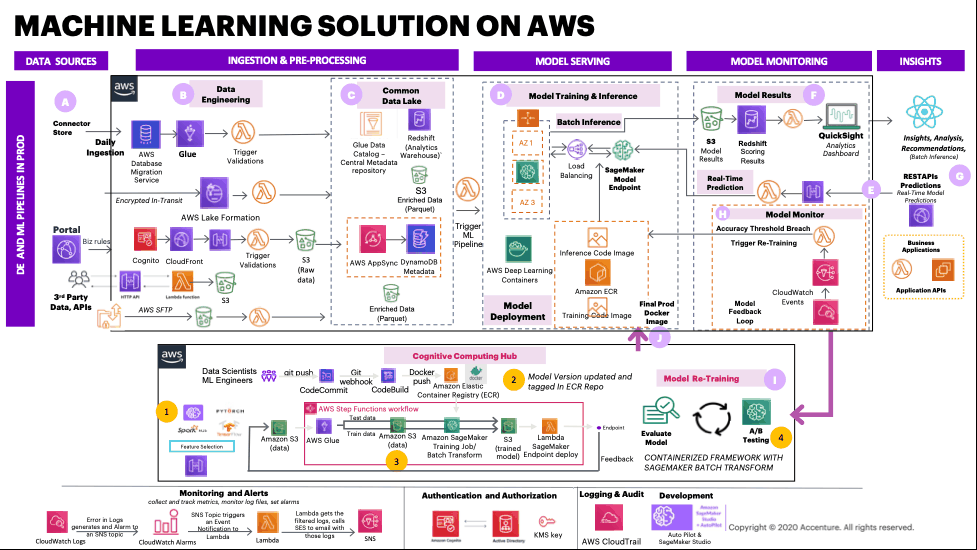
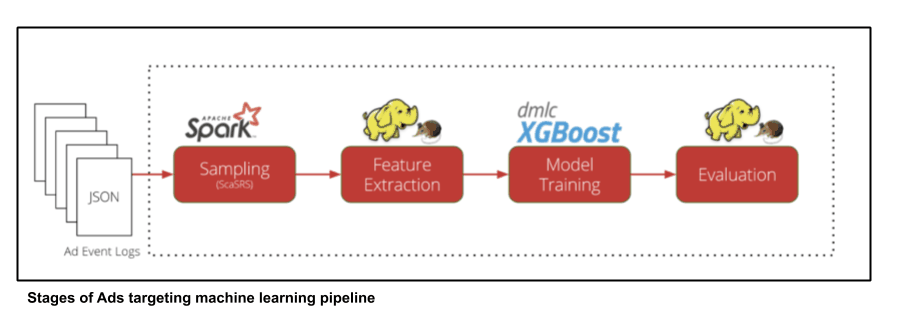
Deep Learning Execution Pipeline
(Preprocessing)
(Feature Extraction)
(Self-Attention)
(Loss Optimization)