Complete Technical Paper Content — Ai Bias Detection
1. Executive Abstract, Problem Formulation & Background
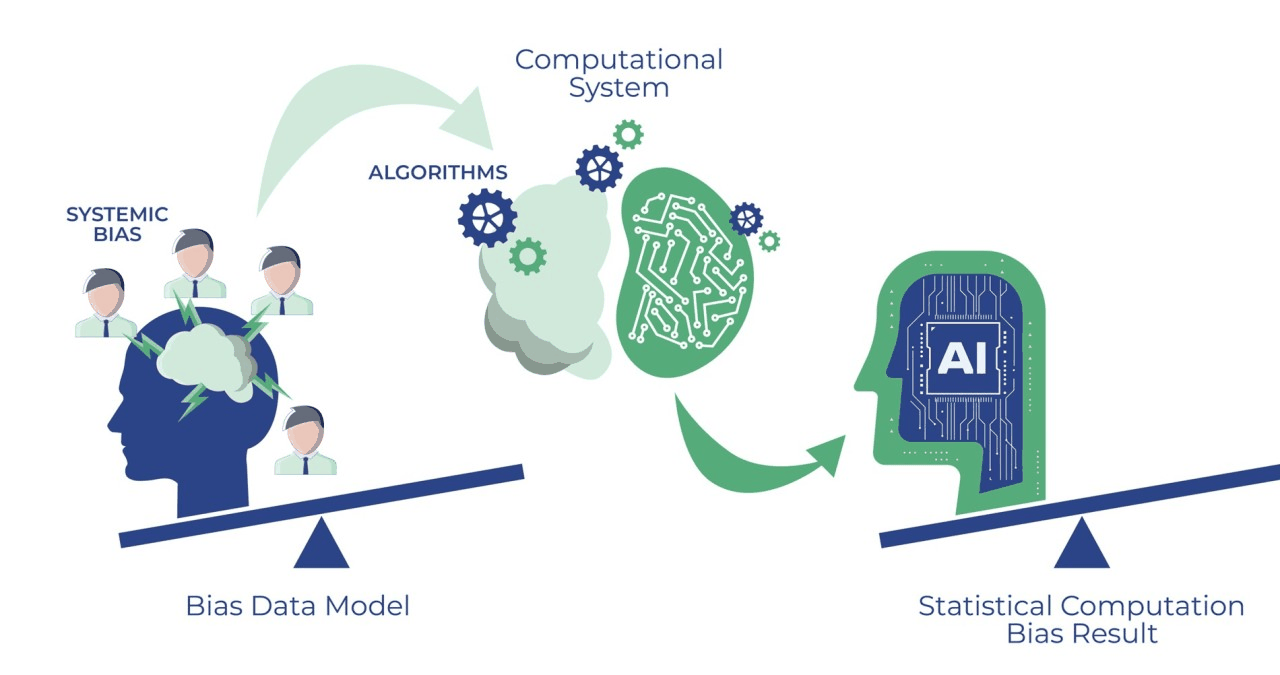
Algorithmic bias describes the systematic and repeatable harmful tendency in a computerized sociotechnical system to create "unfair" outcomes, such as "privileging" one category over another in ways that may or may not be different from the intended function of the algorithm. Bias can emerge from many factors, including intentionally biased design decisions or the unintended or unanticipated use or decisions relating to the way data is coded, collected, selected or used to train the algorithm. For example, algorithmic bias has been observed in search engine results and social media platforms. This bias can have impacts ranging from privacy violations to reinforcing social biases of race, gender, sexuality, and ethnicity. The study of algorithmic bias is most concerned with algorithms that reflect "systematic and unfair" discrimination. This bias has only recently been addressed in legal frameworks, such as the European Union's General Data Protection Regulation (enforced in 2018) and the Artificial Intelligence Act (proposed in 2021 and adopted in 2024). As algorithms expand their ability to organize society, politics, institutions, and behavior, sociologists have become concerned with the ways in which unanticipated output and manipulation of data can impact the physical world. Because algorithms are often considered to be neutral and unbiased, they can inaccurately project greater authority than human expertise (in part due to the psychological phenomenon of automation bias), and in some cases, reliance on algorithms can displace human responsibility for their outcomes, without last mile thinking. Bias can enter into algorithmic systems as a result of pre-existing cultural, social, or institutional expectations; by how features and labels are chosen; because of technical limitations of their design; or by being used in unanticipated contexts or by audiences who are not considered in the software's initial design. Algorithmic bias has been cited in cases ranging from election outcomes to the spread of online hate speech. It has also arisen in criminal justice, healthcare, and hiring, compounding existing racial, socioeconomic, and gender biases. The relative inability of facial recognition technology to accurately identify darker-skinned faces has been linked to multiple wrongful arrests of black men, an issue stemming from imbalanced datasets. Problems in understanding, researching, and discovering algorithmic bias persist due to the proprietary nature of algorithms, which are typically treated as trade secrets. Even when full transparency is provided, the complexity of certain algorithms poses a barrier to understanding their functioning. Furthermore, algorithms may change, or respond to input or output in ways that cannot be anticipated or easily reproduced for analysis. In many cases, even within a single website or application, there is no single "algorithm" to examine, but a network of many interrelated programs and data inputs, even between users of the same service. A 2021 survey identified multiple forms of algorithmic bias, including historical, representation, and measurement biases, each of which can contribute to unfair outcomes.
Algorithms are difficult to define, but may be generally understood as lists of instructions that determine how programs read, collect, process, and analyze data to generate a usable output. For a rigorous technical introduction, see Algorithms. Advances in computer hardware and software have led to an increased capability to process, store and transmit data. This has in turn made the design and adoption of technologies such as machine learning and artificial intelligence technically and commercially feasible. By analyzing and processing data, algorithms are the backbone of search engines, social media websites, recommendation engines, online retail, online advertising, and more. Contemporary social scientists are concerned with algorithmic processes embedded into hardware and software applications because of their political and social impact, and question the underlying assumptions of an algorithm's neutrality. The term algorithmic bias describes systematic and repeatable errors that create unfair outcomes, such as privileging one arbitrary group of users over others. For example, a credit score algorithm may deny a loan without being unfair, if it is consistently weighing relevant financial criteria. If the algorithm recommends loans to one group of users, but denies loans to another set of nearly identical users based on unrelated criteria, and if this behavior can be repeated across multiple occurrences, an algorithm can be described as biased. This bias may be intentional or unintentional (for example, it can come from biased data obtained from a worker that previously did the job the algorithm is going to do from now on).
2. Related Work, Literature Survey & Algorithmic Foundations
The earliest computer programs were designed to mimic human reasoning and deductions, and were deemed to be functioning when they successfully and consistently reproduced that human logic. In his 1976 book Computer Power and Human Reason, artificial intelligence pioneer Joseph Weizenbaum suggested that bias could arise both from the data used in a program, but also from the way a program is coded. Weizenbaum wrote that programs are a sequence of rules created by humans for a computer to follow. By following those rules consistently, such programs "embody law", that is, enforce a specific way to solve problems. The rules a computer follows are based on the assumptions of a computer programmer for how these problems might be solved. That means the code could incorporate the programmer's imagination of how the world works, including their biases and expectations. While a computer program can incorporate bias in this way, Weizenbaum also noted that any data fed to a machine additionally reflects "human decision making processes" as data is being selected. Finally, he noted that machines might also transfer good information with unintended consequences if users are unclear about how to interpret the results. Weizenbaum warned against trusting decisions made by computer programs that a user doesn't understand, comparing such faith to a tourist who can find his way to a hotel room exclusively by turning left or right on a coin toss. Crucially, the tourist has no basis of understanding how or why he arrived at his destination, and a successful arrival does not mean the process is accurate or reliable. An early example of algorithmic bias resulted in as many as 60 women and ethnic minorities denied entry to St. George's Hospital Medical School per year from 1982 to 1986, based on implementation of a new computer-guidance assessment system that denied entry to women and men with "foreign-sounding names" based on historical trends in admissions. While many schools at the time employed similar biases in their selection process, St. George was most notable for automating said bias through the use of an algorithm, thus gaining the attention of people on a much wider scale. In recent years, as algorithms increasingly rely on machine learning methods applied to real-world data, algorithmic bias has become more prevalent due to inherent biases within the data itself. For instance, facial recognition systems have been shown to misidentify individuals from marginalized groups at significantly higher rates than white individuals, highlighting how biases in training datasets manifest in deployed systems. A 2018 study by Joy Buolamwini and Timnit Gebru found that commercial facial recognition technologies exhibited error rates of up to 35% when identifying darker-skinned women, compared to less than 1% for lighter-skinned men. Algorithmic biases are not only technical failures but often reflect systemic inequities embedded in historical and societal data. Researchers and critics, such as Cathy O'Neil in her book Weapons of Math Destruction (2016), emphasize that these biases can amplify existing social inequalities under the guise of objectivity. O'Neil argues that opaque, automated decision-making processes in areas such as credit scoring, predictive policing, and education can reinforce discriminatory practices while appearing neutral or scientific.
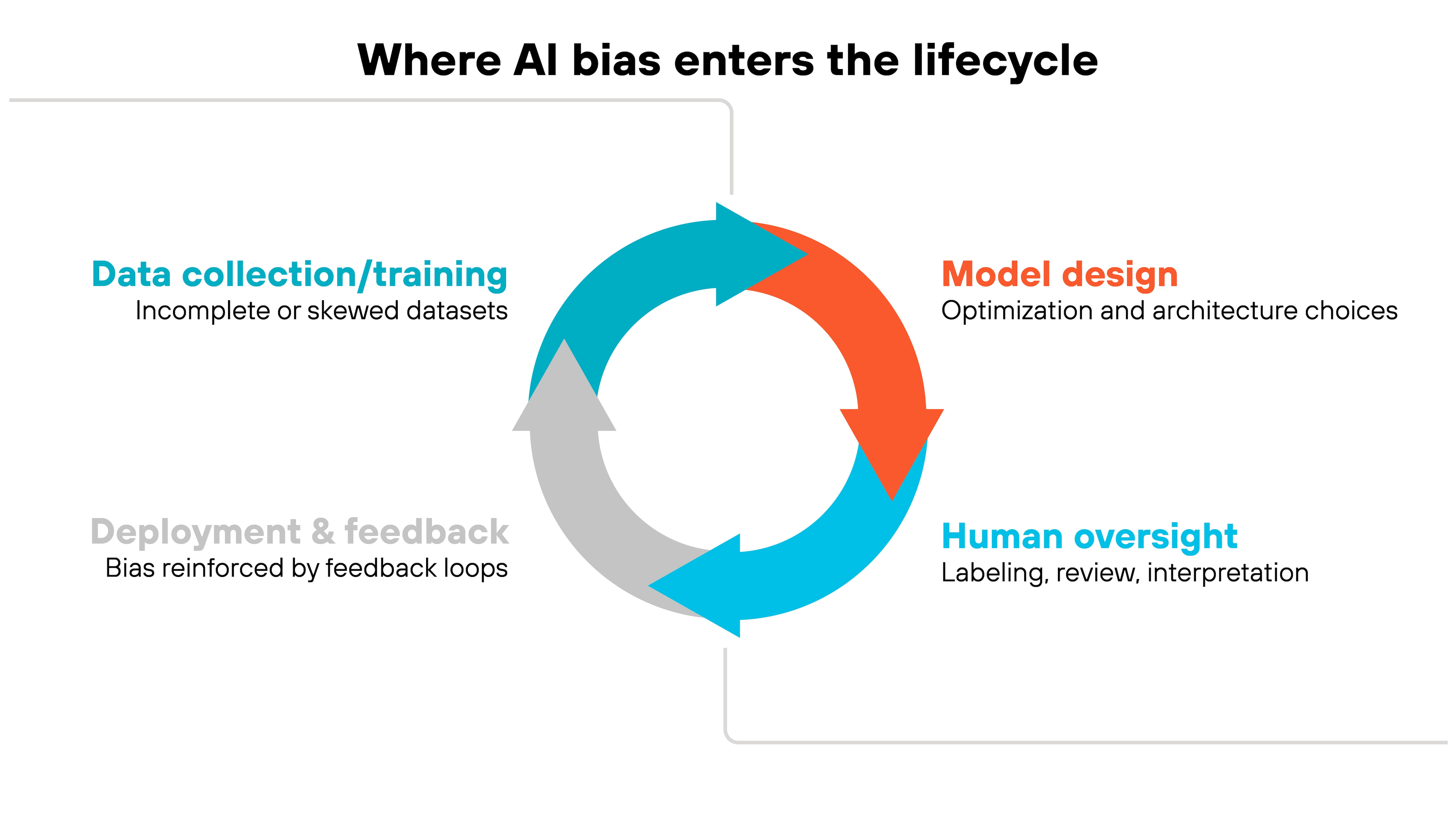
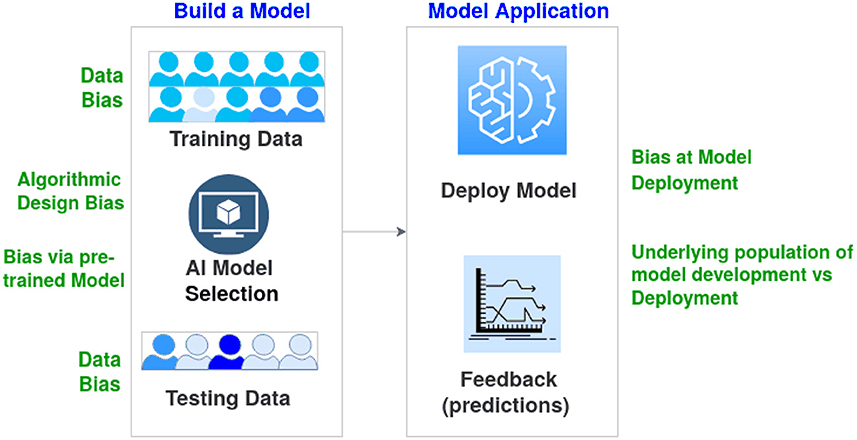
Data bias: Training data may under‑represent certain groups (e.g., minority populations), contain historical inequalities, or be collected in skewed ways, leading the model to perform worse or behave unfairly for those groups. Label bias: Human‑provided labels can encode subjective judgments or prejudices (for example, what is labeled as "risky," "toxic," or "qualified"), so the model learns and amplifies those judgments. Measurement bias: Proxies or measurements used for important concepts (like "creditworthiness" or "job performance") may be noisy or systematically distorted for some groups, which then distorts predictions. Algorithmic bias: Even with relatively balanced data, modeling choices (loss functions, thresholds, optimization objectives) can prioritize overall accuracy over fairness, leaving some subgroups with consistently worse outcomes. Deployment bias: A model used outside the context it was designed for (e.g., a model trained on adults applied to children, or one trained in one country deployed in another) can generate biased results because the environment and population differ. Mitigating machine learning bias typically involves interventions at multiple stages: collecting more representative and higher‑quality data, auditing datasets and models for disparate error rates or outcomes across groups, adjusting training objectives (such as adding fairness constraints), and monitoring systems after deployment. Transparent documentation of data sources, and intended use cases is also crucial so that users and stakeholders can understand where biases may remain and how to interpret model outputs responsibly.
3. Dataset Ingestion, Preprocessing & Stochastic Augmentations
Technical bias emerges through limitations of a program, computational power, its design, or other constraints on the system. Such bias can also be a restraint of design, for example, a search engine that shows three results per screen can be understood to privilege the top three results slightly more than the next three, as in an airline price display. Another case is software that relies on randomness for fair distributions of results. If the random number generation mechanism is not truly random, it can introduce bias, for example, by skewing selections toward items at the end or beginning of a list. A decontextualized algorithm uses unrelated information to sort results, for example, a flight-pricing algorithm that sorts results by alphabetical order would be biased in favor of American Airlines over United Airlines. The opposite may also apply, in which results are evaluated in contexts different from which they are collected. Data may be collected without crucial external context: for example, when facial recognition software is used by surveillance cameras, but evaluated by remote staff in another country or region, or evaluated by non-human algorithms with no awareness of what takes place beyond the camera's field of vision. This could create an incomplete understanding of a crime scene, for example, potentially mistaking bystanders for those who commit the crime. Lastly, technical bias can be created by attempting to formalize decisions into concrete steps on the assumption that human behavior works in the same way. For example, software weighs data points to determine whether a defendant should accept a plea bargain, while ignoring the impact of emotion on a jury. Another unintended result of this form of bias was found in the plagiarism-detection software Turnitin, which compares student-written texts to information found online and returns a probability score that the student's work is copied. Because the software compares long strings of text, it is more likely to identify non-native speakers of English than native speakers, as the latter group might be better able to change individual words, break up strings of plagiarized text, or obscure copied passages through synonyms. Because it is easier for native speakers to evade detection as a result of the technical constraints of the software, this creates a scenario where Turnitin identifies foreign-speakers of English for plagiarism while allowing more native-speakers to evade detection.
Literature on algorithmic bias has focused on the remedy of fairness, but definitions of fairness are often incompatible with each other and the realities of machine learning optimization. For example, defining fairness as an "equality of outcomes" may simply refer to a system producing the same result for all people, while fairness defined as "equality of treatment" might explicitly consider differences between individuals. As a result, fairness is sometimes described as being in conflict with the accuracy of a model, suggesting innate tensions between the priorities of social welfare and the priorities of the vendors designing these systems. In response to this tension, researchers have suggested more care to the design and use of systems that draw on potentially biased algorithms, with "fairness" defined for specific applications and contexts.
4. Neural Network Backbone, Layer Specifications & Loss Formulations
There have been several attempts to create methods and tools that can detect and observe biases within an algorithm. These emergent fields focus on tools which are typically applied to the (training) data used by the program rather than the algorithm's internal processes. These methods may also analyze a program's output and its usefulness and therefore may involve the analysis of its confusion matrix (or table of confusion). Explainable AI to detect algorithm Bias is a suggested way to detect the existence of bias in an algorithm or learning model. Using machine learning to detect bias is called AI auditing, where the "auditor" is an algorithm that goes through the AI model and the training data to identify biases. Ensuring that an AI tool such as a classifier is free from bias is more difficult than just removing the sensitive information from its input signals, because this is typically implicit in other signals. For example, the hobbies, sports and schools attended by a job candidate might reveal their gender to the software, even when this is removed from the analysis. Solutions to this problem involve ensuring that the intelligent agent does not have any information that could be used to reconstruct the protected and sensitive information about the subject, as first demonstrated in where a deep learning network was simultaneously trained to learn a task while at the same time being completely agnostic about the protected feature. A simpler method was proposed in the context of word embeddings, and involves removing information that is correlated with the protected characteristic. Currently, a new IEEE standard is being drafted that aims to specify methodologies which help creators of algorithms eliminate issues of bias and articulate transparency (i.e. to authorities or end users) about the function and possible effects of their algorithms. The project was approved February 2017 and is sponsored by the Software & Systems Engineering Standards Committee, a committee chartered by the IEEE Computer Society. A draft of the standard is expected to be submitted for balloting in June 2019. The standard was published in January 2025. In 2022, the IEEE released a standard aimed at specifying methodologies to help creators of algorithms address issues of bias and promote transparency regarding the function and potential effects of their algorithms. The project, initially approved in February 2017, was sponsored by the Software & Systems Engineering Standards Committee, a committee under the IEEE Computer Society. The standard provides guidelines for articulating transparency to authorities or end users and mitigating algorithmic biases.
Ethics guidelines on AI point to the need for accountability, recommending that steps be taken to improve the interpretability of results. Such solutions include the consideration of the "right to understanding" in machine learning algorithms, and to resist deployment of machine learning in situations where the decisions could not be explained or reviewed. Toward this end, a movement for "Explainable AI" is already underway within organizations such as DARPA, for reasons that go beyond the remedy of bias. Price Waterhouse Coopers, for example, also suggests that monitoring output means designing systems in such a way as to ensure that solitary components of the system can be isolated and shut down if they skew results. An initial approach towards transparency included the open-sourcing of algorithms. Software code can be looked into and improvements can be proposed through source-code-hosting facilities. However, this approach doesn't necessarily produce the intended effects. Companies and organizations can share all possible documentation and code, but this does not establish transparency if the audience doesn't understand the information given. Therefore, the role of an interested critical audience is worth exploring in relation to transparency. Algorithms cannot be held accountable without a critical audience.
5. Training Protocol, Convergence Behavior & Experimental Evaluation
The GDPR addresses algorithmic bias in profiling systems, as well as the statistical approaches possible to clean it, directly in recital 71, noting thatthe controller should use appropriate mathematical or statistical procedures for the profiling, implement technical and organisational measures appropriate ... that prevents, inter alia, discriminatory effects on natural persons on the basis of racial or ethnic origin, political opinion, religion or beliefs, trade union membership, genetic or health status or sexual orientation, or that result in measures having such an effect.Like the non-binding right to an explanation in recital 71, the problem is the non-binding nature of recitals. While it has been treated as a requirement by the Article 29 Working Party that advised on the implementation of data protection law, its practical dimensions are unclear. It has been argued that the Data Protection Impact Assessments for high risk data profiling (alongside other pre-emptive measures within data protection) may be a better way to tackle issues of algorithmic discrimination, as it restricts the actions of those deploying algorithms, rather than requiring consumers to file complaints or request changes.
Meta-learning is a subfield of machine learning where automatic learning algorithms are applied to metadata about machine learning experiments. As of 2017, the term had not found a standard interpretation, however the main goal is to use such metadata to understand how automatic learning can become flexible in solving learning problems, hence to improve the performance of existing learning algorithms or to learn (induce) the learning algorithm itself, hence the alternative term learning to learn. Flexibility is important because each learning algorithm is based on a set of assumptions about the data, its inductive bias. This means that it will only learn well if the bias matches the learning problem. A learning algorithm may perform very well in one domain, but not on the next. This poses strong restrictions on the use of machine learning or data mining techniques, since the relationship between the learning problem (often some kind of database) and the effectiveness of different learning algorithms is not yet understood. By using different kinds of metadata, like properties of the learning problem, algorithm properties (like performance measures), or patterns previously derived from the data, it is possible to learn, select, alter or combine different learning algorithms to effectively solve a given learning problem. Critiques of meta-learning approaches bear a strong resemblance to the critique of metaheuristic, a possibly related problem. A good analogy to meta-learning, and the inspiration for Jürgen Schmidhuber's early work (1987) and Yoshua Bengio et al.'s work (1991), considers that genetic evolution learns the learning procedure encoded in genes and executed in each individual's brain. In an open-ended hierarchical meta-learning system using genetic programming, better evolutionary methods can be learned by meta evolution, which itself can be improved by meta meta evolution, etc.
Model Figures & Evaluation Curves (4 Images)
Deep Learning Execution Pipeline
(Preprocessing)
(Feature Extraction)
(Self-Attention)
(Loss Optimization)