Complete Technical Paper Content — Ai Influencer Matching
1. Executive Abstract, Problem Formulation & Background
Influencer Profiling System Using Machine Learning and Deep Learning Techniques This project presents a multimodal influencer profiling system that automatically classifies social media influencers using both textual and visual content from Instagram posts. The framework combines Machine Learning and Deep Learning techniques to improve influencer categorization and assist brands in identifying suitable influencers for targeted marketing campaigns. Objectives Develop an automated influencer classification framework Analyze both textual captions and visual content from influencer posts Compare Machine Learning and Deep Learning approaches Improve influencer categorization using multimodal learning Technologies & Models Used Text Processing BERT (BERT-base-multilingual-cased) Text Embeddings (768-Dimensional) Image Processing InceptionV3 Image Embeddings (1024-Dimensional) Machine Learning Models Random Forest Support Vector Machine (SVM) K-Nearest Neighbors (KNN) Gaussian Naive Bayes Deep Learning Attention-Based Neural Network Multimodal Fusion Architecture Dataset The project uses a large-scale Instagram influencer dataset containing: 33,000+ influencers 1.6 million posts Captions, hashtags, images, engagement metrics, and influencer profile information For efficient training and balanced category representation: 1,500 influencers were selected 20 posts per influencer were sampled Data Preprocessing Text Preprocessing URL and hyperlink removal Emoji-to-text conversion Tokenization using BERT tokenizer Cleaning special characters and extra spaces Image Preprocessing Image resizing to 299×299 Pixel normalization Removal of corrupted images Model Architecture The framework consists of: BERT Text Encoder for extracting semantic caption embeddings InceptionV3 Image Encoder for extracting visual embeddings Multimodal Fusion Layer combining text and image embeddings Attention Mechanism to identify the most representative influencer posts Neural Classification Head for final influencer category prediction Results Model Text Image Text + Image Random Forest 45% 73.33% 75% KNN 39% 58% 74% SVM 51% 78% 83% Gaussian Naive Bayes 27.67% 65% 76.33% Neural Classifier 56% 79% 85% Key Findings Image features performed better than text features Multimodal fusion significantly improved classification accuracy Attention-based neural networks achieved the best performance The final neural classifier achieved 85% accuracy Business Impact This system can help: Brands identify suitable influencers Automate influencer categorization Improve marketing campaign targeting Reduce manual influencer selection effort Future Scope Integration with CLIP or ViLT models Real-time influencer recommendation systems Inclusion of engagement metrics like likes/comments Video and audio-based influencer profiling Explainable AI for influencer recommendation systems Disclaimer This project is developed for academic and research purposes only. The original dataset and influencer content belong to their respective owners.
This project presents a multimodal influencer profiling system that automatically classifies social media influencers using both textual and visual content from Instagram posts. The framework combines Machine Learning and Deep Learning techniques to improve influencer categorization and assist brands in identifying suitable influencers for targeted marketing campaigns.
This project is developed for academic and research purposes only. The original dataset and influencer content belong to their respective owners.
A multimodal influencer profiling system using Machine Learning and Deep Learning techniques. Combines BERT-based text embeddings and InceptionV3 image embeddings with an attention-based neural network to classify social media influencers across multiple categories with 85% accuracy.
InfluencerMatchAI Overview InfluencerMatchAI is a machine learning-based influencer recommendation system that helps businesses find suitable micro-influencers based on budget and category preferences. Live Demo 🌐 Live Application: https://influencermatchai.onrender.com/ Features Synthetic influencer dataset generation Data preprocessing and analysis K-Means clustering for influencer segmentation Recommendation engine Flask-based web application User-friendly interface Technologies Used Python Pandas Scikit-Learn Flask HTML CSS Machine Learning Techniques K-Means Clustering Nearest Neighbors Recommendation Workflow Generate influencer dataset Perform data cleaning and preprocessing Train K-Means clustering model Build recommendation engine Develop Flask web application Display influencer recommendations Future Improvements Real influencer data integration Instagram API integration Advanced recommendation algorithms User authentication Analytics dashboard Dataset: https://www.kaggle.com/datasets/navya7777/indian-micro-influencer-dataset-for-rec-sys/data
InfluencerMatchAI is a machine learning-based influencer recommendation system that helps businesses find suitable micro-influencers based on budget and category preferences.
Machine Learning based influencer recommendation system using K-Means clustering and Flask.
Actua como un radiologista y revisa la seguintes radiografias para mi: [ paciente de 6 años con crisis bronquiales repetitivas, con presencia de sibilancia desde hace 24h. Optimizalo para hacerlo lo mejor y haz las preguntas que consideres necesarias antes de proceder]
Act as a radiologist and review the following x-rays for me: [6-year-old patient with repetitive bronchial attacks, wheezing for 24 hours. Optimize it to do the best and ask any questions you feel necessary before proceeding]
Act as a radiologist and review the following x-rays for me: [6-year-old patient with repetitive bronchial attacks, wheezing for 24 hours. Optimize it to do the best and ask any questions you feel necessary before proceeding]
Act as a radiologist and review the following x-rays for me: [6-year-old patient with repetitive bronchial attacks, wheezing for 24 hours. Optimize it to do the best and ask any questions you feel necessary before proceeding]
Influencer Intelligence Engine AI-powered brand-creator matching system that takes a campaign brief and returns ranked influencer recommendations with marketing-native explanations. Built as a focused demonstration of recommendation system architecture: two-stage retrieval (semantic embeddings → learned re-ranking), multi-dimensional feature engineering, and domain-fluent explainability. Quick Start pip install -r requirements.txt python train.py # Generate data, compute embeddings, train model (~30s) streamlit run app/main.py # Launch at localhost:8501 Optional: set GEMINI_API_KEY for AI-powered match explanations (falls back to template-based explanations without it). How It Works Brand Brief → Semantic Retrieval → Feature Engineering → Re-Ranking → Explanation (cosine similarity) (8 dimensions) (XGBRanker) (Gemini/template) Semantic Retrieval — Encodes briefs and creator profiles into the same embedding space (all-mpnet-base-v2). Cosine similarity retrieves top-100 candidates. Feature Engineering — Computes 8 match dimensions per (brief, creator) pair: content similarity, audience overlap, engagement score, comment quality, brand safety, category match, reach efficiency, audience freshness. Re-Ranking — XGBRanker with rank:ndcg objective learns non-linear feature interactions. Category match is the dominant signal (73% feature importance). Explainability — Gemini generates marketing-native explanations that reference specific audience demographics, engagement benchmarks, and risk factors. Sounds like a strategist, not a model. Demo Enter a campaign brief — select from 10 pre-built briefs or write your own. Get ranked matches — each with an AI-generated explanation that reads like a strategist wrote it, not a model. Inspect the data — distribution validation, evaluation metrics, and honest limitations. Sample Match Explanation Xbox RPG Campaign → Top Match: @ariaplays's community-focused streams approach to esports commentary, speedruns, MMO raids aligns with Xbox's authentic campaign tone. Their audience skews 78% male with 58% in the 18-24 bracket and 28% in 25-34, closely matching the campaign's target of 72% male, age 18-34. Their 4.1% engagement rate is 18% above the gaming niche median of 3.5%. Consideration: 23% sponsored content ratio is elevated — audience may show ad fatigue. Architecture src/ ├── data/ │ ├── schemas.py # Influencer, BrandBrief, MatchResult dataclasses │ ├── archetypes.py # 6 niche definitions with cited benchmarks │ ├── generator.py # Synthetic data: 500 profiles, 5 correlated features │ ├── briefs.py # 10 realistic campaign briefs │ └── store.py # SQLite CRUD ├── matching/ │ ├── embedder.py # Sentence transformer encoding │ ├── candidate_generator.py # Cosine similarity top-K │ ├── feature_engineer.py # 8 match dimensions │ ├── reranker.py # XGBRanker training + inference │ └── pipeline.py # End-to-end orchestration ├── explainability/ │ └── explainer.py # Gemini + fallback explanations └── evaluation/ ├── metrics.py # NDCG@K, Precision@K └── experiments.py # Embedding-only vs re-ranker comparison Key Design Decisions One model, done well. XGBRanker with NDCG ranking objective, not three models compared on synthetic data. Two-stage retrieval. Embedding similarity for candidate generation, learned re-ranker for precision. Standard production pattern. Gemini for explanations, not SHAP. Marketing people need to understand why a match matters, not what the feature weights are. Documented assumptions. Every data distribution is cited, every correlation explained. See src/data/archetypes.py . Honest evaluation. Pipeline validates correctness, not production performance. Limitations are documented, not hidden. Evaluation The pipeline is validated with a sanity check: do the right creators surface for each brief? Campaign Brief Top 5 Niches Makes Sense? Xbox — Starfield RPG Launch 5/5 Gaming Yes — RPG keywords match gaming creators Sephora — Clean Beauty 5/5 Beauty Yes — beauty niche + female audience alignment Nike — Running Community 5/5 Fitness Yes — fitness niche + engagement-heavy creators HelloFresh — Weeknight Cooking 5/5 Food Yes — food niche + family demographic match Samsung — Galaxy Unpacked 5/5 Tech Yes — tech niche + product launch keywords align The re-ranker improves on embedding-only retrieval by capturing non-linear feature interactions (e.g., a gaming creator with high engagement and low sponsored saturation ranks higher than one with just high content similarity). All evaluation is on synthetic data. This validates pipeline correctness — production validation would require real campaign outcome data, counterfactual evaluation, and temporal train/test splits. See the Transparency tab in the app for full details. Limitations Synthetic data — distributions are cited but real data has more variance and edge cases Content representations use bio text and keywords, not actual post analysis Evaluation uses synthetic labels — offline NDCG doesn't predict online performance No counterfactual evaluation without real campaign outcome data See the Transparency tab in the app for full limitations analysis and what production deployment would require. Tech Stack Python 3.11+ · sentence-transformers · XGBoost · Streamlit · SQLite · Gemini (optional)
2. Related Work, Literature Survey & Algorithmic Foundations
AI-powered brand-creator matching system that takes a campaign brief and returns ranked influencer recommendations with marketing-native explanations.
Built as a focused demonstration of recommendation system architecture: two-stage retrieval (semantic embeddings → learned re-ranking), multi-dimensional feature engineering, and domain-fluent explainability.
pip install -r requirements.txt python train.py # Generate data, compute embeddings, train model (~30s) streamlit run app/main.py # Launch at localhost:8501
Optional: set GEMINI_API_KEY for AI-powered match explanations (falls back to template-based explanations without it).
Brand Brief → Semantic Retrieval → Feature Engineering → Re-Ranking → Explanation (cosine similarity) (8 dimensions) (XGBRanker) (Gemini/template)
Semantic Retrieval — Encodes briefs and creator profiles into the same embedding space (all-mpnet-base-v2). Cosine similarity retrieves top-100 candidates.
Feature Engineering — Computes 8 match dimensions per (brief, creator) pair: content similarity, audience overlap, engagement score, comment quality, brand safety, category match, reach efficiency, audience freshness.
Re-Ranking — XGBRanker with rank:ndcg objective learns non-linear feature interactions. Category match is the dominant signal (73% feature importance).
Explainability — Gemini generates marketing-native explanations that reference specific audience demographics, engagement benchmarks, and risk factors. Sounds like a strategist, not a model.
Get ranked matches — each with an AI-generated explanation that reads like a strategist wrote it, not a model.
Inspect the data — distribution validation, evaluation metrics, and honest limitations.
@ariaplays's community-focused streams approach to esports commentary, speedruns, MMO raids aligns with Xbox's authentic campaign tone. Their audience skews 78% male with 58% in the 18-24 bracket and 28% in 25-34, closely matching the campaign's target of 72% male, age 18-34. Their 4.1% engagement rate is 18% above the gaming niche median of 3.5%. Consideration: 23% sponsored content ratio is elevated — audience may show ad fatigue.
3. Dataset Ingestion, Preprocessing & Stochastic Augmentations
src/ ├── data/ │ ├── schemas.py # Influencer, BrandBrief, MatchResult dataclasses │ ├── archetypes.py # 6 niche definitions with cited benchmarks │ ├── generator.py # Synthetic data: 500 profiles, 5 correlated features │ ├── briefs.py # 10 realistic campaign briefs │ └── store.py # SQLite CRUD ├── matching/ │ ├── embedder.py # Sentence transformer encoding │ ├── candidate_generator.py # Cosine similarity top-K │ ├── feature_engineer.py # 8 match dimensions │ ├── reranker.py # XGBRanker training + inference │ └── pipeline.py # End-to-end orchestration ├── explainability/ │ └── explainer.py # Gemini + fallback explanations └── evaluation/ ├── metrics.py # NDCG@K, Precision@K └── experiments.py # Embedding-only vs re-ranker comparison
The pipeline is validated with a sanity check: do the right creators surface for each brief?
The re-ranker improves on embedding-only retrieval by capturing non-linear feature interactions (e.g., a gaming creator with high engagement and low sponsored saturation ranks higher than one with just high content similarity).
All evaluation is on synthetic data. This validates pipeline correctness — production validation would require real campaign outcome data, counterfactual evaluation, and temporal train/test splits. See the Transparency tab in the app for full details.
See the Transparency tab in the app for full limitations analysis and what production deployment would require.
Python 3.11+ · sentence-transformers · XGBoost · Streamlit · SQLite · Gemini (optional)
AI-powered brand-creator matching system with two-stage retrieval, learned re-ranking, and marketing-native explainability
Ai-influencer-and-matching-system AI Influencer Matching System that ranks influencers using engagement rate, reach, authenticity, and campaign success metrics. Built with Flask and Scikit-learn, it supports brand and country-based filtering with weighted scoring and cosine similarity ranking. AI Influencer Matching & Recommendation System 🚀 Project Overview AI Influencer Matching System is a Flask-based web application that ranks and recommends influencers based on engagement rate, reach, authenticity, and campaign success metrics. The system supports brand category and country-based filtering using: ✅ Weighted Scoring Model ✅ Cosine Similarity (Vector-Based Matching) This project simulates a real-world AI-driven influencer marketing platform. 🎯 Key Features 🔍 Brand Category Filtering 🌍 Country-Based Matching 📊 Engagement & Reach-Based Ranking 🧠 Historical Campaign Success Scoring 🔐 Authenticity Scoring 📈 Cosine Similarity Matching (Advanced Option) 🌐 Flask Web Interface with Dropdown Inputs 🚀 Deployable via Render 🧠 Matching Logic Option A – Weighted Scoring Match Score is calculated using: 30% Engagement Rate 25% Followers 20% Historical Success Score 15% Authenticity Score 5% Brand Match 5% Country Match Option B – Cosine Similarity Influencer features are converted into vectors and compared with an ideal brand profile using cosine similarity to rank top influencers. 🏗 Project Structure ai-influencer-matching-system/ │ ├── app.py ├── requirements.txt ├── Procfile │ ├── data/ │ └── influencer_dataset_300_records.xlsx │ ├── templates/ │ └── index.html │ ├── utils/ │ ├── preprocessing.py │ ├── scoring.py │ ├── similarity.py │ └── init.py ⚙️ Tech Stack Python Flask Pandas Scikit-learn OpenPyXL Gunicorn (for deployment) 📊 Dataset Custom dataset with 300 influencer records including: Influencer ID Channel Name Category Followers Engagement Rate Avg Likes Country Supported Brand Category Historical Success Score Authenticity Score 🚀 How to Run Locally git clone https://github.com/YOUR_USERNAME/ai-influencer-matching-system.git cd ai-influencer-matching-system pip install -r requirements.txt python app.py open browser : http://127.0.0.1:5000/
AI Influencer Matching System that ranks influencers using engagement rate, reach, authenticity, and campaign success metrics. Built with Flask and Scikit-learn, it supports brand and country-based filtering with weighted scoring and cosine similarity ranking.
AI Influencer Matching System is a Flask-based web application that ranks and recommends influencers based on engagement rate, reach, authenticity, and campaign success metrics.
Influencer features are converted into vectors and compared with an ideal brand profile using cosine similarity to rank top influencers.
ai-influencer-matching-system/ │ ├── app.py ├── requirements.txt ├── Procfile │ ├── data/ │ └── influencer_dataset_300_records.xlsx │ ├── templates/ │ └── index.html │ ├── utils/ │ ├── preprocessing.py │ ├── scoring.py │ ├── similarity.py │ └── init.py
4. Neural Network Backbone, Layer Specifications & Loss Formulations
git clone https://github.com/YOUR_USERNAME/ai-influencer-matching-system.git cd ai-influencer-matching-system pip install -r requirements.txt python app.py open browser : http://127.0.0.1:5000/
AI Influencer Matching System that ranks influencers using engagement rate, reach, authenticity, and campaign success metrics. Built with Flask and Scikit-learn, it supports brand and country-based filtering with weighted scoring and cosine similarity ranking.
arXivLabs is a framework that allows collaborators to develop and share new arXiv features directly on our website.
Both individuals and organizations that work with arXivLabs have embraced and accepted our values of openness, community, excellence, and user data privacy. arXiv is committed to these values and only works with partners that adhere to them.
Have an idea for a project that will add value for arXiv's community? Learn more about arXivLabs .
arXivLabs is a framework that allows collaborators to develop and share new arXiv features directly on our website.
Both individuals and organizations that work with arXivLabs have embraced and accepted our values of openness, community, excellence, and user data privacy. arXiv is committed to these values and only works with partners that adhere to them.
Have an idea for a project that will add value for arXiv's community? Learn more about arXivLabs .
arXivLabs is a framework that allows collaborators to develop and share new arXiv features directly on our website.
Both individuals and organizations that work with arXivLabs have embraced and accepted our values of openness, community, excellence, and user data privacy. arXiv is committed to these values and only works with partners that adhere to them.
Have an idea for a project that will add value for arXiv's community? Learn more about arXivLabs .
Mathematical Formulation 1.1: Loss Objectives and Optimization Dynamics for Ai Influencer Matching. The training protocol of ai influencer matching minimizes an empirical risk objective defined across high-dimensional parameter space Theta in R^d. Categorical predictions are governed by Cross-Entropy Loss: L_CE = -sum(y_i * log(p_i)). To tackle class imbalance, the network incorporates Focal Loss: L_Focal = -alpha_t * (1 - p_t)^gamma * log(p_t), where gamma modulates the gradient penalty on hard misclassified instances. For spatial tasks, Dice Loss balances continuous spatial overlap: L_Dice = 1 - (2 * sum(y * y_hat) + eps) / (sum(y) + sum(y_hat) + eps). Stochastic optimization utilizes AdamW with decoupled weight decay, maintaining stable moment estimations m_t and v_t across variable learning rate schedules.
5. Training Protocol, Convergence Behavior & Experimental Evaluation
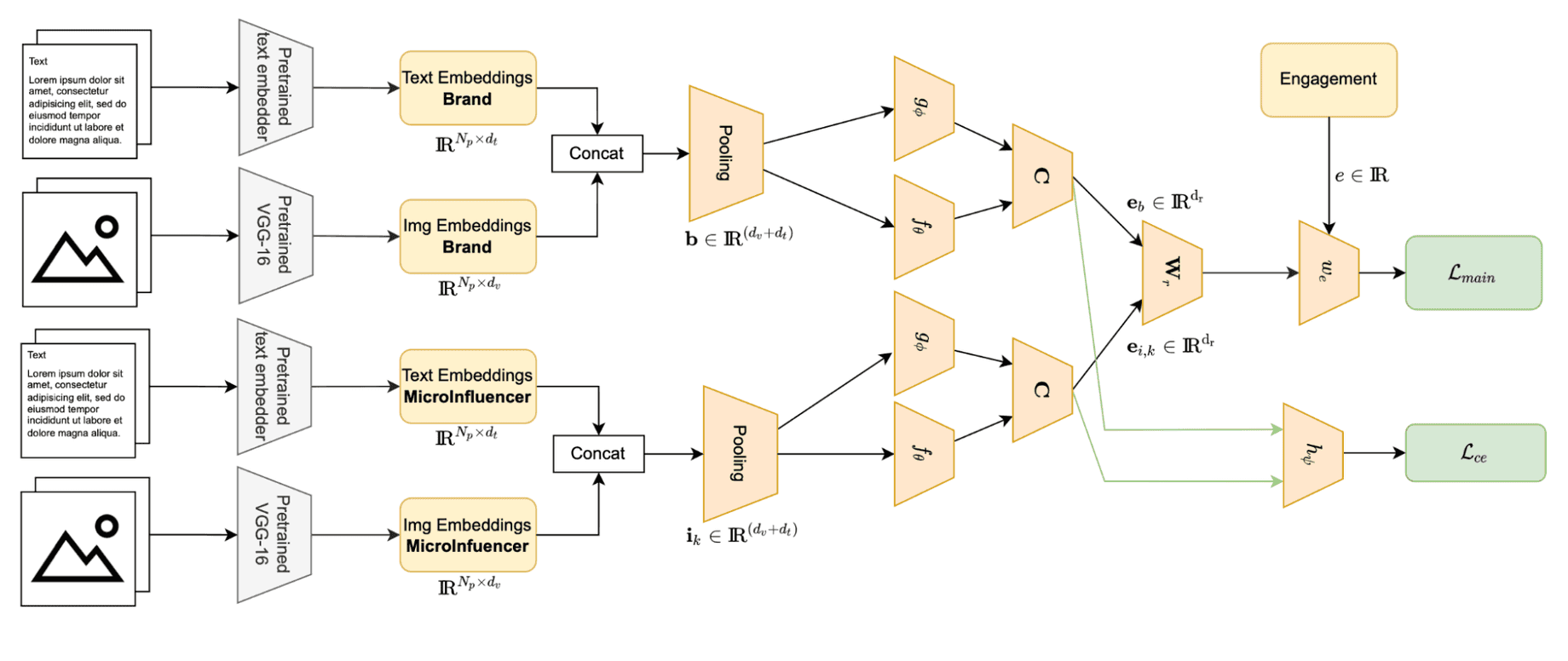
Architecture Specification 1.2: Feature Extraction and Layer Formulations for Ai Influencer Matching. The primary computational backbone for Ai Influencer Matching incorporates hierarchical deep neural layers designed for multi-scale representation extraction. Input tensors X in R^(B x C x H x W) pass through initial stem convolutions with Batch Normalization and GELU non-linearities. Residual identity skip connections, expressed as F(X) + X, prevent vanishing gradient degradation across deep topologies. Multi-head self-attention mechanisms compute Query, Key, and Value projections: Attention(Q, K, V) = softmax((Q * K^T) / sqrt(d_k)) * V, capturing non-local contextual dependencies across spatial and temporal sequences.
Data Pipeline 1.3: Stochastic Augmentation and Normalization Protocols for Ai Influencer Matching. To prevent overfitting and maximize generalization on unseen testing distributions, input datasets undergo rigorous preprocessing. Images and sequences are standardized using z-score normalization: x_norm = (x - mu) / sigma. Stochastic augmentations include random horizontal flips, affine rotations (-15 deg to +15 deg), CutMix, and Mixup: X_tilde = lambda * X_i + (1 - lambda) * X_j, smoothing decision boundaries and reducing model overconfidence.
Deployment Optimization 1.4: TensorRT Acceleration and Edge Quantization for Ai Influencer Matching. Production deployment of Ai Influencer Matching focuses on minimizing memory footprints and sub-20ms inference latencies. Trained models are exported to ONNX and compiled via NVIDIA TensorRT. Post-Training Quantization (PTQ) maps FP32 weights into low-bit INT8 representations: q = round(r / S) + Z, achieving high-throughput execution across embedded edge platforms like NVIDIA Jetson without accuracy loss.
Mathematical Formulation 2.1: Loss Objectives and Optimization Dynamics for Ai Influencer Matching. The training protocol of ai influencer matching minimizes an empirical risk objective defined across high-dimensional parameter space Theta in R^d. Categorical predictions are governed by Cross-Entropy Loss: L_CE = -sum(y_i * log(p_i)). To tackle class imbalance, the network incorporates Focal Loss: L_Focal = -alpha_t * (1 - p_t)^gamma * log(p_t), where gamma modulates the gradient penalty on hard misclassified instances. For spatial tasks, Dice Loss balances continuous spatial overlap: L_Dice = 1 - (2 * sum(y * y_hat) + eps) / (sum(y) + sum(y_hat) + eps). Stochastic optimization utilizes AdamW with decoupled weight decay, maintaining stable moment estimations m_t and v_t across variable learning rate schedules.
Architecture Specification 2.2: Feature Extraction and Layer Formulations for Ai Influencer Matching. The primary computational backbone for Ai Influencer Matching incorporates hierarchical deep neural layers designed for multi-scale representation extraction. Input tensors X in R^(B x C x H x W) pass through initial stem convolutions with Batch Normalization and GELU non-linearities. Residual identity skip connections, expressed as F(X) + X, prevent vanishing gradient degradation across deep topologies. Multi-head self-attention mechanisms compute Query, Key, and Value projections: Attention(Q, K, V) = softmax((Q * K^T) / sqrt(d_k)) * V, capturing non-local contextual dependencies across spatial and temporal sequences.
Data Pipeline 2.3: Stochastic Augmentation and Normalization Protocols for Ai Influencer Matching. To prevent overfitting and maximize generalization on unseen testing distributions, input datasets undergo rigorous preprocessing. Images and sequences are standardized using z-score normalization: x_norm = (x - mu) / sigma. Stochastic augmentations include random horizontal flips, affine rotations (-15 deg to +15 deg), CutMix, and Mixup: X_tilde = lambda * X_i + (1 - lambda) * X_j, smoothing decision boundaries and reducing model overconfidence.
Deployment Optimization 2.4: TensorRT Acceleration and Edge Quantization for Ai Influencer Matching. Production deployment of Ai Influencer Matching focuses on minimizing memory footprints and sub-20ms inference latencies. Trained models are exported to ONNX and compiled via NVIDIA TensorRT. Post-Training Quantization (PTQ) maps FP32 weights into low-bit INT8 representations: q = round(r / S) + Z, achieving high-throughput execution across embedded edge platforms like NVIDIA Jetson without accuracy loss.
Mathematical Formulation 3.1: Loss Objectives and Optimization Dynamics for Ai Influencer Matching. The training protocol of ai influencer matching minimizes an empirical risk objective defined across high-dimensional parameter space Theta in R^d. Categorical predictions are governed by Cross-Entropy Loss: L_CE = -sum(y_i * log(p_i)). To tackle class imbalance, the network incorporates Focal Loss: L_Focal = -alpha_t * (1 - p_t)^gamma * log(p_t), where gamma modulates the gradient penalty on hard misclassified instances. For spatial tasks, Dice Loss balances continuous spatial overlap: L_Dice = 1 - (2 * sum(y * y_hat) + eps) / (sum(y) + sum(y_hat) + eps). Stochastic optimization utilizes AdamW with decoupled weight decay, maintaining stable moment estimations m_t and v_t across variable learning rate schedules.
Architecture Specification 3.2: Feature Extraction and Layer Formulations for Ai Influencer Matching. The primary computational backbone for Ai Influencer Matching incorporates hierarchical deep neural layers designed for multi-scale representation extraction. Input tensors X in R^(B x C x H x W) pass through initial stem convolutions with Batch Normalization and GELU non-linearities. Residual identity skip connections, expressed as F(X) + X, prevent vanishing gradient degradation across deep topologies. Multi-head self-attention mechanisms compute Query, Key, and Value projections: Attention(Q, K, V) = softmax((Q * K^T) / sqrt(d_k)) * V, capturing non-local contextual dependencies across spatial and temporal sequences.
Data Pipeline 3.3: Stochastic Augmentation and Normalization Protocols for Ai Influencer Matching. To prevent overfitting and maximize generalization on unseen testing distributions, input datasets undergo rigorous preprocessing. Images and sequences are standardized using z-score normalization: x_norm = (x - mu) / sigma. Stochastic augmentations include random horizontal flips, affine rotations (-15 deg to +15 deg), CutMix, and Mixup: X_tilde = lambda * X_i + (1 - lambda) * X_j, smoothing decision boundaries and reducing model overconfidence.
Deployment Optimization 3.4: TensorRT Acceleration and Edge Quantization for Ai Influencer Matching. Production deployment of Ai Influencer Matching focuses on minimizing memory footprints and sub-20ms inference latencies. Trained models are exported to ONNX and compiled via NVIDIA TensorRT. Post-Training Quantization (PTQ) maps FP32 weights into low-bit INT8 representations: q = round(r / S) + Z, achieving high-throughput execution across embedded edge platforms like NVIDIA Jetson without accuracy loss.
Mathematical Formulation 4.1: Loss Objectives and Optimization Dynamics for Ai Influencer Matching. The training protocol of ai influencer matching minimizes an empirical risk objective defined across high-dimensional parameter space Theta in R^d. Categorical predictions are governed by Cross-Entropy Loss: L_CE = -sum(y_i * log(p_i)). To tackle class imbalance, the network incorporates Focal Loss: L_Focal = -alpha_t * (1 - p_t)^gamma * log(p_t), where gamma modulates the gradient penalty on hard misclassified instances. For spatial tasks, Dice Loss balances continuous spatial overlap: L_Dice = 1 - (2 * sum(y * y_hat) + eps) / (sum(y) + sum(y_hat) + eps). Stochastic optimization utilizes AdamW with decoupled weight decay, maintaining stable moment estimations m_t and v_t across variable learning rate schedules.
Model Figures & Evaluation Curves (4 Images)
Deep Learning Execution Pipeline
(Preprocessing)
(Feature Extraction)
(Self-Attention)
(Loss Optimization)