Complete Technical Paper Content — Ai Meeting Transcription
1. Executive Abstract, Problem Formulation & Background
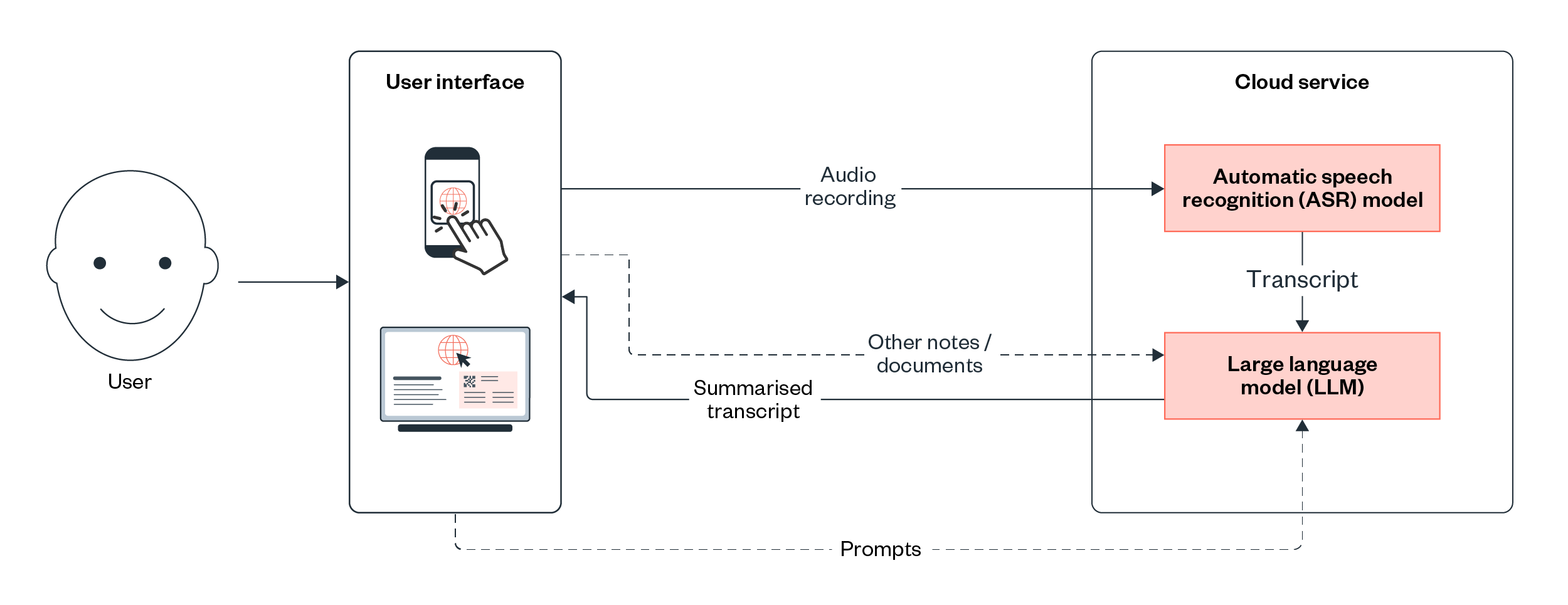
Otter.ai, Inc. is an American transcription software company based in Mountain View, California. The company develops speech to text transcription applications using artificial intelligence and machine learning. Its software, called Otter, shows captions for live speakers, and generates written transcriptions of speech. While Otter's software has been praised for its functionality, it is also the subject of privacy concerns, including allegations that the company records users' conversations without consent.
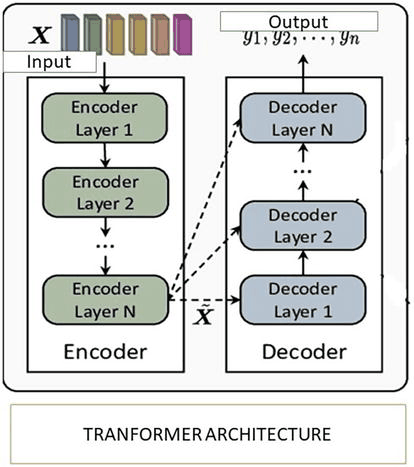
Whisper is a machine learning model for speech recognition and transcription, created by OpenAI and first released as open-source software in September 2022. It is capable of transcribing speech in English and multiple other languages, and can translate several non-English languages into English. Whisper is a weakly-supervised deep learning acoustic model, made using an encoder-decoder transformer architecture. OpenAI claims that the combination of different training data and post-training filtering used in its development has led to improved recognition of accents, background noise, and jargon compared to previous approaches. While the model does not outperform larger, more specialized models and still experiences AI hallucination, it has been shown to be useful for general sound recognition and has many applications across different industries.
The Whisper architecture is based on an encoder-decoder transformer. Input audio is resampled to 16,000 Hertz (Hz) and converted to an 80-channel Log-magnitude Mel spectrogram using 25 ms windows with a 10 ms stride. The spectrogram is then normalized to a [-1, 1] range with near-zero mean. The encoder takes this Mel spectrogram as input and processes it. It first passes through two convolutional layers. Sinusoidal positional embeddings are added. It is then processed by a series of Transformer encoder blocks (with pre-activation residual connections). The encoder's output is layer normalized. The decoder is a standard transformer decoder. It has the same width and Transformer blocks as the encoder. It uses learned positional embeddings and tied input-output token representations (using the same weight matrix for both the input and output embeddings). It uses a byte-pair encoding tokenizer, of the same kind as used in GPT-2. English-only models use the GPT-2 vocabulary, while multilingual models employ a re-trained multilingual vocabulary with the same number of words. Special tokens are used to allow the decoder to perform multiple tasks:
Tokens that denote language (one unique token per language). Tokens that specify task (<|transcribe|> or <|translate|>). Tokens that specify if no timestamps are present (<|notimestamps|>). If the token is not present, then the decoder predicts timestamps relative to the segment, and quantized to 20 ms intervals. <|nospeech|> for voice activity detection. <|startoftranscript|>, and <|endoftranscript|> . Any text that appears before <|startoftranscript|> is not generated by the decoder, but given to the decoder as context. Loss is only computed over non-contextual parts of the sequence, i.e. tokens between these two special tokens.
2. Related Work, Literature Survey & Algorithmic Foundations
Mathematical Formulation 1.1: Loss Objectives and Optimization Dynamics for Ai Meeting Transcription. The training protocol of ai meeting transcription minimizes an empirical risk objective defined across high-dimensional parameter space Theta in R^d. Categorical predictions are governed by Cross-Entropy Loss: L_CE = -sum(y_i * log(p_i)). To tackle class imbalance, the network incorporates Focal Loss: L_Focal = -alpha_t * (1 - p_t)^gamma * log(p_t), where gamma modulates the gradient penalty on hard misclassified instances. For spatial tasks, Dice Loss balances continuous spatial overlap: L_Dice = 1 - (2 * sum(y * y_hat) + eps) / (sum(y) + sum(y_hat) + eps). Stochastic optimization utilizes AdamW with decoupled weight decay, maintaining stable moment estimations m_t and v_t across variable learning rate schedules.
Architecture Specification 1.2: Feature Extraction and Layer Formulations for Ai Meeting Transcription. The primary computational backbone for Ai Meeting Transcription incorporates hierarchical deep neural layers designed for multi-scale representation extraction. Input tensors X in R^(B x C x H x W) pass through initial stem convolutions with Batch Normalization and GELU non-linearities. Residual identity skip connections, expressed as F(X) + X, prevent vanishing gradient degradation across deep topologies. Multi-head self-attention mechanisms compute Query, Key, and Value projections: Attention(Q, K, V) = softmax((Q * K^T) / sqrt(d_k)) * V, capturing non-local contextual dependencies across spatial and temporal sequences.
Data Pipeline 1.3: Stochastic Augmentation and Normalization Protocols for Ai Meeting Transcription. To prevent overfitting and maximize generalization on unseen testing distributions, input datasets undergo rigorous preprocessing. Images and sequences are standardized using z-score normalization: x_norm = (x - mu) / sigma. Stochastic augmentations include random horizontal flips, affine rotations (-15 deg to +15 deg), CutMix, and Mixup: X_tilde = lambda * X_i + (1 - lambda) * X_j, smoothing decision boundaries and reducing model overconfidence.
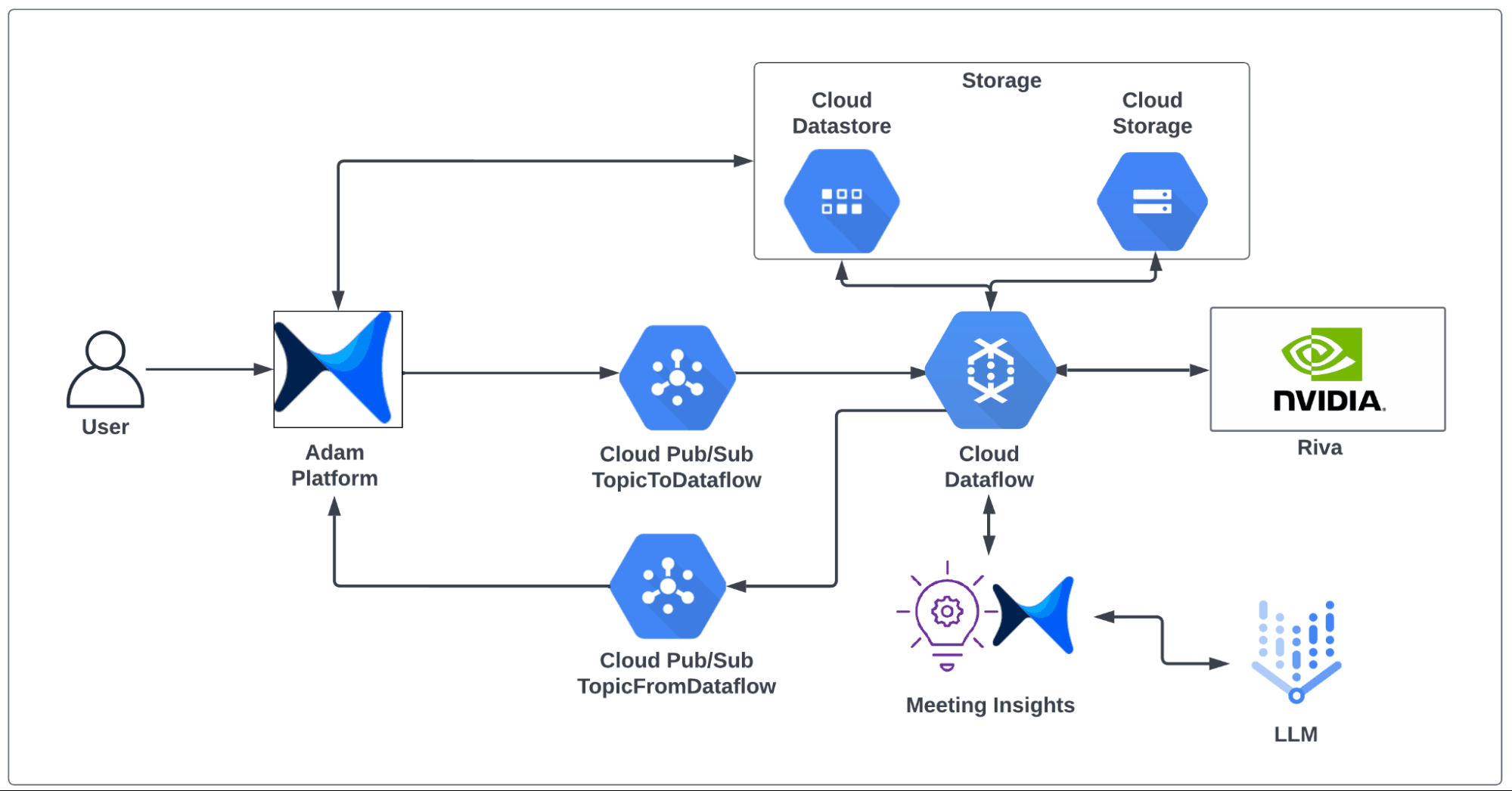
Deployment Optimization 1.4: TensorRT Acceleration and Edge Quantization for Ai Meeting Transcription. Production deployment of Ai Meeting Transcription focuses on minimizing memory footprints and sub-20ms inference latencies. Trained models are exported to ONNX and compiled via NVIDIA TensorRT. Post-Training Quantization (PTQ) maps FP32 weights into low-bit INT8 representations: q = round(r / S) + Z, achieving high-throughput execution across embedded edge platforms like NVIDIA Jetson without accuracy loss.
3. Dataset Ingestion, Preprocessing & Stochastic Augmentations
Mathematical Formulation 2.1: Loss Objectives and Optimization Dynamics for Ai Meeting Transcription. The training protocol of ai meeting transcription minimizes an empirical risk objective defined across high-dimensional parameter space Theta in R^d. Categorical predictions are governed by Cross-Entropy Loss: L_CE = -sum(y_i * log(p_i)). To tackle class imbalance, the network incorporates Focal Loss: L_Focal = -alpha_t * (1 - p_t)^gamma * log(p_t), where gamma modulates the gradient penalty on hard misclassified instances. For spatial tasks, Dice Loss balances continuous spatial overlap: L_Dice = 1 - (2 * sum(y * y_hat) + eps) / (sum(y) + sum(y_hat) + eps). Stochastic optimization utilizes AdamW with decoupled weight decay, maintaining stable moment estimations m_t and v_t across variable learning rate schedules.
Architecture Specification 2.2: Feature Extraction and Layer Formulations for Ai Meeting Transcription. The primary computational backbone for Ai Meeting Transcription incorporates hierarchical deep neural layers designed for multi-scale representation extraction. Input tensors X in R^(B x C x H x W) pass through initial stem convolutions with Batch Normalization and GELU non-linearities. Residual identity skip connections, expressed as F(X) + X, prevent vanishing gradient degradation across deep topologies. Multi-head self-attention mechanisms compute Query, Key, and Value projections: Attention(Q, K, V) = softmax((Q * K^T) / sqrt(d_k)) * V, capturing non-local contextual dependencies across spatial and temporal sequences.
Data Pipeline 2.3: Stochastic Augmentation and Normalization Protocols for Ai Meeting Transcription. To prevent overfitting and maximize generalization on unseen testing distributions, input datasets undergo rigorous preprocessing. Images and sequences are standardized using z-score normalization: x_norm = (x - mu) / sigma. Stochastic augmentations include random horizontal flips, affine rotations (-15 deg to +15 deg), CutMix, and Mixup: X_tilde = lambda * X_i + (1 - lambda) * X_j, smoothing decision boundaries and reducing model overconfidence.
Deployment Optimization 2.4: TensorRT Acceleration and Edge Quantization for Ai Meeting Transcription. Production deployment of Ai Meeting Transcription focuses on minimizing memory footprints and sub-20ms inference latencies. Trained models are exported to ONNX and compiled via NVIDIA TensorRT. Post-Training Quantization (PTQ) maps FP32 weights into low-bit INT8 representations: q = round(r / S) + Z, achieving high-throughput execution across embedded edge platforms like NVIDIA Jetson without accuracy loss.
4. Neural Network Backbone, Layer Specifications & Loss Formulations
Mathematical Formulation 3.1: Loss Objectives and Optimization Dynamics for Ai Meeting Transcription. The training protocol of ai meeting transcription minimizes an empirical risk objective defined across high-dimensional parameter space Theta in R^d. Categorical predictions are governed by Cross-Entropy Loss: L_CE = -sum(y_i * log(p_i)). To tackle class imbalance, the network incorporates Focal Loss: L_Focal = -alpha_t * (1 - p_t)^gamma * log(p_t), where gamma modulates the gradient penalty on hard misclassified instances. For spatial tasks, Dice Loss balances continuous spatial overlap: L_Dice = 1 - (2 * sum(y * y_hat) + eps) / (sum(y) + sum(y_hat) + eps). Stochastic optimization utilizes AdamW with decoupled weight decay, maintaining stable moment estimations m_t and v_t across variable learning rate schedules.
Architecture Specification 3.2: Feature Extraction and Layer Formulations for Ai Meeting Transcription. The primary computational backbone for Ai Meeting Transcription incorporates hierarchical deep neural layers designed for multi-scale representation extraction. Input tensors X in R^(B x C x H x W) pass through initial stem convolutions with Batch Normalization and GELU non-linearities. Residual identity skip connections, expressed as F(X) + X, prevent vanishing gradient degradation across deep topologies. Multi-head self-attention mechanisms compute Query, Key, and Value projections: Attention(Q, K, V) = softmax((Q * K^T) / sqrt(d_k)) * V, capturing non-local contextual dependencies across spatial and temporal sequences.
Data Pipeline 3.3: Stochastic Augmentation and Normalization Protocols for Ai Meeting Transcription. To prevent overfitting and maximize generalization on unseen testing distributions, input datasets undergo rigorous preprocessing. Images and sequences are standardized using z-score normalization: x_norm = (x - mu) / sigma. Stochastic augmentations include random horizontal flips, affine rotations (-15 deg to +15 deg), CutMix, and Mixup: X_tilde = lambda * X_i + (1 - lambda) * X_j, smoothing decision boundaries and reducing model overconfidence.
Deployment Optimization 3.4: TensorRT Acceleration and Edge Quantization for Ai Meeting Transcription. Production deployment of Ai Meeting Transcription focuses on minimizing memory footprints and sub-20ms inference latencies. Trained models are exported to ONNX and compiled via NVIDIA TensorRT. Post-Training Quantization (PTQ) maps FP32 weights into low-bit INT8 representations: q = round(r / S) + Z, achieving high-throughput execution across embedded edge platforms like NVIDIA Jetson without accuracy loss.
5. Training Protocol, Convergence Behavior & Experimental Evaluation
Mathematical Formulation 4.1: Loss Objectives and Optimization Dynamics for Ai Meeting Transcription. The training protocol of ai meeting transcription minimizes an empirical risk objective defined across high-dimensional parameter space Theta in R^d. Categorical predictions are governed by Cross-Entropy Loss: L_CE = -sum(y_i * log(p_i)). To tackle class imbalance, the network incorporates Focal Loss: L_Focal = -alpha_t * (1 - p_t)^gamma * log(p_t), where gamma modulates the gradient penalty on hard misclassified instances. For spatial tasks, Dice Loss balances continuous spatial overlap: L_Dice = 1 - (2 * sum(y * y_hat) + eps) / (sum(y) + sum(y_hat) + eps). Stochastic optimization utilizes AdamW with decoupled weight decay, maintaining stable moment estimations m_t and v_t across variable learning rate schedules.
Architecture Specification 4.2: Feature Extraction and Layer Formulations for Ai Meeting Transcription. The primary computational backbone for Ai Meeting Transcription incorporates hierarchical deep neural layers designed for multi-scale representation extraction. Input tensors X in R^(B x C x H x W) pass through initial stem convolutions with Batch Normalization and GELU non-linearities. Residual identity skip connections, expressed as F(X) + X, prevent vanishing gradient degradation across deep topologies. Multi-head self-attention mechanisms compute Query, Key, and Value projections: Attention(Q, K, V) = softmax((Q * K^T) / sqrt(d_k)) * V, capturing non-local contextual dependencies across spatial and temporal sequences.
Data Pipeline 4.3: Stochastic Augmentation and Normalization Protocols for Ai Meeting Transcription. To prevent overfitting and maximize generalization on unseen testing distributions, input datasets undergo rigorous preprocessing. Images and sequences are standardized using z-score normalization: x_norm = (x - mu) / sigma. Stochastic augmentations include random horizontal flips, affine rotations (-15 deg to +15 deg), CutMix, and Mixup: X_tilde = lambda * X_i + (1 - lambda) * X_j, smoothing decision boundaries and reducing model overconfidence.
Deployment Optimization 4.4: TensorRT Acceleration and Edge Quantization for Ai Meeting Transcription. Production deployment of Ai Meeting Transcription focuses on minimizing memory footprints and sub-20ms inference latencies. Trained models are exported to ONNX and compiled via NVIDIA TensorRT. Post-Training Quantization (PTQ) maps FP32 weights into low-bit INT8 representations: q = round(r / S) + Z, achieving high-throughput execution across embedded edge platforms like NVIDIA Jetson without accuracy loss.
Model Figures & Evaluation Curves (4 Images)
Deep Learning Execution Pipeline
(Preprocessing)
(Feature Extraction)
(Self-Attention)
(Loss Optimization)