Complete Technical Paper Content — Ai On Jetson Nano
1. Executive Abstract, Problem Formulation & Background
Nvidia Jetson is a series of embedded computing boards from Nvidia. The Jetson TK1, TX1 and TX2 models all carry a Tegra processor (or SoC) from Nvidia that integrates an ARM architecture central processing unit (CPU). Jetson is a low-power system and is designed for accelerating machine learning applications.
In late April 2014, Nvidia shipped the Nvidia Jetson TK1 development board containing a Tegra K1 SoC in the T124 variant and running Ubuntu Linux. The Nvidia Jetson TX1 development board bears a Tegra X1 of model T210. The Nvidia Jetson TX2 board bears a Tegra X2 of microarchitecture GP10B (SoC type T186 or very similar). This board and the associated development platform was announced in March 2017 as a compact card design for low power scenarios, e.g. for the use in smaller camera drones such as the Skydio 2. A matrix describing a set of performance modes was provided by the media along with that. Further a TX2i variant, said to be rugged and suitable for industrial use cases, is mentioned. The Nvidia Jetson Xavier was announced as a development kit in end of August 2018. Indications were given that a 20x acceleration for certain application cases compared to predecessor devices should be expected, and that the application power efficiency is 10x improved. Nvidia Jetson Xavier NX has a 6-core Nvidia Carmel ARMv8.2. The Nvidia Jetson AGX Xavier is the 8-core version on the same core architecture (Carmel Armv8.2).
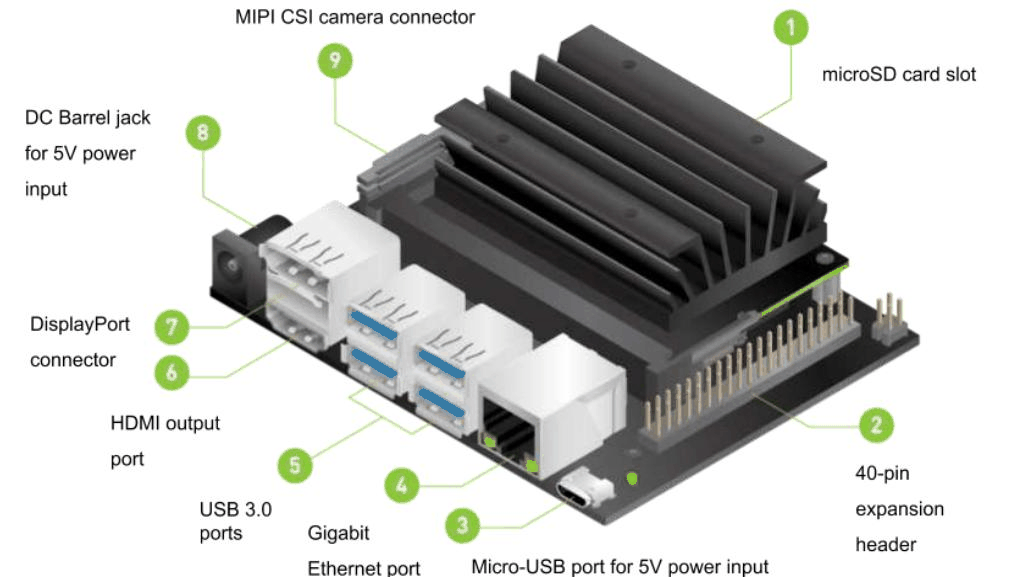
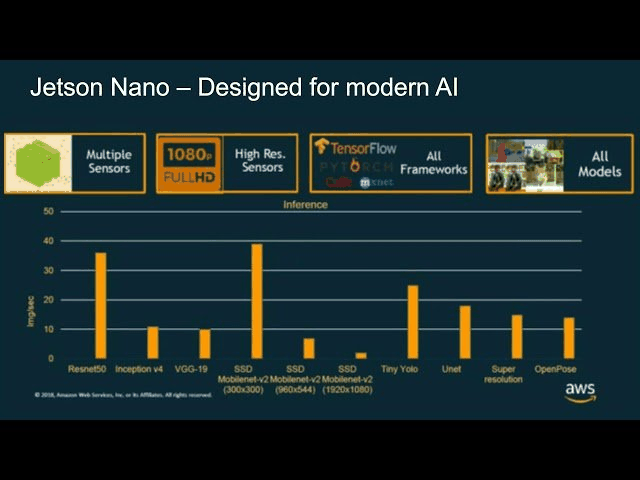
The Nvidia Jetson Nano was announced as a development system in mid-March 2019 The intended market is for hobbyist robotics due to the low price point. The final specs expose the board being sort of a power-optimized, stripped-down version of what a full Tegra X1 system would mean. Only half of the CPU (only 4x A57 @ 1.43 GHz) and GPU (128 cores of Maxwell generation @ 921 MHz) cores are present and only half of the maximum possible RAM is attached (4 GB LPDDR4 @ 64 bit + 1.6 GHz = 25.6 GB/s) whilst the available or usable interfacing is determined by the baseboard design and is further subject of implementation decisions and specifics in an end user specific design for an application case. The Nvidia Jetson Nano Developer Kit.
In September 2022 Nvidia announced the Jetson Orin Nano. The modules have the same 260-pin SO-DIMM connector and 69.6 mm x 45 mm dimensions, and come in two variants. The 4 GB variant provides 20 Sparse or 10 Dense TOPs, using a 512-core Ampere GPU with 16 Tensor cores, while the 8 GB variant doubles those numbers to 40/20 TOPs, a 1024-core GPU and 16 Tensor cores. Both have 6 Arm Cortex-A78AE cores. The 4 GB module starts at $199 and the 8 GB variant for $299, when purchasing 1000 units. In December 2024, Nvidia announced the updated Orin Nano with a claimed 1.7x performance improvement and a price reduction of the development kit from $499 to $249 In August 2025, the Jetson AGX Thor was released. It features 128 GiB memory and a Blackwell GPU capable of 2,070 FP4 TFLOPS. Nvidia claims the AGX Thor delivers 7.5x more computing power and 3.5x the efficiency compared to the previous generation Orin.
2. Related Work, Literature Survey & Algorithmic Foundations
Jetson TX2 also has 5 power modes, numbered 0 through 4 as published by NVIDIA. The default mode is mode 3 (MAX-P).
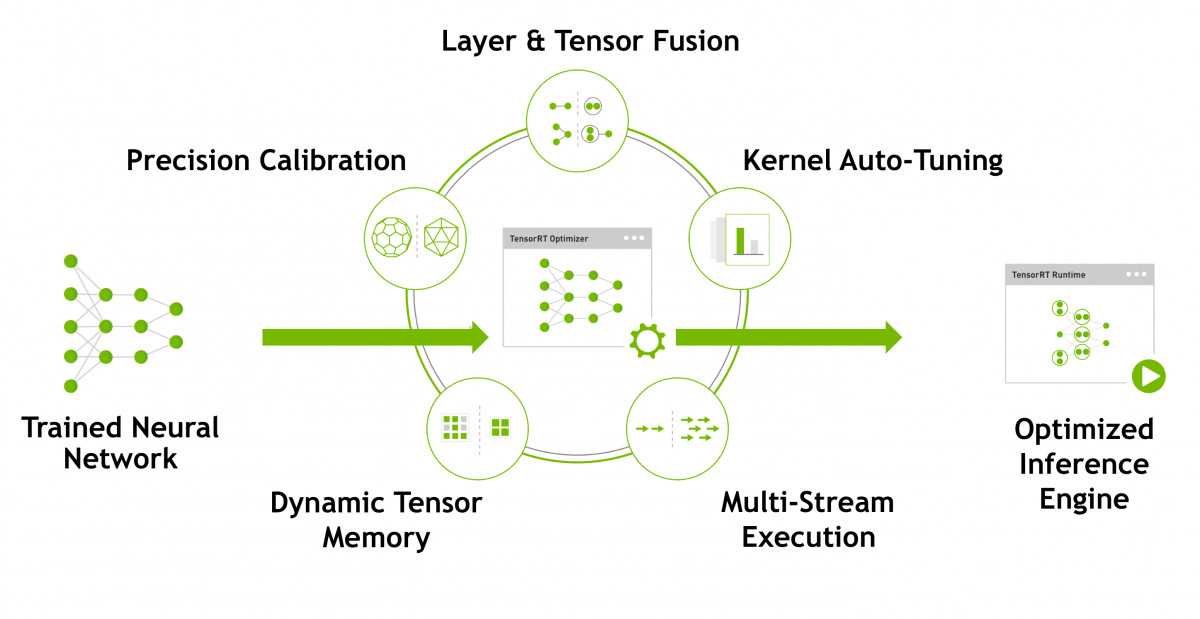
JetPack 3.2 adds support for the Linux for Tegra r28.2 image for the Jetson OS. It is packaged with newer versions of Tegra System Profiler, TensorRT, and cuDNN from the last release. RedHawk Linux is a high-performance RTOS available for the Jetson platform, along with associated NightStar real-time development tools, CUDA/GPU enhancements, and a framework for hardware-in-the-loop and man-in-the-loop simulations.
The module in question is reportedly an Orin NX 8GB/16GB, rated up to 157 sparse INT8 TOPS on an Ampere-architecture GPU with 1024 CUDA cores, and has been shipping commercially since 2023.
The specific module (Orin NX 8GB/16GB), its spec (up to 157 sparse INT8 TOPS, Ampere GPU, 1024 CUDA cores), and shipping history (available since 2023).
3. Dataset Ingestion, Preprocessing & Stochastic Augmentations
Nvidia Corporation ( en-VID-ee-ə) is an American multinational technology company headquartered in Santa Clara, California. The company develops graphics processing units (GPUs), systems on chips (SoCs), and application programming interfaces (APIs) for data science, high-performance computing, artificial intelligence (AI), and mobile and automotive applications. Founded in 1993 by Jensen Huang, Chris Malachowsky, and Curtis Priem, Nvidia has been described as a Big Tech company and is among the largest companies by market capitalization. Originally focused on GPUs for video games, Nvidia broadened their usage into other markets, including AI, professional visualization, and supercomputing. The company's product lines include GeForce GPUs for gaming and creative workloads, and professional GPUs for edge computing, scientific research, and industrial applications. In 2025, Nvidia became the first company to surpass US$4 trillion and US$5 trillion in market capitalization, largely driven by the AI boom and soaring demand for its AI data center hardware.
Nvidia was founded on April 5, 1993, by Jensen Huang, a Taiwanese-American electrical engineer who was previously the director of CoreWare at LSI Logic and a microprocessor designer at AMD, Chris Malachowsky, an engineer who worked at Sun Microsystems, and Curtis Priem, who was previously a senior staff engineer and graphics chip designer at IBM and Sun Microsystems. In late 1992, the three men agreed to start the company by sketching out their initial ideas in a meeting at a Denny's roadside diner on Berryessa Road in East San Jose. At the time, Malachowsky and Priem were frustrated with Sun's management and were looking to leave, but Huang was on "firmer ground", in that he was already running his own division at LSI. The three co-founders discussed a vision of the future for gaming and multimedia markets, which was so compelling that Huang decided to leave LSI and become the chief executive officer of their new startup. The three co-founders envisioned 3D graphics-based processing as the best trajectory for tackling challenges that had eluded general-purpose computing methods. As Huang later explained: "We also observed that video games were simultaneously one of the most computationally challenging problems and would have incredibly high sales volume. Those two conditions don't happen very often. Video games was our killer app – a flywheel to reach large markets funding huge R&D to solve massive computational problems." The first problem was who would quit first. Huang's wife, Lori, did not want him to resign from LSI unless Malachowsky resigned from Sun at the same time, and Malachowsky's wife, Melody, felt the same way about Huang. Priem broke that deadlock by resigning first from Sun, effective December 31, 1992. According to Priem, this put pressure on Huang and Malachowsky to not leave him to "flail alone", so they gave notice too. Huang left LSI and "officially joined Priem on February 17", which was also Huang's 30th birthday, while Malachowsky left Sun in early March. In early 1993, the three founders began working together on their new startup in Priem's townhouse in Fremont, California. With $40,000 in the bank (equivalent to $89,000 in 2025), the company was born. The company subsequently received $20 million of venture capital funding from Sequoia Capital, Sutter Hill Ventures, and others. During the late 1990s, Nvidia was one of 70 startup companies pursuing the idea that graphics acceleration for video games was the path to the future. Only two survived: Nvidia and ATI Technologies, the latter of which merged into AMD. Nvidia initially had no name. Priem's first idea was "Primal Graphics", a syllabic abbreviation of two of the founders' last names, but that left out Huang. They soon discovered it was impossible to create a workable name with syllables from all three founders' names, after considering "Huaprimal", "Prihuamal", "Malluapri", etc. The next idea came from Priem's idea for the name of Nvidia's first product. Priem originally wanted to call it the "GXNV", as in the "next version" of the GX graphics chips which he had worked on at Sun. Then Huang told Priem to "drop the GX", resulting in the name "NV". Priem made a list of words with the letters "NV" in them. At one point, Malachowsky and Priem wanted to call the company NVision, but that name was already taken by a manufacturer of toilet paper. Both Priem and Huang have taken credit for coming up with the name Nvidia, from "invidia", the Latin word for "envy". After the company outgrew Priem's townhouse, its original headquarters office was in Sunnyvale, California. In the early-to-mid 2000s, the company invested over a billion dollars to develop CUDA, a software platform and API that enabled GPUs to run massively parallel programs for a broad range of compute-intensive applications. As a result, as of 2025, Nvidia controlled more than 80% of the market for GPUs used in training and deploying AI models, and provided chips for over 75% of the world's TOP500 supercomputers. The company has also expanded into gaming hardware and services, with products such as the Shield Portable, Shield Tablet, and Shield TV, and operates the GeForce Now cloud gaming service. Furthermore, it has developed the Tegra line of mobile processors for smartphones, tablets, and automotive infotainment systems.
Nvidia went public on January 22, 1999. Investing in Nvidia after it had already failed to deliver on its contract turned out to be Irimajiri's best decision as Sega's president. After Irimajiri left Sega in 2000, Sega sold its Nvidia stock for $15 million. In late 1999, Nvidia released the GeForce 256 (NV10), its first product expressly marketed as a GPU, which was most notable for introducing onboard transformation and lighting (T&L) to consumer-level 3D hardware. Running at 120 MHz and featuring four-pixel pipelines, it implemented advanced video acceleration, motion compensation, and hardware sub-picture alpha blending. The GeForce outperformed existing products by a wide margin. Because its products were performing well, Nvidia won the contract to develop the graphics hardware for Microsoft's Xbox game console, which included a $200 million advance. However, the project took many of its best engineers away from other projects. In the short term this did not matter, and the GeForce 2 GTS shipped in the summer of 2000. In December 2000, Nvidia reached an agreement to acquire the intellectual assets of its one-time rival 3dfx, a pioneer in consumer 3D graphics technology leading the field from the mid-1990s until 2000. The acquisition process was finalized in April 2002. In 2001, Standard & Poor's selected Nvidia to replace the departing Enron in the S&P 500 stock index, meaning that index funds would need to hold Nvidia shares going forward. In July 2002, Nvidia acquired Exluna for an undisclosed sum. Exluna made software-rendering tools and its personnel were merged into Nvidia's Cg project. In August 2003, Nvidia acquired MediaQ for approximately US$70 million. It launched GoForce the following year. On April 22, 2004, Nvidia acquired iReady, also a provider of high-performance TCP offload engines and iSCSI controllers. In December 2004, it was announced that Nvidia would assist Sony with the design of the graphics processor (RSX) for the PlayStation 3 game console. On December 14, 2005, Nvidia acquired ULI Electronics, which at the time supplied third-party southbridge parts for chipsets to ATI, Nvidia's competitor. In March 2006, Nvidia acquired Hybrid Graphics. Forbes named Nvidia its Company of the Year for 2007, citing the accomplishments it made during the said period as well as during the previous five years. On January 5, 2007, Nvidia announced that it had completed the acquisition of PortalPlayer, Inc. In February 2008, Nvidia acquired Ageia, developer of PhysX, a physics engine and physics processing unit. Nvidia announced that it planned to integrate the PhysX technology into its future GPU products. In February 2013, Nvidia announced its plans to build a new headquarters in the form of two giant triangle-shaped buildings on the other side of San Tomas Expressway (to the west of its existing headquarters complex). The company selected triangles as its design theme. As Huang explained in a blog post, the triangle is "the fundamental building block of computer graphics". In May 2022, Nvidia opened Voyager, the second of the two giant buildings at its new headquarters complex to the west of the old one. Unlike its smaller and older sibling Endeavor, the triangle theming is used more "sparingly" in Voyager.
In October 2020, Nvidia announced its plan to build the most powerful computer in Cambridge, England. The computer, called Cambridge-1, launched in July 2021 with a $100 million investment and will employ AI to support healthcare research. According to Jensen Huang, "The Cambridge-1 supercomputer will serve as a hub of innovation for the UK, and further the groundbreaking work being done by the nation's researchers in critical healthcare and drug discovery." Also in October 2020, along with the release of the Nvidia RTX A6000, Nvidia announced it was retiring its workstation GPU brand Quadro, shifting its product name to Nvidia RTX for future products and the manufacturing to be Ampere architecture-based. In March 2022, Nvidia's CEO Jensen Huang mentioned that they were open to having Intel manufacture their chips in the future. This was the first time the company mentioned that it would work together with Intel's upcoming foundry services. In September 2022, Nvidia announced its next-generation automotive-grade chip, Drive Thor. That same month, Nvidia announced a collaboration with the Broad Institute of MIT and Harvard related to the entire suite of Nvidia's AI-powered healthcare software suite called Clara, that includes Parabricks and MONAI. Following United States Department of Commerce regulations which placed an embargo on exports to China of advanced microchips, which went into effect in October 2022, Nvidia saw its data center chip added to the export control list. The next month, the company unveiled a new advanced chip in China, called the A800 GPU, that met the export control rules. In September 2023, Getty Images announced that it was partnering with Nvidia to launch Generative AI by Getty Images, a new tool that let people create images using Getty's library of licensed photos. Getty said they would use Nvidia's Edify model, which was available on Nvidia's generative AI model library Picasso. On September 26, 2023, Denny's CEO Kelli Valade joined Huang in East San Jose to celebrate the founding of Nvidia at Denny's on Berryessa Road, where a plaque was installed to mark the relevant corner booth as the birthplace of a $1 trillion company. By then, Nvidia's H100 GPUs were in such demand that even other tech giants were beholden to how Nvidia allocated supply. Larry Ellison of Oracle Corporation said that month that during a dinner with Huang at Nobu in Palo Alto, he and Elon Musk of Tesla, Inc. and xAI "were begging" for H100s, "I guess is the best way to describe it. An hour of sushi and begging". In October 2023, it was reported that Nvidia had quietly begun designing ARM-based central processing units (CPUs) for Microsoft's Windows operating system with a target to start selling them in 2025.
4. Neural Network Backbone, Layer Specifications & Loss Formulations
Jensen Huang, co-founder, president and chief executive officer Chris Malachowsky, co-founder and Nvidia fellow Colette Kress, executive vice president and chief financial officer Jay Puri, executive vice president of worldwide field operations Debora Shoquist, executive vice president of operations Tim Teter, executive vice president, general counsel and secretary
Tench Coxe (former managing director of Sutter Hill Ventures) John Dabiri (engineer and professor at the California Institute of Technology) Jensen Huang (co-founder, CEO and president of Nvidia) Dawn Hudson (former chief marketing officer of the National Football League) Harvey C. Jones (managing partner of Square Wave Ventures) Melissa B. Lora (former president of Taco Bell International) Stephen Neal (lead independent director of Nvidia, former CEO and chairman emeritus and senior counsel of Cooley LLP) Brooke Seawell (venture partner at New Enterprise Associates) Aarti Shah (former senior vice president & chief information and digital officer at Eli Lilly and Company) Mark Stevens (managing partner at S-Cubed Capital)
Nvidia's GPU Technology Conference (GTC) is a series of technical conferences held around the world. It originated in 2009 in San Jose, California, with an initial focus on the potential for solving computing challenges through GPUs. In recent years, the conference's focus has shifted to various applications of artificial intelligence and deep learning; including self-driving cars, healthcare, high-performance computing, and Nvidia Deep Learning Institute (DLI) training. GTC 2018 attracted over 8400 attendees. GTC 2020 was converted to a digital event and drew roughly 59,000 registrants. After several years of remote-only events, GTC in March 2024 returned to an in-person format in San Jose, California. At GTC 2025, Nvidia unveiled its next-generation AI hardware, the Blackwell Ultra and Vera Rubin chips, signalling a leap toward agentic AI and reasoning-capable computing. Huang projected that AI-driven infrastructure would drive Nvidia's data center revenue to $1 trillion by 2028. The announcement also introduced Isaac GR00T N1 (humanoid robotics model), Cosmos (synthetic training data AI), and the Newton physics engine, developed in collaboration with DeepMind and Disney Research.
Nvidia's product families include graphics processing units, wireless communication devices, and automotive hardware and software, such as:
5. Training Protocol, Convergence Behavior & Experimental Evaluation
GeForce, consumer-oriented graphics processing products RTX, professional visual computing graphics processing products (replacing GTX and Quadro) NVS, a multi-display business graphics processor Tegra, a system on a chip series for mobile devices Tesla, a line of dedicated general-purpose GPUs for high-end image generation applications in professional and scientific fields nForce, a motherboard chipset created by Nvidia for Intel (Celeron, Pentium and Core 2) and AMD (Athlon and Duron) microprocessors GRID, a set of hardware and services by Nvidia for graphics virtualization Shield, a range of gaming hardware including the Shield Portable, Shield Tablet and Shield TV Drive, a range of hardware and software products for designers and manufacturers of autonomous vehicles. The Drive PX-series is a high-performance computer platform aimed at autonomous driving through deep learning, while Driveworks is an operating system for driverless cars. BlueField, a range of data processing units, initially inherited from its acquisition of Mellanox Technologies Datacenter/server class CPU, codenamed Grace, released in 2023 DGX, an enterprise platform designed for deep learning applications Maxine, a platform providing developers a suite of AI-based conferencing software Omniverse, a platform for creating and operating metaverse applications DLSS 5, a compact diffusion transformer architecture designed to improve real-time neural rendering capabilities
Until September 23, 2013, Nvidia had not published any documentation for its advanced hardware, meaning that programmers could not write free and open-source device drivers for its products without resorting to reverse engineering. Additionally, features like its compute platform CUDA and the DLSS technology suite are proprietary and only available on its hardware. As such, Nvidia has been notable for proprietization and vendor-locking practices. Nvidia has released Linux <open-source GPU kernel modules> under dual GPL/MIT licensing, allowing developers to inspect the driver module code and contribute improvements in collaboration with the community.NVIDIA Releases Open-Source GPU Kernel Modules The Nvidia open-gpu-kernel-modules repository on GitHub provides the publicly accessible source code for these modules, supporting modern GPU architectures in Linux environments. Furthermore, Nvidia's acquisition of SchedMD and the release of new open-source AI models highlight its broader commitment to open-source software and the AI ecosystem.[1] Instead, Nvidia provides its own binary GeForce graphics drivers for X.Org and an open-source library that interfaces with the Linux, FreeBSD or Solaris kernels and the proprietary graphics software. Nvidia also provided but stopped supporting an obfuscated open-source driver that only supports two-dimensional hardware acceleration and ships with the X.Org distribution. The proprietary nature of Nvidia's drivers has generated dissatisfaction within free-software communities. In a 2012 talk, Linus Torvalds gave a middle-finger gesture and criticized Nvidia's stance toward Linux. Some Linux and BSD users insist on using only open-source drivers and regard Nvidia's insistence on providing nothing more than a binary-only driver as inadequate, given that competing manufacturers such as Intel offer support and documentation for open-source developers, and others like AMD release partial documentation and provide some active development. Nvidia only provides x86/x64 and ARMv7-A versions of its proprietary driver; as a result, features like CUDA are unavailable on other platforms. Some users claim that Nvidia's Linux drivers impose artificial restrictions, like limiting the number of monitors that can be used at the same time, but the company has not commented on these accusations. In 2014, with the introduction of its Maxwell GPUs, Nvidia began requiring firmware signed with Nvidia's own private cryptographic key to unlock all features of its graphics cards. Consequently, open-source drivers written by third parties were rendered significantly less functional than the official binary driver. On May 12, 2022, Nvidia announced that it is opensourcing its GPU kernel modules. Support for Nvidia's firmware was implemented in nouveau in 2023, which allows proper power management and GPU reclocking for Turing and newer graphics card generations. On July 21, 2025, Nvidia announced to extend CUDA support to RISC-V. As of 2026, NVIDIA has over 100 different open-source projects available on GitHub in different areas such as computer vision, networking, cybersecurity, AR/VR, Robotics, Generative AI etc.
DGX is a line of supercomputers by Nvidia. In April 2016, Nvidia produced the DGX-1 based on an 8 GPU cluster, to improve the ability of users to use deep learning by combining GPUs with integrated deep learning software. Nvidia gifted its first DGX-1 to OpenAI in August 2016 to help it train larger and more complex AI models with the capability of reducing processing time from six days to two hours. It also developed Nvidia Tesla K80 and P100 GPU-based virtual machines, which are available through Google Cloud, which Google installed in November 2016. Microsoft added GPU servers in a preview offering of its N series based on Nvidia's Tesla K80s, each containing 4992 processing cores. Later that year, AWS's P2 instance was produced using up to 16 Nvidia Tesla K80 GPUs. That month Nvidia also partnered with IBM to create a software kit that boosts the AI capabilities of Watson, called IBM PowerAI. Nvidia also offers its own Nvidia Deep Learning software development kit. In 2017, the GPUs were also brought online at the Riken Center for Advanced Intelligence Project for Fujitsu. The company's deep learning technology led to a boost in its 2017 earnings. In 2018, Nvidia researchers demonstrated imitation-learning techniques for industrial robots. They have created a system that, after a short revision and testing, can already be used to control the universal robots of the next generation. In addition to GPU manufacturing, Nvidia provides parallel processing capabilities to researchers and scientists that allow them to efficiently run high-performance applications.
Issues with the GeForce GTX 970's specifications were first brought up by users when they found out that the cards, while featuring 4 GB of memory, rarely accessed memory over the 3.5 GB boundary. Further testing and investigation eventually led to Nvidia issuing a statement that the card's initially announced specifications had been altered without notice before the card was made commercially available, and that the card took a performance hit once memory over the 3.5 GB limit were put into use. The card's back-end hardware specifications, initially announced as being identical to those of the GeForce GTX 980, differed in the amount of L2 cache (1.75 MB versus 2 MB in the GeForce GTX 980) and the number of ROPs (56 versus 64 in the 980). Additionally, it was revealed that the card was designed to access its memory as a 3.5 GB section, plus a 0.5 GB one, access to the latter being 7 times slower than the first one. The company then went on to promise a specific driver modification to alleviate the performance issues produced by the cutbacks suffered by the card. However, Nvidia later clarified that the promise had been a miscommunication and there would be no specific driver update for the GTX 970. Nvidia claimed that it would assist customers who wanted refunds in obtaining them. On February 26, 2015, Nvidia CEO Jensen Huang went on record in Nvidia's official blog to apologize for the incident. In February 2015 a class-action lawsuit alleging false advertising was filed against Nvidia and Gigabyte Technology in the United States District Court for the Northern District of California. Nvidia revealed that it is able to disable individual units, each containing 256 KB of L2 cache and 8 ROPs, without disabling whole memory controllers. This comes at the cost of dividing the memory bus into high speed and low speed segments that cannot be accessed at the same time unless one segment is reading while the other segment is writing because the L2/ROP unit managing both of the GDDR5 controllers shares the read return channel and the write data bus between the two GDDR5 controllers and itself. This is used in the GeForce GTX 970, which therefore can be described as having 3.5 GB in its high speed segment on a 224-bit bus and 0.5 GB in a low speed segment on a 32-bit bus. On July 27, 2016, Nvidia agreed to a preliminary settlement of the U.S. class action lawsuit, offering a $30 refund on GTX 970 purchases. The agreed upon refund represents the portion of the cost of the storage and performance capabilities the consumers assumed they were obtaining when they purchased the card.
Model Figures & Evaluation Curves (4 Images)
Deep Learning Execution Pipeline
(Preprocessing)
(Feature Extraction)
(Self-Attention)
(Loss Optimization)