Complete Technical Paper Content — Alphafold Related Projects
1. Executive Abstract, Problem Formulation & Background
AlphaFold is an artificial intelligence (AI) program developed by DeepMind, a subsidiary of Alphabet, which performs predictions of protein structure. It is designed using deep learning techniques. AlphaFold 1 (2018) placed first in the overall rankings of the 13th Critical Assessment of Structure Prediction (CASP) in December 2018. It was particularly successful at predicting the most accurate structures for targets rated as most difficult by the competition organizers, where no existing template structures were available from proteins with partially similar sequences. AlphaFold 2 (2020) repeated this placement in the CASP14 competition in November 2020. It achieved a level of accuracy much higher than any other entry. It scored above 90 on CASP's global distance test (GDT) for approximately two-thirds of the proteins, a test measuring the similarity between a computationally predicted structure and the experimentally determined structure, where 100 represents a complete match. The inclusion of metagenomic data has improved the quality of the prediction of multiple sequence alignments. One of the biggest sources of the training data was the custom-built Big Fantastic Database of 65,983,866 protein families, represented as multiple sequence alignments and Hidden Markov models, covering 2,204,359,010 protein sequences from reference databases, metagenomes, and metatranscriptomes. AlphaFold 2's results at CASP14 were described as "astounding" and "transformational". However, some researchers noted that the accuracy was insufficient for a third of its predictions, and that it did not reveal the underlying mechanism or rules of protein folding for the protein folding problem, which remains unsolved. Despite this, the technical achievement was widely recognized. On 15 July 2021, the AlphaFold 2 paper was published in Nature as an advance access publication alongside open source software and a searchable database of species proteomes. As of November 2025, the paper had been cited nearly 43,000 times. AlphaFold 3 was announced on 8 May 2024. It can predict the structure of complexes created by proteins with DNA, RNA, various ligands, and ions. The new prediction method shows a minimum 50% improvement in accuracy for protein interactions with other molecules compared to existing methods. Demis Hassabis and John Jumper shared one half of the 2024 Nobel Prize in Chemistry, awarded "for protein structure prediction," while the other half went to David Baker "for computational protein design." Hassabis and Jumper had previously won the Breakthrough Prize in Life Sciences and the Albert Lasker Award for Basic Medical Research in 2023 for their leadership of the AlphaFold project. Dr. Demis Hassabis and Dr. John Jumper also won 2022 VinFuture Special Prize for their pioneering work on AlphaFold 2. Google announced in 2026 that the team behind AlphaFold had been disbanded, with most being reassigned to work on Gemini while others moved to Isomorphic Labs or left the company entirely.
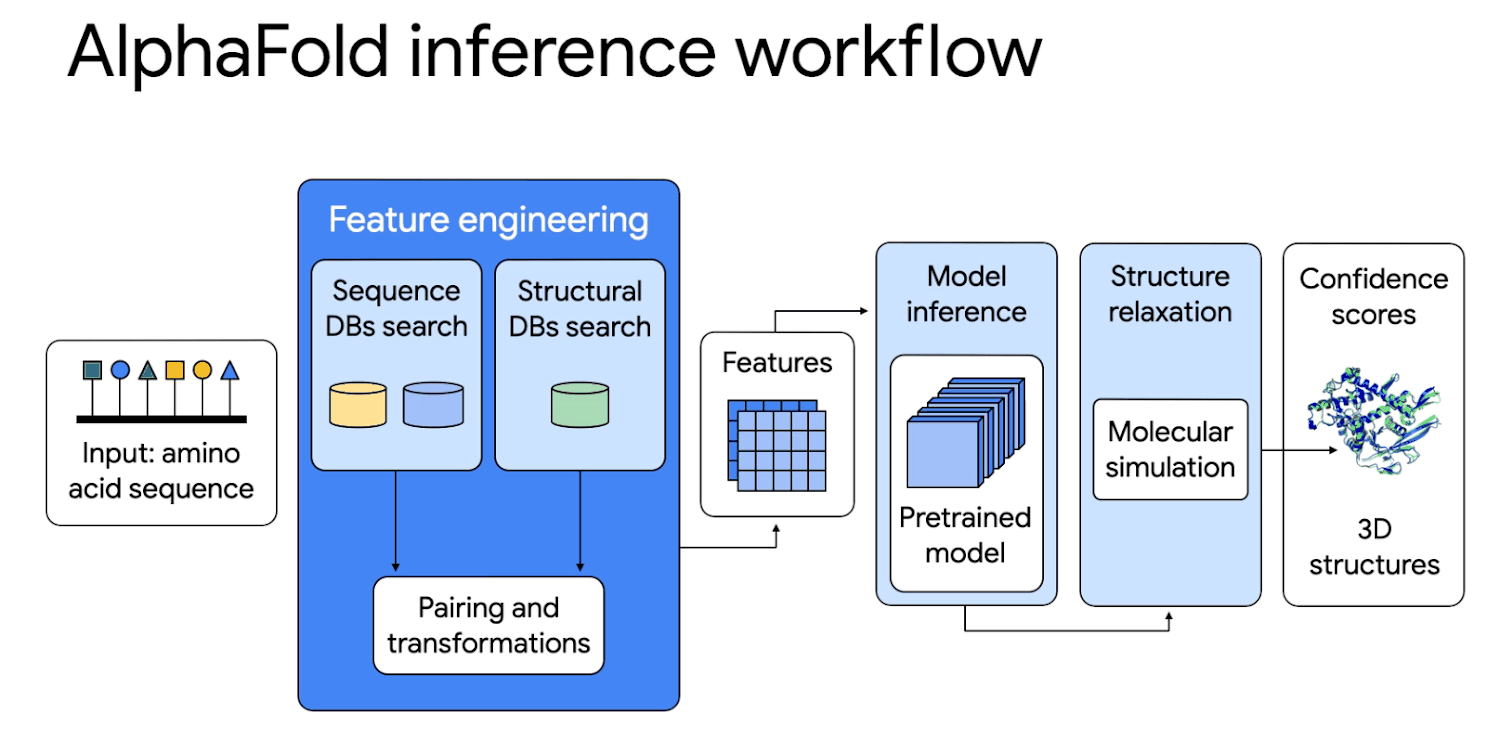
Proteins consist of chains of amino acids which spontaneously fold to form the three dimensional (3-D) structures of the proteins. The 3-D structure is necessary to understanding the biological function of the protein. Protein structures can be determined experimentally through techniques such as X-ray crystallography, cryo-electron microscopy and nuclear magnetic resonance (NMR), which are all expensive and time-consuming. Such efforts, using the experimental methods, have identified the structures of about 170,000 proteins over the last 60 years, while there are over 200 million known proteins across all life forms. Over the years, researchers have applied numerous computational methods to predict the 3D structures of proteins from their amino acid sequences, accuracy of such methods in best possible scenario is close to experimental techniques (NMR) by the use of homology modeling based on molecular evolution. CASP, which was launched in 1994 to challenge the scientific community to produce their best protein structure predictions, found that GDT scores of only about 40 out of 100 can be achieved for the most difficult proteins by 2016. AlphaFold started competing in the 2018 CASP using an artificial intelligence (AI) deep learning technique.
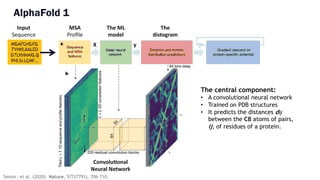
AlphaFold 1 (2018) was built on work developed by various teams in the 2010s, work that looked at the large databases of related protein sequences now available from many different organisms (most without known 3D structures), to try to find changes at different residues (peptides) that appeared to be correlated, even though the residues were not consecutive in the main chain. Such correlations suggest that the residues may be close to each other physically, even though not close in the sequence, allowing a contact map to be estimated. Building on recent work prior to 2018, AlphaFold 1 extended this by estimating a probability distribution for the distances between residues, effectively transforming the contact map into a distance map. It also used more advanced learning methods than previously to develop the inference. The code was not made publicly available, except to run on sequences of proteins in the 2018 CASP competition.
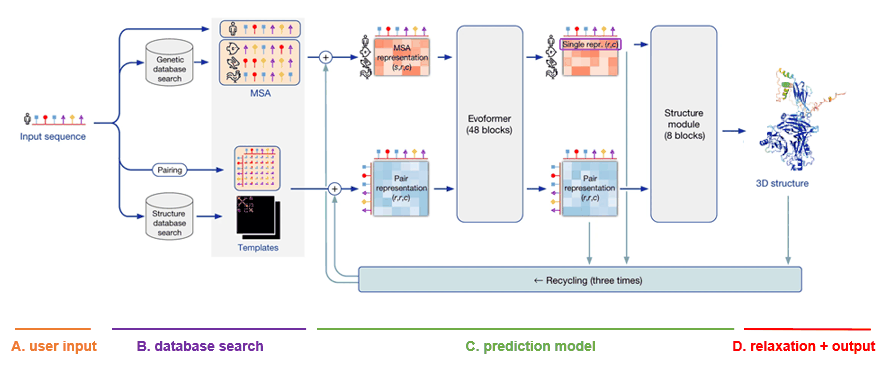
The 2020 version of the program (AlphaFold 2, 2020) is significantly different from the original version that won CASP 13 in 2018, according to the team at DeepMind. AlphaFold 1 used a number of separately trained modules to produce a guide potential, which was then combined with a physics-based energy potential. AlphaFold 2 replaced this with a system of interconnected sub-networks, forming a single, differentiable, end-to-end model based on pattern recognition. This model was trained in an integrated manner. After the neural network's prediction converges, a final refinement step applies local physical constraints using energy minimization based on the AMBER force field. This step only slightly adjusts the predicted structure. A key part of the 2020 system are two modules, believed to be based on a transformer design, which are used to progressively refine a vector of information for each relationship (or "edge" in graph-theory terminology) between an amino acid residue of the protein and another amino acid residue (these relationships are represented by the array shown in green); and between each amino acid position and each different sequences in the input sequence alignment (these relationships are represented by the array shown in red). Internally these refinement transformations contain layers that have the effect of bringing relevant data together and filtering out irrelevant data (the "attention mechanism") for these relationships, in a context-dependent way, learned from training data. These transformations are iterated, the updated information output by one step becoming the input of the next, with the sharpened residue/residue information feeding into the update of the residue/sequence information, and then the improved residue/sequence information feeding into the update of the residue/residue information. As the iteration progresses, according to one report, the "attention algorithm ... mimics the way a person might assemble a jigsaw puzzle: first connecting pieces in small clumps—in this case clusters of amino acids—and then searching for ways to join the clumps in a larger whole." The output of these iterations then informs the final structure prediction module, which also uses transformers, and is itself then iterated. In an example presented by DeepMind, the structure prediction module achieved a correct topology for the target protein on its first iteration, scored as having a GDT_TS of 78, but with a large number (90%) of stereochemical violations – i.e. unphysical bond angles or lengths. With subsequent iterations the number of stereochemical violations fell. By the third iteration the GDT_TS of the prediction was approaching 90, and by the eighth iteration the number of stereochemical violations was approaching zero. The training data was originally restricted to single peptide chains. However, the October 2021 update, named AlphaFold-Multimer, included protein complexes in its training data. DeepMind stated this update succeeded about 70% of the time at accurately predicting protein-protein interactions.
2. Related Work, Literature Survey & Algorithmic Foundations
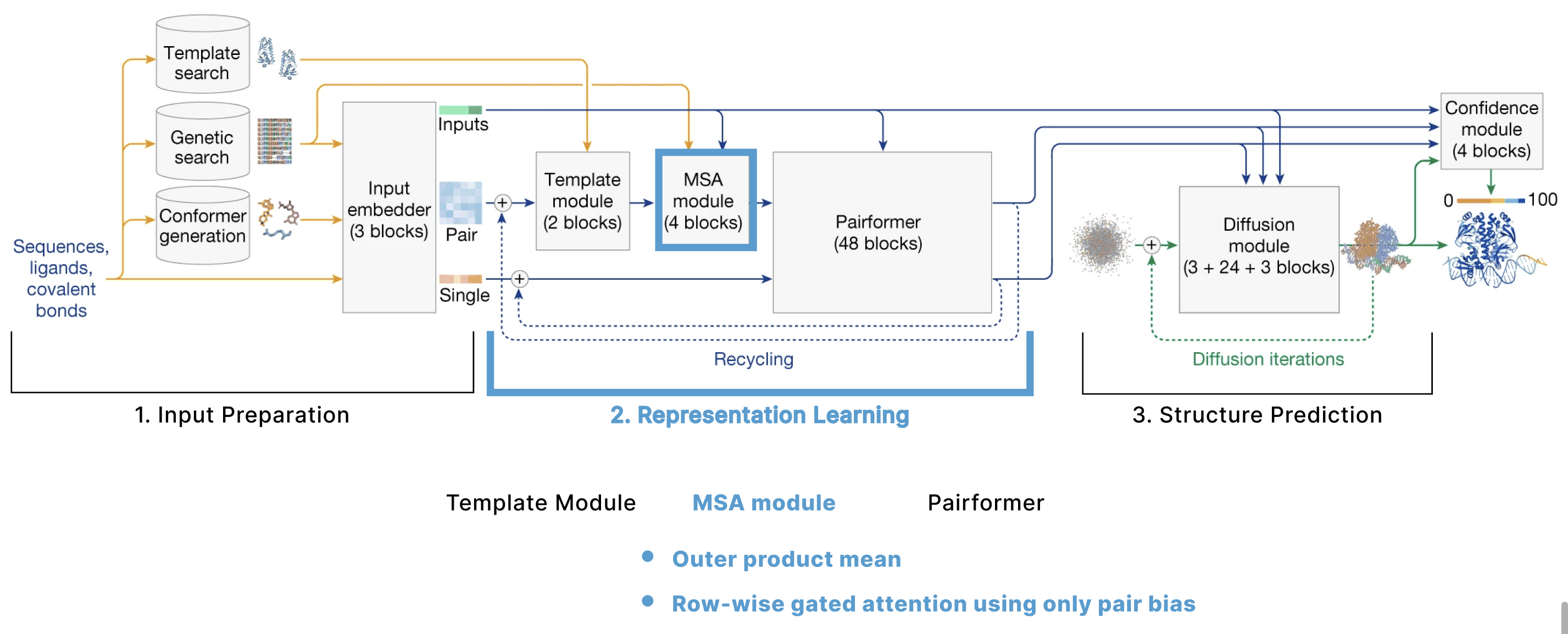
Announced on 8 May 2024, AlphaFold 3 was co-developed by Google DeepMind and Isomorphic Labs, both subsidiaries of Alphabet. AlphaFold 3 is not limited to proteins, as it can also predict the structures of protein complexes with DNA, RNA, post-translational modifications and selected ligands and ions. AlphaFold 3 introduces the "Pairformer," a deep learning architecture inspired by the transformer, which is considered similar to, but simpler than, the Evoformer used in AlphaFold 2. The Pairformer module's initial predictions are refined by a diffusion model. This model begins with a cloud of atoms and iteratively refines their positions, guided by the Pairformer's output, to generate a 3D representation of the molecular structure. The AlphaFold server was created to provide free access to AlphaFold 3 for non-commercial research. As of November 2025, the AlphaFold 3 research paper has been directly cited more than 9,000 times.
In 2023, Demis Hassabis and John Jumper won the Breakthrough Prize in Life Sciences as well as the Albert Lasker Award for Basic Medical Research for their management of the AlphaFold project. Hassabis and Jumper proceeded to win the Nobel Prize in Chemistry in 2024 for their work on "protein structure prediction" with David Baker of the University of Washington.
The AlphaFold Protein Structure Database (AFDB), a joint project between AlphaFold and EMBL-EBI, was launched on July 22, 2021. At launch, the database contained AlphaFold 1-predicted models for nearly the complete UniProt proteome of humans and 20 model organisms, totaling over 365,000 proteins. The database does not include proteins with fewer than 16 or more than 2700 amino acid residues, but for humans they are available in the whole batch file. AlphaFold's initial goal (as of early 2022) was to expand the database to cover most of the UniRef90 set, which contains over 100 million proteins. As of May 15, 2022, the database contained 992,316 predictions. In July 2021, UniProt-KB and InterPro has been updated to show AlphaFold predictions when available. On July 28, 2022, the team uploaded to the database the structures of around 200 million proteins from 1 million species, covering nearly every known protein on the planet. The number as of 2024 is 214 million, with 26 million being duplicates (exact sequence matches) of another protein in the database. The predicted structures can differ significantly between duplicates. As of 2026, the AFDB uses AlphaFold 2 for its predictions. The database previously contained only monomeric structures but in early 2026, AFDB added homo- and heterodimer predictions for some proteomes. Foldseek, which provides fast and accurate structure searches, is also integrated. Information from AlphaMissense (a tool that uses AlphaFold to predict the outcome of missense mutations) is also integrated.
AlphaFold has been used to predict structures of proteins of SARS-CoV-2, the causative agent of COVID-19. The structures of these proteins were pending experimental detection in early 2020. Results were reviewed by scientists at the Francis Crick Institute in the United Kingdom before being released to the broader research community. The team also confirmed accurate prediction against the experimentally determined SARS-CoV-2 spike protein that was shared in the Protein Data Bank, an international open-access database, before releasing the computationally determined structures of the under-studied protein molecules. The team acknowledged that although these protein structures might not be the subject of ongoing therapeutical research efforts, they will add to the community's understanding of the SARS-CoV-2 virus. Specifically, AlphaFold 2's prediction of the structure of the ORF3a protein was very similar to the structure determined by researchers at University of California, Berkeley using cryo-electron microscopy. This specific protein is believed to assist the virus in breaking out of the host cell once it replicates. This protein is also believed to play a role in triggering the inflammatory response to the infection.
3. Dataset Ingestion, Preprocessing & Stochastic Augmentations
Artificial intelligence (AI) is the capability of computational systems to perform tasks typically associated with human intelligence, such as learning, reasoning, problem-solving, perception, and decision-making. It is also a field of research spanning computer science, engineering, and mathematics that develops and studies methods and software enabling machines to perceive their environment and use learning and intelligence to take actions that maximise their chances of achieving defined goals. Prominent applications of AI include advanced web search engines, chatbots, virtual assistants, autonomous vehicles, play and analysis in strategy games (e.g., chess and Go), and content generation (e.g., text, images, audio, and videos). The traditional goals of AI research include learning, reasoning, knowledge representation, planning, natural language processing, and perception, as well as support for robotics. To reach these goals, AI researchers use techniques including state space search and mathematical optimisation, formal logic, artificial neural networks, and methods based on statistics, operations research, and economics. AI also draws upon psychology, linguistics, philosophy, neuroscience, and other fields. Some companies, such as OpenAI, Google DeepMind, and Meta, aim to create artificial general intelligence (AGI)—AI that can complete nearly any cognitive task at least as well as a human. Artificial intelligence was founded as an academic discipline in 1956. The field went through multiple cycles of optimism throughout its history, followed by periods of disappointment and loss of funding, known as AI winters. Funding and interest increased substantially after 2012, when graphics processing units (GPUs) started being used to accelerate neural networks, and deep learning outperformed previous AI techniques. This growth accelerated further after 2017 with the transformer architecture. The 2020s AI boom was spurred on largely by advances in generative AI, which can create and modify media. In addition to AI safety and unintended consequences and harms from the use of AI, ethical concerns, AI's long-term effects, environmental effects, and potential existential risks have prompted discussions of AI regulation.
AI programs use knowledge to answer questions intelligently and make deductions about real-world facts. Formal knowledge representation and knowledge engineering use symbols to represent words, concepts and things in the world. A knowledge base is a body of knowledge represented in a form that can be used by a program. An ontology is the set of objects, relations, concepts, and properties used by a particular domain of knowledge. Formal knowledge has been studied extensively since the 1970s and researchers have developed formalisms for a wide variety of difficult domains. The symbolic approach has difficulty with several problems: the breadth of commonsense knowledge (the set of atomic facts the average person knows is enormous), the sub-symbolic form of most commonsense knowledge (much of what people know is not represented as "facts" or "statements" they can express verbally), and knowledge acquisition (the problem of obtaining knowledge for AI applications). Large language models (and some other AI programs developed since 2012) do not require explicit, symbolic knowledge. They acquire knowledge by being trained on the combined text of millions of books and billions of websites. Modern AI can also learn about a domain by running experiments (as when AlphaZero learns game strategy by playing against itself). Machine learning solves the problems of general knowledge, commonsense knowledge and knowledge acquisition, however, this approach has struggled with accurate recall and valid reasoning.
Unsupervised learning analyses a stream of data, finds patterns, and makes predictions without any other guidance. Supervised learning requires labelling the training data with the expected answers, and comes in two main varieties: classification (where the program must learn to predict what category the input belongs in) and regression (where the program must deduce a numeric function based on numeric input). Reinforcement learning is when the agent is rewarded for good responses and punished for bad ones. The agent learns to choose responses that are classified as "good". Transfer learning is when the knowledge gained from one problem is applied to a new problem. Deep learning is a type of machine learning that runs inputs through biologically inspired artificial neural networks for all of these types of learning. Computational learning theory can assess learners by computational complexity, sample complexity (how much data is required), or other notions of optimisation.
Affective computing is a field that comprises systems that recognise, interpret, process, or simulate human affect (feeling, emotion, and mood). For example, some virtual assistants are programmed to speak conversationally or even banter humorously; it makes them appear more sensitive to the emotional dynamics of human interaction, or to otherwise facilitate human–computer interaction. However, this tends to give naïve users an unrealistic conception of the intelligence of existing computer agents. Moderate successes related to affective computing include textual sentiment analysis and, more recently, multimodal sentiment analysis, wherein AI classifies the effects displayed by a videotaped subject.
4. Neural Network Backbone, Layer Specifications & Loss Formulations
Local search uses mathematical optimisation to find a solution to a problem. It begins with some form of guess and refines it incrementally. Gradient descent is a type of local search that optimises a set of numerical parameters by incrementally adjusting them to minimise a loss function. Variants of gradient descent are commonly used to train neural networks, through the backpropagation algorithm. Another type of local search is evolutionary computation, which aims to iteratively improve a set of candidate solutions by "mutating" and "recombining" them, selecting only the fittest to survive each generation. Distributed search processes can coordinate via swarm intelligence algorithms. Two popular swarm algorithms used in search are particle swarm optimisation (inspired by bird flocking) and ant colony optimisation (inspired by ant trails).
Many problems in AI (including reasoning, planning, learning, perception, and robotics) require the agent to operate with incomplete or uncertain information. AI researchers have devised a number of tools to solve these problems using methods from probability theory and economics. Precise mathematical tools have been developed that analyse how an agent can make choices and plan, using decision theory, decision analysis, and information value theory. These tools include models such as Markov decision processes, dynamic decision networks, game theory, and mechanism design. Bayesian networks are a tool that can be used for reasoning (using the Bayesian inference algorithm), learning (using the expectation–maximisation algorithm), planning (using decision networks) and perception (using dynamic Bayesian networks). Probabilistic algorithms can also be used for filtering, prediction, smoothing, and finding explanations for streams of data, thus helping perception systems analyse processes that occur over time (e.g., hidden Markov models or Kalman filters).
An artificial neural network is based on a collection of nodes also known as artificial neurons, which loosely model the neurons in a biological brain. It is trained to recognise patterns; once trained, it can recognise those patterns in fresh data. There is an input, at least one hidden layer of nodes and an output. Each node applies a function and once the weight crosses its specified threshold, the data is transmitted to the next layer. A network is typically called a deep neural network if it has at least 2 hidden layers. Learning algorithms for neural networks use local search to choose the weights that will get the right output for each input during training. The most common training technique is the backpropagation algorithm. Neural networks learn to model complex relationships between inputs and outputs and find patterns in data. In theory, a neural network can learn any function. In feedforward neural networks the signal passes in only one direction. The term perceptron typically refers to a single-layer neural network. In contrast, deep learning uses many layers. Recurrent neural networks (RNNs) feed the output signal back into the input, which allows short-term memories of previous input events. Long short-term memory networks (LSTMs) are recurrent neural networks that better preserve long-term dependencies and are less sensitive to the vanishing gradient problem. Convolutional neural networks (CNNs) use layers of kernels to more efficiently process local patterns. This local processing is especially important in image processing, where the early CNN layers typically identify simple local patterns such as edges and curves, with subsequent layers detecting more complex patterns like textures, and eventually whole objects.
Deep learning uses several layers of neurons between the network's inputs and outputs. The multiple layers can progressively extract higher-level features from the raw input. For example, in image processing, lower layers may identify edges, while higher layers may identify the concepts relevant to a human such as digits, letters, or faces. Deep learning improves the performance of computer vision, speech recognition, natural language processing, image classification and many other applications.
5. Training Protocol, Convergence Behavior & Experimental Evaluation
In the late 2010s, graphics processing units (GPUs) that were increasingly designed with AI-specific enhancements and used with specialised TensorFlow software had replaced previously used central processing units (CPUs) as the dominant means for large-scale (commercial and academic) machine learning models' training. Specialised programming languages such as Prolog were used in early AI research, but general-purpose programming languages like Python have become predominant. The transistor density in integrated circuits has been observed to roughly double every 18 months—a trend known as Moore's law, named after the Intel co-founder Gordon Moore, who first identified it. Improvements in GPUs have been even faster, a trend sometimes called Huang's law, named after Nvidia co-founder and CEO Jensen Huang.
AI and machine learning technology is used in most of the essential applications of the 2020s, including:
search engines (such as Google Search) targeting online advertisements recommendation systems (offered by Netflix, YouTube or Amazon) driving internet traffic targeted advertising (AdSense, Facebook) virtual assistants (such as Siri or Alexa) autonomous vehicles (including drones, ADAS and self-driving cars) automatic language translation (Microsoft Translator, Google Translate) facial recognition (Apple's FaceID or Facebook's DeepFace and Google's FaceNet) image labelling (used by Facebook, Apple's Photos and TikTok).
AlphaFold 2 (2021) demonstrated the ability to approximate, in hours rather than months, the 3D structure of a protein. In 2023, it was reported that AI-guided drug discovery helped find a class of antibiotics capable of killing two different types of drug-resistant bacteria. In 2024, researchers used machine learning to accelerate the search for Parkinson's disease drug treatments. Their aim was to identify compounds that block the clumping, or aggregation, of alpha-synuclein (the protein that characterises Parkinson's disease). They were able to speed up the initial screening process ten-fold and reduce the cost by a thousand-fold. A 2026 Nature article titled "Dozens of AI disease-prediction models were trained on dubious data" highlighted the use of unreliable data being used to train AI medical prediction models for stroke and diabetes in 125 research articles. Evidence suggested some of the AI tools that were developed on unreliable data had been used on patients, although it was not clear if there were adverse outcomes.
Model Figures & Evaluation Curves (4 Images)
Deep Learning Execution Pipeline
(Preprocessing)
(Feature Extraction)
(Self-Attention)
(Loss Optimization)