Complete Technical Paper Content — Feature Engineering Projects
1. Executive Abstract, Problem Formulation & Background
The following outline is provided as an overview of, and topical guide to, machine learning: Machine learning (ML) is a subfield of artificial intelligence within computer science that evolved from the study of pattern recognition and computational learning theory. In 1959, Arthur Samuel defined machine learning as a "field of study that gives computers the ability to learn without being explicitly programmed". ML involves the study and construction of algorithms that can learn from and make predictions on data. These algorithms operate by building a model from a training set of example observations to make data-driven predictions or decisions expressed as outputs, rather than following strictly static program instructions.
Canonical correlation analysis (CCA) Factor analysis Feature extraction Feature selection Independent component analysis (ICA) Linear discriminant analysis (LDA) Multidimensional scaling (MDS) Non-negative matrix factorization (NMF) Partial least squares regression (PLSR) Principal component analysis (PCA) Principal component regression (PCR) Projection pursuit Sammon mapping t-distributed stochastic neighbor embedding (t-SNE)
AdaBoost Boosting Bootstrap aggregating (also "bagging" or "bootstrapping") Ensemble averaging Gradient boosted decision tree (GBDT) Gradient boosting Random Forest Stacked Generalization
Q-learning State–action–reward–state–action (SARSA) Temporal difference learning (TD) Learning Automata
Averaged one-dependence estimators (AODE) Artificial neural network Case-based reasoning Gaussian process regression Gene expression programming Group method of data handling (GMDH) Inductive logic programming Instance-based learning Lazy learning Learning Automata Learning Vector Quantization Logistic Model Tree Minimum message length (decision trees, decision graphs, etc.) Nearest Neighbor Algorithm Analogical modeling Probably approximately correct learning (PAC) learning Ripple down rules, a knowledge acquisition methodology Symbolic machine learning algorithms Support vector machines Random Forests Ensembles of classifiers Bootstrap aggregating (bagging) Boosting (meta-algorithm) Ordinal classification Conditional Random Field ANOVA Quadratic classifiers k-nearest neighbor Boosting SPRINT Bayesian networks Naive Bayes Hidden Markov models Hierarchical hidden Markov model
Bayesian knowledge base Naive Bayes Gaussian Naive Bayes Multinomial Naive Bayes Averaged One-Dependence Estimators (AODE) Bayesian Belief Network (BBN) Bayesian Network (BN)
Decision tree Classification and regression tree (CART) Iterative Dichotomiser 3 (ID3) C4.5 algorithm C5.0 algorithm Chi-squared Automatic Interaction Detection (CHAID) Decision stump Conditional decision tree ID3 algorithm Random forest SLIQ
Fisher's linear discriminant Linear regression Logistic regression Multinomial logistic regression Naive Bayes classifier Perceptron Support vector machine
Expectation-maximization algorithm Vector Quantization Generative topographic map Information bottleneck method Association rule learning algorithms Apriori algorithm Eclat algorithm
Feedforward neural network Extreme learning machine Convolutional neural network Recurrent neural network Long short-term memory (LSTM) Logic learning machine Self-organizing map
BIRCH DBSCAN Expectation–maximization (EM) Fuzzy clustering Hierarchical clustering k-means clustering k-medians Mean-shift OPTICS algorithm
2. Related Work, Literature Survey & Algorithmic Foundations
Active learning Generative models Low-density separation Graph-based methods Co-training Transduction
Deep belief networks Deep Boltzmann machines Deep Convolutional neural networks Deep Recurrent neural networks Hierarchical temporal memory Generative Adversarial Network Style transfer Transformer Stacked Auto-Encoders
Data Science: Data to Insights from MIT (machine learning) Popular online course by Andrew Ng, at Coursera. It uses GNU Octave. The course is a free version of Stanford University's actual course taught by Ng, see.stanford.edu/Course/CS229 available for free]. mloss is an academic database of open-source machine learning software.
In machine learning (ML), boosting is an ensemble learning method that combines a set of less accurate models (called "weak learners") to create a single, highly accurate model (a "strong learner"). Unlike other ensemble methods that build models in parallel (such as bagging), boosting algorithms build models sequentially. Each new model in the sequence is trained to correct the errors made by its predecessors. This iterative process allows the overall model to improve its accuracy, particularly by reducing bias. Boosting is a popular and effective technique used in supervised learning for both classification and regression tasks. The theoretical foundation for boosting came from a question posed by Kearns and Valiant (1988, 1989): "Can a set of weak learners create a single strong learner?" A weak learner is defined as a classifier that performs only slightly better than random guessing, whereas a strong learner is a classifier that is highly correlated with the true classification. Robert Schapire's affirmative answer to this question in a 1990 paper led to the development of practical boosting algorithms. The first such algorithm was developed by Schapire, with Freund and Schapire later developing AdaBoost, which remains a foundational example of boosting.
There are many boosting algorithms. The original ones, proposed by Robert Schapire (a recursive majority gate formulation), and Yoav Freund (boost by majority), were not adaptive and could not take full advantage of the weak learners. Schapire and Freund then developed AdaBoost, an adaptive boosting algorithm that won the prestigious Gödel Prize. Only algorithms that are provable boosting algorithms in the probably approximately correct learning formulation can accurately be called boosting algorithms. Other algorithms that are similar in spirit to boosting algorithms are sometimes called "leveraging algorithms", although they are also sometimes incorrectly called boosting algorithms. The main variation between many boosting algorithms is their method of weighting training data points and hypotheses. AdaBoost is very popular and the most significant historically as it was the first algorithm that could adapt to the weak learners. It is often the basis of introductory coverage of boosting in university machine learning courses. There are many more recent algorithms such as LPBoost, TotalBoost, BrownBoost, xgboost, MadaBoost, LogitBoost, CatBoost and others. Many boosting algorithms fit into the AnyBoost framework, which shows that boosting performs gradient descent in a function space using a convex cost function.
Given images containing various known objects in the world, a classifier can be learned from them to automatically classify the objects in future images. Simple classifiers built based on some image feature of the object tend to be weak in categorization performance. Using boosting methods for object categorization is a way to unify the weak classifiers in a special way to boost the overall ability of categorization.
Form a large set of simple features Initialize weights for training images For T rounds Normalize the weights For available features from the set, train a classifier using a single feature and evaluate the training error Choose the classifier with the lowest error Update the weights of the training images: increase if classified wrongly by this classifier, decrease if correctly Form the final strong classifier as the linear combination of the T classifiers (coefficient larger if training error is small) After boosting, a classifier constructed from 200 features could yield a 95% detection rate under a 10 − 5 {\displaystyle 10^{-5}} false positive rate. Another application of boosting for binary categorization is a system that detects pedestrians using patterns of motion and appearance. This work is the first to combine both motion information and appearance information as features to detect a walking person. It takes a similar approach to the Viola-Jones object detection framework.
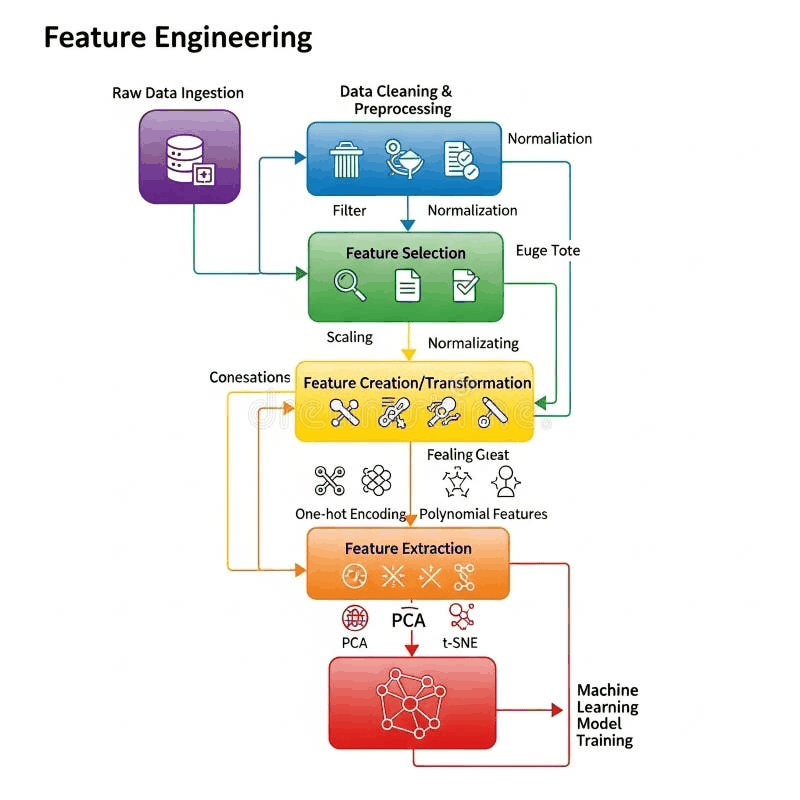
Feature engineering is the process of creating, selecting, and transforming input features to improve the performance of machine learning models. It includes techniques such as feature extraction, feature selection, encoding categorical variables, scaling numerical features, and generating new features from existing data. Effective feature engineering helps models capture meaningful patterns, improve predictive accuracy, and generalize better to unseen data.
microsoft / nni Star 14.4k An open source AutoML toolkit for automate machine learning lifecycle, including feature engineering, neural architecture search, model compression and hyper-parameter tuning. python data-science machine-learning deep-learning neural-network tensorflow machine-learning-algorithms pytorch distributed hyperparameter-optimization feature-engineering nas bayesian-optimization hyperparameter-tuning automl automated-machine-learning model-compression neural-architecture-search deep-neural-network mlops Updated Jul 3, 2024 Python
An open source AutoML toolkit for automate machine learning lifecycle, including feature engineering, neural architecture search, model compression and hyper-parameter tuning.
EpistasisLab / tpot Star 10.1k A Python Automated Machine Learning tool that optimizes machine learning pipelines using genetic programming. python data-science machine-learning automation random-forest scikit-learn aiml model-selection hyperparameter-optimization feature-engineering automl gradient-boosting automated-machine-learning parameter-tuning alzheimer alzheimers nia adsp ag066833 u01ag066833 Updated Sep 11, 2025 Jupyter Notebook
3. Dataset Ingestion, Preprocessing & Stochastic Augmentations
A Python Automated Machine Learning tool that optimizes machine learning pipelines using genetic programming.
alteryx / featuretools Star 7.7k An open source python library for automated feature engineering python data-science machine-learning scikit-learn feature-engineering automl automated-machine-learning automated-feature-engineering Updated Sep 11, 2026 Python
alibaba / Alink Star 3.6k Alink is the Machine Learning algorithm platform based on Flink, developed by the PAI team of Alibaba computing platform. machine-learning data-mining statistics kafka graph-algorithms clustering word2vec regression xgboost classification recommender recommender-system apriori feature-engineering flink fm flink-ml graph-embedding flink-machine-learning Updated Jun 7, 2024 Java
Alink is the Machine Learning algorithm platform based on Flink, developed by the PAI team of Alibaba computing platform.
mljar / mljar-supervised Star 3.3k Python package for AutoML on Tabular Data with Feature Engineering, Hyper-Parameters Tuning, Explanations and Automatic Documentation data-science machine-learning neural-network random-forest scikit-learn xgboost hyperparameter-optimization lightgbm ensemble feature-engineering decision-tree hyper-parameters automl automated-machine-learning catboost mljar automl-api automl-python Updated Oct 29, 2026 Python
Python package for AutoML on Tabular Data with Feature Engineering, Hyper-Parameters Tuning, Explanations and Automatic Documentation
Visualize-ML / Book6_First-Course-in-Data-Science Sponsor Star 2.8k Book_6_《数据有道》 | 鸢尾花书:从加减乘除到机器学习;欢迎大家批评指正!纠错多的同学会得到赠书感谢! python data-science data machine-learning data-visualization feature-engineering Updated May 1, 2026 Jupyter Notebook
apache / hamilton Star 2.6k Apache Hamilton helps data scientists and engineers define testable, modular, self-documenting dataflows, that encode lineage/tracing and metadata. Runs and scales everywhere python does. python data-science machine-learning etl pandas orchestration data-engineering data-analysis software-engineering feature-engineering dataframe hacktoberfest dag lineage etl-framework etl-pipeline rag mlops llmops Updated Oct 27, 2026 Jupyter Notebook
Apache Hamilton helps data scientists and engineers define testable, modular, self-documenting dataflows, that encode lineage/tracing and metadata. Runs and scales everywhere python does.
apachecn / fe4ml-zh Star 2.6k 📖 [译] 面向机器学习的特征工程 python machine-learning book feature-engineering Updated Aug 25, 2023 JavaScript
metarank / metarank Star 2.5k A low code Machine Learning personalized ranking service for articles, listings, search results, recommendations that boosts user engagement. A friendly Learn-to-Rank engine search kubernetes data-science machine-learning scala deep-learning personalization data-engineering feature-extraction ranking neural-networks feature-engineering automl Updated Oct 6, 2026 Scala
4. Neural Network Backbone, Layer Specifications & Loss Formulations
A low code Machine Learning personalized ranking service for articles, listings, search results, recommendations that boosts user engagement. A friendly Learn-to-Rank engine
rorysroes / SGX-Full-OrderBook-Tick-Data-Trading-Strategy Star 2.4k Providing the solutions for high-frequency trading (HFT) strategies using data science approaches (Machine Learning) on Full Orderbook Tick Data. python machine-learning trading feature-selection model-selection quant trading-strategies investment market-maker feature-engineering algorithmic-trading backtesting-trading-strategies limit-order-book quantitative-trading orderbook market-microstructure high-frequency-trading market-making orderbook-tick-data Updated Aug 27, 2022 Jupyter Notebook
Providing the solutions for high-frequency trading (HFT) strategies using data science approaches (Machine Learning) on Full Orderbook Tick Data.
feature-engine / feature_engine Star 2.3k Feature engineering and selection open-source Python library compatible with sklearn. python data-science machine-learning scikit-learn feature-selection feature-extraction feature-engineering Updated Sep 19, 2026 Python
salesforce / TransmogrifAI Star 2.3k TransmogrifAI (pronounced trăns-mŏgˈrə-fī) is an AutoML library for building modular, reusable, strongly typed machine learning workflows on Apache Spark with minimal hand-tuning machine-learning scala ai spark dsl transformations ml transformers estimators sparkml pipelines salesforce structured-data feature-engineering features einstein automl automated-machine-learning transmogrification transmogrify Updated Jun 2, 2026 Scala
TransmogrifAI (pronounced trăns-mŏgˈrə-fī) is an AutoML library for building modular, reusable, strongly typed machine learning workflows on Apache Spark with minimal hand-tuning
featureform / featureform Star 2k The Virtual Feature Store. Turn your existing data infrastructure into a feature store. python data-science machine-learning ml embeddings feature-engineering hacktoberfest data-quality mlops feature-store vector-database embeddings-similarity Updated Jul 3, 2025 Go
The Virtual Feature Store. Turn your existing data infrastructure into a feature store.
feathr-ai / feathr Star 1.9k Feathr – A scalable, unified data and AI engineering platform for enterprise data-science machine-learning apache-spark azure artificial-intelligence data-engineering feature-engineering data-quality mlops feature-store feature-management feature-marketplace feature-governance feature-metadata feature-platform Updated Apr 4, 2024 Scala
asavinov / intelligent-trading-bot Star 1.9k Intelligent Trading Bot: Automatically generating signals and trading based on machine learning and feature engineering machine-learning crypto bitcoin trading artificial-intelligence cryptocurrency feature-engineering algorithmic-trading crypto-trading trading-bots Updated Aug 30, 2026 Python
Intelligent Trading Bot: Automatically generating signals and trading based on machine learning and feature engineering
5. Training Protocol, Convergence Behavior & Experimental Evaluation
LastAncientOne / Deep_Learning_Machine_Learning_Stock Star 1.8k Deep Learning and Machine Learning stocks represent promising opportunities for both long-term and short-term investors and traders. data-science machine-learning deep-learning neural-network trading algorithms prediction feature-selection feature-extraction stock-market stock-price-prediction technical-analysis stock-data feature-engineering stock-prices stock-prediction stock-analysis financial-engineering stock-trading features-extraction Updated Mar 1, 2024 Jupyter Notebook
Deep Learning and Machine Learning stocks represent promising opportunities for both long-term and short-term investors and traders.
4paradigm / OpenMLDB Star 1.7k OpenMLDB is an open-source machine learning database that provides a feature platform computing consistent features for training and inference. machine-learning feature-extraction feature-engineering in-memory-database mlops feature-store featurestore database-for-machine-learning machine-learning-database database-for-ai featureops Updated Oct 23, 2026 C++
OpenMLDB is an open-source machine learning database that provides a feature platform computing consistent features for training and inference.
Yimeng-Zhang / feature-engineering-and-feature-selection Star 1.7k A Guide for Feature Engineering and Feature Selection, with implementations and examples in Python. python machine-learning data-mining feature-selection feature-extraction feature-engineering Updated Sep 24, 2022 Jupyter Notebook
A Guide for Feature Engineering and Feature Selection, with implementations and examples in Python.
ClimbsRocks / auto_ml Star 1.7k [UNMAINTAINED] Automated machine learning for analytics & production python data-science machine-learning deep-learning analytics tensorflow scikit-learn keras artificial-intelligence xgboost hyperparameter-optimization lightgbm machine-learning-library deeplearning production-ready feature-engineering machine-learning-pipelines automl gradient-boosting automated-machine-learning Updated Feb 10, 2021 Python
winedarksea / AutoTS Star 1.4k Automated Time Series Forecasting machine-learning deep-learning time-series forecasting preprocessing feature-engineering automl autots Updated Oct 28, 2026 Python
Automatic feature engineering using deep learning and Bayesian inference We will explore the use of autoencoders for automatic feature engineering. The idea is to automatically learn a set of features from a large unlabelled dataset that can then be useful in a supervised learning task where perhaps the number of labels are few. Python environment pip3 install -r requirements.txt
We will explore the use of autoencoders for automatic feature engineering. The idea is to automatically learn a set of features from a large unlabelled dataset that can then be useful in a supervised learning task where perhaps the number of labels are few.
Automatic feature engineering using deep learning and Bayesian inference using PyTorch.
Model Figures & Evaluation Curves (4 Images)
Deep Learning Execution Pipeline
(Preprocessing)
(Feature Extraction)
(Self-Attention)
(Loss Optimization)