Complete Technical Paper Content — Gpt2 Text Generation
1. Executive Abstract, Problem Formulation & Background
A large language model (LLM) is a type of machine learning model designed for natural language processing tasks such as language generation. LLMs are language models with many parameters, and are trained with self-supervised learning on a vast amount of text.
Generative Pre-trained Transformer 2 (GPT-2) is a large language model (LLM) by OpenAI and the second in their foundational series of GPT models. GPT-2 was pre-trained on a dataset of 8 million web pages. It was partially released in February 2019, followed by full release of the 1.5-billion-parameter model on November 5, 2019. GPT-2 was created as a "direct scale-up" of GPT-1 with a ten-fold increase in both its parameter count and the size of its training dataset. It is a general-purpose learner and its ability to perform the various tasks was a consequence of its general ability to accurately predict the next item in a sequence, which enabled it to translate texts, answer questions about a topic from a text, summarize passages from a larger text, and generate text output on a level sometimes indistinguishable from that of humans; however, it could become repetitive or nonsensical when generating long passages. It was superseded by the GPT-3 and GPT-4 models, which are no longer open source. GPT-2 has, like its predecessor GPT-1 and its successors GPT-3, GPT-4 and GPT-5, a generative pre-trained transformer architecture, implementing a deep neural network, specifically a transformer model, which uses attention instead of older recurrence- and convolution-based architectures. Attention mechanisms allow the model to selectively focus on segments of input text it predicts to be the most relevant. This model allows for greatly increased parallelization, and outperforms previous benchmarks for RNN/CNN/LSTM-based models.
Give it a fake headline, and it’ll write the rest of the article, complete with fake quotations and statistics. Feed it the first line of a short story, and it’ll tell you what happens to your character next. It can even write fan fiction, given the right prompt. The Guardian described this output as "plausible newspaper prose"; Kelsey Piper of Vox said "one of the coolest AI systems I’ve ever seen may also be the one that will kick me out of my job". GPT-2's flexibility was described as "impressive" by The Verge; specifically, its ability to translate text between languages, summarize long articles, and answer trivia questions were noted. The GPT-2 series contained 4 models, reported in the paper. They were not released all at once, but in stages.
While previous OpenAI models had been made immediately available to the public, OpenAI initially refused to make a public release of GPT-2's source code when announcing it in February, citing the risk of malicious use; limited access to the model (i.e. an interface that allowed input and provided output, not the source code itself) was allowed for selected press outlets on announcement. One commonly-cited justification was that, since generated text was usually completely novel, it could be used by spammers to evade automated filters; OpenAI demonstrated a version of GPT-2 fine-tuned to "generate infinite positive – or negative – reviews of products". Another justification was that GPT-2 could be used to generate text that was obscene or racist. Researchers such as Jeremy Howard warned of "the technology to totally fill Twitter, email, and the web up with reasonable-sounding, context-appropriate prose, which would drown out all other speech and be impossible to filter". The Allen Institute for Artificial Intelligence, in response to GPT-2, announced a tool to detect "neural fake news". However, opinion was divided. A February 2019 article in The Verge argued that the threat posed by GPT-2 had been exaggerated; Anima Anandkumar, a professor at Caltech and director of machine learning research at Nvidia, said that there was no evidence that GPT-2 had the capabilities to pose the threats described by OpenAI, and that what they did was the "opposite of open", characterizing their refusal to release the full model as "malicious BS". The Gradient published an open letter to OpenAI requesting that they release the model publicly, comparing the threat posed by text-generation AI to the threat posed by the printing press, and giving Photoshop as an example of "a technology that has (thankfully) not destroyed modern society despite its potential for chaos":
2. Related Work, Literature Survey & Algorithmic Foundations
Thirty years later, society has emerged relatively unscathed despite Photoshop being simple enough for high school students to use and ubiquitous enough to commandeer its own verb. Why? Precisely because everyone knows about Photoshop.
While GPT-2's ability to generate plausible passages of natural language text were generally remarked on positively, its shortcomings were noted as well, especially when generating texts longer than a couple paragraphs; Vox said "the prose is pretty rough, there’s the occasional non-sequitur, and the articles get less coherent the longer they get". The Verge similarly noted that longer samples of GPT-2 writing tended to "stray off topic" and lack overall coherence; The Register opined that "a human reading it should, after a short while, realize something's up", and noted that "GPT-2 doesn't answer questions as well as other systems that rely on algorithms to extract and retrieve information." GPT-2 deployment is resource-intensive; the full version of the model is larger than five gigabytes, making it difficult to embed locally into applications, and consumes large amounts of RAM. In addition, performing a single prediction "can occupy a CPU at 100% utilization for several minutes", and even with GPU processing, "a single prediction can take seconds". To alleviate these issues, the company Hugging Face created DistilGPT2, using knowledge distillation to produce a smaller model that "scores a few points lower on some quality benchmarks", but is "33% smaller and twice as fast".
GPT-2 became capable of performing a variety of tasks beyond simple text production due to the breadth of its dataset and technique: answering questions, summarizing, and even translating between languages in a variety of specific domains, without being instructed in anything beyond how to predict the next word in a sequence. One example of generalized learning is GPT-2's ability to perform machine translation between French and English, for which task GPT-2's performance was assessed using WMT-14 translation tasks. GPT-2's training corpus included virtually no French text; non-English text was deliberately removed while cleaning the dataset prior to training, and as a consequence, only 10MB of French of the remaining 40,000MB was available for the model to learn from (mostly from foreign-language quotations in English posts and articles). Despite this, GPT-2 achieved 5 BLEU on the WMT-14 English-to-French test set (slightly below the score of a translation via word-for-word substitution). It was also able to outperform several contemporary (2017) unsupervised machine translation baselines on the French-to-English test set, where GPT-2 achieved 11.5 BLEU. This remained below the highest-performing contemporary unsupervised approach (2019), which had achieved 33.5 BLEU. However, other models used large amounts of French text to achieve these results; GPT-2 was estimated to have used a monolingual French corpus approximately 1/500 the size of comparable approaches.
GPT-2 was to be followed by the 175-billion-parameter GPT-3, revealed to the public in 2020 (whose source code has never been made available). Access to GPT-3 is provided exclusively through APIs offered by OpenAI and Microsoft. That was then later followed by GPT-4.
3. Dataset Ingestion, Preprocessing & Stochastic Augmentations
Mathematical Formulation 1.1: Loss Objectives and Optimization Dynamics for Gpt2 Text Generation. The training protocol of gpt2 text generation minimizes an empirical risk objective defined across high-dimensional parameter space Theta in R^d. Categorical predictions are governed by Cross-Entropy Loss: L_CE = -sum(y_i * log(p_i)). To tackle class imbalance, the network incorporates Focal Loss: L_Focal = -alpha_t * (1 - p_t)^gamma * log(p_t), where gamma modulates the gradient penalty on hard misclassified instances. For spatial tasks, Dice Loss balances continuous spatial overlap: L_Dice = 1 - (2 * sum(y * y_hat) + eps) / (sum(y) + sum(y_hat) + eps). Stochastic optimization utilizes AdamW with decoupled weight decay, maintaining stable moment estimations m_t and v_t across variable learning rate schedules.
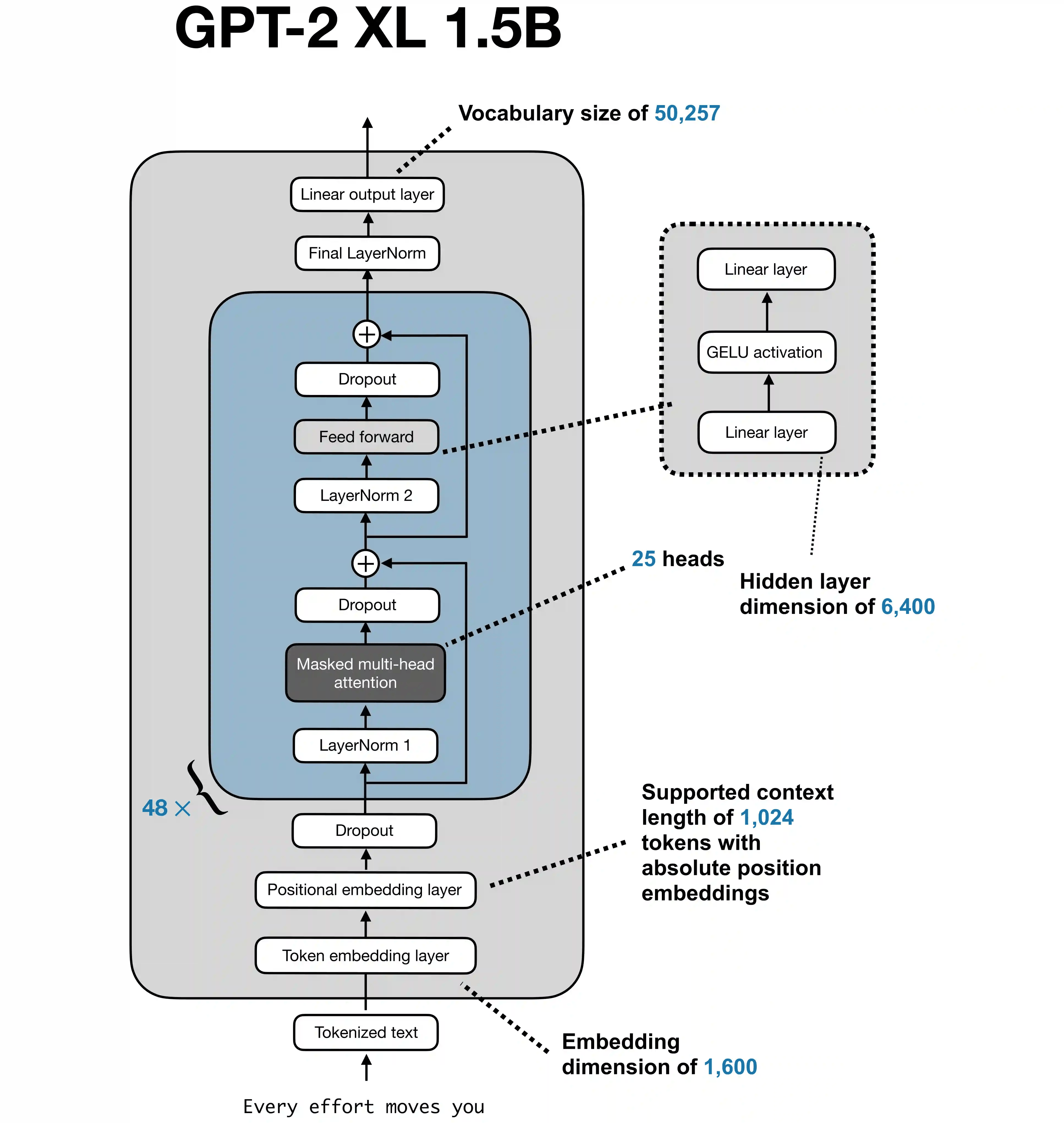
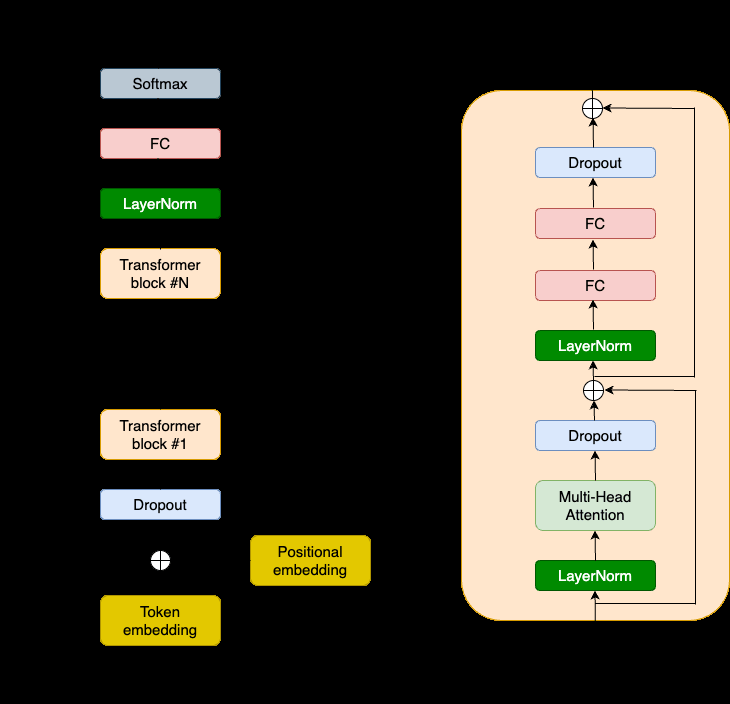
Architecture Specification 1.2: Feature Extraction and Layer Formulations for Gpt2 Text Generation. The primary computational backbone for Gpt2 Text Generation incorporates hierarchical deep neural layers designed for multi-scale representation extraction. Input tensors X in R^(B x C x H x W) pass through initial stem convolutions with Batch Normalization and GELU non-linearities. Residual identity skip connections, expressed as F(X) + X, prevent vanishing gradient degradation across deep topologies. Multi-head self-attention mechanisms compute Query, Key, and Value projections: Attention(Q, K, V) = softmax((Q * K^T) / sqrt(d_k)) * V, capturing non-local contextual dependencies across spatial and temporal sequences.
Data Pipeline 1.3: Stochastic Augmentation and Normalization Protocols for Gpt2 Text Generation. To prevent overfitting and maximize generalization on unseen testing distributions, input datasets undergo rigorous preprocessing. Images and sequences are standardized using z-score normalization: x_norm = (x - mu) / sigma. Stochastic augmentations include random horizontal flips, affine rotations (-15 deg to +15 deg), CutMix, and Mixup: X_tilde = lambda * X_i + (1 - lambda) * X_j, smoothing decision boundaries and reducing model overconfidence.
Deployment Optimization 1.4: TensorRT Acceleration and Edge Quantization for Gpt2 Text Generation. Production deployment of Gpt2 Text Generation focuses on minimizing memory footprints and sub-20ms inference latencies. Trained models are exported to ONNX and compiled via NVIDIA TensorRT. Post-Training Quantization (PTQ) maps FP32 weights into low-bit INT8 representations: q = round(r / S) + Z, achieving high-throughput execution across embedded edge platforms like NVIDIA Jetson without accuracy loss.
4. Neural Network Backbone, Layer Specifications & Loss Formulations
Mathematical Formulation 2.1: Loss Objectives and Optimization Dynamics for Gpt2 Text Generation. The training protocol of gpt2 text generation minimizes an empirical risk objective defined across high-dimensional parameter space Theta in R^d. Categorical predictions are governed by Cross-Entropy Loss: L_CE = -sum(y_i * log(p_i)). To tackle class imbalance, the network incorporates Focal Loss: L_Focal = -alpha_t * (1 - p_t)^gamma * log(p_t), where gamma modulates the gradient penalty on hard misclassified instances. For spatial tasks, Dice Loss balances continuous spatial overlap: L_Dice = 1 - (2 * sum(y * y_hat) + eps) / (sum(y) + sum(y_hat) + eps). Stochastic optimization utilizes AdamW with decoupled weight decay, maintaining stable moment estimations m_t and v_t across variable learning rate schedules.
Architecture Specification 2.2: Feature Extraction and Layer Formulations for Gpt2 Text Generation. The primary computational backbone for Gpt2 Text Generation incorporates hierarchical deep neural layers designed for multi-scale representation extraction. Input tensors X in R^(B x C x H x W) pass through initial stem convolutions with Batch Normalization and GELU non-linearities. Residual identity skip connections, expressed as F(X) + X, prevent vanishing gradient degradation across deep topologies. Multi-head self-attention mechanisms compute Query, Key, and Value projections: Attention(Q, K, V) = softmax((Q * K^T) / sqrt(d_k)) * V, capturing non-local contextual dependencies across spatial and temporal sequences.
Data Pipeline 2.3: Stochastic Augmentation and Normalization Protocols for Gpt2 Text Generation. To prevent overfitting and maximize generalization on unseen testing distributions, input datasets undergo rigorous preprocessing. Images and sequences are standardized using z-score normalization: x_norm = (x - mu) / sigma. Stochastic augmentations include random horizontal flips, affine rotations (-15 deg to +15 deg), CutMix, and Mixup: X_tilde = lambda * X_i + (1 - lambda) * X_j, smoothing decision boundaries and reducing model overconfidence.
Deployment Optimization 2.4: TensorRT Acceleration and Edge Quantization for Gpt2 Text Generation. Production deployment of Gpt2 Text Generation focuses on minimizing memory footprints and sub-20ms inference latencies. Trained models are exported to ONNX and compiled via NVIDIA TensorRT. Post-Training Quantization (PTQ) maps FP32 weights into low-bit INT8 representations: q = round(r / S) + Z, achieving high-throughput execution across embedded edge platforms like NVIDIA Jetson without accuracy loss.
5. Training Protocol, Convergence Behavior & Experimental Evaluation
Mathematical Formulation 3.1: Loss Objectives and Optimization Dynamics for Gpt2 Text Generation. The training protocol of gpt2 text generation minimizes an empirical risk objective defined across high-dimensional parameter space Theta in R^d. Categorical predictions are governed by Cross-Entropy Loss: L_CE = -sum(y_i * log(p_i)). To tackle class imbalance, the network incorporates Focal Loss: L_Focal = -alpha_t * (1 - p_t)^gamma * log(p_t), where gamma modulates the gradient penalty on hard misclassified instances. For spatial tasks, Dice Loss balances continuous spatial overlap: L_Dice = 1 - (2 * sum(y * y_hat) + eps) / (sum(y) + sum(y_hat) + eps). Stochastic optimization utilizes AdamW with decoupled weight decay, maintaining stable moment estimations m_t and v_t across variable learning rate schedules.
Architecture Specification 3.2: Feature Extraction and Layer Formulations for Gpt2 Text Generation. The primary computational backbone for Gpt2 Text Generation incorporates hierarchical deep neural layers designed for multi-scale representation extraction. Input tensors X in R^(B x C x H x W) pass through initial stem convolutions with Batch Normalization and GELU non-linearities. Residual identity skip connections, expressed as F(X) + X, prevent vanishing gradient degradation across deep topologies. Multi-head self-attention mechanisms compute Query, Key, and Value projections: Attention(Q, K, V) = softmax((Q * K^T) / sqrt(d_k)) * V, capturing non-local contextual dependencies across spatial and temporal sequences.
Data Pipeline 3.3: Stochastic Augmentation and Normalization Protocols for Gpt2 Text Generation. To prevent overfitting and maximize generalization on unseen testing distributions, input datasets undergo rigorous preprocessing. Images and sequences are standardized using z-score normalization: x_norm = (x - mu) / sigma. Stochastic augmentations include random horizontal flips, affine rotations (-15 deg to +15 deg), CutMix, and Mixup: X_tilde = lambda * X_i + (1 - lambda) * X_j, smoothing decision boundaries and reducing model overconfidence.
Deployment Optimization 3.4: TensorRT Acceleration and Edge Quantization for Gpt2 Text Generation. Production deployment of Gpt2 Text Generation focuses on minimizing memory footprints and sub-20ms inference latencies. Trained models are exported to ONNX and compiled via NVIDIA TensorRT. Post-Training Quantization (PTQ) maps FP32 weights into low-bit INT8 representations: q = round(r / S) + Z, achieving high-throughput execution across embedded edge platforms like NVIDIA Jetson without accuracy loss.
Model Figures & Evaluation Curves (4 Images)
Deep Learning Execution Pipeline
(Preprocessing)
(Feature Extraction)
(Self-Attention)
(Loss Optimization)