Complete Technical Paper Content — Kubeflow Pipelines
1. Executive Abstract, Problem Formulation & Background
Kubeflow is an open-source platform for machine learning and MLOps on Kubernetes introduced by Google. The different stages in a typical machine learning lifecycle are represented with different software components in Kubeflow, including model development (Kubeflow Notebooks), model training (Kubeflow Pipelines, Kubeflow Training Operator), model serving (KServe), and automated machine learning (Katib). Each component of Kubeflow can be deployed separately, and it is not a requirement to deploy every component.
Horovod is a free and open-source distributed deep learning training framework for TensorFlow, Keras, PyTorch and Apache MXNet. It is designed to scale existing single-GPU training scripts to efficiently run on multiple GPUs and computer nodes with minimal code changes, using synchronous data-parallel training based on the ring-allreduce communication pattern. Horovod was initially developed at Uber and released as an open-source project in 2017, and is now hosted by the LF AI & Data Foundation, a project of the Linux Foundation.
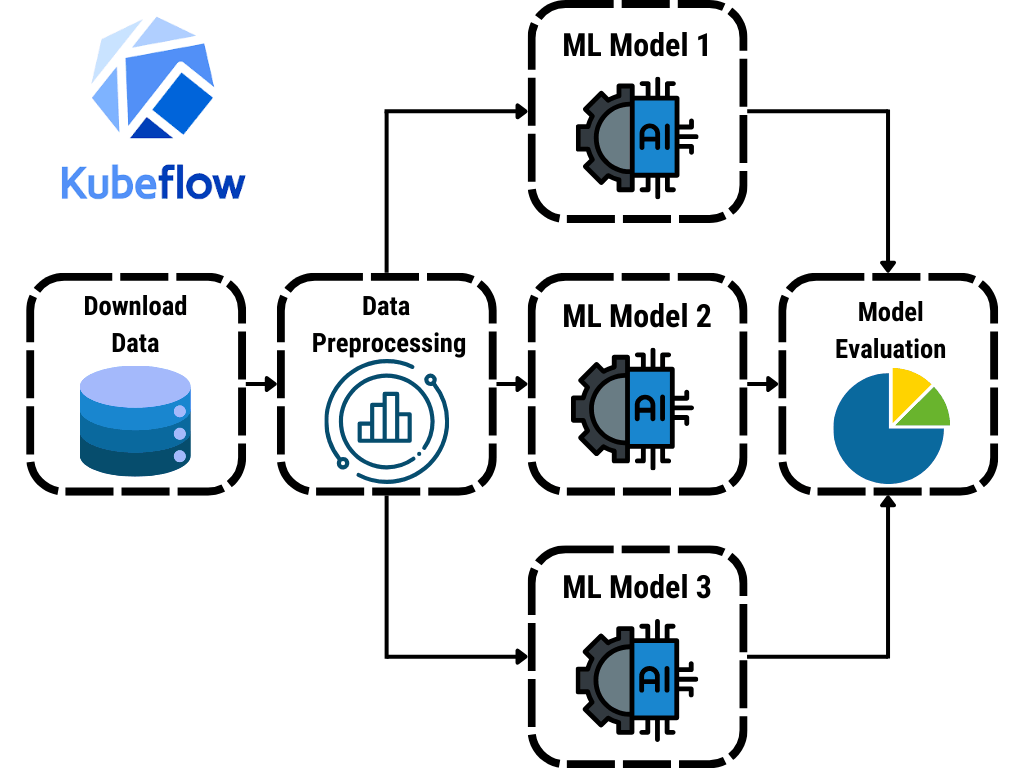
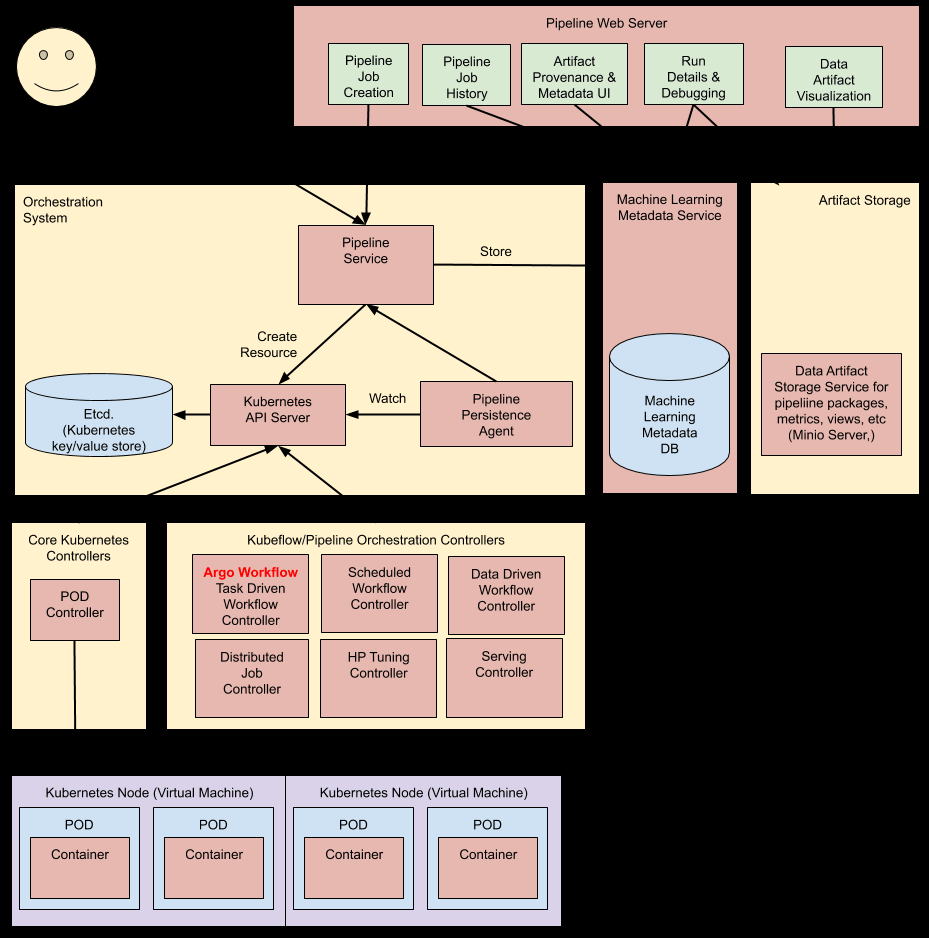
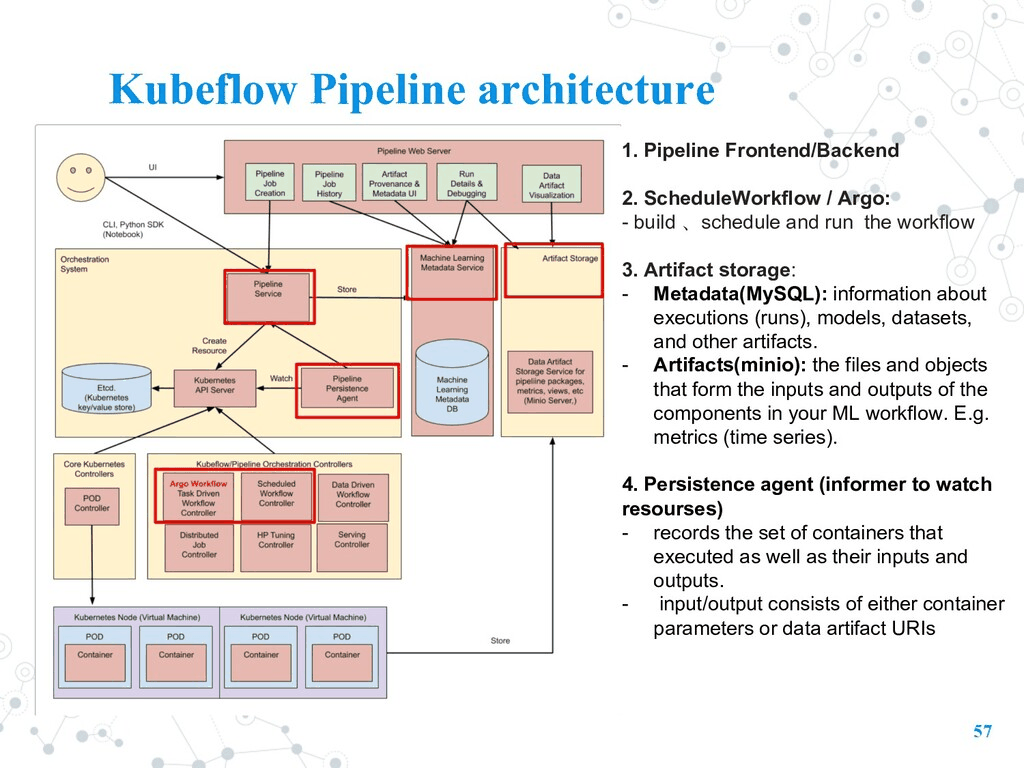
Kubeflow Pipelines Overview of the Kubeflow pipelines service Kubeflow is a machine learning (ML) toolkit that is dedicated to making deployments of ML workflows on Kubernetes simple, portable, and scalable. Kubeflow pipelines are reusable end-to-end ML workflows built using the Kubeflow Pipelines SDK. The Kubeflow pipelines service has the following goals: End to end orchestration: enabling and simplifying the orchestration of end to end machine learning pipelines Easy experimentation: making it easy for you to try numerous ideas and techniques, and manage your various trials/experiments. Easy re-use: enabling you to re-use components and pipelines to quickly cobble together end to end solutions, without having to re-build each time. Installation Kubeflow Pipelines can be installed as part of the Kubeflow Platform . Alternatively you can deploy Kubeflow Pipelines as a standalone service. Pipeline execution uses the Argo Emissary executor , which is independent of the Kubernetes container runtime. Dependencies Compatibility Matrix Dependency Versions Argo Workflows v4.0, v4.1 MySQL v8 KFP 3.0 compatibility notice: This branch supports Argo Workflows 4.0.x and 4.1.x, tested at 4.0.13 and 4.1.6 respectively. Argo 3.x is not supported on this branch; KFP 2.x release branches retain their documented compatibility coverage. Before upgrading to KFP 3.0, operators must upgrade their controller to a supported 4.x release. Follow the KFP 3.0 compatibility tracking issue for the removal and migration work. Documentation See Releases for what changed, upgrade guidance, compatibility, and the maintainer release runbook. Get started with your first pipeline and read further information in the Kubeflow Pipelines overview . See the various ways you can use the Kubeflow Pipelines SDK . See the Kubeflow Pipelines API doc for API specification. Consult the Python SDK reference docs when writing pipelines using the Python SDK. Deep Wiki Check out our AI Powered repo documentation on DeepWiki . ⚠️ Please note, this is AI generated and may not have completely accurate information. Contributing to Kubeflow Pipelines Before you start contributing to Kubeflow Pipelines, read the guidelines in How to Contribute . To learn how to build and deploy Kubeflow Pipelines from source code, read the developer guide . Optional just command runner For local developer convenience, this repository includes an optional just command runner at the repo root. It provides short aliases for existing make targets and does not replace any CI or release workflows. To use it, install just and run, for example: just # list available recipes just backend-test just backend-images Notes: All just recipes are thin wrappers around existing make targets (for example, make -C backend/src/v2 test ). There is intentionally no generic just build or just test recipe; heavy or Docker-building flows are exposed only via explicitly named recipes such as backend-images . Kubeflow Pipelines Community Community Meeting The Kubeflow Pipelines Community Meeting occurs every other Wed 10-11AM (PST). Calendar Invite Direct Meeting Link Meeting notes Slack We also have a slack channel (#kubeflow-pipelines) on the Cloud Native Computing Foundation Slack workspace. You can find more details at https://www.kubeflow.org/docs/about/community/#kubeflow-slack-channels Architecture Details about the KFP Architecture can be found at Architecture.md Blog posts From Raw Data to Model Serving: A Blueprint for the AI/ML Lifecycle with Kubeflow (By Helber Belmiro ) Getting started with Kubeflow Pipelines (By Amy Unruh) How to create and deploy a Kubeflow Machine Learning Pipeline (By Lak Lakshmanan) Part 1: How to create and deploy a Kubeflow Machine Learning Pipeline Part 2: How to deploy Jupyter notebooks as components of a Kubeflow ML pipeline Part 3: How to carry out CI/CD in Machine Learning (“MLOps”) using Kubeflow ML pipelines Acknowledgments Kubeflow pipelines uses Argo Workflows by default under the hood to orchestrate Kubernetes resources. The Argo community has been very supportive and we are very grateful.
Kubeflow is a machine learning (ML) toolkit that is dedicated to making deployments of ML workflows on Kubernetes simple, portable, and scalable.
Kubeflow pipelines are reusable end-to-end ML workflows built using the Kubeflow Pipelines SDK.
Kubeflow Pipelines can be installed as part of the Kubeflow Platform . Alternatively you can deploy Kubeflow Pipelines as a standalone service.
Pipeline execution uses the Argo Emissary executor , which is independent of the Kubernetes container runtime.
2. Related Work, Literature Survey & Algorithmic Foundations
KFP 3.0 compatibility notice: This branch supports Argo Workflows 4.0.x and 4.1.x, tested at 4.0.13 and 4.1.6 respectively. Argo 3.x is not supported on this branch; KFP 2.x release branches retain their documented compatibility coverage. Before upgrading to KFP 3.0, operators must upgrade their controller to a supported 4.x release. Follow the KFP 3.0 compatibility tracking issue for the removal and migration work.
See Releases for what changed, upgrade guidance, compatibility, and the maintainer release runbook.
Get started with your first pipeline and read further information in the Kubeflow Pipelines overview .
⚠️ Please note, this is AI generated and may not have completely accurate information.
Before you start contributing to Kubeflow Pipelines, read the guidelines in How to Contribute . To learn how to build and deploy Kubeflow Pipelines from source code, read the developer guide .
For local developer convenience, this repository includes an optional just command runner at the repo root. It provides short aliases for existing make targets and does not replace any CI or release workflows.
We also have a slack channel (#kubeflow-pipelines) on the Cloud Native Computing Foundation Slack workspace. You can find more details at https://www.kubeflow.org/docs/about/community/#kubeflow-slack-channels
3. Dataset Ingestion, Preprocessing & Stochastic Augmentations
Kubeflow pipelines uses Argo Workflows by default under the hood to orchestrate Kubernetes resources. The Argo community has been very supportive and we are very grateful.
Installation of Kubeflow Pipelines The best guide to install Kubeflow or any of its components is the official documentation. https://www.kubeflow.org/docs/started/ In this tutorial, we will learn how to Install, Configure and Use the most popular component of Kubeflow that is KFP (Kubeflow Pipelines). Step 1: Install Docker Desktop Follow the below guide and follow the steps according to your OS Distribution. https://docs.docker.com/desktop/setup/install/mac-install/ Step 2: Install KIND Easy way to learn Kubeflow Pipelines is to setup a KIND k8s cluster and configure Kubeflow Pipelines on the cluster. https://kind.sigs.k8s.io/docs/user/quick-start/ Step 3: Install KFP in Kubernertes Follow the steps to setup KFP. https://www.kubeflow.org/docs/components/pipelines/operator-guides/installation/ Step 4: Install Python kfp package Create a folder - mkdir kfp Create a Python virtual environment - python3 -m venv .kfp Source the virtual environment - source .kfp/bin/activate Install the package - pip3 install kfp==2.9.0
The best guide to install Kubeflow or any of its components is the official documentation.
In this tutorial, we will learn how to Install, Configure and Use the most popular component of Kubeflow that is KFP (Kubeflow Pipelines).
Easy way to learn Kubeflow Pipelines is to setup a KIND k8s cluster and configure Kubeflow Pipelines on the cluster.
Most of the pods go to CrashLoopBackOff and the minio pod goes into ImagePullBackOff I tried searching about the logs I got and found that the minio ImagePullBackOff is due to recent changes where minio stopped publishing prebuilt docker images.
NAME READY STATUS RESTARTS AGE cache-deployer-deployment-568c969444-tbml4 1/1 Running 0 125m cache-server-864749847f-btcdg 1/1 Running 0 126m controller-manager-9bc5fd5df-6j5rd 1/1 Running 0 111m metadata-envoy-deployment-5c97bdbd97-4tcr5 1/1 Running 0 126m metadata-grpc-deployment-7cd994d449-dm9sw 1/1 Running 7 (119m ago) 126m metadata-writer-689cbbfc88-p9zcv 1/1 Running 0 126m minio-6bdf7c6c9b-22qsl 1/1 Running 0 4m38s ml-pipeline-d94cb5f45-wfrc6 1/1 Running 0 3m26s ml-pipeline-persistenceagent-5d5b784486-86mm8 1/1 Running 18 (10m ago) 126m ml-pipeline-scheduledworkflow-b4f959f59-sb44d 1/1 Running 0 2m39s ml-pipeline-ui-5dcfff6ddd-7r78r 1/1 Running 0 126m ml-pipeline-viewer-crd-7cdd4745b8-szwgv 1/1 Running 0 126m ml-pipeline-visualizationserver-b5c797b95-wrnt2 1/1 Running 0 126m mysql-5bb7cf8b95-kdtj2 1/1 Running 0 126m workflow-controller-5b497bfffd-g7r2t 1/1 Running 0 126m
4. Neural Network Backbone, Layer Specifications & Loss Formulations
my all pod is running fine, need to understand the error. (sone pods need resources, and minio image need to be change,)
export PIPELINE_VERSION=2.14.3 kubectl apply -k "github.com/kubeflow/pipelines/manifests/kustomize/cluster-scoped-resources?ref=$PIPELINE_VERSION"
kubectl apply -k "github.com/kubeflow/pipelines/manifests/kustomize/env/platform-agnostic?ref=$PIPELINE_VERSION"
kubectl set image deployment/minio minio=minio/minio:RELEASE.2023-03-20T20-16-18Z -n kubeflow
Kubeflow Pipelines Overview of the Kubeflow pipelines service Kubeflow is a machine learning (ML) toolkit that is dedicated to making deployments of ML workflows on Kubernetes simple, portable, and scalable. Kubeflow pipelines are reusable end-to-end ML workflows built using the Kubeflow Pipelines SDK. The Kubeflow pipelines service has the following goals: End to end orchestration: enabling and simplifying the orchestration of end to end machine learning pipelines Easy experimentation: making it easy for you to try numerous ideas and techniques, and manage your various trials/experiments. Easy re-use: enabling you to re-use components and pipelines to quickly cobble together end to end solutions, without having to re-build each time. Installation Kubeflow Pipelines can be installed as part of the Kubeflow Platform . Alternatively you can deploy Kubeflow Pipelines as a standalone service. The Docker container runtime has been deprecated on Kubernetes 1.20+. Kubeflow Pipelines has switched to use Emissary Executor by default from Kubeflow Pipelines 1.8. Emissary executor is Container runtime agnostic, meaning you are able to run Kubeflow Pipelines on Kubernetes cluster with any Container runtimes . Documentation Get started with your first pipeline and read further information in the Kubeflow Pipelines overview . See the various ways you can use the Kubeflow Pipelines SDK . See the Kubeflow Pipelines API doc for API specification. Consult the Python SDK reference docs when writing pipelines using the Python SDK. Deep Wiki Check out our AI Powered repo documentation on DeepWiki . ⚠️ Please note, this is AI generated and may not have completely accurate information. Contributing to Kubeflow Pipelines Before you start contributing to Kubeflow Pipelines, read the guidelines in How to Contribute . To learn how to build and deploy Kubeflow Pipelines from source code, read the developer guide . Kubeflow Pipelines Community Community Meeting The Kubeflow Pipelines Community Meeting occurs every other Wed 10-11AM (PST). Calendar Invite Direct Meeting Link Meeting notes Slack We also have a slack channel (#kubeflow-pipelines) on the Cloud Native Computing Foundation Slack workspace. You can find more details at https://www.kubeflow.org/docs/about/community/#kubeflow-slack-channels Architecture Details about the KFP Architecture can be found at Architecture.md Blog posts Getting started with Kubeflow Pipelines (By Amy Unruh) How to create and deploy a Kubeflow Machine Learning Pipeline (By Lak Lakshmanan) Part 1: How to create and deploy a Kubeflow Machine Learning Pipeline Part 2: How to deploy Jupyter notebooks as components of a Kubeflow ML pipeline Part 3: How to carry out CI/CD in Machine Learning (“MLOps”) using Kubeflow ML pipelines Acknowledgments Kubeflow pipelines uses Argo Workflows by default under the hood to orchestrate Kubernetes resources. The Argo community has been very supportive and we are very grateful.
Kubeflow is a machine learning (ML) toolkit that is dedicated to making deployments of ML workflows on Kubernetes simple, portable, and scalable.
Kubeflow pipelines are reusable end-to-end ML workflows built using the Kubeflow Pipelines SDK.
5. Training Protocol, Convergence Behavior & Experimental Evaluation
Kubeflow Pipelines can be installed as part of the Kubeflow Platform . Alternatively you can deploy Kubeflow Pipelines as a standalone service.
The Docker container runtime has been deprecated on Kubernetes 1.20+. Kubeflow Pipelines has switched to use Emissary Executor by default from Kubeflow Pipelines 1.8. Emissary executor is Container runtime agnostic, meaning you are able to run Kubeflow Pipelines on Kubernetes cluster with any Container runtimes .
Get started with your first pipeline and read further information in the Kubeflow Pipelines overview .
⚠️ Please note, this is AI generated and may not have completely accurate information.
Before you start contributing to Kubeflow Pipelines, read the guidelines in How to Contribute . To learn how to build and deploy Kubeflow Pipelines from source code, read the developer guide .
We also have a slack channel (#kubeflow-pipelines) on the Cloud Native Computing Foundation Slack workspace. You can find more details at https://www.kubeflow.org/docs/about/community/#kubeflow-slack-channels
Kubeflow pipelines uses Argo Workflows by default under the hood to orchestrate Kubernetes resources. The Argo community has been very supportive and we are very grateful.
Model Figures & Evaluation Curves (4 Images)
Deep Learning Execution Pipeline
(Preprocessing)
(Feature Extraction)
(Self-Attention)
(Loss Optimization)