Complete Technical Paper Content — Layoutlm Document Understanding
1. Executive Abstract, Problem Formulation & Background
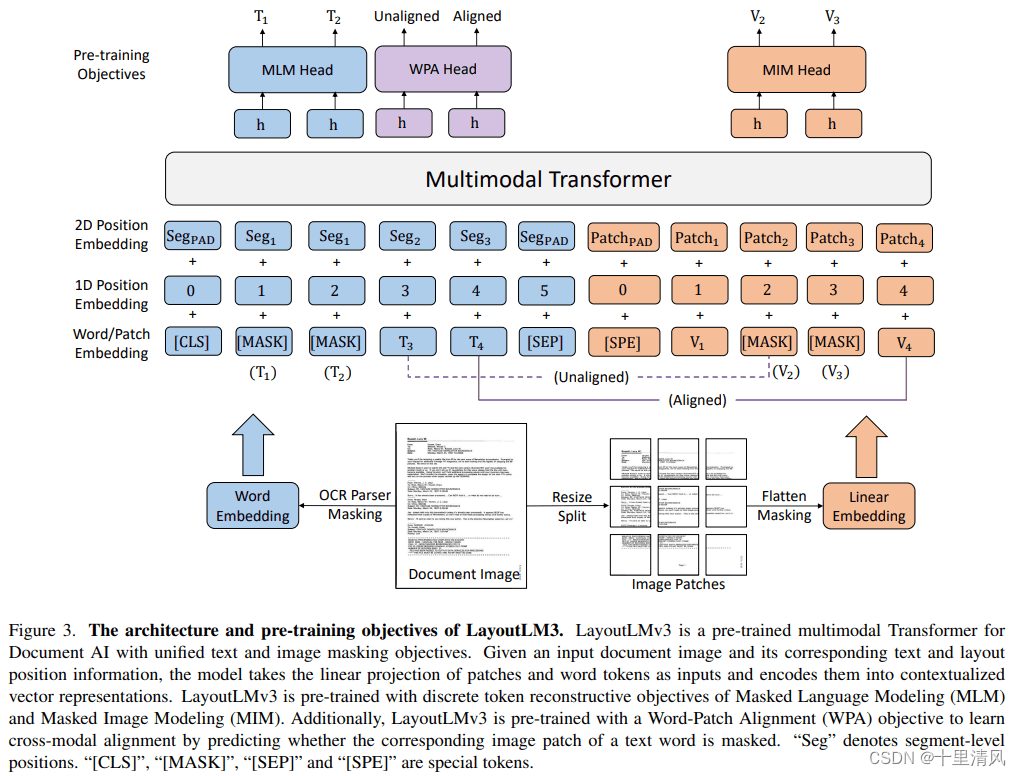
LayoutLMv3 (Document Foundation Model) Self-supervised pre-training techniques have achieved remarkable progress in Document AI. Most multimodal pre-trained models use a masked language modeling objective to learn bidirectional representations on the text modality, but they differ in pre-training objectives for the image modality. This discrepancy adds difficulty to multimodal representation learning. In this paper, we propose LayoutLMv3 to pre-train multimodal Transformers for Document AI with unified text and image masking. Additionally, LayoutLMv3 is pre-trained with a word-patch alignment objective to learn cross-modal alignment by predicting whether the corresponding image patch of a text word is masked. The simple unified architecture and training objectives make LayoutLMv3 a general-purpose pre-trained model for both text-centric and image-centric Document AI tasks. Experimental results show that LayoutLMv3 achieves state-of-the-art performance not only in text-centric tasks, including form understanding, receipt understanding, and document visual question answering, but also in image-centric tasks such as document image classification and document layout analysis. Installation conda create --name layoutlmv3 python=3.7 conda activate layoutlmv3 git clone https://github.com/microsoft/unilm.git cd unilm/layoutlmv3 pip install -r requirements.txt # install pytorch, torchvision refer to https://pytorch.org/get-started/locally/ pip install torch==1.10.0+cu111 torchvision==0.11.1+cu111 -f https://download.pytorch.org/whl/torch_stable.html # install detectron2 refer to https://detectron2.readthedocs.io/en/latest/tutorials/install.html python -m pip install detectron2 -f https://dl.fbaipublicfiles.com/detectron2/wheels/cu111/torch1.10/index.html pip install -e . Pre-trained Models Model Model Name (Path) layoutlmv3-base microsoft/layoutlmv3-base layoutlmv3-large microsoft/layoutlmv3-large layoutlmv3-base-chinese microsoft/layoutlmv3-base-chinese Fine-tuning Examples We provide some fine-tuned models and their train/test logs. Form Understanding on FUNSD Train python -m torch.distributed.launch \ --nproc_per_node=8 --master_port 4398 examples/run_funsd_cord.py \ --dataset_name funsd \ --do_train --do_eval \ --model_name_or_path microsoft/layoutlmv3-base \ --output_dir /path/to/layoutlmv3-base-finetuned-funsd \ --segment_level_layout 1 --visual_embed 1 --input_size 224 \ --max_steps 1000 --save_steps -1 --evaluation_strategy steps --eval_steps 100 \ --learning_rate 1e-5 --per_device_train_batch_size 2 --gradient_accumulation_steps 1 \ --dataloader_num_workers 8 Test python -m torch.distributed.launch \ --nproc_per_node=8 --master_port 4398 examples/run_funsd_cord.py \ --dataset_name funsd \ --do_eval \ --model_name_or_path HYPJUDY/layoutlmv3-base-finetuned-funsd \ --output_dir /path/to/layoutlmv3-base-finetuned-funsd \ --segment_level_layout 1 --visual_embed 1 --input_size 224 \ --dataloader_num_workers 8 Model on FUNSD precision recall f1 layoutlmv3-base-finetuned-funsd 0.8955 0.9165 0.9059 layoutlmv3-large-finetuned-funsd 0.9219 0.9210 0.9215 Document Layout Analysis on PubLayNet Please follow unilm/dit/object_detection to prepare data and read more details about this task. In the folder of layoutlmv3/examples/object_detecion: Train Please firstly download the pre-trained models to /path/to/microsoft/layoutlmv3-base , then run: python train_net.py --config-file cascade_layoutlmv3.yaml --num-gpus 16 \ MODEL.WEIGHTS /path/to/microsoft/layoutlmv3-base/pytorch_model.bin \ OUTPUT_DIR /path/to/layoutlmv3-base-finetuned-publaynet Test If you want to test the layoutlmv3-base-finetuned-publaynet model, please download it to /path/to/layoutlmv3-base-finetuned-publaynet , then run: python train_net.py --config-file cascade_layoutlmv3.yaml --eval-only --num-gpus 8 \ MODEL.WEIGHTS /path/to/layoutlmv3-base-finetuned-publaynet/model_final.pth \ OUTPUT_DIR /path/to/layoutlmv3-base-finetuned-publaynet Model on PubLayNet Text Title List Table Figure Overall layoutlmv3-base-finetuned-publaynet 94.5 90.6 95.5 97.9 97.0 95.1 Form Understanding on XFUND An example for the LayoutLMv3 Chinese model to train and evaluate model. Data Preparation Download the chinese data in XFUND from this link . The resulting directory structure looks like the following: │── data │ ├── zh.train.json │ ├── zh.val.json │ └── images │ ├── zh_train_*.jpg │ └── zh_val_*.jpg Train python -m torch.distributed.launch \ --nproc_per_node=8 --master_port 4398 examples/run_xfund.py \ --data_dir data --language zh \ --do_train --do_eval \ --model_name_or_path microsoft/layoutlmv3-base-chinese \ --output_dir path/to/output \ --segment_level_layout 1 --visual_embed 1 --input_size 224 \ --max_steps 1000 --save_steps -1 --evaluation_strategy steps --eval_steps 20 \ --learning_rate 7e-5 --per_device_train_batch_size 2 --gradient_accumulation_steps 1 \ --dataloader_num_workers 8 Test python -m torch.distributed.launch \ --nproc_per_node=8 --master_port 4398 examples/run_xfund.py \ --data_dir data --language zh \ --do_eval \ --model_name_or_path path/to/model \ --output_dir /path/to/output \ --segment_level_layout 1 --visual_embed 1 --input_size 224 \ --dataloader_num_workers 8 Pre-trained Model precision recall f1 layoutlmv3-base-chinese 0.8980 0.9435 0.9202 We also fine-tune the LayoutLMv3 Chinese model on EPHOIE for reference. Pre-trained Model Subject Test Time Name School Examination Number Seat Number Class Student Number Grade Score Mean layoutlmv3-base-chinese 98.99 100 99.77 99.2 100 100 98.82 99.78 98.31 97.27 99.21 Citation If you find LayoutLMv3 helpful, please cite us: @inproceedings{huang2022layoutlmv3, author={Yupan Huang and Tengchao Lv and Lei Cui and Yutong Lu and Furu Wei}, title={LayoutLMv3: Pre-training for Document AI with Unified Text and Image Masking}, booktitle={Proceedings of the 30th ACM International Conference on Multimedia}, year={2022} } Acknowledgement Portions of the source code are based on the transformers , layoutlmv2 , layoutlmft , beit , dit and Detectron2 projects. We sincerely thank them for their contributions! License The content of this project itself is licensed under the Attribution-NonCommercial-ShareAlike 4.0 International (CC BY-NC-SA 4.0) Contact For help or issues using LayoutLMv3, please email Yupan Huang or submit a GitHub issue. For other communications related to LayoutLM, please contact Lei Cui or Furu Wei .
Self-supervised pre-training techniques have achieved remarkable progress in Document AI. Most multimodal pre-trained models use a masked language modeling objective to learn bidirectional representations on the text modality, but they differ in pre-training objectives for the image modality. This discrepancy adds difficulty to multimodal representation learning. In this paper, we propose LayoutLMv3 to pre-train multimodal Transformers for Document AI with unified text and image masking. Additionally, LayoutLMv3 is pre-trained with a word-patch alignment objective to learn cross-modal alignment by predicting whether the corresponding image patch of a text word is masked. The simple unified architecture and training objectives make LayoutLMv3 a general-purpose pre-trained model for both text-centric and image-centric Document AI tasks. Experimental results show that LayoutLMv3 achieves state-of-the-art performance not only in text-centric tasks, including form understanding, receipt understanding, and document visual question answering, but also in image-centric tasks such as document image classification and document layout analysis.
conda create --name layoutlmv3 python=3.7 conda activate layoutlmv3 git clone https://github.com/microsoft/unilm.git cd unilm/layoutlmv3 pip install -r requirements.txt # install pytorch, torchvision refer to https://pytorch.org/get-started/locally/ pip install torch==1.10.0+cu111 torchvision==0.11.1+cu111 -f https://download.pytorch.org/whl/torch_stable.html # install detectron2 refer to https://detectron2.readthedocs.io/en/latest/tutorials/install.html python -m pip install detectron2 -f https://dl.fbaipublicfiles.com/detectron2/wheels/cu111/torch1.10/index.html pip install -e .
python -m torch.distributed.launch \ --nproc_per_node=8 --master_port 4398 examples/run_funsd_cord.py \ --dataset_name funsd \ --do_train --do_eval \ --model_name_or_path microsoft/layoutlmv3-base \ --output_dir /path/to/layoutlmv3-base-finetuned-funsd \ --segment_level_layout 1 --visual_embed 1 --input_size 224 \ --max_steps 1000 --save_steps -1 --evaluation_strategy steps --eval_steps 100 \ --learning_rate 1e-5 --per_device_train_batch_size 2 --gradient_accumulation_steps 1 \ --dataloader_num_workers 8
python -m torch.distributed.launch \ --nproc_per_node=8 --master_port 4398 examples/run_funsd_cord.py \ --dataset_name funsd \ --do_eval \ --model_name_or_path HYPJUDY/layoutlmv3-base-finetuned-funsd \ --output_dir /path/to/layoutlmv3-base-finetuned-funsd \ --segment_level_layout 1 --visual_embed 1 --input_size 224 \ --dataloader_num_workers 8
Please follow unilm/dit/object_detection to prepare data and read more details about this task. In the folder of layoutlmv3/examples/object_detecion:
Please firstly download the pre-trained models to /path/to/microsoft/layoutlmv3-base , then run:
python train_net.py --config-file cascade_layoutlmv3.yaml --num-gpus 16 \ MODEL.WEIGHTS /path/to/microsoft/layoutlmv3-base/pytorch_model.bin \ OUTPUT_DIR /path/to/layoutlmv3-base-finetuned-publaynet
If you want to test the layoutlmv3-base-finetuned-publaynet model, please download it to /path/to/layoutlmv3-base-finetuned-publaynet , then run:
python train_net.py --config-file cascade_layoutlmv3.yaml --eval-only --num-gpus 8 \ MODEL.WEIGHTS /path/to/layoutlmv3-base-finetuned-publaynet/model_final.pth \ OUTPUT_DIR /path/to/layoutlmv3-base-finetuned-publaynet
Download the chinese data in XFUND from this link . The resulting directory structure looks like the following:
│── data │ ├── zh.train.json │ ├── zh.val.json │ └── images │ ├── zh_train_*.jpg │ └── zh_val_*.jpg
2. Related Work, Literature Survey & Algorithmic Foundations
python -m torch.distributed.launch \ --nproc_per_node=8 --master_port 4398 examples/run_xfund.py \ --data_dir data --language zh \ --do_train --do_eval \ --model_name_or_path microsoft/layoutlmv3-base-chinese \ --output_dir path/to/output \ --segment_level_layout 1 --visual_embed 1 --input_size 224 \ --max_steps 1000 --save_steps -1 --evaluation_strategy steps --eval_steps 20 \ --learning_rate 7e-5 --per_device_train_batch_size 2 --gradient_accumulation_steps 1 \ --dataloader_num_workers 8
python -m torch.distributed.launch \ --nproc_per_node=8 --master_port 4398 examples/run_xfund.py \ --data_dir data --language zh \ --do_eval \ --model_name_or_path path/to/model \ --output_dir /path/to/output \ --segment_level_layout 1 --visual_embed 1 --input_size 224 \ --dataloader_num_workers 8
@inproceedings{huang2022layoutlmv3, author={Yupan Huang and Tengchao Lv and Lei Cui and Yutong Lu and Furu Wei}, title={LayoutLMv3: Pre-training for Document AI with Unified Text and Image Masking}, booktitle={Proceedings of the 30th ACM International Conference on Multimedia}, year={2022} }
Portions of the source code are based on the transformers , layoutlmv2 , layoutlmft , beit , dit and Detectron2 projects. We sincerely thank them for their contributions!
The content of this project itself is licensed under the Attribution-NonCommercial-ShareAlike 4.0 International (CC BY-NC-SA 4.0)
For help or issues using LayoutLMv3, please email Yupan Huang or submit a GitHub issue.
LayoutLM (Document Foundation Model) Multimodal (text + layout/format + image) pre-training for Document AI April, 2021: LayoutXLM is coming by extending the LayoutLM into multilingual support! A multilingual form understanding benchmark XFUND is also introduced, which includes forms with human labeled key-value pairs in 7 languages (Chinese, Japanese, Spanish, French, Italian, German, Portuguese). December 29th, 2020: LayoutLMv2 is coming with the new SOTA on a wide varierty of document AI tasks, including DocVQA and SROIE leaderboard. Introduction LayoutLM is a simple but effective multi-modal pre-training method of text, layout and image for visually-rich document understanding and information extraction tasks, such as form understanding and receipt understanding. LayoutLM archives the SOTA results on multiple datasets. For more details, please refer to our paper: LayoutLM: Pre-training of Text and Layout for Document Image Understanding Yiheng Xu, Minghao Li, Lei Cui, Shaohan Huang, Furu Wei, Ming Zhou, KDD 2020 LayoutLMv2: Multi-modal Pre-training for Visually-Rich Document Understanding Yang Xu, Yiheng Xu, Tengchao Lv, Lei Cui, Furu Wei, Guoxin Wang, Yijuan Lu, Dinei Florencio, Cha Zhang, Wanxiang Che, Min Zhang, Lidong Zhou, ACL 2021 LayoutXLM: Multimodal Pre-training for Multilingual Visually-rich Document Understanding Yiheng Xu, Tengchao Lv, Lei Cui, Guoxin Wang, Yijuan Lu, Dinei Florencio, Cha Zhang, Furu Wei, Preprint Release Notes ***** New Sep 27th, 2021: LayoutLM-cased are on HuggingFace ***** ***** New Aug 7th, 2020: Our new document understanding datasets, TableBank (LREC 2020) and DocBank (COLING 2020), are now publicly available.***** ***** New May 16th, 2020: Our LayoutLM paper has been accepted to KDD 2020 as a full paper in the research track***** ***** New Feb 18th, 2020: Initial release of pre-trained models and fine-tuning code for LayoutLM v1 ***** Pre-trained Model We pre-train LayoutLM on IIT-CDIP Test Collection 1.0* dataset. name #params HuggingFace LayoutLM-Base, Uncased 113M Model Hub LayoutLM-Base, Cased 113M Model Hub LayoutLM-Large, Uncased 343M Model Hub *As some downstream datasets are the subsets of IIT-CDIP, we have carefully excluded the overlap portion from the pre-training data. Different Tokenizer Note that LayoutLM-Base-Cased requires a different tokenizer, based on RobertaTokenizer. You can initialize it as follows: from transformers import AutoTokenizer tokenizer = AutoTokenizer.from_pretrained('microsoft/layoutlm-base-cased') Fine-tuning Example on FUNSD Installation Please refer to layoutlmft Command cd layoutlmft python -m torch.distributed.launch --nproc_per_node=4 examples/run_funsd.py \ --model_name_or_path microsoft/layoutlm-base-uncased \ --output_dir /tmp/test-ner \ --do_train \ --do_predict \ --max_steps 1000 \ --warmup_ratio 0.1 \ --fp16 Results SROIE (field-level) Model Hmean BERT-Large 90.99% RoBERTa-Large 92.80% Ranking 1st in SROIE 94.02% LayoutLM 96.04% RVL-CDIP Model Accuracy BERT-Large 89.92% RoBERTa-Large 90.11% VGG-16 (Afzal et al., 2017) 90.97% Stacked CNN Ensemble (Das et al., 2018) 92.21% LadderNet (Sarkhel & Nandi, 2019) 92.77% Multimodal Ensemble (Dauphinee et al., 2019) 93.07% LayoutLM 94.42% FUNSD (field-level) Model Precision Recall F1 BERT-Large 0.6113 0.7085 0.6563 RoBERTa-Large 0.6780 0.7391 0.7072 LayoutLM 0.7677 0.8195 0.7927 Citation If you find LayoutLM useful in your research, please cite the following paper: @inproceedings{Xu2020LayoutLMPO, title = {LayoutLM: Pre-training of Text and Layout for Document Image Understanding}, author = {Yiheng Xu and Minghao Li and Lei Cui and Shaohan Huang and Furu Wei and Ming Zhou}, journal = {Proceedings of the 26th ACM SIGKDD International Conference on Knowledge Discovery & Data Mining}, year = {2020} } License This project is licensed under the license found in the LICENSE file in the root directory of this source tree. Portions of the source code are based on the transformers project. Microsoft Open Source Code of Conduct Contact Information For help or issues using LayoutLM, please submit a GitHub issue. For other communications related to LayoutLM, please contact Lei Cui ( lecu@microsoft.com ), Furu Wei ( fuwei@microsoft.com ).
LayoutLM is a simple but effective multi-modal pre-training method of text, layout and image for visually-rich document understanding and information extraction tasks, such as form understanding and receipt understanding. LayoutLM archives the SOTA results on multiple datasets. For more details, please refer to our paper:
LayoutLM: Pre-training of Text and Layout for Document Image Understanding Yiheng Xu, Minghao Li, Lei Cui, Shaohan Huang, Furu Wei, Ming Zhou, KDD 2020
LayoutLMv2: Multi-modal Pre-training for Visually-Rich Document Understanding Yang Xu, Yiheng Xu, Tengchao Lv, Lei Cui, Furu Wei, Guoxin Wang, Yijuan Lu, Dinei Florencio, Cha Zhang, Wanxiang Che, Min Zhang, Lidong Zhou, ACL 2021
LayoutXLM: Multimodal Pre-training for Multilingual Visually-rich Document Understanding Yiheng Xu, Tengchao Lv, Lei Cui, Guoxin Wang, Yijuan Lu, Dinei Florencio, Cha Zhang, Furu Wei, Preprint
***** New Aug 7th, 2020: Our new document understanding datasets, TableBank (LREC 2020) and DocBank (COLING 2020), are now publicly available.*****
3. Dataset Ingestion, Preprocessing & Stochastic Augmentations
***** New May 16th, 2020: Our LayoutLM paper has been accepted to KDD 2020 as a full paper in the research track*****
***** New Feb 18th, 2020: Initial release of pre-trained models and fine-tuning code for LayoutLM v1 *****
*As some downstream datasets are the subsets of IIT-CDIP, we have carefully excluded the overlap portion from the pre-training data.
Note that LayoutLM-Base-Cased requires a different tokenizer, based on RobertaTokenizer. You can initialize it as follows:
from transformers import AutoTokenizer tokenizer = AutoTokenizer.from_pretrained('microsoft/layoutlm-base-cased')
cd layoutlmft python -m torch.distributed.launch --nproc_per_node=4 examples/run_funsd.py \ --model_name_or_path microsoft/layoutlm-base-uncased \ --output_dir /tmp/test-ner \ --do_train \ --do_predict \ --max_steps 1000 \ --warmup_ratio 0.1 \ --fp16
@inproceedings{Xu2020LayoutLMPO, title = {LayoutLM: Pre-training of Text and Layout for Document Image Understanding}, author = {Yiheng Xu and Minghao Li and Lei Cui and Shaohan Huang and Furu Wei and Ming Zhou}, journal = {Proceedings of the 26th ACM SIGKDD International Conference on Knowledge Discovery & Data Mining}, year = {2020} }
This project is licensed under the license found in the LICENSE file in the root directory of this source tree. Portions of the source code are based on the transformers project. Microsoft Open Source Code of Conduct
For other communications related to LayoutLM, please contact Lei Cui ( lecu@microsoft.com ), Furu Wei ( fuwei@microsoft.com ).
LayoutLMv3 (Document Foundation Model) Self-supervised pre-training techniques have achieved remarkable progress in Document AI. Most multimodal pre-trained models use a masked language modeling objective to learn bidirectional representations on the text modality, but they differ in pre-training objectives for the image modality. This discrepancy adds difficulty to multimodal representation learning. In this paper, we propose LayoutLMv3 to pre-train multimodal Transformers for Document AI with unified text and image masking. Additionally, LayoutLMv3 is pre-trained with a word-patch alignment objective to learn cross-modal alignment by predicting whether the corresponding image patch of a text word is masked. The simple unified architecture and training objectives make LayoutLMv3 a general-purpose pre-trained model for both text-centric and image-centric Document AI tasks. Experimental results show that LayoutLMv3 achieves state-of-the-art performance not only in text-centric tasks, including form understanding, receipt understanding, and document visual question answering, but also in image-centric tasks such as document image classification and document layout analysis. Installation conda create --name layoutlmv3 python=3.7 conda activate layoutlmv3 git clone https://github.com/microsoft/unilm.git cd unilm/layoutlmv3 pip install -r requirements.txt # install pytorch, torchvision refer to https://pytorch.org/get-started/locally/ pip install torch==1.10.0+cu111 torchvision==0.11.1+cu111 -f https://download.pytorch.org/whl/torch_stable.html # install detectron2 refer to https://detectron2.readthedocs.io/en/latest/tutorials/install.html python -m pip install detectron2 -f https://dl.fbaipublicfiles.com/detectron2/wheels/cu111/torch1.10/index.html pip install -e . Pre-trained Models Model Model Name (Path) layoutlmv3-base microsoft/layoutlmv3-base layoutlmv3-large microsoft/layoutlmv3-large layoutlmv3-base-chinese microsoft/layoutlmv3-base-chinese Fine-tuning Examples We provide some fine-tuned models and their train/test logs. Form Understanding on FUNSD Train python -m torch.distributed.launch \ --nproc_per_node=8 --master_port 4398 examples/run_funsd_cord.py \ --dataset_name funsd \ --do_train --do_eval \ --model_name_or_path microsoft/layoutlmv3-base \ --output_dir /path/to/layoutlmv3-base-finetuned-funsd \ --segment_level_layout 1 --visual_embed 1 --input_size 224 \ --max_steps 1000 --save_steps -1 --evaluation_strategy steps --eval_steps 100 \ --learning_rate 1e-5 --per_device_train_batch_size 2 --gradient_accumulation_steps 1 \ --dataloader_num_workers 8 Test python -m torch.distributed.launch \ --nproc_per_node=8 --master_port 4398 examples/run_funsd_cord.py \ --dataset_name funsd \ --do_eval \ --model_name_or_path HYPJUDY/layoutlmv3-base-finetuned-funsd \ --output_dir /path/to/layoutlmv3-base-finetuned-funsd \ --segment_level_layout 1 --visual_embed 1 --input_size 224 \ --dataloader_num_workers 8 Model on FUNSD precision recall f1 layoutlmv3-base-finetuned-funsd 0.8955 0.9165 0.9059 layoutlmv3-large-finetuned-funsd 0.9219 0.9210 0.9215 Document Layout Analysis on PubLayNet Please follow unilm/dit/object_detection to prepare data and read more details about this task. In the folder of layoutlmv3/examples/object_detecion: Train Please firstly download the pre-trained models to /path/to/microsoft/layoutlmv3-base , then run: python train_net.py --config-file cascade_layoutlmv3.yaml --num-gpus 16 \ MODEL.WEIGHTS /path/to/microsoft/layoutlmv3-base/pytorch_model.bin \ OUTPUT_DIR /path/to/layoutlmv3-base-finetuned-publaynet Test If you want to test the layoutlmv3-base-finetuned-publaynet model, please download it to /path/to/layoutlmv3-base-finetuned-publaynet , then run: python train_net.py --config-file cascade_layoutlmv3.yaml --eval-only --num-gpus 8 \ MODEL.WEIGHTS /path/to/layoutlmv3-base-finetuned-publaynet/model_final.pth \ OUTPUT_DIR /path/to/layoutlmv3-base-finetuned-publaynet Model on PubLayNet Text Title List Table Figure Overall layoutlmv3-base-finetuned-publaynet 94.5 90.6 95.5 97.9 97.0 95.1 Form Understanding on XFUND An example for the LayoutLMv3 Chinese model to train and evaluate model. Data Preparation Download the chinese data in XFUND from this link . The resulting directory structure looks like the following: │── data │ ├── zh.train.json │ ├── zh.val.json │ └── images │ ├── zh_train_*.jpg │ └── zh_val_*.jpg Train python -m torch.distributed.launch \ --nproc_per_node=8 --master_port 4398 examples/run_xfund.py \ --data_dir data --language zh \ --do_train --do_eval \ --model_name_or_path microsoft/layoutlmv3-base-chinese \ --output_dir path/to/output \ --segment_level_layout 1 --visual_embed 1 --input_size 224 \ --max_steps 1000 --save_steps -1 --evaluation_strategy steps --eval_steps 20 \ --learning_rate 7e-5 --per_device_train_batch_size 2 --gradient_accumulation_steps 1 \ --dataloader_num_workers 8 Test python -m torch.distributed.launch \ --nproc_per_node=8 --master_port 4398 examples/run_xfund.py \ --data_dir data --language zh \ --do_eval \ --model_name_or_path path/to/model \ --output_dir /path/to/output \ --segment_level_layout 1 --visual_embed 1 --input_size 224 \ --dataloader_num_workers 8 Pre-trained Model precision recall f1 layoutlmv3-base-chinese 0.8980 0.9435 0.9202 We also fine-tune the LayoutLMv3 Chinese model on EPHOIE for reference. Pre-trained Model Subject Test Time Name School Examination Number Seat Number Class Student Number Grade Score Mean layoutlmv3-base-chinese 98.99 100 99.77 99.2 100 100 98.82 99.78 98.31 97.27 99.21 Citation If you find LayoutLMv3 helpful, please cite us: @inproceedings{huang2022layoutlmv3, author={Yupan Huang and Tengchao Lv and Lei Cui and Yutong Lu and Furu Wei}, title={LayoutLMv3: Pre-training for Document AI with Unified Text and Image Masking}, booktitle={Proceedings of the 30th ACM International Conference on Multimedia}, year={2022} } Acknowledgement Portions of the source code are based on the transformers , layoutlmv2 , layoutlmft , beit , dit and Detectron2 projects. We sincerely thank them for their contributions! License The content of this project itself is licensed under the Attribution-NonCommercial-ShareAlike 4.0 International (CC BY-NC-SA 4.0) Contact For help or issues using LayoutLMv3, please email Yupan Huang or submit a GitHub issue. For other communications related to LayoutLM, please contact Lei Cui or Furu Wei .
Self-supervised pre-training techniques have achieved remarkable progress in Document AI. Most multimodal pre-trained models use a masked language modeling objective to learn bidirectional representations on the text modality, but they differ in pre-training objectives for the image modality. This discrepancy adds difficulty to multimodal representation learning. In this paper, we propose LayoutLMv3 to pre-train multimodal Transformers for Document AI with unified text and image masking. Additionally, LayoutLMv3 is pre-trained with a word-patch alignment objective to learn cross-modal alignment by predicting whether the corresponding image patch of a text word is masked. The simple unified architecture and training objectives make LayoutLMv3 a general-purpose pre-trained model for both text-centric and image-centric Document AI tasks. Experimental results show that LayoutLMv3 achieves state-of-the-art performance not only in text-centric tasks, including form understanding, receipt understanding, and document visual question answering, but also in image-centric tasks such as document image classification and document layout analysis.
conda create --name layoutlmv3 python=3.7 conda activate layoutlmv3 git clone https://github.com/microsoft/unilm.git cd unilm/layoutlmv3 pip install -r requirements.txt # install pytorch, torchvision refer to https://pytorch.org/get-started/locally/ pip install torch==1.10.0+cu111 torchvision==0.11.1+cu111 -f https://download.pytorch.org/whl/torch_stable.html # install detectron2 refer to https://detectron2.readthedocs.io/en/latest/tutorials/install.html python -m pip install detectron2 -f https://dl.fbaipublicfiles.com/detectron2/wheels/cu111/torch1.10/index.html pip install -e .
4. Neural Network Backbone, Layer Specifications & Loss Formulations
python -m torch.distributed.launch \ --nproc_per_node=8 --master_port 4398 examples/run_funsd_cord.py \ --dataset_name funsd \ --do_train --do_eval \ --model_name_or_path microsoft/layoutlmv3-base \ --output_dir /path/to/layoutlmv3-base-finetuned-funsd \ --segment_level_layout 1 --visual_embed 1 --input_size 224 \ --max_steps 1000 --save_steps -1 --evaluation_strategy steps --eval_steps 100 \ --learning_rate 1e-5 --per_device_train_batch_size 2 --gradient_accumulation_steps 1 \ --dataloader_num_workers 8
python -m torch.distributed.launch \ --nproc_per_node=8 --master_port 4398 examples/run_funsd_cord.py \ --dataset_name funsd \ --do_eval \ --model_name_or_path HYPJUDY/layoutlmv3-base-finetuned-funsd \ --output_dir /path/to/layoutlmv3-base-finetuned-funsd \ --segment_level_layout 1 --visual_embed 1 --input_size 224 \ --dataloader_num_workers 8
Please follow unilm/dit/object_detection to prepare data and read more details about this task. In the folder of layoutlmv3/examples/object_detecion:
Please firstly download the pre-trained models to /path/to/microsoft/layoutlmv3-base , then run:
python train_net.py --config-file cascade_layoutlmv3.yaml --num-gpus 16 \ MODEL.WEIGHTS /path/to/microsoft/layoutlmv3-base/pytorch_model.bin \ OUTPUT_DIR /path/to/layoutlmv3-base-finetuned-publaynet
If you want to test the layoutlmv3-base-finetuned-publaynet model, please download it to /path/to/layoutlmv3-base-finetuned-publaynet , then run:
python train_net.py --config-file cascade_layoutlmv3.yaml --eval-only --num-gpus 8 \ MODEL.WEIGHTS /path/to/layoutlmv3-base-finetuned-publaynet/model_final.pth \ OUTPUT_DIR /path/to/layoutlmv3-base-finetuned-publaynet
Download the chinese data in XFUND from this link . The resulting directory structure looks like the following:
│── data │ ├── zh.train.json │ ├── zh.val.json │ └── images │ ├── zh_train_*.jpg │ └── zh_val_*.jpg
python -m torch.distributed.launch \ --nproc_per_node=8 --master_port 4398 examples/run_xfund.py \ --data_dir data --language zh \ --do_train --do_eval \ --model_name_or_path microsoft/layoutlmv3-base-chinese \ --output_dir path/to/output \ --segment_level_layout 1 --visual_embed 1 --input_size 224 \ --max_steps 1000 --save_steps -1 --evaluation_strategy steps --eval_steps 20 \ --learning_rate 7e-5 --per_device_train_batch_size 2 --gradient_accumulation_steps 1 \ --dataloader_num_workers 8
python -m torch.distributed.launch \ --nproc_per_node=8 --master_port 4398 examples/run_xfund.py \ --data_dir data --language zh \ --do_eval \ --model_name_or_path path/to/model \ --output_dir /path/to/output \ --segment_level_layout 1 --visual_embed 1 --input_size 224 \ --dataloader_num_workers 8
@inproceedings{huang2022layoutlmv3, author={Yupan Huang and Tengchao Lv and Lei Cui and Yutong Lu and Furu Wei}, title={LayoutLMv3: Pre-training for Document AI with Unified Text and Image Masking}, booktitle={Proceedings of the 30th ACM International Conference on Multimedia}, year={2022} }
5. Training Protocol, Convergence Behavior & Experimental Evaluation
Portions of the source code are based on the transformers , layoutlmv2 , layoutlmft , beit , dit and Detectron2 projects. We sincerely thank them for their contributions!
The content of this project itself is licensed under the Attribution-NonCommercial-ShareAlike 4.0 International (CC BY-NC-SA 4.0)
For help or issues using LayoutLMv3, please email Yupan Huang or submit a GitHub issue.
LayoutLM Multimodal (text + layout/format + image) pre-training for document understanding Introduction LayoutLM is a simple but effective pre-training method of text and layout for document image understanding and information extraction tasks, such as form understanding and receipt understanding. LayoutLM archives the SOTA results on multiple datasets. For more details, please refer to our paper: LayoutLM: Pre-training of Text and Layout for Document Image Understanding Yiheng Xu, Minghao Li, Lei Cui, Shaohan Huang, Furu Wei, Ming Zhou, KDD 2020 Release Notes ***** New May 16th, 2020: Our LayoutLM paper has been accepted to KDD 2020 as a full paper in the research track***** ***** New Feb 18th, 2020: Initial release of pre-trained models and fine-tuning code for LayoutLM v1 ***** Pre-trained Model We pre-train LayoutLM on IIT-CDIP Test Collection 1.0* dataset with two settings. LayoutLM-Base, Uncased (11M documents, 2 epochs): 12-layer, 768-hidden, 12-heads, 113M parameters || OneDrive | Google Drive LayoutLM-Large, Uncased (11M documents, 2 epochs): 24-layer, 1024-hidden, 16-heads, 343M parameters || OneDrive | Google Drive *As some downstream datasets are the subsets of IIT-CDIP, we have carefully excluded the overlap portion from the pre-training data. Fine-tuning Example We evaluate LayoutLM on several document image understanding datasets, and it outperforms several SOTA pre-trained models and approaches. Setup environment as follows: conda create -n layoutlm python=3.6 conda activate layoutlm conda install pytorch==1.4.0 cudatoolkit=10.1 -c pytorch git clone https://github.com/NVIDIA/apex && cd apex pip install -v --no-cache-dir --global-option= " --cpp_ext " --global-option= " --cuda_ext " ./ pip install . # # For development mode # pip install -e ".[dev]" Sequence Labeling Task We give a fine-tuning example for sequence labeling tasks. You can run this example on FUNSD , a dataset for document understanding tasks. First, we need to preprocess the JSON file into txt. You can run the preprocessing scripts funsd_preprocess.py in the scripts directory. For more options, please refer to the arguments. cd examples/seq_labeling ./preprocess.sh After preprocessing, run LayoutLM as follows: python run_seq_labeling.py --data_dir data \ --model_type layoutlm \ --model_name_or_path path/to/pretrained/model/directory \ --do_lower_case \ --max_seq_length 512 \ --do_train \ --num_train_epochs 100.0 \ --logging_steps 10 \ --save_steps -1 \ --output_dir path/to/output/directory \ --labels data/labels.txt \ --per_gpu_train_batch_size 16 \ --per_gpu_eval_batch_size 16 \ --fp16 Note: The DataParallel will be enabled automatically to utilize all GPUs. If you want to train with DistributedDataParallel , please run the script like: # Suppose you have 4 GPUs. python -m torch.distributed.launch --nproc_per_node=4 run_seq_labeling.py --data_dir data \ --model_type layoutlm \ --model_name_or_path path/to/pretrained/model/directory \ --do_lower_case \ --max_seq_length 512 \ --do_train \ --num_train_epochs 100.0 \ --logging_steps 10 \ --save_steps -1 \ --output_dir path/to/output/directory \ --labels data/labels.txt \ --per_gpu_train_batch_size 16 \ --per_gpu_eval_batch_size 16 \ --fp16 Then you can do evaluation or inference by replacing --do_train with --do_eval or --do_predict Also, you can run Bert and RoBERTa baseline by modifying the --model_type argument. For more options, please refer to the arguments of run.py . Document Image Classification Task We also fine-tune LayoutLM on the document image classification task. You can download the RVL-CDIP dataset from here . Because this dataset only provides the document image, you should use the OCR tool to get the texts and bounding boxes. For example, you can easily use Tesseract, an open-source OCR engine, to generate corresponding OCR data in hOCR format. For more details, please refer to the Tesseract wiki . Your processed data should look like this sample data . With the processed OCR data, you can run LayoutLM as follows: python run_classification.py --data_dir data \ --model_type layoutlm \ --model_name_or_path path/to/pretrained/model/directory \ --output_dir path/to/output/directory \ --do_lower_case \ --max_seq_length 512 \ --do_train \ --do_eval \ --num_train_epochs 40.0 \ --logging_steps 5000 \ --save_steps 5000 \ --per_gpu_train_batch_size 16 \ --per_gpu_eval_batch_size 16 \ --evaluate_during_training \ --fp16 Similarly, you can do evaluation by changing --do_train to --do_eval and --do_test Like the sequence labeling task, you can run Bert and RoBERTa baseline by modifying the --model_type argument. Results SROIE Model Hmean BERT-Large 90.99% RoBERTa-Large 92.80% Ranking 1st in SROIE 94.02% LayoutLM 96.04% RVL-CDIP Model Accuracy BERT-Large 89.92% RoBERTa-Large 90.11% VGG-16 (Afzal et al., 2017) 90.97% Stacked CNN Ensemble (Das et al., 2018) 92.21% LadderNet (Sarkhel & Nandi, 2019) 92.77% Multimodal Ensemble (Dauphinee et al., 2019) 93.07% LayoutLM 94.42% FUNSD Model Precision Recall F1 BERT-Large 0.6113 0.7085 0.6563 RoBERTa-Large 0.6780 0.7391 0.7072 LayoutLM 0.7677 0.8195 0.7927 Citation If you find LayoutLM useful in your research, please cite the following paper: @misc{xu2019layoutlm, title={LayoutLM: Pre-training of Text and Layout for Document Image Understanding}, author={Yiheng Xu and Minghao Li and Lei Cui and Shaohan Huang and Furu Wei and Ming Zhou}, year={2019}, eprint={1912.13318}, archivePrefix={arXiv}, primaryClass={cs.CL} } License This project is licensed under the license found in the LICENSE file in the root directory of this source tree. Portions of the source code are based on the transformers project. Microsoft Open Source Code of Conduct Contact Information For help or issues using LayoutLM, please submit a GitHub issue. For other communications related to LayoutLM, please contact Lei Cui ( lecu@microsoft.com ), Furu Wei ( fuwei@microsoft.com ).
LayoutLM is a simple but effective pre-training method of text and layout for document image understanding and information extraction tasks, such as form understanding and receipt understanding. LayoutLM archives the SOTA results on multiple datasets. For more details, please refer to our paper:
LayoutLM: Pre-training of Text and Layout for Document Image Understanding Yiheng Xu, Minghao Li, Lei Cui, Shaohan Huang, Furu Wei, Ming Zhou, KDD 2020
***** New May 16th, 2020: Our LayoutLM paper has been accepted to KDD 2020 as a full paper in the research track*****
***** New Feb 18th, 2020: Initial release of pre-trained models and fine-tuning code for LayoutLM v1 *****
*As some downstream datasets are the subsets of IIT-CDIP, we have carefully excluded the overlap portion from the pre-training data.
We evaluate LayoutLM on several document image understanding datasets, and it outperforms several SOTA pre-trained models and approaches.
conda create -n layoutlm python=3.6 conda activate layoutlm conda install pytorch==1.4.0 cudatoolkit=10.1 -c pytorch git clone https://github.com/NVIDIA/apex && cd apex pip install -v --no-cache-dir --global-option= " --cpp_ext " --global-option= " --cuda_ext " ./ pip install . # # For development mode # pip install -e ".[dev]"
We give a fine-tuning example for sequence labeling tasks. You can run this example on FUNSD , a dataset for document understanding tasks.
Model Figures & Evaluation Curves (4 Images)
Deep Learning Execution Pipeline
(Preprocessing)
(Feature Extraction)
(Self-Attention)
(Loss Optimization)