Complete Technical Paper Content — Machine Learning Projects
1. Executive Abstract, Problem Formulation & Background
Proper model training and evaluation techniques can improve ML performance by 40-60% compared to naive approaches (Google Research, 2024). This tutorial covers best practices for developing robust, production-ready models.
Proper model training and evaluation techniques can improve ML performance by 40-60% compared to naive approaches (Google Research, 2024). This tutorial covers best practices for developing robust, production-ready models.
1. Effective Training Strategies Key Techniques: Train-Validation-Test Split: 60-20-20 typical ratio Cross-Validation: k-fold (k=5 or 10) for small datasets Early Stopping: Monitor validation loss Learning Rate Scheduling: Reduce on plateau Python Implementation: from sklearn.model_selection import train_test_split, KFold from sklearn.ensemble import RandomForestClassifier # Basic split X_train, X_test, y_train, y_test = train_test_split(X, y, test_size=0.2) # Cross-validation kf = KFold(n_splits=5) for train_index, val_index in kf.split(X): X_train, X_val = X[train_index], X[val_index] y_train, y_val = y[train_index], y[val_index] model = RandomForestClassifier().fit(X_train, y_train) # Evaluate on X_val, y_val Pro Tip: Use stratified splits for imbalanced datasets to maintain class distribution
from sklearn.model_selection import train_test_split, KFold from sklearn.ensemble import RandomForestClassifier # Basic split X_train, X_test, y_train, y_test = train_test_split(X, y, test_size=0.2) # Cross-validation kf = KFold(n_splits=5) for train_index, val_index in kf.split(X): X_train, X_val = X[train_index], X[val_index] y_train, y_val = y[train_index], y[val_index] model = RandomForestClassifier().fit(X_train, y_train) # Evaluate on X_val, y_val
2. Hyperparameter Tuning Tuning Methods: Method Description When to Use Grid Search Exhaustive search Small parameter spaces Random Search Random sampling Medium parameter spaces Bayesian Optimization Probabilistic model Expensive evaluations Optuna Example: import optuna def objective(trial): params = { 'n_estimators': trial.suggest_int('n_estimators', 50, 500), 'max_depth': trial.suggest_int('max_depth', 3, 10), 'learning_rate': trial.suggest_float('learning_rate', 0.01, 0.3) } model = XGBClassifier(**params) return cross_val_score(model, X, y, cv=5).mean() study = optuna.create_study(direction='maximize') study.optimize(objective, n_trials=100)
import optuna def objective(trial): params = { 'n_estimators': trial.suggest_int('n_estimators', 50, 500), 'max_depth': trial.suggest_int('max_depth', 3, 10), 'learning_rate': trial.suggest_float('learning_rate', 0.01, 0.3) } model = XGBClassifier(**params) return cross_val_score(model, X, y, cv=5).mean() study = optuna.create_study(direction='maximize') study.optimize(objective, n_trials=100)
3. Evaluation Metrics Key Metrics by Task: Classification Precision, Recall, F1, ROC-AUC Imbalanced: PR-AUC Regression RMSE, MAE, R² Robust: Huber Loss Clustering Silhouette, Davies-Bouldin Visual: t-SNE Classification Report: from sklearn.metrics import classification_report, roc_auc_score y_pred = model.predict(X_test) print(classification_report(y_test, y_pred)) # For probabilities roc_auc = roc_auc_score(y_test, model.predict_proba(X_test)[:,1])
from sklearn.metrics import classification_report, roc_auc_score y_pred = model.predict(X_test) print(classification_report(y_test, y_pred)) # For probabilities roc_auc = roc_auc_score(y_test, model.predict_proba(X_test)[:,1])
4. Advanced Validation Specialized Techniques: Time Series: Walk-forward validation Geospatial: Spatial cross-validation Grouped: Leave-one-group-out Bootstrapping: Confidence intervals Time Series Example: from sklearn.model_selection import TimeSeriesSplit tscv = TimeSeriesSplit(n_splits=5) for train_index, test_index in tscv.split(X): X_train, X_test = X[train_index], X[test_index] y_train, y_test = y[train_index], y[test_index] # Train and evaluate Production Tip: Implement continuous evaluation in production with A/B testing and monitoring
from sklearn.model_selection import TimeSeriesSplit tscv = TimeSeriesSplit(n_splits=5) for train_index, test_index in tscv.split(X): X_train, X_test = X[train_index], X[test_index] y_train, y_test = y[train_index], y[test_index] # Train and evaluate
ML Engineer Insight: The 2024 ML Production Survey reveals that teams implementing rigorous validation practices experience 70% fewer production failures. The most successful projects use multiple evaluation methods tailored to their specific data characteristics and business requirements.
ML Engineer Insight: The 2024 ML Production Survey reveals that teams implementing rigorous validation practices experience 70% fewer production failures. The most successful projects use multiple evaluation methods tailored to their specific data characteristics and business requirements.
Learn to train, validate, optimize, and monitor machine learning models for production.
Train, evaluate, and compare ML models using bias-variance reasoning, cross-validation, and explainability techniques like SHAP.
Build reproducible ML workflows with experiment tracking, dependency management, version control, and resource monitoring.
Validate and monitor production models using hold-out testing, A/B experiments, drift detection, and structured debugging practices.
This Specialization equips learners with end-to-end skills for training, validating, and optimizing machine learning models in production environments. Through hands-on labs and practical exercises, you'll learn to transform raw data into model-ready datasets, train and compare multiple algorithm families, evaluate model performance using appropriate metrics, and implement validation strategies including cross-validation and explainability techniques like SHAP. You'll also build production-grade skills in ML pipeline orchestration, experiment versioning, resource monitoring, debugging ML-specific failures, and monitoring deployed models for drift. By completion, you'll confidently deliver reproducible, cost-efficient, and reliable ML workflows that meet real-world business requirements.
Throughout this Specialization, learners complete hands-on projects that mirror real-world ML engineering challenges. You'll build reproducible modeling workflows using experiment tracking, compare XGBoost and Random Forest models for cost-effectiveness, implement k-fold cross-validation and SHAP-based explainability on imbalanced datasets, design ETL pipelines feeding feature stores, and debug ML-specific failures using structured testing workflows. Each project emphasizes practical decision-makingâselecting algorithms based on resource constraints, validating models against hold-out data, monitoring production drift with PSI metrics, and communicating evidence-based recommendations to stakeholders.
2. Related Work, Literature Survey & Algorithmic Foundations
This course teaches you how to evaluate and design custom neural network architectures for real machine-learning tasks. You start by learning how to compare common model familiesâsuch as CNNs, RNNs, and Transformersâand match them to task needs, data patterns, and compute limits. You then learn how to construct custom architectures using layers, activations, and regularization techniques that improve generalization and training stability. Through videos, readings, hands-on practice, and guided coach support, you build models in PyTorch and test how design choices affect performance. By the end of the course, you can confidently select topologies, justify architectural decisions, and design models ready for real-world deployment.
This short, hands-on course helps learners adapt and optimize deep learning models for real-world use. Learners begin by exploring how transfer learning accelerates model development when data is limited. Through guided practice, they fine-tune a pretrained model, adjust freezing and unfreezing strategies, and troubleshoot common training challenges. The course then shifts to evaluating model configurations for deployment, focusing on accuracy, latency, memory footprint, and efficiency. Learners experiment with optimization methods such as hyperparameter tuning and quantization, compare multiple model setups, and make evidence-based recommendations for production environments. By the end, learners can confidently balance accuracy and performance constraints to choose the right model for their needs.
This short course helps you build and validate ML-ready data pipelines with confidence. Youâll start by learning how to design ETL workflows that ingest, clean, and partition large datasets using tools like Airflow and Spark. Youâll see how real teams manage click-stream logs, handle nulls, and prepare partitioned training data at scale. Next, youâll evaluate data quality, governance, and lineage so your pipelines remain trustworthy and reproducible. Youâll work with practical techniques like schema drift checks, expectations suites, and audit-ready lineage records. Through short videos, applied readings, hands-on practice, and a final graded assessment, youâll walk away knowing how to engineer reliable pipelines and validate them for production use.
This course helps you break down complex ML systems into clear, reusable parts and communicate them using practical abstractions. Youâll learn how to separate ingestion, feature serving, inference APIs, and monitoring components while creating flowcharts and pseudocode that guide implementation. Using examples such as real-time fraud detection and feature store workflows, youâll practice decomposing systems and designing abstractions engineers depend on. Through short videos, readings, hands-on practice, a coach-guided reflection, and a 45-minute ungraded lab, youâll build skills used across ML engineering and MLOps roles. By the end, youâll be able to confidently analyze ML systems and produce artifacts that support scaling, clarity, and production readiness.
This course helps learners transform scattered AI preprocessing code into clean, reusable, and testable Python utilities that meet modern MLOps expectations. Across two focused lessons, learners explore advanced programming constructsâsuch as generators, decorators, and structured loggingâthat make ML workflows modular and maintainable. They then apply software-engineering principles to design standards-compliant Python packages that integrate smoothly into real AI pipelines. Through videos, readings, hands-on exercises, and a guided Coursera Lab, learners practice refactoring preprocessing steps, structuring packages using current Python packaging standards, managing dependencies, and writing unit tests with pytest. By the end of the course, learners will have the skills to build and test a functional Python package suitable for internal PyPI publishing and production-ready machine learning work.
This intermediate-level course is designed for machine learning engineers and developers who want to move beyond experiments and ship reliable ML systems. Learners will learn how to apply core MLOps practices such as version control, pull requests, and CI/CD pipelines to keep an ML codebase healthy and production-ready. Learners will also design modular software components and build a FastAPI microservice that serves a transformer model through a clean, well-defined API.
Through short videos, guided coaching conversations, hands-on learning activities, and an ungraded lab, Learners will practice real workflows used by ML teams in industry. By the end of the course, Learners will be able to confidently collaborate on ML codebases, pass automated quality checks, and deploy machine learning models behind scalable APIs.
Document AI: Project & API Writing teaches you how to communicate AI systems with clarity, structure, and precision - skills that are essential for ML engineering in real organizations. In this course, youâll learn to document model architectures, data schemas, training procedures, and evaluation summaries in ways that support onboarding, debugging, and reproducibility. Youâll also create developer-facing API documentation with request and response schemas, examples, error behaviors, and usage notes. Through hands-on practice and a full MkDocs documentation lab, youâll build a complete, developer-ready documentation site for a prediction API. By the end, youâll be able to turn raw ML projects into professional, discoverable, and maintainable technical documentation that teams rely on.
Machine learning systems shift over time, making structured testing essential. In this short course, youâll learn how to evaluate ML pipelines using unit, integration, and smoke tests and how to detect data drift across critical features. You will also create automated regression test suites that compare new model outputs to golden datasets, helping you catch degradation early and deploy reliably. Through concise videos, readings, hands-on practice, and guided coaching, youâll define meaningful ML test cases and configure nightly pytest suites. By the end, you will have a practical, reusable testing framework you can apply directly to real-world ML pipelines.
Configure distributed ML training pipelines on Amazon SageMaker using Spot Instances and autoscaling to optimize cost and performance.
Analyze GPU utilization logs and CloudWatch metrics to right-size ML workloads and justify data-driven architecture decisions.
Design end-to-end AI system architectures that meet throughput, latency, and fault-tolerance goals using industry-standard ML patterns.
Produce complete architecture documents with component diagrams and interface specifications that engineering teams can implement directly.
Integrate AI prediction services using gRPC and protobuf to improve consistency, performance, and cross-language compatibility in production.
Interpret Prometheus metrics and canary release signals to make safe rollback or stabilization decisions for live AI services.
This short course helps you build and optimize machine learning workflows using TensorFlow 2.x. Youâll start by structuring an end-to-end pipeline that includes data ingestion with tf.data, model definition with Keras, and custom training with checkpointing for reliability. Youâll then learn how to optimize your models for deployment using TensorFlow Lite, including post-training quantization and latency benchmarking. Along the way, youâll see how ML engineers measure performance, evaluate tradeoffs, and deploy models to mobile and edge devices. Through hands-on practice and real-world examples, youâll learn to think like an applied ML practitioner who builds efficient, production-ready TensorFlow systems.
Add this credential to your LinkedIn profile, resume, or CV. Share it on social media and in your performance review.
This course is completely online, so thereâs no need to show up to a classroom in person. You can access your lectures, readings and assignments anytime and anywhere via the web or your mobile device.
3. Dataset Ingestion, Preprocessing & Stochastic Augmentations
Yes. In select learning programs, you can apply for financial aid or a scholarship if you canât afford the enrollment fee. If fin aid or scholarship is available for your learning program selection, youâll find a link to apply on the description page.
No, you cannot take this course for free. When you enroll in the course, you get access to all of the courses in the Specialization, and you earn a certificate when you complete the work. If you cannot afford the fee, you can apply for financial aid.
This Specialization doesn't carry university credit, but some universities may choose to accept Specialization Certificates for credit. Check with your institution to learn more.
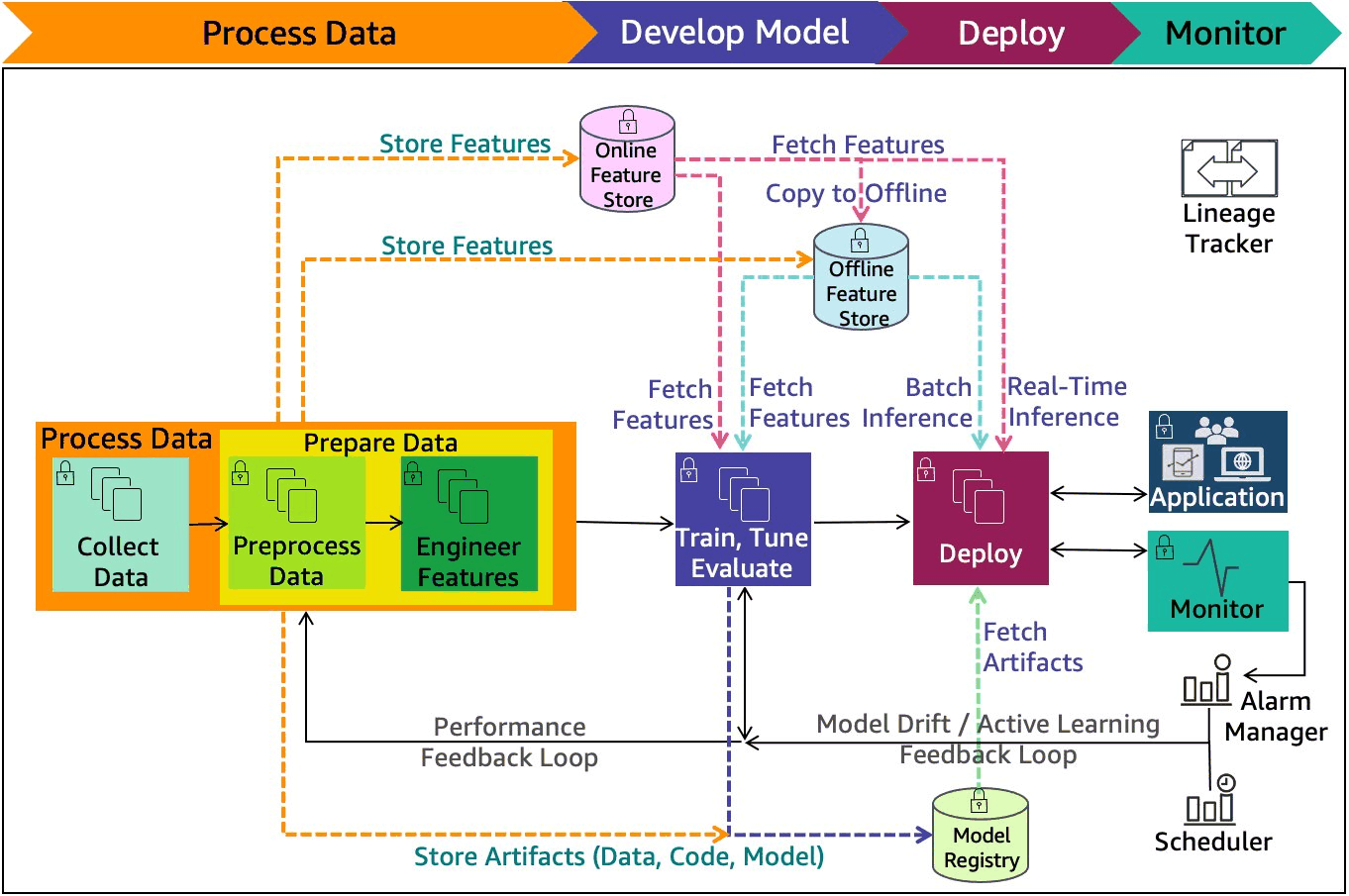
The first step in implementing machine learning is collecting the data that will be used to train and test the model. The data should be relevant to the problem that the machine learning model is being built to solve. Once the data has been collected, it needs to be preprocessed and cleaned to remove any inconsistencies or missing values.
The next step is to explore and visualize the data to gain insights into its structure and identify any patterns or trends. Data visualization tools such as matplotlib and seaborn can be used to create visualizations such as histograms, scatter plots, and heat maps.
The features of the data that are relevant to the problem need to be selected or engineered. Feature engineering involves creating new features from existing data that can improve the accuracy of the model.
Once the data has been prepared and features selected or engineered, the next step is to select a suitable machine learning algorithm to train the model. This involves splitting the data into training and testing sets and using the training set to fit the model. Various machine learning algorithms such as linear regression, logistic regression, decision trees, random forests, support vector machines, and neural networks can be used to train the model.
After training the model, it needs to be evaluated to determine its performance. The performance of the model can be evaluated using metrics such as accuracy, precision, recall, and F1 score. Cross-validation techniques can also be used to test the model's performance.
The performance of the model can be improved by tuning its hyperparameters. Hyperparameters are settings that are not learned from the data, but rather set by the user. The optimal values for these hyperparameters can be found using techniques such as grid search and random search.
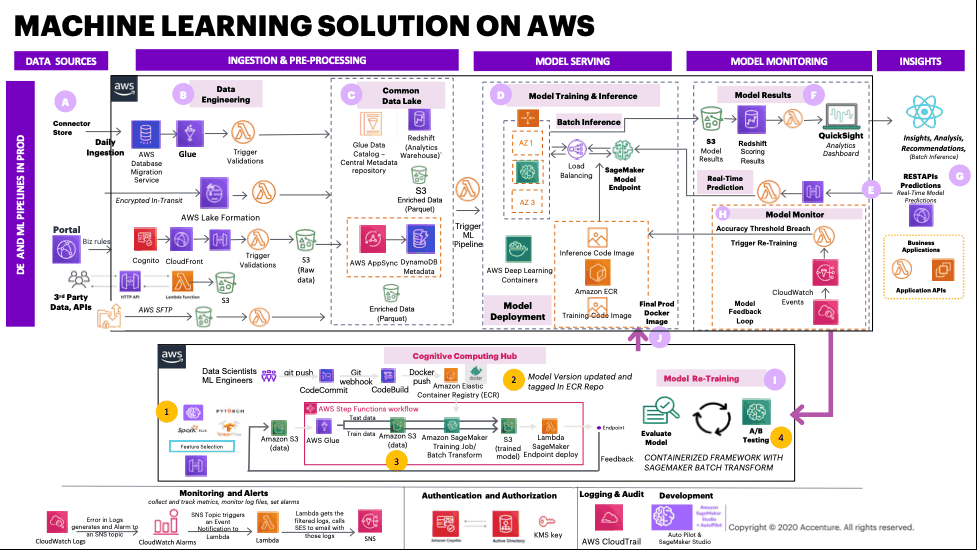
Once the model has been trained and tuned, it needs to be deployed to a production environment. The deployment process involves integrating the model into the business process or system. The model also needs to be monitored regularly to ensure that it continues to perform well and to identify any issues that need to be addressed.
Each of the above steps requires different tools and techniques, and successful implementation requires a combination of technical and business skills.
To develop ML applications, you will have to decide on the platform, the IDE and the language for development. There are several choices available. Most of these would meet your requirements easily as all of them provide the implementation of AI algorithms discussed so far.
If you are developing the ML algorithm on your own, the following aspects need to be understood carefully −
The language of your choice − this essentially is your proficiency in one of the languages supported in ML development.
The IDE that you use − This would depend on your familiarity with the existing IDEs and your comfort level.
Development platform − There are several platforms available for development and deployment. Most of these are free-to-use. In some cases, you may have to incur a license fee beyond a certain amount of usage. Here is a brief list of choice of languages, IDEs and platforms for your ready reference.
This list is not essentially comprehensive; however, it covers many popular languages used in machine learning development. Depending upon your comfort level, select a language for the development, develop your models and test.
The above list is not essentially comprehensive. Each one has its own merits and demerits. The reader is encouraged to try out these different IDEs before narrowing down to a single one.
4. Neural Network Backbone, Layer Specifications & Loss Formulations
Training, validation and testing sets are three essential components in building reliable machine learning models. The training set teaches the model patterns, the validation set helps fine‑tune hyperparameters and prevent overfitting and the testing set evaluates how well the model performs on completely unseen data.
The training set is the portion of the dataset used to fit the machine learning model. During training, the algorithm learns patterns, relationships and parameters (such as weights in neural networks or coefficients in regression models) directly from this data. The model repeatedly adjusts itself to minimize the training error using optimization techniques like gradient descent.
from sklearn.datasets import fetch_openml from sklearn.model_selection import train_test_split from sklearn.linear_model import LogisticRegression import pandas as pd titanic = fetch_openml ( name = "titanic" , version = 1 , as_frame = True ) data = titanic . frame data = data [[ "pclass" , "sex" , "age" , "fare" , "survived" ]] . copy () data [ "sex" ] = data [ "sex" ] . map ({ "male" : 0 , "female" : 1 }) data [ "age" ] = data [ "age" ] . fillna ( data [ "age" ] . median ()) data [ "fare" ] = data [ "fare" ] . fillna ( data [ "fare" ] . median ()) X = data . drop ( "survived" , axis = 1 ) y = data [ "survived" ] X_train , X_temp , y_train , y_temp = train_test_split ( X , y , test_size = 0.3 , random_state = 42 ) model = LogisticRegression ( max_iter = 300 ) model . fit ( X_train , y_train )
The validation set is a separate subset of data used to tune model hyperparameters and make design decisions during training. Unlike the training set, it is not used to update model weights directly. Instead, it provides an unbiased estimate of model performance during development.
X_val , X_test , y_val , y_test = train_test_split ( X_temp , y_temp , test_size = 0.5 , random_state = 42 ) validation_accuracy = model . score ( X_val , y_val ) print ( "Validation Accuracy:" , validation_accuracy )
The testing set is a completely independent subset used to evaluate the final model’s performance after all training and tuning are complete. It simulates how the model will perform on unseen, real-world data and provides the most reliable estimate of generalization.
test_accuracy = model . score ( X_test , y_test ) print ( "Test Accuracy:" , test_accuracy )
This course is part of Machine Learning Made Easy for Software Engineers Specialization
Build and train machine learning models by mapping real-world problems to appropriate ML tasks
Optimize and validate models using hyperparameter tuning, cross-validation, and feature analysis
Create automated ML pipelines that streamline feature engineering, training, and experimentation
Machine learning models rarely perform well without careful design, evaluation, and optimization. In this course, you'll learn how to build machine learning models and systematically improve their performance using proven engineering practices.
Youâll start by learning how to map business problems to appropriate machine learning tasks and train multiple model types using common ML libraries. Youâll explore how different algorithms behave under varying data conditions and learn how to justify model choices based on performance and bias-variance trade-offs. Next, youâll optimize models through systematic hyperparameter tuning and evaluate the computational cost of different algorithms to choose efficient solutions. Youâll also learn validation techniques such as cross-validation and stratified sampling to estimate model performance reliably. The course concludes by showing how to automate machine learning workflows. Youâll build end-to-end pipelines that streamline feature engineering, model training, and optimization so experiments can be reproduced and improved efficiently. By the end of this course, youâll understand how to design, optimize, and validate machine learning models that are ready for integration into larger ML systems.
You will analyze business requirements and translate them into appropriate machine learning task types, ensuring correct problem framing before modeling begins.
You will use ML APIs to train and compare multiple algorithms on structured datasets using reproducible workflows.
You will evaluate model behavior across algorithm families and justify selection decisions using biasâvariance reasoning and performance evidence.
You will examine default hyperparameters and computational complexity to understand how they influence model behavior and training cost.
You will design structured search strategies, run tuning experiments, and interpret cross-validated results to improve model performance.
5. Training Protocol, Convergence Behavior & Experimental Evaluation
You will benchmark training time, memory usage, and computational cost to select algorithms that meet performance and efficiency goals.
You will implement k-fold and stratified validation strategies to generate reliable performance estimates, especially for imbalanced datasets.
You will interpret feature-importance outputs and SHAP explanations to clearly communicate model behavior to technical and non-technical stakeholders.
You will construct, tune, and package an automated machine learning pipeline that integrates preprocessing, model training, and optimization into a reusable workflow.
Add this credential to your LinkedIn profile, resume, or CV. Share it on social media and in your performance review.
This course is designed for learners who already have programming experience and some familiarity with machine learning concepts. It focuses on practical techniques used to improve and validate models in real applications.
Youâll work with common machine learning tools and libraries such as scikit-learn and ML pipeline frameworks used to train, evaluate, and optimize models.
Validation techniques help ensure that a model performs reliably on new data. In this course, youâll learn methods such as cross-validation and feature importance analysis to assess model behavior and avoid overfitting.
To access course materials, assignments, and earn a Certificate, you'll need to purchase the Certificate experience when you enroll in a course. Eligible learners may also have the option to start with a Free Trial. Some courses may also offer a Full Course, No Certificate option. This lets you access course materials, submit required assessments, and receive a final grade, but you won't be able to earn or purchase a Certificate.
When you enroll in the course, you get access to all of the courses in the Specialization, and you earn a certificate when you complete the work. Your electronic Certificate will be added to your Accomplishments page - from there, you can print your Certificate or add it to your LinkedIn profile.
Yes. In select learning programs, you can apply for financial aid or a scholarship if you canât afford the enrollment fee. If fin aid or scholarship is available for your learning program selection, youâll find a link to apply on the description page.
¹ Some assignments in this course are AI-graded. For these assignments, your data will be used in accordance with Coursera's Privacy Notice .
Mathematical Formulation 1.1: Loss Objectives and Optimization Dynamics for Machine Learning Projects. The training protocol of machine learning projects minimizes an empirical risk objective defined across high-dimensional parameter space Theta in R^d. Categorical predictions are governed by Cross-Entropy Loss: L_CE = -sum(y_i * log(p_i)). To tackle class imbalance, the network incorporates Focal Loss: L_Focal = -alpha_t * (1 - p_t)^gamma * log(p_t), where gamma modulates the gradient penalty on hard misclassified instances. For spatial tasks, Dice Loss balances continuous spatial overlap: L_Dice = 1 - (2 * sum(y * y_hat) + eps) / (sum(y) + sum(y_hat) + eps). Stochastic optimization utilizes AdamW with decoupled weight decay, maintaining stable moment estimations m_t and v_t across variable learning rate schedules.
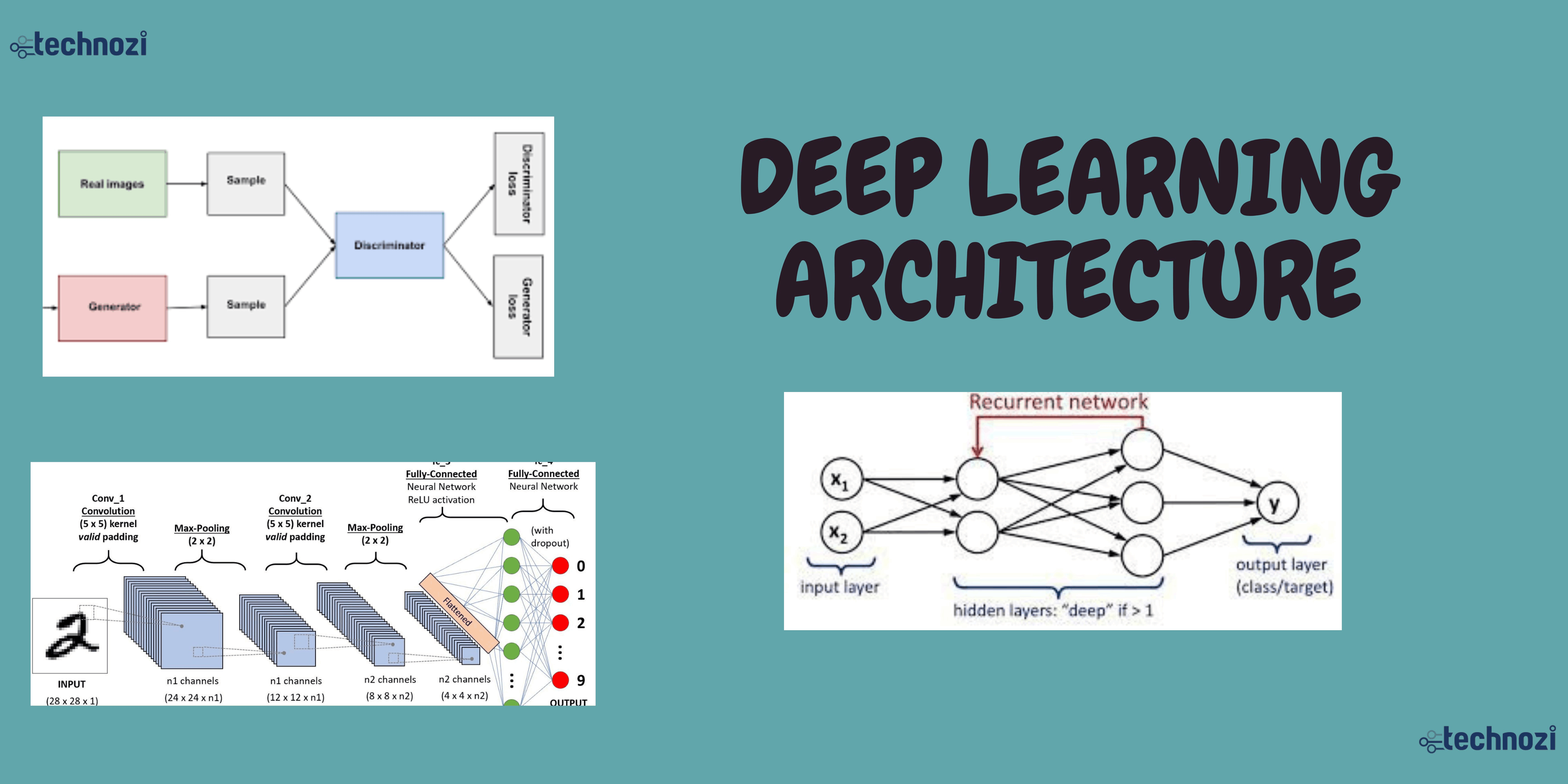
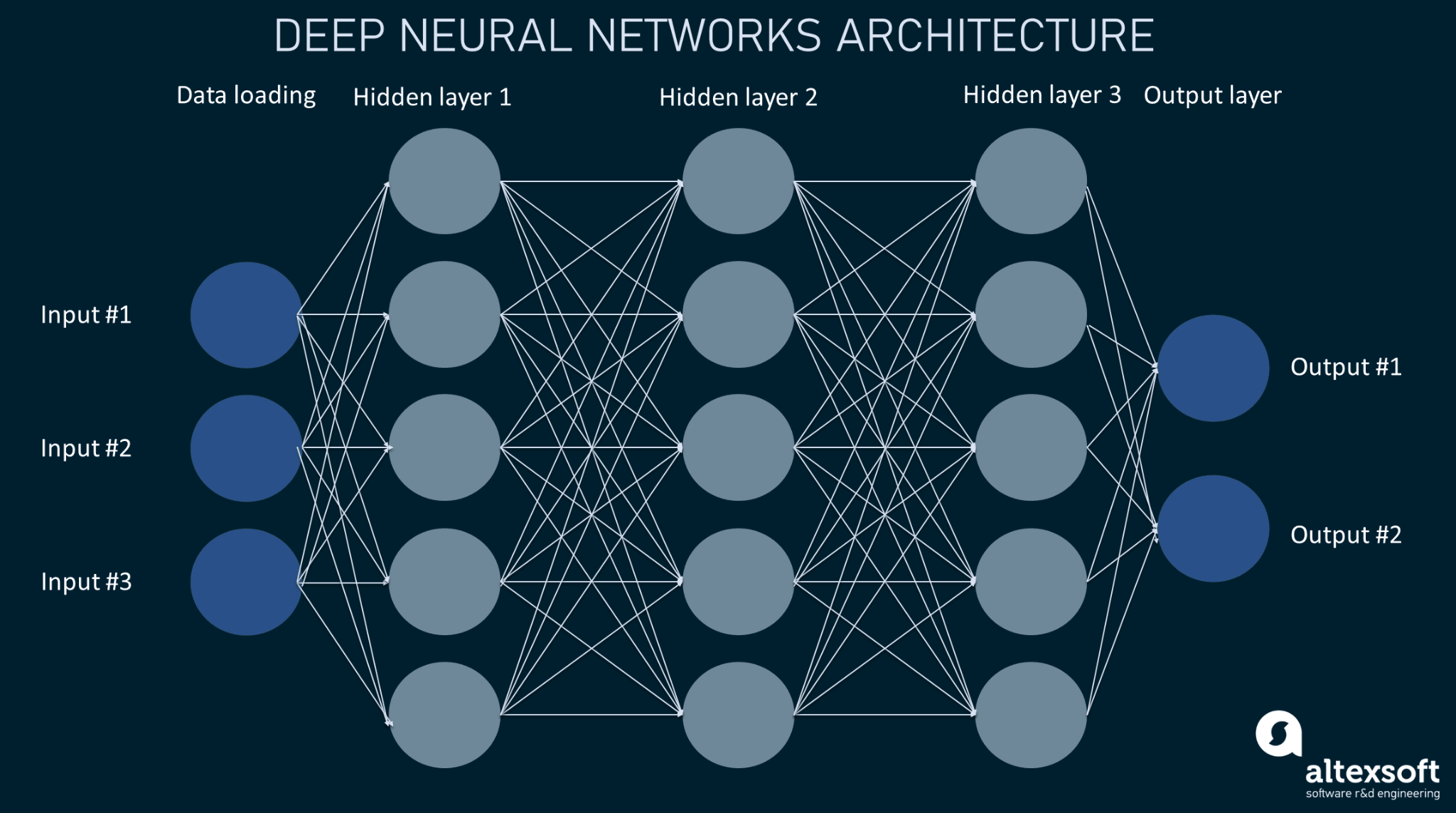
Architecture Specification 1.2: Feature Extraction and Layer Formulations for Machine Learning Projects. The primary computational backbone for Machine Learning Projects incorporates hierarchical deep neural layers designed for multi-scale representation extraction. Input tensors X in R^(B x C x H x W) pass through initial stem convolutions with Batch Normalization and GELU non-linearities. Residual identity skip connections, expressed as F(X) + X, prevent vanishing gradient degradation across deep topologies. Multi-head self-attention mechanisms compute Query, Key, and Value projections: Attention(Q, K, V) = softmax((Q * K^T) / sqrt(d_k)) * V, capturing non-local contextual dependencies across spatial and temporal sequences.
Data Pipeline 1.3: Stochastic Augmentation and Normalization Protocols for Machine Learning Projects. To prevent overfitting and maximize generalization on unseen testing distributions, input datasets undergo rigorous preprocessing. Images and sequences are standardized using z-score normalization: x_norm = (x - mu) / sigma. Stochastic augmentations include random horizontal flips, affine rotations (-15 deg to +15 deg), CutMix, and Mixup: X_tilde = lambda * X_i + (1 - lambda) * X_j, smoothing decision boundaries and reducing model overconfidence.
Deployment Optimization 1.4: TensorRT Acceleration and Edge Quantization for Machine Learning Projects. Production deployment of Machine Learning Projects focuses on minimizing memory footprints and sub-20ms inference latencies. Trained models are exported to ONNX and compiled via NVIDIA TensorRT. Post-Training Quantization (PTQ) maps FP32 weights into low-bit INT8 representations: q = round(r / S) + Z, achieving high-throughput execution across embedded edge platforms like NVIDIA Jetson without accuracy loss.
Mathematical Formulation 2.1: Loss Objectives and Optimization Dynamics for Machine Learning Projects. The training protocol of machine learning projects minimizes an empirical risk objective defined across high-dimensional parameter space Theta in R^d. Categorical predictions are governed by Cross-Entropy Loss: L_CE = -sum(y_i * log(p_i)). To tackle class imbalance, the network incorporates Focal Loss: L_Focal = -alpha_t * (1 - p_t)^gamma * log(p_t), where gamma modulates the gradient penalty on hard misclassified instances. For spatial tasks, Dice Loss balances continuous spatial overlap: L_Dice = 1 - (2 * sum(y * y_hat) + eps) / (sum(y) + sum(y_hat) + eps). Stochastic optimization utilizes AdamW with decoupled weight decay, maintaining stable moment estimations m_t and v_t across variable learning rate schedules.
Architecture Specification 2.2: Feature Extraction and Layer Formulations for Machine Learning Projects. The primary computational backbone for Machine Learning Projects incorporates hierarchical deep neural layers designed for multi-scale representation extraction. Input tensors X in R^(B x C x H x W) pass through initial stem convolutions with Batch Normalization and GELU non-linearities. Residual identity skip connections, expressed as F(X) + X, prevent vanishing gradient degradation across deep topologies. Multi-head self-attention mechanisms compute Query, Key, and Value projections: Attention(Q, K, V) = softmax((Q * K^T) / sqrt(d_k)) * V, capturing non-local contextual dependencies across spatial and temporal sequences.
Model Figures & Evaluation Curves (4 Images)
Deep Learning Execution Pipeline
(Preprocessing)
(Feature Extraction)
(Self-Attention)
(Loss Optimization)