Complete Technical Paper Content — Onnx Model Conversion
1. Executive Abstract, Problem Formulation & Background
TensorRT is a software development kit (SDK) and inference optimization runtime developed by Nvidia for deploying trained deep learning and machine learning models on graphics processing units (GPUs). It can import models from frameworks such as PyTorch, TensorFlow, and ONNX, and compile them into optimized runtime engines for low-latency and high-throughput inference. In current Nvidia documentation, the TensorRT name is also used for a broader product family that includes the core TensorRT SDK, TensorRT-LLM, and TensorRT-RTX. The core SDK is primarily a proprietary Nvidia product, although Nvidia also maintains Apache-licensed open-source TensorRT repositories and related companion projects.
MLIR (Multi-Level Intermediate Representation) is a compiler infrastructure project developed as a sub-project of the LLVM project. It provides a modular and extensible intermediate representation (IR) framework intended to facilitate constructing domain-specific compilers and improve compiling for heterogeneous computing platforms. MLIR supports multiple abstraction levels in one IR and introduces dialects, a mechanism for defining custom operations, types, and attributes tailored to specific domains. The system’s expanded name reflects the ability to model computations at various abstraction levels and progressively lower them toward machine code. It is free and open-source software released with an Apache License 2.0 with LLVM exceptions. MLIR was originally developed in 2018 by Chris Lattner at Google, and publicly released as part of LLVM in 2019. It was designed to address challenges in building compilers for modern workloads such as machine learning, hardware acceleration, and high-level synthesis by providing reusable components and standardizing the representation of intermediate computations across different programming languages and hardware targets. MLIR is used in a range of systems including TensorFlow, Mojo, TPU-MLIR, and others. It is maintained as part of the LLVM project.
This operation, named morph, belongs to the mydialect dialect. It takes one input operand (%input#3) of type custom_type and produces two output values of type other_type. The operation includes two attributes-some.attribute and other_attribute-and contains a region with a single block (^bb0) that accepts one argument. The loc keyword specifies source-level location information, which can be used for debugging or diagnostic reporting. The syntax of operations, types and attributes can also be customized according to the user preferences by implementing proper parsing and printing functions within the operation definition.
Although different dialects may be used to express similar computations, the level of abstraction and the intended compilation flow may vary. In the example above, the affine dialect enables polyhedral analysis and optimizations, while the memref and arith dialects express memory and arithmetic operations, respectively.
Another possible strategy, however, could have been to use the gpu dialect to generate code for GPUs:
2. Related Work, Literature Survey & Algorithmic Foundations
Onnx Conversion A curated collection of notebooks and scripts demonstrating the end-to-end pipeline for converting Deep Learning models to ONNX. Features performance benchmarks, graph validation, and cross-framework deployment examples. Features - Installation - Repository Setup - Usage - Configuration - Contributing - License - Contact Overview A curated collection of notebooks and scripts demonstrating the end-to-end pipeline for converting Deep Learning models to ONNX. Features performance benchmarks, graph validation, and cross-framework deployment examples. Repository Structure Path Description assets/ Images, figures, or other supporting media used by the project. notebooks/ Exploratory notebooks and experiment walkthroughs. .gitignore Top-level file included in the repository. LICENSE Repository license information. README.md Primary project documentation. requirements.txt Python dependency specification for local setup. Getting Started Clone the repository. git clone https://github.com/devMuniz02/Onnx-conversion.git cd Onnx-conversion Prepare the local environment. Install Python dependencies: pip install -r requirements.txt Run or inspect the project entry point. Use the project-specific scripts or notebooks in the repository root to run the workflow. Features PyTorch to ONNX Conversion : Convert PyTorch models to ONNX format with ease Model Validation : Validate exported ONNX models for correctness ONNX Runtime Inference : Run inference using ONNX Runtime for performance benchmarking Graph Visualization : Side-by-side comparison of PyTorch and ONNX computational graphs with custom layouts Jupyter Notebooks : Interactive examples and tutorials for model conversion Cross-Framework Support : Examples for converting models from various deep learning frameworks Installation Prerequisites Python 3.8+ Git Installation Steps # Clone the repository git clone https://github.com/devMuniz02/Onnx-conversion.git # Navigate to the project directory cd Onnx-conversion # Install dependencies pip install -r requirements.txt Usage Basic Usage Install dependencies: pip install -r requirements.txt Open the Jupyter notebook: jupyter notebook notebooks/conversion.ipynb Run the cells to convert a PyTorch model to ONNX and validate it Running the Conversion Example The notebooks/conversion.ipynb demonstrates: Defining a simple PyTorch neural network (3-layer MLP) Exporting it to ONNX format Loading and running inference with ONNX Runtime Validating model outputs for correctness Visualizing and comparing PyTorch vs ONNX computational graphs side-by-side Advanced Usage For more complex models, modify the notebook to: Use your own PyTorch model Adjust input shapes and dynamic axes Add custom preprocessing/postprocessing Customize graph visualization layouts and styling The notebook generates a model_flow.png image in the assets/ folder showcasing the graph comparison. License This project is licensed under the MIT License - see the LICENSE file for details. Links: GitHub: https://github.com/devMuniz02/ LinkedIn: https://www.linkedin.com/in/devmuniz Hugging Face: https://huggingface.co/manu02 Portfolio: https://devmuniz02.github.io/ Project Link: https://github.com/devMuniz02/Onnx-conversion ⭐ If you find this project helpful, please give it a star! Table of Contents Features Installation Repository Setup Usage Configuration Contributing License Contact Project Structure Onnx-conversion/ ├── assets/ # Static assets (images, icons, etc.) ├── data/ # Data files and datasets ├── docs/ # Documentation files ├── notebooks/ # Jupyter notebooks for conversion examples │ └── conversion.ipynb # PyTorch to ONNX conversion demo ├── scripts/ # Utility scripts and automation tools ├── src/ # Source code ├── tests/ # Unit tests and test files ├── model.onnx # Exported ONNX model example ├── LICENSE # License file ├── README.md # Project documentation └── requirements.txt # Python dependencies Directory Descriptions assets/ : Store static files like images, icons, fonts, and other media assets. data/ : Place datasets, input files, and any data-related resources here. docs/ : Additional documentation, guides, and project-related files. notebooks/ : Jupyter notebooks for data exploration, prototyping, and demonstrations. scripts/ : Utility scripts for automation, setup, deployment, or maintenance tasks. src/ : Main source code for the project. tests/ : Unit tests, integration tests, and test-related files. Visualization Examples Here are examples of the computational graph visualizations generated by the notebook: Simple MLP Model Comparison Complex Residual CNN Model Comparison ️ Configuration ONNX Opset Version : The notebook uses opset version 11, which is widely supported Dynamic Axes : Configured for variable batch sizes ONNX Runtime : Supports both CPU and GPU execution (if CUDA is available) Graph Visualization : Custom matplotlib-based plotting with per-label text box sizing for optimal fit
A curated collection of notebooks and scripts demonstrating the end-to-end pipeline for converting Deep Learning models to ONNX. Features performance benchmarks, graph validation, and cross-framework deployment examples.
A curated collection of notebooks and scripts demonstrating the end-to-end pipeline for converting Deep Learning models to ONNX. Features performance benchmarks, graph validation, and cross-framework deployment examples.
Use the project-specific scripts or notebooks in the repository root to run the workflow.
# Clone the repository git clone https://github.com/devMuniz02/Onnx-conversion.git # Navigate to the project directory cd Onnx-conversion # Install dependencies pip install -r requirements.txt
3. Dataset Ingestion, Preprocessing & Stochastic Augmentations
The notebook generates a model_flow.png image in the assets/ folder showcasing the graph comparison.
Onnx-conversion/ ├── assets/ # Static assets (images, icons, etc.) ├── data/ # Data files and datasets ├── docs/ # Documentation files ├── notebooks/ # Jupyter notebooks for conversion examples │ └── conversion.ipynb # PyTorch to ONNX conversion demo ├── scripts/ # Utility scripts and automation tools ├── src/ # Source code ├── tests/ # Unit tests and test files ├── model.onnx # Exported ONNX model example ├── LICENSE # License file ├── README.md # Project documentation └── requirements.txt # Python dependencies
Here are examples of the computational graph visualizations generated by the notebook:
ONNX Tutorials Open Neural Network Exchange (ONNX) is an open standard format for representing machine learning models. ONNX is supported by a community of partners who have implemented it in many frameworks and tools. Getting ONNX models Pre-trained models (validated): Many pre-trained ONNX models are provided for common scenarios in the ONNX Model Zoo Pre-trained models (non-validated): Many pre-trained ONNX models are provided for common scenarios in the ONNX Model Zoo . Services: Customized ONNX models are generated for your data by cloud based services (see below) Convert models from various frameworks (see below) Services Below is a list of services that can output ONNX models customized for your data. Azure Custom Vision service Azure Machine Learning automated ML Lobe desktop app Converting to ONNX format Framework / Tool Installation Tutorial Caffe apple/coremltools and onnx/onnxmltools Example Caffe2 part of caffe2 package Example Chainer chainer/onnx-chainer Example Cognitive Toolkit (CNTK) built-in Example CoreML (Apple) onnx/onnxmltools Example JAX enpasos/jax2onnx / pip install jax2onnx ( PyPI ) Getting Started Keras onnx/tensorflow-onnx Example LibSVM onnx/onnxmltools Example LightGBM onnx/onnxmltools Example MATLAB Deep Learning Toolbox Example ML.NET built-in Example MXNet (Apache) part of mxnet package docs github Example PyTorch part of pytorch package Example1 , Example2 , export for Windows ML , Extending support SciKit-Learn onnx/sklearn-onnx Example SINGA (Apache) - Github (experimental) built-in Example TensorFlow onnx/tensorflow-onnx Examples Scoring ONNX Models Once you have an ONNX model, it can be scored with a variety of tools. Framework / Tool Installation Tutorial Caffe2 Caffe2 Example Cognitive Toolkit (CNTK) built-in Example CoreML (Apple) onnx/onnx-coreml Example MATLAB Deep Learning Toolbox Converter Documentation and Examples Menoh Github Packages or from Nuget Example ML.NET Microsoft.ML Nuget Package Example MXNet (Apache) - Github MXNet API Example ONNX Runtime See onnxruntime.ai Documentation SINGA (Apache) - Github [experimental] built-in Example Tensorflow onnx-tensorflow Example TensorRT onnx-tensorrt Example Windows ML Pre-installed on Windows 10 API Tutorials - C++ Desktop App , C# UWP App Examples Vespa.ai Vespa Getting Started Guide Real Time ONNX Inference Distributed Real Time ONNX Inference for Search and Passage Ranking End-to-End Tutorials Tutorials demonstrating how to use ONNX in practice for varied scenarios across frameworks, platforms, and device types General AI-Serving AWS Lambda Cortex MXNet MXNet Model Server AWS SageMaker and MXNet MXNet to ONNX to ML.NET with SageMaker, ECS and ECR - external link ONNX Runtime ONNX Runtime Tutorials Azure ML and ONNX Runtime Mobile Converting SuperResolution model from PyTorch to Caffe2 with ONNX and deploying on mobile device Transferring SqueezeNet from PyTorch to Caffe2 with ONNX and to Android app Converting Style Transfer model from PyTorch to CoreML with ONNX and deploying to an iPhone Deploy ONNX Runtime on Mobile/Edge devices ONNX Quantization HuggingFace Bert Quantization with ONNX Runtime ONNX as an intermediary format Convert a PyTorch model to Tensorflow using ONNX ONNX Custom Operators How to export Pytorch model with custom op to ONNX and run it in ONNX Runtime Visualizing ONNX Models Netdrawer: Visualizing ONNX models Netron: Viewer for ONNX models Zetane: 3D visualizer for ONNX models and internal tensors Other ONNX tools Verifying correctness and comparing performance Example of operating on ONNX protobuf Float16 <-> Float32 converter Version conversion Application of ONNX Explainable AI for ONNX models Contributing We welcome improvements to the convertor tools and contributions of new ONNX bindings. Check out contributor guide to get started. Use ONNX for something cool? Send the tutorial to this repo by submitting a PR.
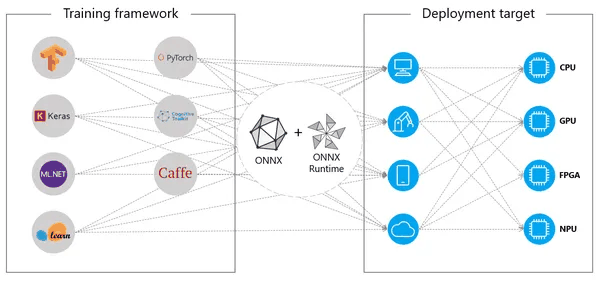
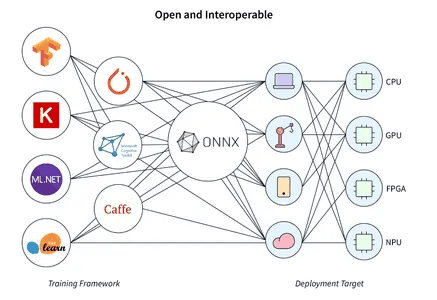
Open Neural Network Exchange (ONNX) is an open standard format for representing machine learning models. ONNX is supported by a community of partners who have implemented it in many frameworks and tools.
4. Neural Network Backbone, Layer Specifications & Loss Formulations
Tutorials demonstrating how to use ONNX in practice for varied scenarios across frameworks, platforms, and device types
We welcome improvements to the convertor tools and contributions of new ONNX bindings. Check out contributor guide to get started.
The project will be updated continuously ...... Pull requests are welcome! Deep Learning Model Convertors Note: This is not one convertor for all frameworks, but a collection of different converters. Because github is an open source platform, I hope we can help each other here, gather everyone's strength. Because of these different frameworks, the awesome convertors of deep learning models for different frameworks occur. It should be noted that I did not test all the converters, so I could not guarantee that each was available. But I also hope this convertor collection may help you! The sheet below is a overview of all convertors in github (not only contain official provided and more are user-self implementations). I just make a little work to collect these convertors. Also, hope everyone can support this project to help more people who're also crazy because of various frameworks. convertor mxnet caffe ✨ caffe2 CNTK theano / lasagne neon pytorch ✨ torch keras ✨ darknet tensorflow ✨ chainer coreML/iOS ✨ paddle ONNX mxnet - MMdnn MXNet2Caffe Mxnet2Caffe MMdnn (through ONNX) MMdnn None None MMdnn gluon2pytorch None MMdnn None MMdnn None mxnet-to-coreml MMdnn None None caffe ✨ mxnet/tools/caffe_converter ResNet_caffe2mxnet MMdnn - CaffeToCaffe2 MMdnn (through ONNX) crosstalkcaffe/CaffeConverter MMdnn caffe_theano_conversion caffe-model-convert caffe-to-theano caffe2neon MMdnn pytorch-caffe pytorch-resnet googlenet-caffe2torch mocha loadcaffe keras-caffe-converter caffe_weight_converter caffe2keras nn_tools keras caffe2keras Deep_Learning_Model_Converter MMdnn pytorch-caffe-darknet-convert MMdnn nn_tools caffe-tensorflow None CoreMLZoo apple/coremltools MMdnn X2Paddle caffe2onnx caffe2 None None - ONNX None None ONNX None None None None None None None None CNTK MMdnn MMdnn ONNX MMdnn (through ONNX) - None None ONNX MMdnn None MMdnn None MMdnn None MMdnn None None theano / lasagne None None None None - None None None None None None None None None None neon None None None None None - None None None None None None None None None pytorch ✨ MMdnn brocolli PytorchToCaffe MMdnn pytorch2caffe pytorch-caffe-darknet-convert onnx-caffe2 MMdnn (through ONNX) ONNX MMdnn None None - None MMdnn pytorch2keras nn-transfer pytorch-caffe-darknet-convert MMdnn pytorch2keras (over Keras) pytorch-tf None MMdnn onnx-coreml None None torch None fb-caffe-exts/torch2caffe mocha trans-torch th2caffe Torch2Caffe2 None None None convert_torch_to_pytorch - None None None None torch2coreml torch2ios None None keras ✨ MMdnn keras-caffe-converter MMdnn nn_tools keras2caffe MMdnn (through ONNX) MMdnn None None MMdnn nn-transfer None - None nn_tools convert-to-tensorflow keras_to_tensorflow keras_to_tensorflow MMdnn None apple/coremltools ✨ model-converters keras_models MMdnn None None darknet None pytorch-caffe-darknet-convert None MMdnn None None pytorch-caffe-darknet-convert None MMdnn - DW2TF darkflow lego_yolo None None None None tensorflow ✨ MMdnn MMdnn nn_tools MMdnn (through ONNX) crosstalk MMdnn None None pytorch-tf MMdnn None model-converters nn_tools convert-to-tensorflow MMdnn None - None tfcoreml MMdnn X2Paddle None chainer None None None None None None chainer2pytorch None None None None - None None None coreML/iOS ✨ MMdnn MMdnn MMdnn (through ONNX) MMdnn None None MMdnn None MMdnn None MMdnn None - None paddle None None None None None None None None None None None None None - None ONNX None None None None None None onnx2torch onnx2torch None None None None None None X2Paddle - Brief Intro of Convertors Open Neural Network Exchange General framework for converting between all kinds of neural networks ONNX is an effort to unify converters for neural networks in order to bring some sanity to the NN world. Released by Facebook and Microsoft. More info here . MMdnn MMdnn is a set of tools to help users inter-operate among different deep learning frameworks. E.g. model conversion and visualization. Convert models between CaffeEmit, CNTK, CoreML, Keras, MXNet, ONNX, PyTorch and TensorFlow. MXNet convertor Convert to MXNet model . mdering/CoreMLZoo: A few models converted from caffe to CoreMLs format A few deep learning models converted from various formats to CoreMLs format. Models currently available: SqueezeNet VGG19 Please feel free to create a pull request with additional models. mxnet/tools/caffe_converter Key topics covered include the following: Converting Caffe trained models to MXNet Calling Caffe operators in MXNet More concretly, please refer to mxnet/tools/caffe_converter and How to | Convert from Caffe to MXNet . nicklhy/ResNet_caffe2mxnet This is a tool to convert the deep-residual-networks from caffe model to mxnet model. The weights are directly copied from caffe network blobs. Caffe convertor Convert to Caffe model . keras-caffe-converter It is a converter between Keras and Caffe in both ways. It works using only the Keras model to generate both the caffemodel and prototxt files, but it is also possible to pass it the prototxt file with the description of the model if you have it. brocolli Support 1.9.0 or higher Pytorch pytorch2caffe Convert PyTorch model to Caffemodel. cypw/MXNet2Caffe Convert MXNet model to Caffe model. wranglerwong/Mxnet2Caffe: Convert MXNet model to Caffe model Convert MXNet model to Caffe model. kuangliu/mocha Convert torch model to/from caffe model easily. uhfband/keras2caffe: Keras to Caffe model converter tool This tool tested with Caffe 1.0, Keras 2.1.2 and TensorFlow 1.4.0 Working conversion examples: Inception V3 Inception V4 ( https://github.com/kentsommer/keras-inceptionV4 ) Xception V1 SqueezeNet ( https://github.com/rcmalli/keras-squeezenet ) VGG16 Problem layers: ZeroPadding2D MaxPooling2D and AveragePooling2D with asymmetric padding facebook/fb-caffe-exts/torch2caffe Some handy utility libraries and tools for the Caffe deep learning framework, which has ** A library for converting pre-trained Torch models to the equivalent Caffe models.** pytorch-caffe-darknet-convert Convert between pytorch, caffe and darknet models. Caffe darknet models can be load directly by pytorch. Teaonly/trans-torch Translating Torch model to other framework such as Caffe, MxNet ... e-lab/th2caffe A torch-nn to caffe converter for specific layers. hahnyuan/nn_tools a neural network convertor for models among caffe tensorflow keras xxradon/PytorchToCaffe: Pytorch model to caffe model, supported pytorch 0.3, 0.3.1, 0.4, 0.4.1 ,1.0 , 1.0.1 , 1.2 ,1.3 .notice that only pytorch 1.1 have some bugs Providing a tool for neural network frameworks for pytorch and caffe. The nn_tools is released under the MIT License (refer to the LICENSE file for details). features: Converting a pytorch model to caffe model. Some convenient tools of manipulate caffemodel and prototxt quickly(like get or set weights of layers). Support pytorch version >= 0.2.(Have tested on 0.3,0.3.1, 0.4, 0.4.1 ,1.0, 1.2) Analysing a model, get the operations number(ops) in every layers. Noting: pytorch version 1.1 is not supported now requirements Python2.7 or Python3.x Each functions in this tools requires corresponding neural network python package (pytorch and so on). Caffe2 convertor Convert to Caffe2 model . CaffeToCaffe2 This is an official convertor, which not only provoide a script also an ipython notebook as below: caffe2/Getting_Caffe1_Models_for_Translation.ipynb at master · caffe2/caffe2 caffe2/caffe_translator.py at master · caffe2/caffe2 onnx-caffe2 Convert PyTorch to Caffe2 (making it especially easy to deploy on mobile devices) CNTK convertor Convert to CNTK model . crosstalkcaffe/CaffeConverter The tool will help you convert trained models from Caffe to CNTK. Convert trained models: giving a model script and its weights file, export to CNTK model. crosstalk crosstalk is from CNTK contrib. Theano/Lasagne convertor Convert to Theano/Lasagne model . an-kumar/caffe-theano-conversion This is part of a project for CS231N at Stanford University, written by Ankit Kumar, Mathematics major, Class of 2015 This is a repository that allows you to convert pretrained caffe models into models in Lasagne, a thin wrapper around Theano. You can also convert a caffe model's architecture to an equivalent one in Lasagne. You do not need caffe installed to use this module. Currently, the following caffe layers are supported: * Convolution * LRN * Pooling * Inner Product * Relu * Softmax kencoken/caffe-model-convert Convert models from Caffe to Theano format. piergiaj/caffe-to-theano Convert a Caffe Model to a Theano Model. This currently works on AlexNet, but should work for any Caffe model that only includes layers that have been impemented. Neon convertor Convert to Neon model . NervanaSystems/caffe2neon Tools to convert Caffe models to neon's serialization format. This repo contains tools to convert Caffe models into a format compatible with the neon deep learning library . The main script, "decaffeinate.py", takes as input a caffe model definition file and the corresponding model weights file and returns a neon serialized model file. This output file can be used to instantiate the neon Model object, which will generate a model in neon that should replicate the behavior of the Caffe model. PyTorch convertor Convert to PyTorch model . nerox8664/gluon2pytorch Convert mxnet / gluon graph to PyTorch source + weights. ruotianluo/pytorch-resnet Convert resnet trained in caffe to pytorch model. clcarwin/convert_torch_to_pytorch Convert torch t7 model to pytorch model and source. vzhong/chainer2pytorch chainer2pytorch implements conversions from Chainer modules to PyTorch modules, setting parameters of each modules such that one can port over models on a module basis. pytorch-caffe Load caffe prototxt and weights directly in pytorch without explicitly converting model from caffe to pytorch. nn-transfer Convert between Keras and PyTorch models. Torch convertor Convert to Torch model . kmatzen/googlenet-caffe2torch Converts bvlc_googlenet.caffemodel to a Torch nn model. Want to use the pre-trained GoogLeNet from the BVLC Model Zoo in Torch? Do you not want to use Caffe as an additional dependency inside Torch? Use these two scripts to build the network definition in Torch and copy the learned weights from the Caffe model. kuangliu/mocha Convert torch model to/from caffe model easily. szagoruyko/loadcaffe Convert caffe model to a Torch nn.Sequential model. Keras convertor Convert to Keras model . AlexPasqua/keras-caffe-converter It is a both-ways converter between Keras and Caffe. It takes the weights from the .caffemodel using caffe_weight_converter and generates an equivalent Keras model. It also outputs the Python source code used to generate that Keras model. AlexPasqua/caffe_weight_converter This project is used as a part of the previous one on this list: AlexPasqua/keras-caffe-converter , which is more complete, documented and easy to use. I'd recommend using that one instead. This is a Caffe-to-Keras weight converter, i.e. it converts .caffemodel weight files to Keras-2-compatible HDF5 weight files. It can also export .caffemodel weights as Numpy arrays for further processing. This converter converts the weights of a model only (not the model definition), which has the great advantage that it doesn't break every time it encounters an unknown layer type like other converters to that try to translate the model definition as well. The downside, of course, is that you'll have to write the model definition yourself. The repository also provides converted weights for some popular models. qxcv/caffe2keras Note: This converter has been adapted from code in Marc Bolaños fork of Caffe . See acks for code provenance. This is intended to serve as a conversion module for Caffe models to Keras models. Please, be aware that this module is not regularly maintained. Thus, some layers or parameter definitions introduced in newer versions of either Keras or Caffe might not be compatible with the converter. Pull requests welcome! hahnyuan/nn_tools a neural network convertor for models among caffe tensorflow keras MarcBS/keras Keras' fork with several new functionalities. Caffe2Keras converter, multimodal layers, etc. https://github.com/MarcBS/keras This fork of Keras offers the following contributions: Caffe to Keras conversion module Layer-specific learning rates New layers for multimodal data Contact email: marc.bolanos@ub.edu GitHub page: https://github.com/MarcBS MarcBS/keras is compatible with: Python 2.7 and Theano only. OdinLin/caffe2keras a simple tool to translate caffe model to keras model. jamescfli/Deep_Learning_Model_Converter nn-transfer Convert between Keras and PyTorch models. pytorch2keras Convert pytorch models to Keras. Darknet convertor Convert to Darknet model . pytorch-caffe-darknet-convert Convert between pytorch, caffe and darknet models. Caffe darknet models can be load directly by pytorch. TensorFlow convertor Convert to TensorFlow model . crosstalk crosstalk is from CNTK. triagemd/model-converters: Tools for converting Keras models for use with other ML frameworks Tools for converting Keras models for use with other ML frameworks (coreML, TensorFlow). hahnyuan/nn_tools a neural network convertor for models among caffe tensorflow keras ethereon/caffe-tensorflow: Caffe models in TensorFlow Convert Caffe models to TensorFlow. goranrauker/convert-to-tensorflow Converts a variety of trained models to a frozen tensorflow protocol buffer file for use with the c++ tensorflow api. C++ code is included for using the frozen models. thtrieu/darkflow Translate darknet to tensorflow. Load trained weights, retrain/fine-tune using tensorflow, export constant graph def to mobile devices. dEcmir/lego_yolo Tensorflow code to to retrain yolo on a new dataset using weights from darknet This repository contains experiments of transfer learning using YOLO on a new synthetical LEGO data set ROUGH AND UNDOCUMENTED! alanswx/keras_to_tensorflow Convert keras models to tensorflow frozen graph for use on cell phones, etc. amir-abdi/keras_to_tensorflow General code to convert a trained keras model into an inference tensorflow model. leonidk/pytorch-tf Converting a pretrained pytorch model to tensorflow pytorch2keras Convert pytorch models to Tensorflow (via Keras) jinyu121/DW2TF: Darknet Weights to TensorFlow This is a simple convector which converts Darknet weights file (.weights) to Tensorflow weights file (.ckpt). leonidk/pytorch-tf No readme. Chainer convertor Convert to Chainer model . coreML convertor Convert to coreML model . Apple: Converting Trained Models to Core ML Convert trained models created with third-party machine learning tools to the Core ML model format. If your model is created and trained using a supported third-party machine learning tool, you can use Core ML Tools to convert it to the Core ML model format. Table 1 lists the supported models and third-party tools. Model type Supported models Supported tools Neural networks Feedforward, convolutional, recurrent Caffe v1 Keras 1.2.2+ Tree ensembles Random forests, boosted trees, decision trees scikit-learn 0.18 XGBoost 0.6 Support vector machines Scalar regression, multiclass classification scikit-learn 0.18 LIBSVM 3.22 Generalized linear models Linear regression, logistic regression scikit-learn 0.18 Feature engineering Sparse vectorization, dense vectorization, categorical processing scikit-learn 0.18 Pipeline models Sequentially chained models scikit-learn 0.18 mxnet/tools/mxnet-to-coreml Convert MXNet models into Apple CoreML format. This tool helps convert MXNet models into Apple CoreML format which can then be run on Apple devices. prisma-ai/torch2coreml: Torch7 -> CoreML This tool helps convert Torch7 models into Apple CoreML format which can then be run on Apple devices. woffle/torch2ios: Torch7 Library - Convert NN Models To iOS Format Torch7 Library - Convert NN Models To iOS Format. Small lib to serialise Torch7 Networks for iOS. Supported Layers include Fully Connected, Pooling and Convolution Layers at present. The library stores the weights & biases (if any) for each layer necesarry for inference on iOS devices. Bulochkin/keras_models: Keras models with python-based convertor to provide embedding in IOS platform Keras models with python-based convertor to provide embedding in IOS platform. triagemd/model-converters: Tools for converting Keras models for use with other ML frameworks Tools for converting Keras models for use with other ML frameworks (coreML, TensorFlow). Apple & Google: Tensorflow to CoreML converter Google collaborated with Apple to create a Tensorflow to CoreML converter announcement . Support for Core ML is provided through a tool that takes a TensorFlow model and converts it to the Core ML Model Format (.mlmodel). Paddle convertor Convert to Paddle model . PaddlePaddle/X2Paddle: X2Paddle is a toolkit for converting trained model to PaddlePaddle from other deep learning frameworks. 支持主流深度学习框架模型转换至PaddlePaddle『飞桨』 X2Paddle is a toolkit for converting trained model to PaddlePaddle from other deep learning frameworks. More detailed models: X2Paddle/x2paddle_model_zoo.md at develop · PaddlePaddle/X2Paddle
Note: This is not one convertor for all frameworks, but a collection of different converters. Because github is an open source platform, I hope we can help each other here, gather everyone's strength.
Because of these different frameworks, the awesome convertors of deep learning models for different frameworks occur. It should be noted that I did not test all the converters, so I could not guarantee that each was available. But I also hope this convertor collection may help you!
5. Training Protocol, Convergence Behavior & Experimental Evaluation
The sheet below is a overview of all convertors in github (not only contain official provided and more are user-self implementations). I just make a little work to collect these convertors. Also, hope everyone can support this project to help more people who're also crazy because of various frameworks.
ONNX is an effort to unify converters for neural networks in order to bring some sanity to the NN world. Released by Facebook and Microsoft. More info here .
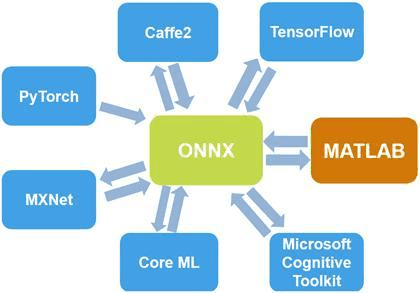
MMdnn is a set of tools to help users inter-operate among different deep learning frameworks. E.g. model conversion and visualization. Convert models between CaffeEmit, CNTK, CoreML, Keras, MXNet, ONNX, PyTorch and TensorFlow.
A few deep learning models converted from various formats to CoreMLs format. Models currently available:
This is a tool to convert the deep-residual-networks from caffe model to mxnet model. The weights are directly copied from caffe network blobs.
Model Figures & Evaluation Curves (4 Images)

Deep Learning Execution Pipeline
(Preprocessing)
(Feature Extraction)
(Self-Attention)
(Loss Optimization)