Complete Technical Paper Content — Precision Farming Ai
1. Executive Abstract, Problem Formulation & Background
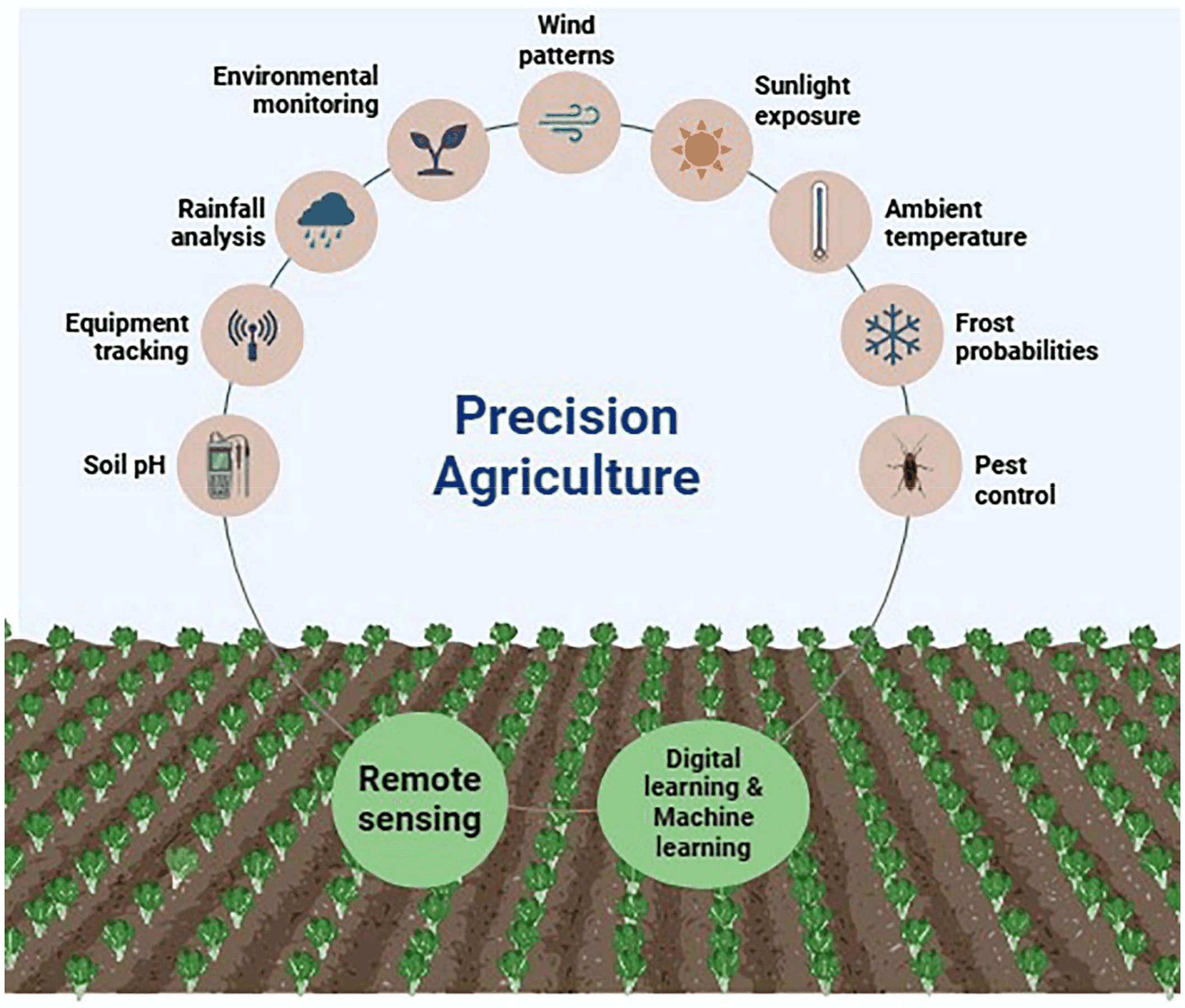
Precision agriculture is a management strategy that gathers, processes and analyzes temporal, spatial and individual plant and animal data and combines it with other information to support management decisions according to estimated variability for improved resource use efficiency, productivity, quality, profitability and sustainability of agricultural production. It is used in both crop and livestock production. A central component of implementing this strategy is the satellite monitoring of agricultural machinery, which forms the basis for modern farm fleet management. This is achieved through the use of fleet telematics systems, where vehicles are equipped with a GPS tracking unit and an onboard controller that transmits telemetry data—such as location, speed, engine hours, and fuel consumption—to a central server for analysis. This stream of real-time data allows for the automation of agricultural operations and provides critical insights for improving diagnosis and decision-making. Beyond machinery, precision agriculture also analyzes the spatial variability within fields, such as how terrain attributes (geomorphology) and soil properties affect crop growth and water distribution (hydrology).[] The goal of precision agriculture research is to define a decision support system for whole farm management with the goal of optimizing returns on inputs while preserving resources. The practice of precision agriculture has been enabled by the advent of GPS and GNSS. The farmer's and/or researcher's ability to locate their precise position in a field allows for the creation of maps of the spatial variability of as many variables as can be measured (e.g. crop yield, terrain features/topography, organic matter content, moisture levels, nitrogen levels, pH, EC, Mg, K, and others). Similar data is collected by sensor arrays mounted on GPS-equipped combine harvesters. These arrays consist of real-time sensors that measure everything from chlorophyll levels to plant water status, along with multispectral imagery. This data is used in conjunction with satellite imagery by variable rate technology (VRT) including seeders, sprayers, etc. to optimally distribute resources. However, recent technological advances have enabled the use of real-time sensors directly in soil, which can wirelessly transmit data without the need of human presence. Precision agriculture can benefit from unmanned aerial vehicles, that are relatively inexpensive and can be operated by novice pilots. These agricultural drones can be equipped with multispectral or RGB cameras to capture many images of a field that can be stitched together using photogrammetric methods to create orthophotos. These multispectral images contain multiple values per pixel in addition to the traditional red, green blue values such as near infrared and red-edge spectrum values used to process and analyze vegetative indexes such as NDVI maps. These drones are capable of capturing imagery and providing additional geographical references such as elevation, which allows software to perform map algebra functions to build precise topography maps. These topographic maps can be used to correlate crop health with topography, the results of which can be used to optimize crop inputs such as water, fertilizer or chemicals such as herbicides and growth regulators through variable rate applications.
Precision agriculture is a key component of the third wave of modern agricultural revolutions. The first agricultural revolution was the increase of mechanized agriculture, from 1900 to 1930. Each farmer produced enough food to feed about 26 people during this time. The 1960s prompted the Green Revolution with new methods of genetic modification, which led to each farmer feeding about 156 people. It is expected that by 2050, the global population will reach about 9.6 billion, and food production must effectively double from current levels in order to feed every mouth. With new technological advancements in the agricultural revolution of precision farming, each farmer will be able to feed 265 people on the same acreage.
crop science: by matching farming practices more closely to crop needs (e.g. fertilizer inputs); environmental protection: by reducing environmental risks and footprint of farming (e.g. limiting leaching of nitrogen); economics: by boosting competitiveness through more efficient practices (e.g. improved management of fertilizer usage and other inputs). Precision agriculture also provides farmers with a wealth of information to:
build up a record of their farm improve decision-making foster greater traceability enhance marketing of farm products improve lease arrangements and relationships with landlords enhance the inherent quality of farm products (e.g. protein level in bread-flour wheat)
The field is delineated using an in-vehicle GPS device as the farmer drives a tractor around the field. The field is delineated on a basemap derived from aerial or satellite imagery. The base images must have the right level of resolution and geometric quality to ensure that geolocation is sufficiently accurate.
Predictive approach: based on analysis of static indicators (soil, resistivity, field history, etc.) during the crop cycle. Control approach: information from static indicators is regularly updated during the crop cycle by: sampling: weighing biomass, measuring leaf chlorophyll content, weighing fruit, etc. remote sensing: measuring parameters like temperature (air/soil), humidity (air/soil/leaf), wind or stem diameter is possible thanks to Wireless Sensor Networks and Internet of things (IoT) proxy-detection: in-vehicle sensors measure leaf status; this requires the farmer to drive around the entire field. aerial or satellite remote sensing: multispectral imagery is acquired and processed to derive maps of crop biophysical parameters, including indicators of disease. Airborne instruments are able to measure the amount of plant cover and to distinguish between crops and weeds. Decisions may be based on decision-support models (crop simulation models and recommendation models) based on big data, but in the final analysis it is up to the farmer to decide in terms of business value and impacts on the environment- a role being taken over by artificial intelligence (AI) systems based on machine learning and artificial neural networks. It is important to realize why PA technology is or is not adopted, "for PA technology adoption to occur the farmer has to perceive the technology as useful and easy to use. It might be insufficient to have positive outside data on the economic benefits of PA technology as perceptions of farmers have to reflect these economic considerations."
positioning system (e.g. GPS trackers that use satellite signals to precisely determine a position on the globe); geographic information systems (GIS), i.e., software that makes sense of all the available data; variable-rate farming equipment (seeder, spreader).
The concept of precision agriculture first emerged in the United States in the early 1980s. In 1985, researchers at the University of Minnesota varied lime inputs in crop fields. It was also at this time that the practice of grid sampling appeared (applying a fixed grid of one sample per hectare). Towards the end of the 1980s, this technique was used to derive the first input recommendation maps for fertilizers and pH corrections. The use of yield sensors developed from new technologies, combined with the advent of GPS receivers, has been gaining ground ever since. Today, such systems cover several million hectares. In the American Midwest (US), it is associated not with sustainable agriculture but with mainstream farmers who are trying to maximize profits by spending money only in areas that require fertilizer. This practice allows the farmer to vary the rate of fertilizer across the field according to the need identified by GPS guided Grid or Zone Sampling. Fertilizer that would have been spread in areas that do not need it can be placed in areas in need, thereby optimizing its use. Around the world, precision agriculture developed at a varying pace. Precursor nations were the United States, Canada and Australia. In Europe, the United Kingdom was the first to go down this path, followed closely by France, where it first appeared in 1997–1998. In Latin America the leading country is Argentina, where it was introduced in the middle 1990s with the support of the National Agricultural Technology Institute. Brazil established a state-owned enterprise, Embrapa, to research and develop sustainable agriculture. The development of GPS and variable-rate spreading techniques helped to anchor precision farming management practices. Today, less than 10% of France's farmers are equipped with variable-rate systems. Uptake of GPS is more widespread, but this hasn't stopped them using precision agriculture services, which supplies field-level recommendation maps. While digital technologies can transform the landscape of agricultural machinery, making mechanization both more precise and more accessible, non-mechanized production is still dominant in many low- and middle-income countries, especially in sub-Saharan Africa. Research on precision agriculture for non-mechanized production is increasing and so is its adoption. Examples include the AgroCares hand-held soil scanner, uncrewed aerial vehicle (UAV) services (also known as drones), and GNSS to map field boundaries and establish land tenure. However, it is not clear how many agricultural producers actually use digital technologies. Precision livestock farming supports farmers in real-time by continuously monitoring and controlling animal productivity, environmental impacts, and health and welfare parameters. Sensors attached to animals or to barn equipment operate climate control and monitor animals’ health status, movement and needs. For example, cows can be tagged with the electronic identification (EID) that allows a milking robot to access a database of udder coordinates for specific cows. Global automatic milking system sales have increased over recent years, but adoption is likely mostly in Northern Europe, and likely almost absent in low- and middle-income countries. Automated feeding machines for both cows and poultry also exist, but data and evidence regarding their adoption trends and drivers is likewise scarce. The economic and environmental benefits of precision agriculture have also been confirmed in China, but China is lagging behind countries such as Europe and the United States because the Chinese agricultural system is characterized by small-scale family-run farms, which makes the adoption rate of precision agriculture lower than other countries. Therefore, China is trying to better introduce precision agriculture technology into its own country and reduce some risks, paving the way for China's technology to develop precision agriculture in the future. In December 2014, the Russian President made an address to the Russian Parliament where he called for a National Technology Initiative. It is divided into subcomponents such as the FoodNet initiative. The FoodNet initiative contains a set of declared priorities, such as precision agriculture. This field is of special interest to Russia as an important tool in developing elements of the bioeconomy in Russia.
Smartphone and tablet applications are becoming increasingly popular in precision agriculture. Smartphones come with many useful applications already installed, including the camera, microphone, GPS, and accelerometer. There are also applications made dedicated to various agriculture applications such as field mapping, tracking animals, obtaining weather and crop information, and more. They are easily portable, affordable, and have high computing power.
The artificial intelligence (AI) market in India is projected to reach $8 billion by 2025, growing at 40% CAGR from 2020 to 2025. This growth is part of the broader AI boom, a global period of rapid technological advancements with India being pioneer starting in the early 2010s with NLP based Chatbots from Haptik, Corover.ai, Niki.ai and then gaining prominence in the early 2020s based on reinforcement learning, marked by breakthroughs such as generative AI models from Krutrim, Sarvam, Bintex AI, CoRover. India has many AI Hardware startups, AI Datacenter, Supercomputing and HPC companies such as Netweb Technologies. In India, the development of AI has been similarly transformative, with applications in healthcare, finance, and education, bolstered by government initiatives like NITI Aayog's 2018 National Strategy for Artificial Intelligence. Institutions such as the Indian Statistical Institute and the Indian Institute of Science published breakthrough AI research papers and patents. India's transformation to AI is primarily being driven by startups and government initiatives & policies like Digital India. By fostering technological trust through digital public infrastructure, India is tackling socioeconomic issues by taking a bottom-up approach to AI. NASSCOM and Boston Consulting Group estimate that by 2027, India's AI services might be valued at $17 billion. According to 2025 Technology and Innovation Report, by UN Trade and Development, India ranks 10th globally for private sector investments in AI. According to Mary Meeker, India has emerged as a key market for AI platforms, accounting for the largest share of ChatGPT's mobile app users and having the third-largest user base for DeepSeek in 2025. While AI presents significant opportunities for economic growth and social development in India, challenges such as data privacy concerns, skill shortages, and ethical considerations need to be addressed for responsible AI deployment. The growth of AI in India has also led to an increase in the number of cyberattacks that use AI to target organizations.
2. Related Work, Literature Survey & Algorithmic Foundations
Eklavya, a knowledge-based program created by IIT Madas, helped community health workers deal with toddler illness symptoms by generating systematic case histories, offering basic treatment advice, or indicating when a referral was necessary. The National Centre for Software Technology (NCST) created the Vidya language teaching system, which enhances educational quality through the use of speech-vision processing, ML, and NLP. C-DAC created the Sarani flight-scheduling expert system. TIFR and the Central Electronics Engineering Research Institute created a formant-based speech synthesis system for the Indian Railways. IISc and ISRO built an image processing facility that uses AI and computer vision.
Additionally, IndiaAI Overheads and Contingency received funding of ₹102.69 crore (US$11 million). The digital public infrastructure framework for AI in India guarantees consent-based, ethically generated datasets while lowering dependency on foreign and synthetic data. On 30 January 2025, Ashwini Vaishnaw, the Minister for Electronics and information Technology, confirmed that the IndiaAI Mission would customize native AI solutions for the Indian context using Indian languages, supported by a state-of-the-art shared computing infrastructure. The initial AI model starts with a compute capacity of about 10,000 GPUs, with the remaining 8693 GPUs to be added shortly. The facility includes 7,200 AMD Instinct MI200 and MI300 series, 12,896 Nvidia H100, and 1,480 H200 processors. The cost of computing the AI model will be less than ₹100 per hour following a 40% government subsidy, with half-yearly and annual plans for developers, researchers, and students. Startups, MSMEs, universities, researchers, students, and governmental organizations will all be able to access AI compute, network, storage, platform, and cloud services through the IndiaAI Compute Portal. Easy access to Nvidia H100, H200, A100, L40S, and L4, AMD MI300x and 325X, Intel Gaudi 2, AWS Trainium, and Inferentia will be made possible by the portal. Nearly 45% of the IndiaAI Mission's budget goes into the AI Compute Portal. Accessing more expensive GPUs would cost ₹150 per hour, while utilizing less expensive GPUs would cost ₹115.85 per hour. Orient Technologies, CMS Computers Limited, SHI Locuz, CtrlS, NxtGen Cloud Technologies, Yotta Infrastructure, Jio Platforms, Tata Communications, E2E Networks, and Vensysco Technologies have been approved by the government to provide 18,693 GPUs. As part of the IndianAI Mission, the union government, in April 2025, selected Sarvam AI, to develop the country's first sovereign LLM, which will include the capabilities of reasoning, voice, and fluency in Indian languages. As of May 2025, the government, as part of the IndianAI Mission, is supporting Indian researchers in designing indigenous GPUs. Ashwini Vaishnaw announced AIKosha: IndiaAI Datasets Platform, the AI Compute Portal, the AI Competency Framework for Public Sector Officials, iGOT-AI Mission Karmayogi, the IndiaAI Startups Global Acceleration Program with Station F, the IndiaAI Application Development Initiative, and IndiaAI FutureSkills on 6 March 2025, as part of the IndiaAI Mission to strengthen AI-driven research, innovation, and skill development. For public officials, the iGOT-AI Mission Karmayogi incorporates AI-driven learning recommendations. AIKosha: IndiaAI Datasets Platform To facilitate AI innovation, AIKosha will offer a safe, centralized platform with easy access to a database of models, use cases, and datasets. Through an integrated development environment, tools, and tutorials, it offers AI sandbox capabilities. AIKosha has features like permission-based access, content discoverability, AI readiness scoring of datasets, and security methods including secure APIs, firewalls for real-time harmful traffic filtering, and data encryption both in motion and at rest. More than 80 models and 300 datasets are available on AIKosha. Both the public and private sector organizations gather AIKosha datasets, which include census data, geospatial data, and linguistic data. IndiaAI Startups Global Acceleration Program The IndiaAI Mission will begin a four-month acceleration program in partnership with Station F and HEC Paris from 2025. The ten shortlisted AI startup companies will have access to networking opportunities, mentorship, and international market expansion in Europe.
Themes for second round of projects include watermarking and labelling, ethical AI frameworks, AI risk-assessment and management, stress testing tools, and deepfake detection tools. Infosys released an open-source "Responsible AI" toolbox on 26 February 2025. The program, is a component of the Infosys Topaz Responsible AI Suite. It assists in identifying and stopping security risks, privacy violations, biased outputs, damaging content, copyright infringement, false information, deepfakes, and the use of malevolent AI. The toolkit can improve the transparency of outcomes produced by AI. It works with both on-premises and cloud systems. Citing concerns about the confidentiality of government data and documents, the Ministry of Finance issued an internal department caution advising staff not to use AI tools like ChatGPT and DeepSeek for work-related purposes. In order to comply with the Digital Personal Data Protection Act, 2023 and other sovereignty requirements, OpenAI allowed the local storage of data for ChatGPT Enterprise, ChatGPT Edu, and OpenAI API platform customers from 8 May 2025. Talks to establish data center operations in India have already been started by OpenAI. Google launched its Safety Charter for India's AI-led transformation on 18 June 2025. Keeping end users safe, cybersecurity for government and enterprise infrastructure, and responsibly developing AI are the three core pillars that it outlines for addressing the difficulties of the online world in partnership with the larger ecosystem. In order to operationalize Google's Safety Charter, Google Safety Engineering Center in Hyderabad was established.
meyerls / FruitNeRF Star 337 [IROS24] Offical Code for "FruitNeRF: A Unified Neural Radiance Field based Fruit Counting Framework" - Inegrated into Nerfstudio agriculture fruit farming nerf precision-agriculture precision-farming nerfstudio fruit-count fruit-counting digital-horticulture Updated Jun 13, 2025 Python
[IROS24] Offical Code for "FruitNeRF: A Unified Neural Radiance Field based Fruit Counting Framework" - Inegrated into Nerfstudio
px39n / Awesome-Precision-Agriculture Star 145 Advancement of UAV, deep Learning and cutting edged technologies and papers in Precision Agriculture. agriculture precision-agriculture Updated Sep 26, 2020
Advancement of UAV, deep Learning and cutting edged technologies and papers in Precision Agriculture.
nesl / agrobot Star 86 Neural-Kalman GNSS/INS Navigation for Precision Agriculture machine-learning ai localization deep-learning neural-network robotics navigation agriculture gps imu convolutional-neural-networks gnss kalman-filter inertial-sensors precision-agriculture extended-kalman-filter tinyml edgeai temporal-convolutional-networks agrobot Updated Jul 5, 2023 Jupyter Notebook
AhmadJeddi / Plant-Disease-Classification Star 50 A ResNet50-DCBAM deep learning framework for plant disease classification using the PlantVillage dataset with reproducible training and evaluation pipelines. computer-vision deep-learning cnn pytorch image-classification transfer-learning attention-mechanism plantvillage precision-agriculture resnet50 cbam plant-disease-classification dcbam Updated Oct 19, 2026 Python
A ResNet50-DCBAM deep learning framework for plant disease classification using the PlantVillage dataset with reproducible training and evaluation pipelines.
3. Dataset Ingestion, Preprocessing & Stochastic Augmentations
RentadroneCL / AI-Agro Star 50 Set of Machine Learning Algorithms developed with the aim of determining health states of different types of crops opendata agriculture-research precision-agriculture agricultural-modelling vegetation-index phenological-metrics agriculture-data leaf-area-index water-stress Updated May 17, 2023 Jupyter Notebook
Set of Machine Learning Algorithms developed with the aim of determining health states of different types of crops
Bioinformatics-UM6P / MLOSSRF Star 49 Companion codebase for the paper "Machine Learning-Based Optimization of Site-Specific NPK Fertilizer Recommendation". machine-learning optimization precision-agriculture explainable-ai fertilizer-recommendations Updated Mar 17, 2026 Jupyter Notebook
Companion codebase for the paper "Machine Learning-Based Optimization of Site-Specific NPK Fertilizer Recommendation".
Mr-TalhaIlyas / CWD30 Star 44 Official Repository for CWD30 Dataset dataset precision-agriculture plant-classification weeds-data crops-dataset crops-and-weeds Updated Jun 9, 2025 Python
superzero11 / OpenFarm Star 43 Open Intelligence for Every Farm - Monitor crop health with satellite imagery, detect anomalies early, and make data-driven decisions. iot geojson agriculture geospatial gis earth remote-sensing farming segmentation satellite-imagery ndvi geospatial-analysis agtech precision-agriculture geoai agriculture-data py-torch ndvi-index ndvi-analysis Updated Aug 14, 2026 TypeScript
Open Intelligence for Every Farm - Monitor crop health with satellite imagery, detect anomalies early, and make data-driven decisions.
emanuel36 / lora-agro-sensor-node Star 30 Low-cost sensor node device using solar energy and a sx1276 LoRa transmitter for a Wireless Sensor Network. iot sensor pcb lora lorawan sx1276 solar-energy wireless-sensor-network pic16f sensor-node precision-agriculture sht30 max44009 sx127x shtx pic16f18426 Updated Oct 23, 2026 C
Low-cost sensor node device using solar energy and a sx1276 LoRa transmitter for a Wireless Sensor Network.
wikilimo / mobile-pest-identification Star 28 A Lightweight Deep Learning Model for Automated Pest Detection on Mobile mobile deep-neural-networks sustainability deep-learning farming precision-agriculture Updated Jan 13, 2022 Python
4. Neural Network Backbone, Layer Specifications & Loss Formulations
grimmlab / UAVWeedSegmentation Star 27 Deep Learning-based Early Weed Segmentation using Motion Blurred UAV Images of Sorghum Fields deep-learning precision-agriculture uav-images weed-detection weed-segmentation Updated Jul 24, 2023 Python
Deep Learning-based Early Weed Segmentation using Motion Blurred UAV Images of Sorghum Fields
simranvolunesia / Irrigreat Star 27 Precision Agriculture based ML and DL project (local host deployment) which have features of crop recommendation, fertilizer recommendation and pesticide recommendation. css html flask machine-learning deep-learning deployment js agriculture tensorflow keras python3 webapp pest precision-agriculture crop-recommendation fertilizer-recommendation pesticide-recommendation Updated Nov 15, 2022
Precision Agriculture based ML and DL project (local host deployment) which have features of crop recommendation, fertilizer recommendation and pesticide recommendation.
md-121 / yellow-sticky-traps-dataset Star 25 Yellow Sticky Traps Dataset with improved annotations. Based on: "Raw data from Yellow Sticky Traps with insects for training of deep learning Convolutional Neural Network for object detection" by A.T. Nieuwenhuizen et. al. machine-learning deep-learning images image-processing artificial-intelligence dataset classification image-classification object-detection high-resolution pest bounding-boxes precision-agriculture insects precision-farming yellow-sticky-traps whitefly macrolophus-pygmaeus trialeurodes-vaporariorum nesidiocoris-tenuis Updated Aug 15, 2022
Yellow Sticky Traps Dataset with improved annotations. Based on: "Raw data from Yellow Sticky Traps with insects for training of deep learning Convolutional Neural Network for object detection" by A.T. Nieuwenhuizen et. al.
peter-evance / demo-efarm Star 25 This GitHub repo contains the code for a precision agriculture app built with Python-Django, and Typescript-Angular. The whole web app is designed to help farmers manage their dairy and poultry farms by making data-driven decisions for their business. In this repo, you'll find the code for the dairy and poultry franchises python django angular precision-agriculture Updated Feb 22, 2024 Python
This GitHub repo contains the code for a precision agriculture app built with Python-Django, and Typescript-Angular. The whole web app is designed to help farmers manage their dairy and poultry farms by making data-driven decisions for their business. In this repo, you'll find the code for the dairy and poultry franchises
meyerls / FruitNeRFpp Star 22 [IROS25] Offical Code for "FruitNeRF++: A Generalized Multi-Fruit Counting Method Utilizing Contrastive Learning and Neural Radiance Fields" - Inegrated into Nerfstudio robotics agriculture fruit farming nerf precision-agriculture precision-farming nerfstudio neural-radiance-field fruit-count fruit-counting digital-horticulture Updated Dec 14, 2025 Python
[IROS25] Offical Code for "FruitNeRF++: A Generalized Multi-Fruit Counting Method Utilizing Contrastive Learning and Neural Radiance Fields" - Inegrated into Nerfstudio
5. Training Protocol, Convergence Behavior & Experimental Evaluation
carrington-115 / agrosensor Star 22 AI-level Agro-sensor Firmware for measuring: pH, NPK, sunlight, temperature, salinity, conductivity, etc iot arduino esp8266 unit-testing embedded firmware platformio modbus-rtu precision-agriculture soil-sensor Updated Aug 6, 2026 C++
AI-level Agro-sensor Firmware for measuring: pH, NPK, sunlight, temperature, salinity, conductivity, etc
bovheat / bovheat Star 20 Bovine Heat Detection and Analysis Tool (BovHEAT) - Automated heat detection and analysis tool for "SCR Heatime" cow activity monitoring data. python precision-agriculture livestock scr-heatime Updated Oct 5, 2023 Python
Bovine Heat Detection and Analysis Tool (BovHEAT) - Automated heat detection and analysis tool for "SCR Heatime" cow activity monitoring data.
SmartFarmingLab / field_dataset_survey Star 18 A curated collection of 45 high-quality RGB image datasets for computer vision in agriculture. Features datasets for weed detection, disease identification, and crop monitoring, focusing on natural field scenes. Part of our GIL 2025 survey paper. computer-science machine-learning computer-vision deep-learning agriculture artificial-intelligence survey dataset phenotyping plant-disease agtech precision-agriculture crop-detection plant-classification rgb-images smart-farming weed-detection crop-monitoring agricultural-robotics field-robotics Updated Jan 7, 2026 TeX
A curated collection of 45 high-quality RGB image datasets for computer vision in agriculture. Features datasets for weed detection, disease identification, and crop monitoring, focusing on natural field scenes. Part of our GIL 2025 survey paper.
Ebo1996 / green-guardian-ml Star 17 AI-powered platform for plant disease detection & intelligent crop recommendations. Next.js + Django + MongoDB + ML models. 99.5% accuracy. Open source agriculture tech helping farmers worldwide. django computer-vision mongodb deep-learning agriculture rest-api nextjs python3 pytorch full-stack artificial-intelligence farmers precision-agriculture typescripts agritech plant-disease-detection crop-recommendation taiwindcss machine-learningmachine-learning Updated Sep 14, 2026 TypeScript
AI-powered platform for plant disease detection & intelligent crop recommendations. Next.js + Django + MongoDB + ML models. 99.5% accuracy. Open source agriculture tech helping farmers worldwide.
mehran-tarif / AgriSegment Star 15 AgriSegment — A multi-modal plant segmentation suite for agricultural research. It offers four FastAPI-powered tools—Hybrid (SegFormer + SAM), Interactive (real-time SAM), Semantic (batch SegFormer), and Panoptic (Mask2Former)—making AI-driven plant segmentation accessible to non-programmers. computer-vision deep-learning agriculture image-analysis semantic-segmentation agronomy precision-agriculture instance-segmentation panoptic-segmentation fastapi plant-segmentation segformer segment-anything mask2former Updated Sep 30, 2025 HTML
AgriSegment — A multi-modal plant segmentation suite for agricultural research. It offers four FastAPI-powered tools—Hybrid (SegFormer + SAM), Interactive (real-time SAM), Semantic (batch SegFormer), and Panoptic (Mask2Former)—making AI-driven plant segmentation accessible to non-programmers.
Model Figures & Evaluation Curves (4 Images)
Deep Learning Execution Pipeline
(Preprocessing)
(Feature Extraction)
(Self-Attention)
(Loss Optimization)