Complete Technical Paper Content — Recommendation Engine Ai
1. Executive Abstract, Problem Formulation & Background
How to Build an AI-Powered Recommendation System Welcome to the How-to-Build-an-AI-powered-Recommendation-System repository! 🎉 This repository provides a comprehensive guide to building recommendation systems using two powerful approaches: Traditional Recommendation System in Python Recommendation System using Cutting-edge Large Language Models (LLMs) The project is designed to help you understand and implement personalized recommendation systems while working with real-world datasets. 📂 Repository Structure . ├── datasets/ # Real-world datasets for training and evaluation ├── AIRecoSystem.ipynb # Implementation using Python and traditional ML techniques ├── AIRecoSystem_LLM.ipynb # Implementation using LLMs for recommendations ├── README.md # You're here! For a detailed explanation of each step and the fundamentals, read the complete blog: How to Build an AI-powered Recommendation System? 🌟 Acknowledgments Special thanks to shivam1808 for inspiration for the Python-based recommendation system implementation.
This repository provides a comprehensive guide to building recommendation systems using two powerful approaches:
The project is designed to help you understand and implement personalized recommendation systems while working with real-world datasets.
. ├── datasets/ # Real-world datasets for training and evaluation ├── AIRecoSystem.ipynb # Implementation using Python and traditional ML techniques ├── AIRecoSystem_LLM.ipynb # Implementation using LLMs for recommendations ├── README.md # You're here!
For a detailed explanation of each step and the fundamentals, read the complete blog: How to Build an AI-powered Recommendation System?
Special thanks to shivam1808 for inspiration for the Python-based recommendation system implementation.
This repository provides a comprehensive guide to building AI-powered recommendation systems using both traditional machine learning techniques in Python and cutting-edge large language models (LLMs). It includes step-by-step code implementations and real-world datasets for hands-on learning and experimentation.
You've seen the stats: recommendation engines drive a massive share of revenue for giants like Amazon and Netflix. But as a startup founder, you don't need to be a giant to benefit. A custom AI recommendation engine can boost engagement, increase conversion, and keep users coming back. Yet, building one seems daunting, where do you start? What data do you need? Which algorithm should you pick? In this guide, we'll break down the entire process, from data collection to deployment, so you can build a recommendation engine that actually works for your startup. Key takeaways Start with clear business goals : define what you want to optimize (engagement, revenue, retention) before choosing an algorithm. Data is king : you need quality user interaction data, not just user profiles, to train effective models. Algorithm choice matters : collaborative filtering, content-based, and hybrid approaches each have tradeoffs; start simple and iterate. Plan for scale : design your architecture to handle growing data and user base from day one. Measure and refine : track offline and online metrics to continuously improve your engine. Why Your Startup Needs a Custom AI Recommendation Engine Generic recommendations, like showing your most popular items, are easy but rarely effective. They ignore individual preferences, leading to a one-size-fits-all experience that fails to engage. A custom AI recommendation engine personalizes the experience, showing each user items they are likely to love. This increases session duration, click-through rates, and ultimately revenue. For startups, personalization can be a key differentiator. In crowded markets, a tailored experience can set you apart. It also builds loyalty: users return when the platform understands them. In our experience, even simple recommendation systems can lift engagement significantly, but a custom approach ensures you're not just copying the market leader. Understanding AI Recommendation Engine Development Before diving into code, you need a solid understanding of the core concepts. At its heart, a recommendation engine predicts what a user will like based on historical data. There are three primary paradigms: Collaborative filtering : uses the behavior of many users to recommend items to a specific user. It's the backbone of many systems. Content-based filtering : recommends items similar to those a user liked in the past, based on item attributes. Hybrid approaches : combine both to overcome limitations, such as the cold-start problem. Each has its strengths and weaknesses. Collaborative filtering can discover new interests but suffers from cold-start for new users or items. Content-based is great for new items but can lead to a filter bubble. Hybrid methods aim for the best of both worlds. Data: The Fuel for Your Recommendation Engine What Data Do You Need? The quality of your recommendations hinges on data. At minimum, you need: User interaction data : views, clicks, likes, purchases, ratings. This is the most valuable. Item metadata : category, price, description, tags. User attributes : demographics, location, device, but these are secondary. If you're just starting, you might have limited data. That's okay. You can start with content-based recommendations using item metadata, then gradually incorporate collaborative filtering as you collect interactions. Data Quality and Collection Garbage in, garbage out. Ensure your data is clean, consistent, and well-structured. Implement proper event tracking from day one. Tools like Segment or a simple analytics setup can capture user actions. In our practice, we emphasize defining a data schema early to avoid costly migrations later. Choosing the Right Algorithm for Your Startup Collaborative Filtering Collaborative filtering is the most common approach. It works by finding users with similar tastes and recommending items they liked. There are two types: User-based : find similar users and recommend what they liked. Item-based : find similar items based on user interactions and recommend those. Item-based is often more scalable and stable, making it a good starting point. Matrix factorization (like SVD) is a popular technique that reduces dimensionality and captures latent factors. Content-Based Filtering Content-based filtering uses item features to recommend similar items. For example, if a user likes a sci-fi movie, recommend other sci-fi movies. It works well for new items but can be limited in discovering new interests. Building a content-based system requires good item metadata and a way to compute similarity (e.g., cosine similarity on TF-IDF vectors). Hybrid Approaches Hybrid systems combine both methods to mitigate weaknesses. For example, you can use collaborative filtering for established users and content-based for new users or items. Another approach is to use a weighted combination of scores from both models. In our experience, hybrid models often yield the best performance but require more engineering effort. Machine Learning Models Beyond classical methods, you can leverage modern ML models like neural collaborative filtering or deep learning models (e.g., Wide & Deep). These can capture complex patterns but require more data and computational resources. For most startups, starting with simple models and progressively adding complexity is wise. AI Recommender System Architecture: A Practical Blueprint Offline vs. Online Components A robust recommendation system has two components: Offline : training models on historical data, typically done periodically (e.g., nightly). Online : serving recommendations in real-time, using the trained model to generate results for a user request. This separation allows you to update models without downtime and serve fast responses. Data Pipeline Your architecture should include a data pipeline that collects, cleans, and stores data. Common tools include Apache Kafka for streaming, Airflow for orchestration, and a data warehouse like Redshift or BigQuery. For feature storage, you might use Redis or a feature store. Model Serving Once trained, you need to serve the model. This can be via a REST API using frameworks like TensorFlow Serving or FastAPI. For low-latency requirements, consider caching or approximate nearest neighbor search (e.g., FAISS). Step-by-Step Implementation Plan Phase 1: Define Goals and Metrics Start by defining what success looks like. Are you optimizing for click-through rate, conversion, or user retention? Choose metrics that align with your business objectives. In our projects, we often use offline metrics (precision@k, recall@k) for model evaluation and online metrics (CTR, revenue lift) for A/B testing. Phase 2: Data Collection and Preparation Ensure you have the data infrastructure to collect user interactions. If you're building from scratch, integrate tracking events into your product. Clean the data: handle missing values, deduplicate, and format appropriately. Split into training and validation sets. Phase 3: Build a Simple Baseline Before diving into complex models, build a simple baseline, like recommending the most popular items. This gives you a benchmark to beat. Then implement a basic collaborative filtering or content-based model. Phase 4: Iterate and Improve Evaluate your models and iterate. Try different algorithms, tune hyperparameters, and incorporate additional features. Use A/B testing to validate improvements in production. Common Challenges and How to Overcome Them Cold Start New users or items have little data. Solutions include using content-based recommendations for new items, and for new users, asking for preferences during onboarding or using popular items as fallback. Scalability As your user base grows, your engine must handle larger data volumes. Use distributed computing frameworks like Spark for training, and ensure your serving layer can handle high throughput. Consider using approximate algorithms for nearest neighbor search. Bias and Fairness Recommendation systems can reinforce biases. Be mindful of algorithmic fairness and diversity. For instance, ensure that your recommendations don't exclude certain groups. Regularly audit your models for unintended biases. Building vs. Buying: What's Best for Your Startup? There are off-the-shelf recommendation engines, but they often lack customization. A custom AI recommendation engine gives you control over algorithms, data, and user experience. It can be tailored to your specific domain and business logic. However, building from scratch requires expertise and time. If you have a unique use case or data, custom development is often worth it. If not, you might start with a third-party service and later migrate. At Avaton, we've helped startups design and build custom AI recommendation engines that scale with their growth. Our team can guide you through the technical decisions and implementation. Frequently Asked Questions How long does it take to build a custom AI recommendation engine? The timeline varies based on complexity and data readiness. A simple MVP can be built in a few weeks, while a full-scale production system might take several months. Key factors include data quality, algorithm choice, and engineering resources. What data do I need to start? At a minimum, you need user interaction data (views, clicks, purchases) and item metadata. If you lack this, you can start with content-based recommendations using item attributes and gradually add collaborative filtering as you collect more data. Can I use a pre-trained model? There are pre-trained models for general purposes, but they often don't fit your specific domain. It's better to train your own model on your data, even if you start with a simple algorithm. This ensures relevance and accuracy. How do I evaluate my recommendation engine? Use offline metrics like precision@k and recall@k on a held-out dataset. Then, run A/B tests to measure online metrics like click-through rate, conversion, or revenue lift. Continuously monitor performance and retrain models as needed. Cover: Photo by Andrew Neel on Pexels
You've seen the stats: recommendation engines drive a massive share of revenue for giants like Amazon and Netflix. But as a startup founder, you don't need to be a giant to benefit. A custom AI recommendation engine can boost engagement, increase conversion, and keep users coming back. Yet, building one seems daunting, where do you start? What data do you need? Which algorithm should you pick? In this guide, we'll break down the entire process, from data collection to deployment, so you can build a recommendation engine that actually works for your startup.
Generic recommendations, like showing your most popular items, are easy but rarely effective. They ignore individual preferences, leading to a one-size-fits-all experience that fails to engage. A custom AI recommendation engine personalizes the experience, showing each user items they are likely to love. This increases session duration, click-through rates, and ultimately revenue.
For startups, personalization can be a key differentiator. In crowded markets, a tailored experience can set you apart. It also builds loyalty: users return when the platform understands them. In our experience, even simple recommendation systems can lift engagement significantly, but a custom approach ensures you're not just copying the market leader.
Before diving into code, you need a solid understanding of the core concepts. At its heart, a recommendation engine predicts what a user will like based on historical data. There are three primary paradigms:
2. Related Work, Literature Survey & Algorithmic Foundations
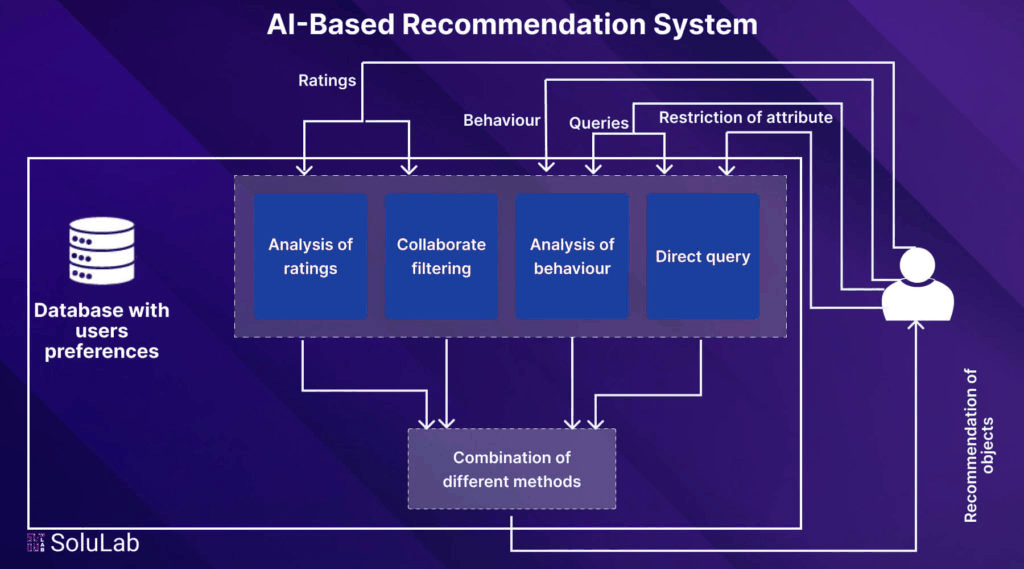
Each has its strengths and weaknesses. Collaborative filtering can discover new interests but suffers from cold-start for new users or items. Content-based is great for new items but can lead to a filter bubble. Hybrid methods aim for the best of both worlds.
If you're just starting, you might have limited data. That's okay. You can start with content-based recommendations using item metadata, then gradually incorporate collaborative filtering as you collect interactions.
Garbage in, garbage out. Ensure your data is clean, consistent, and well-structured. Implement proper event tracking from day one. Tools like Segment or a simple analytics setup can capture user actions. In our practice, we emphasize defining a data schema early to avoid costly migrations later.
Collaborative filtering is the most common approach. It works by finding users with similar tastes and recommending items they liked. There are two types:
Item-based is often more scalable and stable, making it a good starting point. Matrix factorization (like SVD) is a popular technique that reduces dimensionality and captures latent factors.
Content-based filtering uses item features to recommend similar items. For example, if a user likes a sci-fi movie, recommend other sci-fi movies. It works well for new items but can be limited in discovering new interests. Building a content-based system requires good item metadata and a way to compute similarity (e.g., cosine similarity on TF-IDF vectors).
Hybrid systems combine both methods to mitigate weaknesses. For example, you can use collaborative filtering for established users and content-based for new users or items. Another approach is to use a weighted combination of scores from both models. In our experience, hybrid models often yield the best performance but require more engineering effort.
Beyond classical methods, you can leverage modern ML models like neural collaborative filtering or deep learning models (e.g., Wide & Deep). These can capture complex patterns but require more data and computational resources. For most startups, starting with simple models and progressively adding complexity is wise.
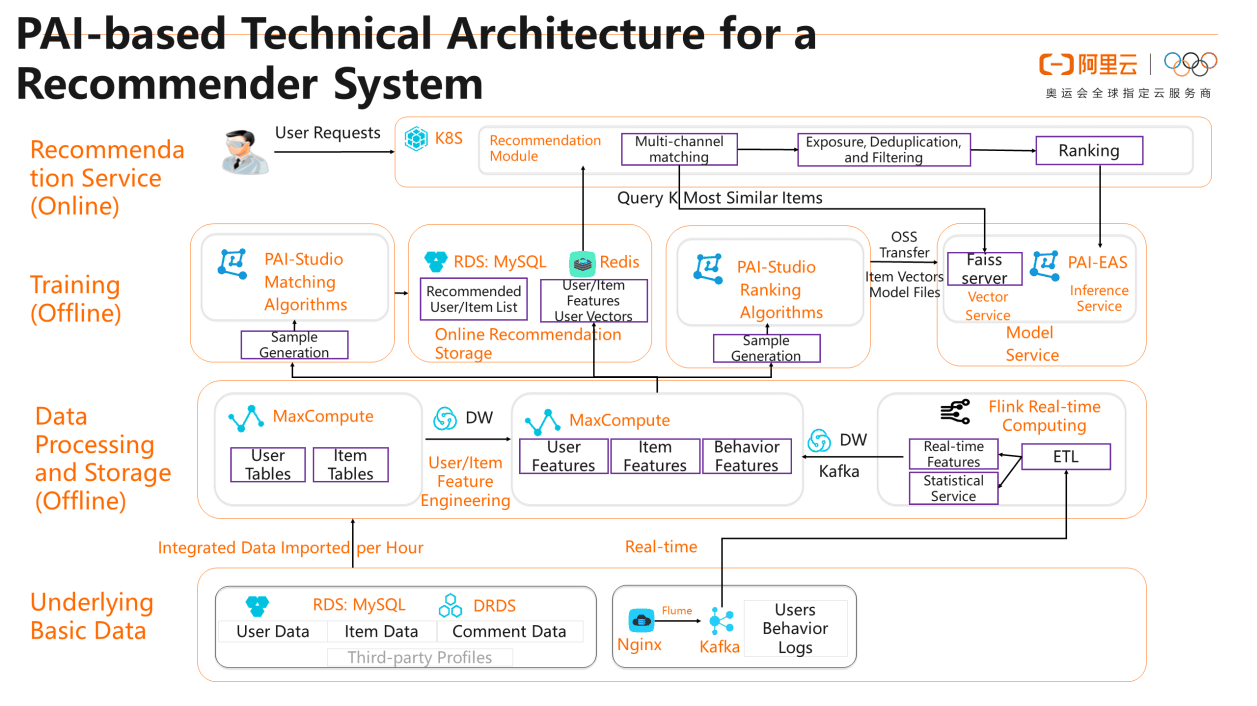
This separation allows you to update models without downtime and serve fast responses.
Your architecture should include a data pipeline that collects, cleans, and stores data. Common tools include Apache Kafka for streaming, Airflow for orchestration, and a data warehouse like Redshift or BigQuery. For feature storage, you might use Redis or a feature store.
Once trained, you need to serve the model. This can be via a REST API using frameworks like TensorFlow Serving or FastAPI. For low-latency requirements, consider caching or approximate nearest neighbor search (e.g., FAISS).
Start by defining what success looks like. Are you optimizing for click-through rate, conversion, or user retention? Choose metrics that align with your business objectives. In our projects, we often use offline metrics (precision@k, recall@k) for model evaluation and online metrics (CTR, revenue lift) for A/B testing.
3. Dataset Ingestion, Preprocessing & Stochastic Augmentations
Ensure you have the data infrastructure to collect user interactions. If you're building from scratch, integrate tracking events into your product. Clean the data: handle missing values, deduplicate, and format appropriately. Split into training and validation sets.
Before diving into complex models, build a simple baseline, like recommending the most popular items. This gives you a benchmark to beat. Then implement a basic collaborative filtering or content-based model.
Evaluate your models and iterate. Try different algorithms, tune hyperparameters, and incorporate additional features. Use A/B testing to validate improvements in production.
New users or items have little data. Solutions include using content-based recommendations for new items, and for new users, asking for preferences during onboarding or using popular items as fallback.
As your user base grows, your engine must handle larger data volumes. Use distributed computing frameworks like Spark for training, and ensure your serving layer can handle high throughput. Consider using approximate algorithms for nearest neighbor search.
Recommendation systems can reinforce biases. Be mindful of algorithmic fairness and diversity. For instance, ensure that your recommendations don't exclude certain groups. Regularly audit your models for unintended biases.
There are off-the-shelf recommendation engines, but they often lack customization. A custom AI recommendation engine gives you control over algorithms, data, and user experience. It can be tailored to your specific domain and business logic. However, building from scratch requires expertise and time. If you have a unique use case or data, custom development is often worth it. If not, you might start with a third-party service and later migrate.
At Avaton, we've helped startups design and build custom AI recommendation engines that scale with their growth. Our team can guide you through the technical decisions and implementation.
The timeline varies based on complexity and data readiness. A simple MVP can be built in a few weeks, while a full-scale production system might take several months. Key factors include data quality, algorithm choice, and engineering resources.
At a minimum, you need user interaction data (views, clicks, purchases) and item metadata. If you lack this, you can start with content-based recommendations using item attributes and gradually add collaborative filtering as you collect more data.
There are pre-trained models for general purposes, but they often don't fit your specific domain. It's better to train your own model on your data, even if you start with a simple algorithm. This ensures relevance and accuracy.
Use offline metrics like precision@k and recall@k on a held-out dataset. Then, run A/B tests to measure online metrics like click-through rate, conversion, or revenue lift. Continuously monitor performance and retrain models as needed.
4. Neural Network Backbone, Layer Specifications & Loss Formulations
Shipping AI models without a rollback plan is gambling with live traffic. This guide gives CTOs and founders a concrete versioning strategy, deployment gates, and a step-by-step rollback process to ship updates safely.
A concrete engineering roadmap for automating model retraining: drift detection triggers, data and model versioning, validation gates, and safe production rollout.
A practical guide to estimating custom AI agent development timelines, covering key phases, dependencies, and common bottlenecks to help founders and CTOs plan accurately.
A day, a week, a month, or a whole project. Scope and price agreed on a 30-minute call.
How to Build A Remote Patient Monitoring App Features, Architecture & Development Cost
How to Build A Remote Patient Monitoring App Features, Architecture & Development Cost
Users increasingly expect digital platforms to understand their interests and deliver experiences that feel relevant to them. This is why recommendation systems have become an important part of eCommerce, media, entertainment, travel, and other digital platforms. However, building an AI recommendation system is more complex than simply adding a recommendation feature to a website or application. A reliable recommendation engine requires relevant data, effective AI models, application integration, scalable infrastructure, and continuous optimization. The quality of the recommendations ultimately depends on how well these components work together. This guide explains how to build an AI recommendation system, covering the process from data collection and preparation to AI model development, application integration, deployment, and ongoing optimization.
An AI recommendation system is a software system that analyzes data to predict and present products, content, services, or other items that are likely to be relevant to a specific user. Traditional recommendation systems often rely on predefined rules. For example, an eCommerce platform might recommend products from the same category or display items that are frequently purchased together. AI-powered recommendation systems can analyze a much broader range of signals. These may include user behavior, preferences, search activity, content characteristics, historical interactions, and contextual information. The difference becomes particularly valuable when a platform has a large and diverse catalog where simple category-based recommendations are not enough. Consider an online art marketplace or digital art gallery with thousands of artworks from different artists, styles, mediums, and categories. A conventional recommendation system might simply suggest other artworks from the same category or artist. An AI recommendation system can go further by analyzing artwork characteristics along with user behavior and preferences to identify more relevant recommendations. For example, if a user repeatedly explores contemporary abstract paintings with specific color palettes or mediums, the AI recommendation engine can identify these preferences and recommend other artworks with similar characteristics, even when they belong to different categories or are created by different artists. The objective is to move from generic suggestions to personalized discovery based on content, user data, and intent.
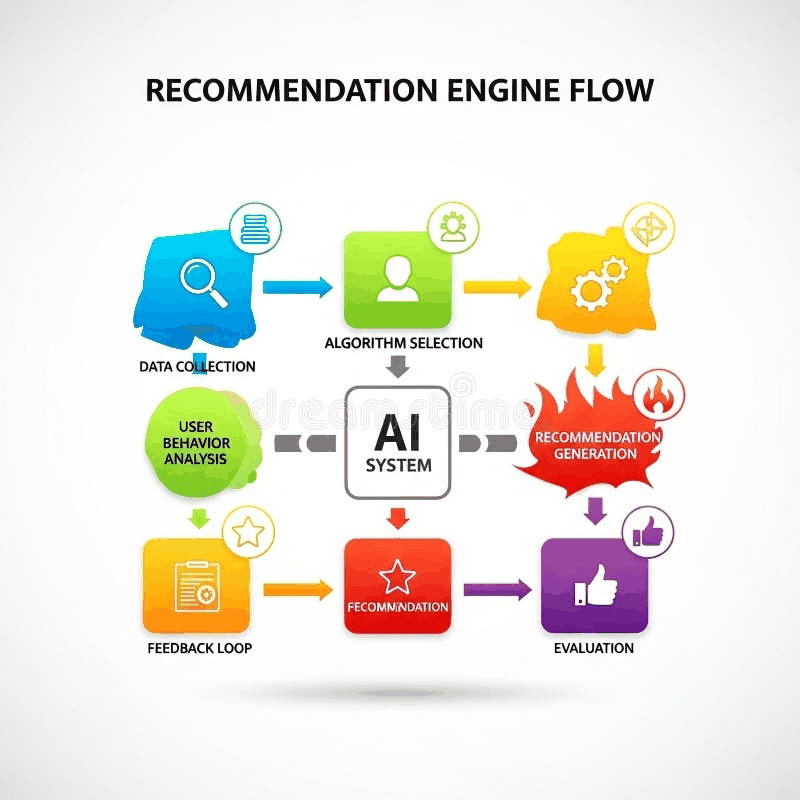
An AI recommendation system can be viewed as a continuous learning cycle rather than a one-time process. It takes information from users and the content or products available on the platform, transforms that information into signals that AI can interpret, and uses those signals to determine what may be relevant to each user.
The system then delivers personalized recommendations through the application. What makes an AI-powered recommendation system different from a static recommendation feature is the feedback it receives after those recommendations are presented. User interactions provide new signals that can influence subsequent recommendations, allowing the system to become more relevant over time.
Data is the foundation of an AI recommendation system. The objective is not simply to collect large volumes of information but to capture signals that are meaningful for the recommendation objective. Depending on the application, this may include:
The available data should be evaluated based on its relevance, quality, consistency, and ability to represent user intent.
5. Training Protocol, Convergence Behavior & Experimental Evaluation
Raw data is rarely ready for direct use by an AI model. Data may need to be cleaned, normalized, categorized, enriched, and mapped into a consistent structure. Duplicate records, incomplete metadata, inconsistent terminology, and poorly structured information can all affect recommendation quality. For content-rich applications, this stage may also involve extracting meaningful attributes from descriptions, documents, images, or other unstructured sources. A well-designed data preparation process creates the foundation on which the recommendation engine operates.
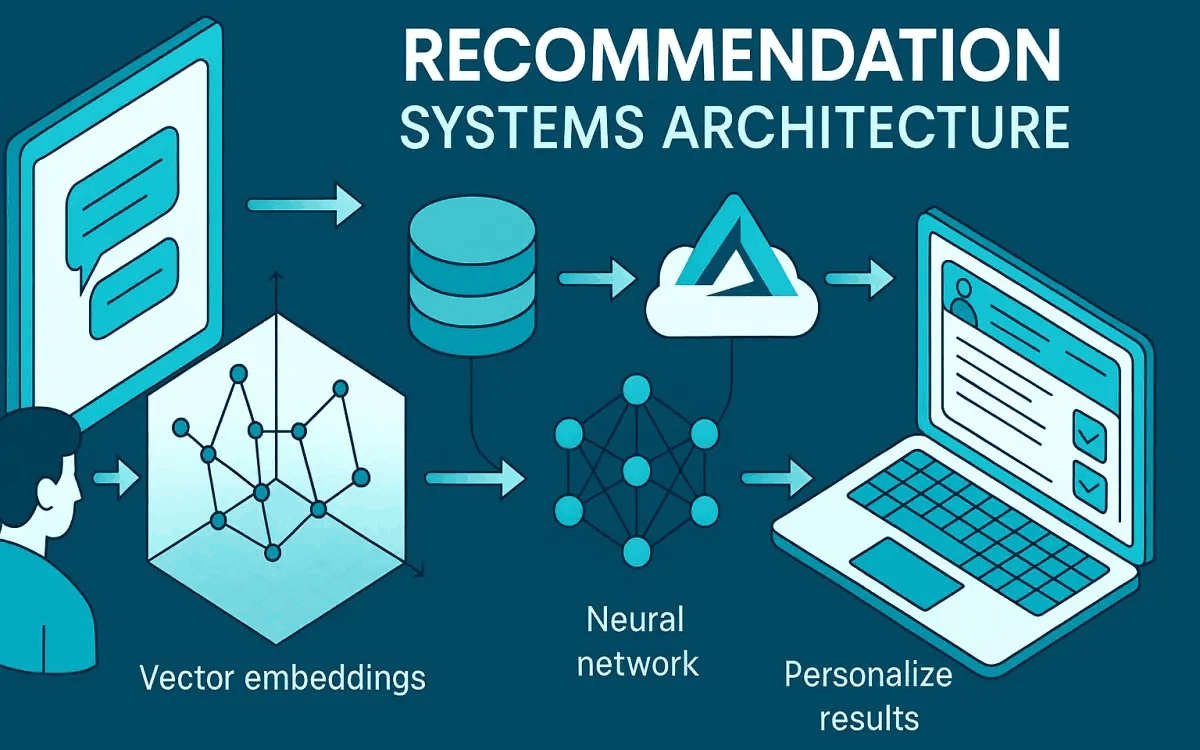
Different recommendation approaches can be used depending on the available data and business objective. Content-based recommendation recommends items based on their characteristics and their similarity to items a user has previously interacted with. Collaborative filtering identifies patterns among users and items. If users with similar behavior have shown interest in a particular item, the system can use that relationship to generate recommendations. Hybrid recommendation systems combine multiple approaches to improve relevance and address limitations such as sparse interaction data or insufficient user history. Modern AI applications can also use embeddings and vector similarity to identify relationships based on the underlying meaning or characteristics of content rather than relying only on predefined categories.
The recommendation engine brings the different components together. It receives information about the user, available content, and relevant context, then determines which items should be considered, ranked, and presented. A production recommendation engine may involve multiple stages, including candidate generation, scoring, ranking, and filtering. For example, a platform may have thousands of possible items available. The system can first identify a smaller set of potentially relevant candidates and then apply additional scoring and ranking logic to determine which recommendations should be shown.
The recommendation engine ultimately needs to become part of the application’s user experience. APIs allow web applications, mobile applications, or other digital platforms to request recommendations and present them to users. Integration may also involve authentication, user session management, caching, analytics, business rules, and existing backend systems. This is where AI engineering and conventional software engineering need to work together. A sophisticated recommendation model has limited business value if it cannot deliver relevant results reliably and efficiently within the application.
Recommendation systems should not be treated as one-time implementations. User preferences change. New products or content are introduced. Existing content may become less relevant. Business priorities also evolve. The system should therefore capture feedback signals and monitor recommendation performance over time. Relevant metrics may include click-through rate, engagement, conversion, interaction depth, retention, recommendation acceptance, and other business-specific indicators. Continuous evaluation allows teams to identify weak recommendations, improve data quality, adjust ranking logic, and optimize the overall user experience.
Once the objectives, data, and recommendation approach are defined, the development process can be structured into the following key steps.
Start by defining what the recommendation system is expected to achieve. A clear business objective helps determine the right AI strategy , data requirements, recommendation approach, and success metrics. The objective could be to increase product discovery, improve customer engagement, increase conversions, personalize content, reduce search effort, or improve retention. A clearly defined objective also helps determine which data should be collected and which performance metrics should be measured.
Next, identify the available data sources and determine whether they provide sufficient information for meaningful recommendations. This stage often requires a combination of data engineering, data science and analytics , and domain knowledge to determine which signals are meaningful for the recommendation objective. If data quality is poor, improving the data foundation may create more value than immediately investing in a more sophisticated AI model.
The recommendation approach should be selected based on the business use case and available data. A content-based approach may be appropriate when detailed product or content information is available. Collaborative filtering can be useful when sufficient user interaction data exists. A hybrid approach can combine multiple signals. For newer applications with limited historical interaction data, AI embeddings and semantic similarity can provide another way to identify relevant relationships.
Once the data and recommendation approach are defined, the AI recommendation engine can be developed. This may involve embeddings, similarity calculations, candidate ranking, business rules, and APIs for application integration. The architecture should remain flexible enough to accommodate future changes in data, models, and business requirements.
Once the recommendation engine is ready, it needs to be integrated into the application’s existing user experience as part of the broader AI application development process. The objective is to make recommendations available at the right point in the user journey without disrupting the application’s existing workflows. The integration should consider factors such as response time, scalability, security, user context, caching, and failure handling . For example, recommendations may need to be generated in real time for some use cases, while others can be prepared in advance and served through cached results. The integration should also allow the recommendation engine to receive relevant context from the application and return results in a format that can be easily presented to users.
Testing should go beyond conventional software testing. The team needs to evaluate whether recommendations are actually relevant and useful to users. Testing may include recommendation relevance, technical performance, response time, diversity, edge cases, and overall user experience. A recommendation system that is technically functional but consistently produces irrelevant results is not a successful implementation.
Model Figures & Evaluation Curves (4 Images)
Deep Learning Execution Pipeline
(Preprocessing)
(Feature Extraction)
(Self-Attention)
(Loss Optimization)