Parabolic Reflector Antenna — Tools & Flow
Parabolic Reflector Antenna design and simulation projects using HFSS, CST, COMSOL and FEKO — geometry, S-parameters, patterns, arrays and fabrication for final-year antenna engineering students.
Typical stack: Ansys HFSS, CST Microwave Studio, COMSOL RF, FEKO, MATLAB post-processing, VNA measurements and anechoic pattern tests.
Tools & Platforms
Project Overview & Technical Details
Abstract, simulation tools, fabrication dimensions and expected metrics for Parabolic Reflector Antenna.
Abstract
The Parabolic Reflector Antenna project focuses on the electromagnetic design and performance analysis of an antenna structure intended for its target wireless application. The study considers the antenna geometry, substrate or dielectric environment, conducting elements, excitation method, and surrounding boundaries so that the proposed configuration can be evaluated under realistic operating conditions.
The design process begins with suitable antenna dimensions and material parameters derived from the intended operating requirements. The intended operating frequency range is considered during the initial design and tuning. Key geometric parameters can be varied to study their influence on impedance matching, bandwidth, radiation behaviour, efficiency, and gain.
Full-wave electromagnetic simulation is used to examine the behaviour of the proposed Parabolic Reflector Antenna before fabrication. Ansys HFSS and CST Studio Suite are suitable for this type of antenna investigation because they support detailed electromagnetic field analysis and extraction of parameters such as S-parameters, resonant response, radiation patterns, gain, directivity, and field distributions.
During optimization, parameters such as feed position, element dimensions, spacing, substrate properties, and other project-specific geometric features can be adjusted to obtain the required response. Simulation results can be compared across design iterations to identify a practical configuration while reducing unnecessary fabrication trials and helping validate the expected antenna characteristics.
The completed study provides a structured basis for antenna fabrication and experimental verification. The simulated results can be used to prepare performance plots and design documentation, followed by measurements such as return loss, impedance response, radiation pattern, gain, or other application-specific characteristics. This approach supports systematic evaluation of the Parabolic Reflector Antenna for academic research, prototype development, and wireless communication applications.
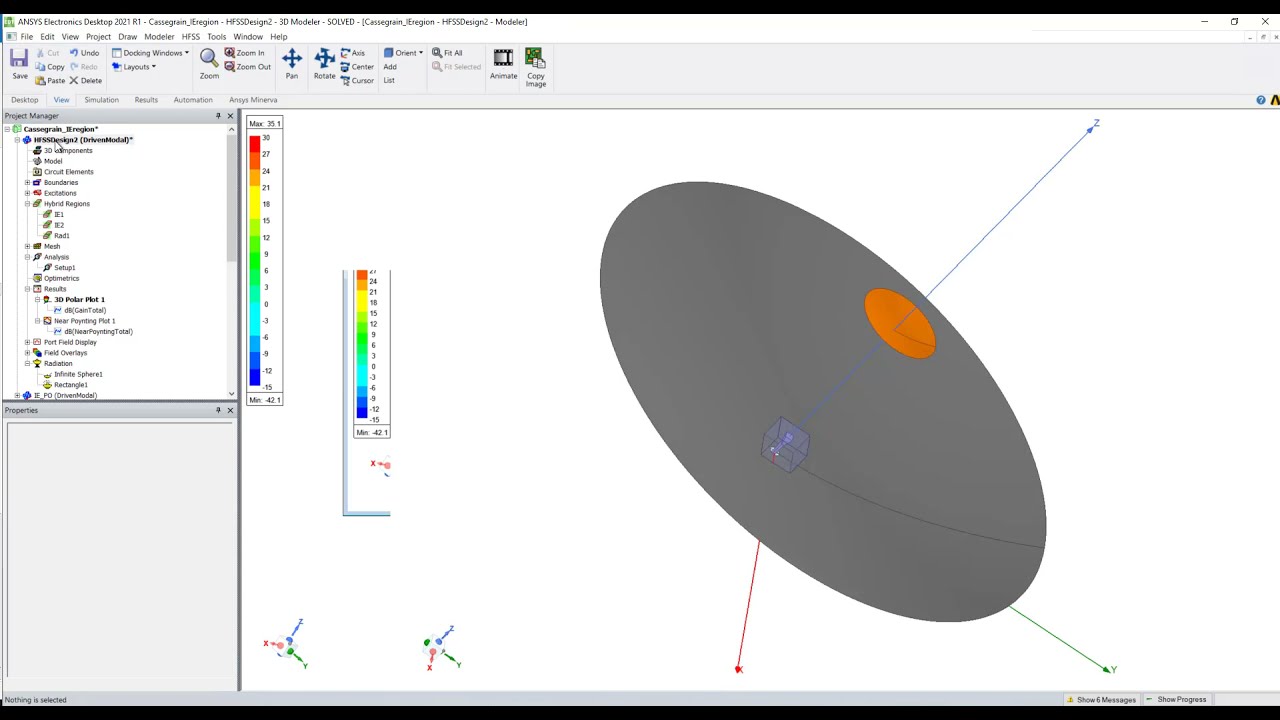
Simulation Tools Used
HFSS / CST for feed; physical-optics / MATLAB for reflector pattern
Typical workflow: geometry → boundary conditions → parametric sweep → S-parameter & far-field post-processing → optimization.
Operating Frequency
C / Ku band student examples
Antenna Dimensions (Typical)
Dish diameter 0.3–1 m class for lab; focal length from f/D = 0.3–0.5
Feed Network
Pyramidal or conical horn at focus
Fabrication Details
Commercial dish or formed sheet; 3D-printed feed horn possible
Key Performance Metrics
Gain ≈ 20–35 dBi depending on size; beamwidth; cross-pol
Deliverables for Students
Simulation project files (HFSS/CST), dimensioned drawings, S11 / Smith / pattern plots, comparison table (sim vs target), university-format report, PPT and viva Q&A support from Bangalore.
Contact us for full simulation setup, fabrication guidance, university-format report, PPT and viva Q&A.
Why Choose Us?
Bangalore guidance for RF, microwave and antenna engineering students.
Full-Wave Simulation
HFSS, CST, COMSOL and FEKO setups with S-parameters, patterns and parametric studies.
Arrays & MIMO
Array factor, mutual coupling, ECC and beam-steering related studies.
Fabrication
PCB prototypes, feed assembly, VNA and pattern measurement guidance.
Report & Viva
University-format documentation, PPT and expected viva questions.
FAQ
Antenna / RF Lab — Bangalore
Simulation, fabrication and measurement support for antenna projects.
Model
Time Domain
Plots
Design
Prototype
Measurement
States
Support