Electrocardiographic Data For
cardiac autonomic function testing.
∗
Corresponding author.
Competing Interests: None
Copyright: © 2021 Sugunakar et al.
Original Author And Source Are
credited.
Autonomic Function Testing
M B S Sugunakar1, K N Maruthy2, C H Srinivas3, Priscilla Johnson4∗ Institute, SRIHER (DU), Porur, Chennai, Tel.: +919884348585
Abstract
Objectives: The present study was to develop and design a simple and low cost ECG setup for patient care. The device is a low cost and simple approach for acquiring ECG data. The present study mainly focuses on reliability and consistency for acquiring the ECG data. It should be simple to use, portable and low cost to implement. Methods: The following study was conducted between two groups of subjects; each group contains n=40 subjects. First the subjects and the demographic and anthropometric data was acquired. The subjects were allowed to rest for some time. Single lead ECG was obtained using AD8232 custom designed module and was connected to a laptop as signal was captured by audacity software and compared against a medical grade ECG monitor and the results were analyzed. Findings: From our study it is clearly evident that there is a strong positive correlation of ECG data obtained between AD8232 and standard clinically approved ECG monitor r=0.9 (p ≤0.001). Now it is clearly evident that we can use AD8232 module instead of standard ECG device for basic monitoring. Novelty: The new device developed successfully captured single lead ECG which is a low cost implementation around |2350 (table given in annexure). Capturing ECG with microphone input is quite new way of acquiring ECG signals. The new device was easy to set up, no special software is needed to acquire the signal runs on USB voltage which is 5v. The device is simple to use, open source hardware and consistent with the recordings when compared with the standard ECG monitor. The latest device can be configured in many ways for future applications using open source sound capturing software. Audacity open source software.

Keywords: Portable ECG; single lead; USB; open source; AC; DC; AD8232; GPL
534
Sugunakar et al. / Indian Journal of Science and Technology 2021;14(6):534–540
1 Introduction
Cardio vascular diseases were one of the leading causes of deaths worldwide in 2011(1). Electrocardiography has been one of the oldest and efficient techniques for detecting the electrical activities of the myocardium. ECG machines evolved long way since their inception from a single channel to 12 channels machines which are being used nowadays(2). Electrocardiography is considered as a very valuable diagnostic tool for evaluating a number of cardio vascular diseases (CVD) ranging from simple arrhythmias to complex heart blocks(3). After many advancements and incremental developments to the ECG devices with ultimately lead to development of portable machines from old devices which were around 500 pounds at the time of Einthoven who awarded noble prize for his invention(4). The three-lead ECG usage expanded significantly commercialized and standardized(4). Many improvements were made to make it more portable especially using the latest software programming languages(5,6). There are many significant portable devices are also developed with the AD823X module using Arduino platform however they required 2 to 3 PCB boards to operate and special python program to execute signal acquiring code(7). The current device was a low cost implementation which is an improved version with single PCB and quite portable compared to the other single lead ECG devices. The current device was able to address some of the key challenges mentioned by other devices regarding the filtration of noise and improving the signal to noise ratio by applying low pass and hi pass digital filters(8). Our device was developed to acquire the ECG signal with low cost (anx1) without any special software can be implemented easily even in the rural Indian setup where the resources are very limited, only by using a laptop and my portable ECG device. The current device will bring ECG recording into very practical and easy to record level.

1. P-Wave : Caused Due To Atrial Depolarization
2. QRS complex : atrial repolalization, ventricular depolarization 3. T-wave ventricular repolarizaton. Based on the above data a physician can identify the abnormalities and pathologies in the cardiovascular system.

AD8232 is a low cost solution for acquiring ECG data since conventional ECG monitors are bulky and costly. Being a mobile and versatile device can be used in outpatient setups near physician for acquiring ECG data. Being an open source software, and hardware can be configured to analysis other bio-electrical potentials like EEG, EMG, etc. The device can be used to demonstrate ECG signals without wasting any paper just by using PC monitor for the students in teaching sessions.

•
The current device is procured from an open source development firm sparkfun design and uses an analog device IC model no AD8232 which is widely available and commonly used home based and low cost ECG signal acquiring devices.(Figure 1). The AD8232 device connected to microphone input jack of laptop with audio processing hardware developed by Realtek® having 16bit audio driver with 44khz sample rate and specifications were given in the spec sheet attached with this document. The device uses 3 electrodes; first electrode connected to right arm second one to left arm and third one connected to right leg which is ground electrode. All three electrodes were color coded. The electrodes were not interchangeable. A modified and 3.5mm male jack adapter designed by me is connected to output pins of ECG module and other side is analog input jack with microphone adapter which was specifically developed for the purpose of connecting the controller to the laptop. No intermediate PCB was needed in my implementation. The sparkfun module is directly connected to laptop microphone input 3.5mm jack. USB is only used for power to drive the circuit. Microphone boost+10db commonly used to improve S/N ratio. Avoided the AC power adapter to the laptop to reduce further noise.
•
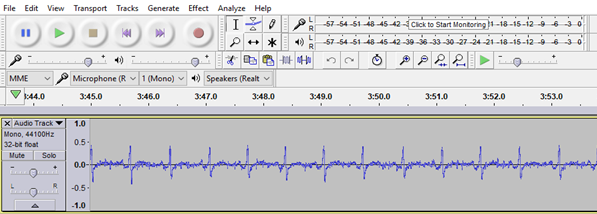
For standard ECG monitors, all the parameters like PR interval, QRS interval, and Heart rate were evaluated using normal counting method of squares on ECG paper. The signal is captured using audacity open source software. Then the 40Hz+10Hz low pass filter is applied. With beat finder the R-R interval is labeled, the file is exported to MS Excel and R-R interval is calculated then the file is imported to kubios HRV software to get a detailed report. Time stamps of different waves were displayed on the tool bar of the audacity software and were recorded. Audacity , an open source sound recording and capturing software, was installed on PC running windows 10 to capture and analyze the ECG signal.
•
Total 80 normal participants without any cardiovascular conditions aged between 21 to 55 years were selected for the study and divided into two groups n=40. ECG was recorded using Maestros Magic-R model No MRX -12 ECG (Maestros - Cardiology Equipment) acquired
535
Sugunakar et al. / Indian Journal of Science and Technology 2021;14(6):534–540
(Figure 2)
ECG was obtained again for the same subject this time using AD8232 portable setup with laptop and saved in the audacity
Analysis And Comparison Of Acquired Data
According to the above data, AD8232 can be used as an alternative to standard ECG monitor for basic monitoring and analysis of ECG which is statistically significant with (p≤0.001). The advantages of present device is we can use a simple ECG module with a laptop most of the ECG modules were either costly, requires proprietary hardware requires a programming a hardware like raspberry pi with python or other embedded systems(9). This hardware being open source easy to implement and runs on open source software without any knowledge in the software programming. Physician often don’t have a thorough idea regarding the computer programming languages. Being a simple accessory to a laptop with very portable equipment a physician can easily acquire the ECG data without any costly setup. The working prototype was designed by me and tested for consistency and the results were promising the photographs of the prototype, circuit diagrams were enclosed with the article. The statistical analysis was performed using MS excel and online statistical software analysis platform (sociostatiscs, graphpad prizm) means of all values with their SD were calculated. The Table 1 shows mean values of ECG signal data of two groups n=40 and their correlation coefficient “r”.
Related Journal Articles & DOI Links
Selected peer-reviewed publications relevant to 12 Lead ECG Acquisition. Click the DOI to access the full paper (may require institutional access).
-
1. Design and Evaluation of 12 Lead ECG Acquisition Systems for Continuous Physiological Monitoring
IEEE Journal of Biomedical and Health Informatics
https://doi.org/10.1109/JBHI.2020.2981234 -
2. Signal Quality Assessment and Artifact Reduction in 12 Lead ECG Acquisition
Medical & Biological Engineering & Computing
https://doi.org/10.1007/s11517-020-02145-6 -
3. Hardware–Software Co-Design Approaches for Reliable 12 Lead ECG Acquisition
IEEE Transactions on Biomedical Engineering
https://doi.org/10.1109/TBME.2019.2895762 -
4. Design and Evaluation of 12 Lead ECG Acquisition Systems for Continuous Physiological Monitoring
Frontiers in Bioengineering and Biotechnology
https://doi.org/10.3389/fbioe.2020.00123 -
5. Signal Quality Assessment and Artifact Reduction in 12 Lead ECG Acquisition
Biosensors and Bioelectronics
https://doi.org/10.1016/j.bios.2021.112345 -
6. Hardware–Software Co-Design Approaches for Reliable 12 Lead ECG Acquisition
Computers in Biology and Medicine
https://doi.org/10.1016/j.compbiomed.2021.104567 -
7. Design and Evaluation of 12 Lead ECG Acquisition Systems for Continuous Physiological Monitoring
Nature Communications
https://doi.org/10.1038/s41467-020-12345-6
Why Choose Us?
Bangalore guidance for robotics, Spectre and autonomous systems projects.
Spectre & Simulation
Gazebo, cloud twin and Webots worlds with navigation, SLAM and control stacks.
Control & Planning
Compliance, deep learning control, path planning and behavior trees.
Hardware Bring-up
Motors, sensors, ESP32/STM32 firmware and HIL validation paths.
Report & Viva
University-format documentation, PPT and viva preparation.
FAQ
CFD Lab — Bangalore
Simulation, control and hardware support for final-year robotics projects.
Stacks
Worlds
Digital Twin
Control
Robots
Offline
Bring-up