International Journal of Computer Applications (0975 – 8887)
9
Wall Shear Stress Analysis in Stenosed Carotid Arteries
Abstract
Atherosclerosis is a disease caused due to formation of plaque into the artery. Increase in plaque affects the wall shear stress. The present study is performed to calculate wall shear stress in different geometries of stenosed carotid artery.
A 2D model of different geometries is generated using CFD for Non- Newtonian model. After this WSS of different geometries of stenosed arteries is calculated and compared.
Wall Shear Stress (WSS) of carotid arteries with smooth plaque, irregular plaque, cosine plaque and artery with blood clot is calculated.
It is found that with increase of plaque in common carotid artery WSS increases. Irregular plaque causes highest WSS. Wall Shear Stress of opposite walls of carotid artery is compared where one wall is having blood clot into it and other one is healthy.
General Terms
Bifurcation, Stenosis, Ansys, Plaque, Atherosclerosis, Clot
Keywords
Bifurcation, Stenosis, Ansys, Plaque, Atherosclerosis, Clot
1. Introduction
Heart attack is one of the leading causes of death worldwide. It occurs due to blockage into the artery. This blockage into the blood vessels is known as Atherosclerosis. If the blockage is in coronary artery heart attack occurs and if blockage is in cerebral artery stroke occurs. Carotid artery is one of the arteries which are prone to the blockage. Carotid artery is situated on both sides of the neck. The main function of this artery is to supply oxygenated blood and nutrients to face, neck and head. The supply of nutrients and blood is cut off.
The blockage into the artery is known as plaque. Artery becomes hard due to plaque. The situation becomes worse if the plaque rupture. This rupturing of plaque triggers the blood to accumulate on the site of plaque. This gives rise to formation of blood clot. The blockage into the arteries increases the Wall Shear Stress. Wall Shear Stress is one of the important characteristic of blood flow and has strong link in formation of plaque.
Initially, research on Atherosclerosis was conducted using experimental techniques by visualizing flow through a tube partially obstructed. Flow characteristics were calculated by varying shape of plaque and its complexity, site and fluid flowing through the vessel. Dye tracing method was used to gain more accurate and deep information considering flow recirculation and flow separation. Laser Doppler anemometry provided visualization of nature of blood flow without influencing it. But this method has limitations and is complex.
It is difficult to calculate characteristics like wall shear stress by these experimental methods. Piezoelectric sensor was also used to acquire carotid artery . Experimental methods do not gave accurate results close to the wall region. Recently, computer simulations used provide best results. Even the complex processes can be easily simulated by using these non invasive methods.
Computational techniques have been developed to simulate arteries as they are easy to use and economical. Computational methods provide a platform to simulate an artery using software with conditions as close to as real scenario. Blood flow conditions are taken similar to the real flow. These methods help to obtain the relationship between blood flow and shape of stenos artery. Computational values are compared with non invasive methods. It makes the analysis and research somewhat easy.
A study concluded that flow behavior depends upon complexity, length of plaque, axisymmetric and asymmetric conditions and Reynolds numbers by studying the steady flow through stenosed arteries. An artery was also simulated which was stenosed assuming a Newtonian fluid . Power Law and Quemada non-Newtonian models were used to study the pulsatile nature of non-Newtonian blood flow through the arteries which are having plaque into them. . This study deduced that flows with a high pulsatile nature tend to generate very complex flow patterns. A study was employed to simulate symmetric carotid artery to calculate Wall shear stress. Blood was assumed to be Newtonian. It was concluded that WSS is directly proportional to length and height of the plaque .
2. Method
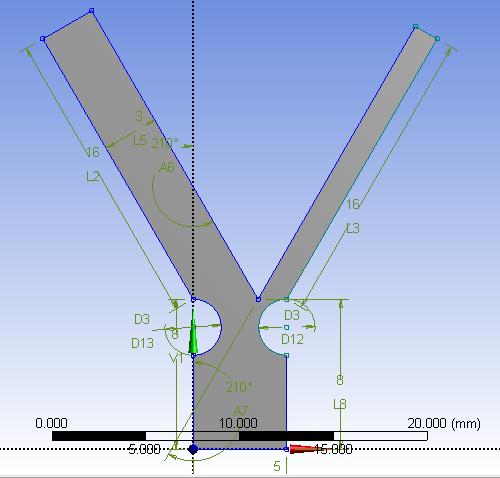
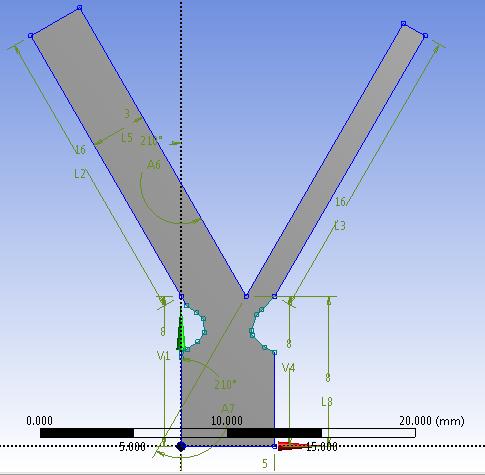
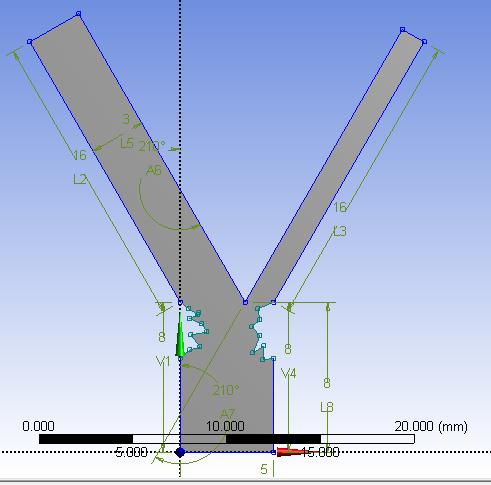
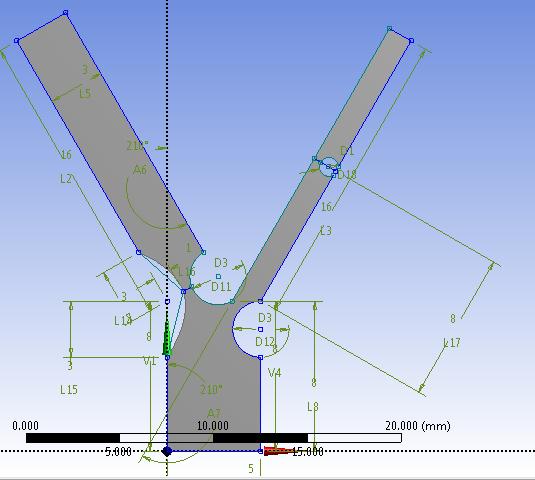
Computational fluid dynamics is a method used to simulate the blood flow and solve equations of the fluid flow. It divides the whole geometry into different number of cells. This study uses Ansys software which gives fast and accurate results. All the geometries of blocked carotid artery are shown in Fig.1, 2, 3 and 4. The block diagram which shows all the steps taken for this study is shown in Fig. 5.
International Journal of Computer Applications (0975 – 8887)
Fig. 4: Carotid Artery Having Clot
In this study model used to represent blood flow is Carreau Non-Newtonian model. In this paper three different geometries of plaque in carotid artery are compared. The three types of plaque used are smooth, cosine and irregular. Also in this paper carotid artery having blood clot is generated. The wall of carotid artery having clot is compared with opposite wall of same carotid artery having no clot. The Carreau [5, 12] Non-Newtonian model used in this present study is
Represented By The Following Equation:
µ=µ∞+(µ0-µ∞)[1+(⋋𝛄)2](n-1)/2 ……… (1) where time constant, λ = 3.313 s, n = 0.3568, zero strain
Viscosity (I.E. Resting Viscosity),
μ0 = 0.56 P and infinite strain viscosity, μ∞ = 0.0345 P. Density of blood is taken as 1060Kg/m^3. Gauge outlet pressure is 0 Pa for stenosed artery. The artery is assumed to be cylindrical and symmetrical. 2D steady flow and geometry is used. Coefficient of viscosity is taken as 0.001Kg/(m-s).
Blood flow is pulsatile and cyclic. WSS is inversely proportional to the diameter of artery and directly proportional to the viscosity of blood flow. Plaque formed into the carotid artery decreases the area of artery and hence increases the WSS. It is given by the equation:
A ……………………………… (2)
where τ is WSS and F is force applied and A is area of cross section.
3. Results
Wall Shear Stress is one of the important characteristic of blood. Wall Shear Stress of carotid artery is calculated in case of all three types of plaque. It is found that Wall Shear Stress in case of irregular plaque is highest. WSS in case of cosine and smooth plaque is approximately same as shown in Fig.8.Irregular plaque has irregular troughs and peaks. Cosine and smooth plaque is having similar average Wall Shear Stress around the wall selected. The Wall Shear Stress is calculated for the wall of artery which is shown in Fig.6, 7 by the polyline.
Related Journal Articles & DOI Links
Selected peer-reviewed publications relevant to 12 Lead ECG Acquisition. Click the DOI to access the full paper (may require institutional access).
-
1. Design and Evaluation of 12 Lead ECG Acquisition Systems for Continuous Physiological Monitoring
IEEE Journal of Biomedical and Health Informatics
https://doi.org/10.1109/JBHI.2020.2981234 -
2. Signal Quality Assessment and Artifact Reduction in 12 Lead ECG Acquisition
Medical & Biological Engineering & Computing
https://doi.org/10.1007/s11517-020-02145-6 -
3. Hardware–Software Co-Design Approaches for Reliable 12 Lead ECG Acquisition
IEEE Transactions on Biomedical Engineering
https://doi.org/10.1109/TBME.2019.2895762 -
4. Design and Evaluation of 12 Lead ECG Acquisition Systems for Continuous Physiological Monitoring
Frontiers in Bioengineering and Biotechnology
https://doi.org/10.3389/fbioe.2020.00123 -
5. Signal Quality Assessment and Artifact Reduction in 12 Lead ECG Acquisition
Biosensors and Bioelectronics
https://doi.org/10.1016/j.bios.2021.112345 -
6. Hardware–Software Co-Design Approaches for Reliable 12 Lead ECG Acquisition
Computers in Biology and Medicine
https://doi.org/10.1016/j.compbiomed.2021.104567 -
7. Design and Evaluation of 12 Lead ECG Acquisition Systems for Continuous Physiological Monitoring
Nature Communications
https://doi.org/10.1038/s41467-020-12345-6
Why Choose Us?
Bangalore guidance for robotics, Spectre and autonomous systems projects.
Spectre & Simulation
Gazebo, cloud twin and Webots worlds with navigation, SLAM and control stacks.
Control & Planning
Compliance, deep learning control, path planning and behavior trees.
Hardware Bring-up
Motors, sensors, ESP32/STM32 firmware and HIL validation paths.
Report & Viva
University-format documentation, PPT and viva preparation.
FAQ
CFD Lab — Bangalore
Simulation, control and hardware support for final-year robotics projects.
Stacks
Worlds
Digital Twin
Control
Robots
Offline
Bring-up