The Proceeding of International Conference on Soft Computing and Software Engineering 2013 [SCSE’13],
Islamabad, Pakistan
ABSTRACT— The issues of “research required in the field of
“Externally-Powered
prostheses” are attracting attention of regulatory bodies and the common people in various parts of the globe. Today, 90% of prostheses used are conventional body-powered cable- controlled ones which are very uncomfortable to the amputees as fairly large amount of forces and excursions have to be generated by the amputee. Additionally, its amount of rotation is limited. Alternatively, prosthetic limbs driven using electrical motors might deliver added functionality and improved control, accompanied by better cosmesis, however, it could be bulky and costly. Presently existing proposals usually require fewer bodily response and need additional upkeep than the cable operated prosthetic limbs. Due to the motives mentioned, proposal for mechanization of body- powered prostheses, with ease of maintenance and cost in mind, is presented in this paper. The prosthetic upper limb which is being automated is for Transhumeral type of amputees i.e., amputated from above elbow. The study consists of two main portions: one is lifting mechanism of the limb and the other is gripping mechanism for the hand using switch controls, which is the most cost effective and optimized solution, rather than using complex and expensive myoelectric control signals.

Keywords: Prosthetic upper limb, Body-powered cable-
Introduction
N artificial limb is a type of prosthesis that replaces a missing extremity, such as arms or legs. The type of artificial limb used is determined largely by the extent of an amputation or loss and location of the missing extremity .

Ideally, prosthesis must be comfortable to wear, easy to put on and remove, lightweight, durable, and cosmetically pleasing. Furthermore, prosthesis must function well mechanically and require only reasonable maintenance.

Finally, prosthetic use largely depends on the motivation of the individual, as none of the above characteristics matter if the patient doesn’t want to wear the prosthesis .
This paper is an amalgamation of extensive research and novel automation of upper extremity. Many amazing advancements in prosthetic technology have been made in recent years, with more currently underway.
In general, robots are either controlled through remote control or programmed to perform certain tasks at a given time.
Be
preprogrammed. by what means can we identify at what time a person will start to march down the staircases, or need to have a glass of water? Handheld controls will require a lot of attention along with the continuous usage of single or multiple hands. Two methods are presently employed for controlling the prostheses. One method is to utilize supplementary movements of the body, for instance using the movement of shoulders, to give a jerk to cables which in turn controls the wrist, hand, or elbow. Such type The Proceeding of International Conference on Soft Computing and Software Engineering 2013 [SCSE’13],
Of Prosthetic Limbs Are Known As “Cable-Operated”
prosthetic limbs. Small electrical pulses are produced by the muscles when they expand or contract. The more sophisticated technique is to extract these pulses and use the pulses from rest of the muscles to operate prostheses
Using Motors. Small Electrical Antennas Known As
electrodes extract the pulses from muscles. For instance, somebody who is amputated beyond the elbow can utilize his triceps or biceps muscles to operate his artificial hand.
The prosthetic limb can be preset to “open the hand” if it takes pulses from biceps muscle and “close the hand” if it takes pulses from triceps muscle. Such prosthetic limbs are termed as “myoelectric prosthetic limbs”. Engineers of myoelectric prosthetic limbs have a main issue to resolve - actions to operate are many, but there is not sufficient muscles available to operate them. See the case in point above: if the biceps and triceps muscles are utilized to close and open the hand, which muscles can be used to drive the pulses to elbow to straighten and bend it? It would be even more complex if the hand wishes to revolve sideward so as to get anything - how would the operator communicate it to carry it out? Scientists have tested numerous techniques to avoid such problems. They had employed numerous kinds of switches, or trained operators
To Execute Arrangements Of Muscle Expansion Or
contractions in place of switches. Nevertheless, the deficiency of accessible operating pulses, intricacy of design and struggle to control the operating pulses deem it exceedingly challenging to take myoelectric prostheses technology ahead .
The key purpose is to provide ease of use to the user and make the prosthetic upper limb cost effective using switch-controlled mechanism. When the user is unable to trained for myoelectric controls or sites producing such signals are not accessible, this could become a better option to operate the prosthetic limb. Mechanical switches would be placed under different easily accessible parts of the body, such as under armpits, which would act as control signals for the motorized arm. This would save
Many People From Pain And Misery Because It Would
require fairly less amount of effort on part of the patient.
A. Recent Technologies
In the modern era, developments in prosthesis have been noteworthy. Cutting-edge plastics and new materials, for example graphite, have made prostheses tougher and light in weight, restricting the quantity of additional power essential to control the prosthesis. This is especially important for transfemoral amputees. Additional materials have allowed artificial limbs to look much more realistic, which is important to transradial and transhumeral amputees because they are more likely to have the artificial limb exposed. In addition to new materials, the use of electronics has become very common in artificial limbs.
Myoelectric And Switch-Controlled Limbs Allow The
amputees to directly control the artificial limb. CAD and
Cam Are Often Used To Assist In The Design And
manufacture of artificial limbs.
B. Techniques Used
The variety of prostheses ranges from mostly passive or cosmetic types on one end to primarily functional types on the other. The aim of many prosthetic limbs lies in between.
Passive prosthetic limbs are also known as Cosmetic prostheses. Those amputees, who think their outlook is more essential, use these types of prostheses.
Functional prostheses generally can be classified into two categories. Cable-operated prosthetic limbs , are typically less costly and generally have lighter mass. They have greater physical response and are highly robust prosthetic limbs. Yet, a cable-operated prosthetic limb is
Usually Not Visually Attractive As Compared To A
myoelectric prosthesis. Also, the amputee has to apply a larger force in order to operate the prosthesis. Externally- powered prosthetic limbs , are artificial extremities driven by electronically controlled motors and they deliver greater functionality and stronger grasping power, accompanied by better outlook, yet again they could be hefty and costly. These prosthetic limbs are operated using motors and batteries controlled by the amputees. At present, existing prostheses usually have lower physical response and need added upkeep as compared to cable- operated prosthetic limbs. A control system is always needed for such type of prosthetic limbs.
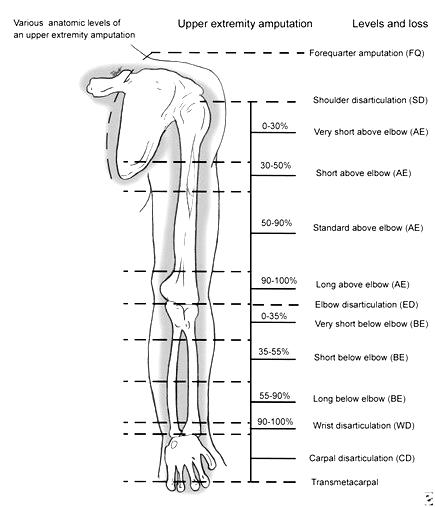
There are basically two kinds of control systems generally employed which are switch and myoelectric control. Muscle expansions and contractions are used as a pulse to operate the myoelectric prosthetic limb. The other type of control system employed in externally-powered prosthetic limbs is switch-controlled. It employs tiny switches, instead of pulses generated from muscles, to control the electronic motors. A switch can be activated by the movement of a remnant digit or part of a bony prominence against the switch. Each type of prosthesis has its own pros and cons depending upon amputation level (See Figure 1), patient’s comfort, cost, weight and maintenance.
The Proceeding of International Conference on Soft Computing and Software Engineering 2013 [SCSE’13],
A. Description
The case under study is of Transhumeral amputation i.e., the patient is amputated from above elbow. For that purpose, we have divided the study into two portions i.e., working of elbow and grip.
1. Elbow Portion
In elbow part of the research a worm gear mechanism is used to lift the limb. For that purpose a very high torque and light weight motor will be used.
2. Grip Portion
In grip portion a worm gear mechanism is used with bidirectional motor control with further implementation of current feedbacks for limiting the constraints for motor.
1. Mechanical Hardware
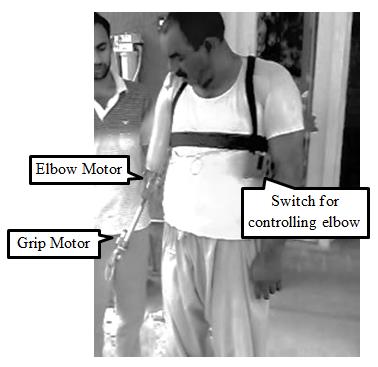
The mechanical hardware includes motors and switches mounted on the upper prosthetic extremity (See Figure 2 and Table 1). Design of the limb with placement and actuation of motors is thoroughly worked out. Actuation will be done using mechanical switches placed under both the armpits and behind the shoulder opposite to the arm which is amputated. One of our aims was to make the project cost effective. For that purpose, light weight, low cost and high torque motors for elbow lifting and gripping are selected.
Appropriate DC geared motor for lifting the limb is mounted on the limb for elbow movement with worm gear mechanism operated in upward and downward direction using two switches. As for the wrist movement, it is controlled using switches behind the shoulder activated by giving a sudden jerk to it and current feedback from the motor to judge if the object is firmly picked (See Figure 3).
In addition to that, limit switches for the actuation of motors are prepared with adequate padding, so that it may not be too sensitive or too hard to be pressed.
Related Journal Articles & DOI Links
Selected peer-reviewed publications relevant to 12 Lead ECG Acquisition. Click the DOI to access the full paper (may require institutional access).
-
1. Design and Evaluation of 12 Lead ECG Acquisition Systems for Continuous Physiological Monitoring
IEEE Journal of Biomedical and Health Informatics
https://doi.org/10.1109/JBHI.2020.2981234 -
2. Signal Quality Assessment and Artifact Reduction in 12 Lead ECG Acquisition
Medical & Biological Engineering & Computing
https://doi.org/10.1007/s11517-020-02145-6 -
3. Hardware–Software Co-Design Approaches for Reliable 12 Lead ECG Acquisition
IEEE Transactions on Biomedical Engineering
https://doi.org/10.1109/TBME.2019.2895762 -
4. Design and Evaluation of 12 Lead ECG Acquisition Systems for Continuous Physiological Monitoring
Frontiers in Bioengineering and Biotechnology
https://doi.org/10.3389/fbioe.2020.00123 -
5. Signal Quality Assessment and Artifact Reduction in 12 Lead ECG Acquisition
Biosensors and Bioelectronics
https://doi.org/10.1016/j.bios.2021.112345 -
6. Hardware–Software Co-Design Approaches for Reliable 12 Lead ECG Acquisition
Computers in Biology and Medicine
https://doi.org/10.1016/j.compbiomed.2021.104567 -
7. Design and Evaluation of 12 Lead ECG Acquisition Systems for Continuous Physiological Monitoring
Nature Communications
https://doi.org/10.1038/s41467-020-12345-6
Why Choose Us?
Bangalore guidance for robotics, Spectre and autonomous systems projects.
Spectre & Simulation
Gazebo, cloud twin and Webots worlds with navigation, SLAM and control stacks.
Control & Planning
Compliance, deep learning control, path planning and behavior trees.
Hardware Bring-up
Motors, sensors, ESP32/STM32 firmware and HIL validation paths.
Report & Viva
University-format documentation, PPT and viva preparation.
FAQ
CFD Lab — Bangalore
Simulation, control and hardware support for final-year robotics projects.
Stacks
Worlds
Digital Twin
Control
Robots
Offline
Bring-up