Generic Medical Equipment Interface
Siddharth Srivastava, Ramji Gupta, Astha Rai, A S Cheema Center for Development of Advanced Computing, Noida
Abstract
Now-a-days Health Care industry is well equipped with Med- ical Equipments to provide accurate and timely reports of investigation and examination results. Medical Equipments available in market are made for specific tests suited for a particular laboratory leading to a wide variety of devices.
The result viewing experience on console of these devices is not only cumborsome for medical staffbut inefficient. Therefore, Medical Equipment Interfaces act as backbone of any Hospital Management Information System assisting in better management and delivery of test results. It also acts as a mode to collect data for further research and analysis.
These equipments communicate via a fixed data format but compatibility among these formats is a major issue being faced in modern and legacy medical equipments. In this pa- per, we present a case study of designing and implementing a cloud based Generic Medical Equipment Interface(GMEI) along with the state of the art in such systems. This solu- tion removes the burden of reentry of patient details into the Electronic Health Record(EHR) and thrives for accelerating EMR initiative in the country.
Keywords
Medical Equipment Interface, Medical Informatics, Electronic Health Records, Health Information System, Cloud Com-
Puting
1.
Introduction
Healthcare Industry has seen massive digitization and stan- dardization in the past 5 years . With the growing amount of patient related information, its efficient storage, proper management, timely access and security have now become imperative features for any healthcare solution. A substan- tial amount of patient information is in the form of test results such as biochemistry, pathology, and haematology.
Another area of key importance is formation of Electronic Health Records [17, 1]. Health Standards such as HL7 [9, 3], Continuity of Care Document etc. The Electronic Health Records have already been established as effective in many areas [8, 13, 14]. In this work, we develop a Cloud based Generic Medical Equipment Interfacing (GMEI) soft- ware solution addressing the problems stated above where Medical instrument interface is an automatic connection be- tween analyzer and Host Computer for the quick exchange of information.
The GMEI at the back end, is supported by a sophisticated Health Information System (HIS). The Health Information System spans across all the major activities in a hospital such as Enquiry, Registration, Payment, OPD, Lab report etc. GMEI specifically deals with Lab Report which forms the largest chunk of information in an EHR. The other re- lated information are utilized for maintaining the EHR of a patient. Contemporary studies[15, 7, 18] have demonstrated the usefulness and importance of Medical Equipment Inter- faces or the ”Laboratory Information Systems” to a large extent. Therefore, the main problems that have led to the
Need Of The Current Work Are:
• Lack of standardization in the data formats among medical equipments. • In case of modern medical facilities, a few standard
Compatible (Hl7, Ihe Etc.)
machines are available. Yet, the availability is sparse and is not the same across • The test result data is stored over local storage at-
Tached With The Machine In Form Of A Computer Or
dedicated storage. • Due to local and heterogenous nature of data storage by different vendors, the unification of medical records of a patient for generation of EHR is difficult. This
Also Presents A Major Drawback While Updating And
maintaining the EHR. Recent research in Medical Equipment Interfaces or the ”Lab- oratory Information Systems”has shown succesful migration of such systems to web interfaces and their need and impor- tance [6, 12, 4, 16, 21]. Moreover, in view of the growing need of analytics, context awareness, recommendations into Medical Equipment Interfaces [5, 10, 20], there is a need to address the availability of data over cloud. Hence, the data not only from modern machines but legacy machines and equipments need to be made available for promoting and facilitating further research.
Arxiv:1411.1387V2 [Cs.Cy] 7 Sep 2015
2.
System Architecture
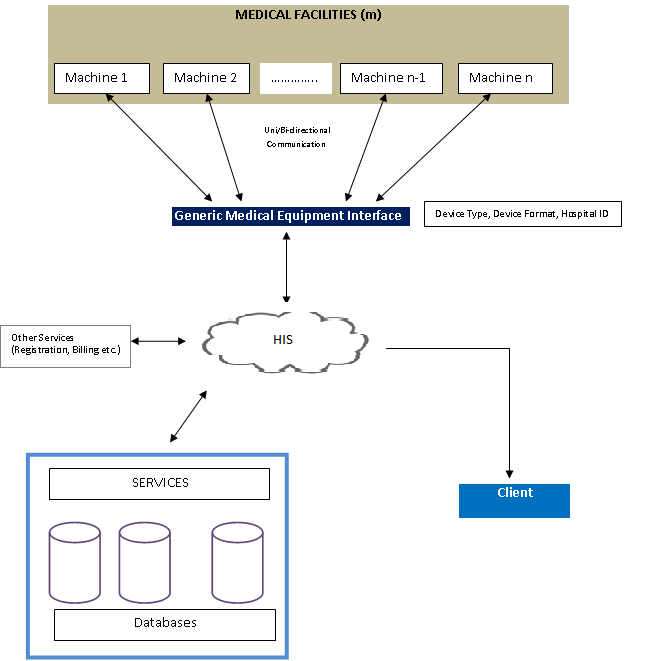
Figure 1 depicts the general architecture of the developed system. GMEI can serve data from multiple machines(n) located at multiple(m) medical faciliities. The GMEI can be configured for data format specific to a device and hospi- tal. The data received from the machines is organized into a prefixed global format by the GMEI. Subsequently, this is asynchronously sent to the cloud where the Health Informa- tion System maintains a uniform database for these records.
This is in contrast to the traditional mode of communica- tion where each LIS was vendor specific and hence the re- sponsibility for data aggregation in a universally compatible format was left to the HIS. This type of flow resulted in additional complexities to the system. An LIS is aware of the incoming data format and related fields. We exploited this characteristics in GMEI and mapped each data format to a common database schema. This not only simplifies the overall architecture but also offloads task of machine specific parsing from the server.
A major problem in laboratories is presence of legacy ma- chines or machines with non-universal data formats. In our study, we found that over 95% of the machines in various Government Hospitals across the country are not compliant to standards such as HL7, IHE etc. Most laboratories have heterogenous mixture of these formats i.e. a few machines are HL7 etc. compatible while others use different proto- cols. GMEI abstracts out this problem by assigning IDs to packet formats and devices. Another advantage of this ap- proach is that if the device is upgraded or replaced, only the format ID at the GMEI needs to be reconfigured. The HIS can remain transparent to this modification. Since, an HIS can serve multiple hospitals, clinics etc.
, The Trans-
parency further enahances the ease with which an EHR can be generated and shared among various entities.
Implementation Of Gmei
Following questions are needed to be addressed for planning
Implementation Of Gmei:
• What would be the Mode of communicaton for trans- ferring data and message between equipment and GMEI.
• How Will Lis Match Up Results With Sample Id
• Are there any additional calculations that the end user
May Need For Deductions From Results
• Can these calculations be automated in the interface • Does the technician need to review the results after
Basic Requirement For Interfacing
Analyzers capable of being interfaced to an LIS are found in all areas of the clinical laboratory: Bio-chemistry, Hema- tology, Urinalysis, Toxicology, Immunoassay, Coagulation, Microbiology, Blood Bank, and in another Labs. Nearly all of the routine clinical instruments are equipped with a se- rial RS-232 I/O port. Many new communication points like USB, TCP/IP port also provided. Some basic requirements neeedd to interface with instruments are enumerated below:
A. Physical Hardware
The instrument must be equipped with an active input/output port to which computer devices may be connected. 1. The host system must have a corresponding I/O port available.
2. On clinical analyzers, this is a serial synchronous RS- 232 port. 3. A connection cable is required, from the analyzer to an interface device or the host system connection point 4. Devices including bar code scanners, printers, environ- mental monitoring devices, etc.
B. Software
The host system software is operating system software and Generic Medical Equipment Interfacing application software. Operating system software is typically provided by a hard- ware manufacturer or a third party. Operating system soft- ware controls basic machine functions such as interaction with I/O devices, memory management, disk access, and creating the application software environment. GMEI soft- ware is the major product of the LIS software.
C. Data Formats
There are many data formats, but for designing the GMEI, the data formats are categorized broadly into a few cate- gories, and each data format from a machine is subclassified as a part.
These Are The Standards
for communication with peripheral devices such as clinical analyzers. The parameters that classify this category are: • Serial communication parameters (baud rate, parity, data bits, stop bits, ASCII standard character set) • The ”handshaking” protocol between host and a pe- ripheral device for data exchange to occur: ACK/NAK • Message blocking: how does each side of the commu- nication define where a message begins and ends. For
Example Stx, Etx For Start Bit And End Bit
• Message structure (what will be the order of data fields, or where is the sample ID relative to the rest of the
Data Record?)
• Message content (what is the sample ID and what are the test names and results associated with this ID?
Standards For Communication Be-
tween laboratory analyzers and information systems have been defined by ASTM (American Society for Testing and
Related Journal Articles & DOI Links
Selected peer-reviewed publications relevant to 12 Lead ECG Acquisition. Click the DOI to access the full paper (may require institutional access).
-
1. Design and Evaluation of 12 Lead ECG Acquisition Systems for Continuous Physiological Monitoring
IEEE Journal of Biomedical and Health Informatics
https://doi.org/10.1109/JBHI.2020.2981234 -
2. Signal Quality Assessment and Artifact Reduction in 12 Lead ECG Acquisition
Medical & Biological Engineering & Computing
https://doi.org/10.1007/s11517-020-02145-6 -
3. Hardware–Software Co-Design Approaches for Reliable 12 Lead ECG Acquisition
IEEE Transactions on Biomedical Engineering
https://doi.org/10.1109/TBME.2019.2895762 -
4. Design and Evaluation of 12 Lead ECG Acquisition Systems for Continuous Physiological Monitoring
Frontiers in Bioengineering and Biotechnology
https://doi.org/10.3389/fbioe.2020.00123 -
5. Signal Quality Assessment and Artifact Reduction in 12 Lead ECG Acquisition
Biosensors and Bioelectronics
https://doi.org/10.1016/j.bios.2021.112345 -
6. Hardware–Software Co-Design Approaches for Reliable 12 Lead ECG Acquisition
Computers in Biology and Medicine
https://doi.org/10.1016/j.compbiomed.2021.104567 -
7. Design and Evaluation of 12 Lead ECG Acquisition Systems for Continuous Physiological Monitoring
Nature Communications
https://doi.org/10.1038/s41467-020-12345-6
Why Choose Us?
Bangalore guidance for robotics, Spectre and autonomous systems projects.
Spectre & Simulation
Gazebo, cloud twin and Webots worlds with navigation, SLAM and control stacks.
Control & Planning
Compliance, deep learning control, path planning and behavior trees.
Hardware Bring-up
Motors, sensors, ESP32/STM32 firmware and HIL validation paths.
Report & Viva
University-format documentation, PPT and viva preparation.
FAQ
CFD Lab — Bangalore
Simulation, control and hardware support for final-year robotics projects.
Stacks
Worlds
Digital Twin
Control
Robots
Offline
Bring-up