Received November 21, 2019, accepted December 19, 2019, date of publication January 3, 2020, date of current version January 15, 2020. Digital Object Identifier 10.1109/ACCESS.2019.2963881
1
1Facultad de Ciencias de la Ingeniería y Tecnología, Universidad Autónoma de Baja California, Tijuana 21500, Mexico 2Instituto de Ingeniería y Tecnología, Universidad Autónoma de Ciudad Juárez, Ciudad Juárez 32310, Mexico ABSTRACT The myoelectric interfaces are being used in rehabilitation technology, assistance and as an input device. This review focuses on an insightful analysis of the data acquisition system of EMG signals from these interfaces. According to applications reported in research articles of the last five years, the prop- erties of the sensors, the number of channels, the pre-processing of the EMG signal, as well as the software and hardware used were identified. This analysis was performed for the following applications: monitoring of muscular activation for rehabilitation, muscle activation plans, and identification of possible pathologies, exoskeletons, electric of wheelchairs, prosthetics control, myoelectric bracelets, handwriting recognition and silent speech recognition. The results presented in this review become a guide of recommendations for the myoelectric signal processing according to the application of the interface. The main developments, degrees of research and open challenges are also presented in this direction.

INDEX TERMS Emg acquisition system, emg processing, electromyography sensors, myoelectric control, myoelectric signals.
I. Introduction
Electromyography (EMG) is a technique used to measure the muscle’s response to electrical stimulus of the nerves . The EMG signal acquired from the skin surface around muscle and joint areas is the summation of the electrical activity of all the muscle-fibred motor unit action potentials (MUAPs) caused as a result of motion activity .

EMG signals have been relevant in several health fields. The periodical monitoring of EMG signals can be utilized to detect diseases like Huntington’s disease, Myopathies, or Muscular dystrophies, and to timely address problems such as heart attacks or stroke occur , . Furthermore, EMG signals could be useful to detect neuromuscular dis- orders that could affect motor units (Mus) and to identify the origin of such disorders . Recently, in the Human- Computer Interaction (HCI) field, the use of bio signals has opened the way for the development of muscle-computer interfaces. Particularly, EMG signals collected by sensors The associate editor coordinating the review of this manuscript and
Approving It For Publication Was Shaohua Wan
. attached to superior limbs, have been used for controlling devices by means of the electric impulses generated through the muscles .
Given all the possibilities for exploiting EMG signals, it is critical to ensure that the data collected is reliable and that it is a precise representation of the electrical activ- ity of the muscles. Therefore, an important research area, is the analysis of the specific application design require- ments of the acquisition system considered for obtaining the myoelectric signals. Once these requirements are identified, it will be possible to provide widespread recommendations for the design of efficient and reliable EMG signal acquisition systems.

An EMG signal acquisition system consists of four main stages: (i) signal collection (ii) signal amplification, (iii) sig- nal filtering and (iv) analog-to-digital converting. Each stage demands specific requirements according to its operational characteristics. These requirements can be specified in terms of the design parameters necessary for the implementation of EMG signal acquisition systems and will be further discussed in the rest of this document.

7792
This work is licensed under a Creative Commons Attribution 4.0 License. For more information, see http://creativecommons.org/licenses/by/4.0/
Volume 7, 2019
B. Rodríguez-Tapia et al.: Myoelectric Interfaces and Related Applications: Current State of EMG Signal Processing The method for collecting the EMG signal is by using elec- trodes. An electrode is a transductor that represents the level of muscle activity by recording the electrical activity in it.

Invasive approaches, also known as needle electromyography (nEMG), record electrical activity through needle electrodes. Whereas, non-invasive approaches, also known as surface electromyography (sEMG), record muscle activity from the skin surface through wet or dry surface electrodes , .

The suitability of each approach depends on the feasibility of using an invasive or non-invasive approach to collect the EMG signal. Although nEMG provides more features of the muscular activity, its main disadvantage emerges from the dynamics of muscular activities. Given the inherent inva- siveness of the approach, it is difficult to repeatedly reposi- tion the needle electrode if multiple locations of the muscle need to be analyzed. Thus, only a limited number of active engine units can be measured . sEMG is preferable for obtaining information regarding the duration or intensity of superficial muscle activation . The majority of applications consider the non-invasive sEMG approach, as it is free of discomfort and observes extremely low risk of infection to amputees .
Two critical design parameters for the signal collection stage are the selection (type) and location (placement) of the electrodes. Given that the signal-to-noise ratio (SNR) depends on the place where the signal is collected, an optimal selection of the electrode placement is mandatory to achieve an adequate SNR level –. On the other side, the open- loop gain (output-to-input ratio) as well as the input and output impedances, are key parameters in the amplification stage .

Given the proximity of many other bio signals in the sur- roundings of the muscle and power line interference, it is expected that the collected EMG signals will contain unde- sired features that may obscure important information regard- ing the electrical activity of the muscle. Hence, the optimal design of the filtering stage is critical to exclude all the unwanted frequency components. Several variables must be considered in order to efficiently design the filtering stage: the selected muscles, the type of contraction, the configuration of the sensor and the source of the specific noise . The characteristics of the amplifiers and filters will determine the quality of EMG signal.
After the EMG signal is amplified and filtered, it is fed into an analogue-to-digital converter (ADC) circuit . For each specific application, EMG signals must be processed by means of advanced signal processing algorithms, which are commonly implemented in computer systems. Therefore, the analogue-to-digital conversion stage needs to be carefully designed. Three main variables must be considered during the design of the ADC stage: the open-loop gain considered during the amplification stage, the maximum output voltage at the back-end of the EMG signal acquisition system, and the additive noise. Moreover, in order to reconstruct digitized signals with minimal errors, it is necessary to determine the optimal sampling frequency, which makes it another impor- tant design parameter for the ADC stage .
Insightful recommendations regarding non-invasive eval- uation of muscles were provided by the European project SENIAM , published in 2000. Sensor type selection and sensor placement were remarkable topics addressed in the recommendations. More than a decade later, the considera- tions draw from SENIAM for sensor placement were updated . Moreover, key features as signal amplification, filtering and sampling rate were added to the previous recommenda- tions. Recently, works have been developed to perform anal- ysis related to filtering, thinking about obtaining minimum sampling frequency parameters to determine more favorable conditions for processing time and its implementation in portable acquisition systems , . These contributions have been very valuable for the pre-processing of EMG signals, however, none of these previous works study the relationship among the configuration of the data acquisition system and the specific application of the EMG signal.
Therefore, this paper focuses on providing an insightful analysis of the data acquisition system requirements, from a measurement and data pre-processing point of view, as related to the myoelectric interface for a specific application of the EMG signal.
A. Search Strategy
In order to collect significant information regarding the parameters of EMG signal acquisition systems, a system- atic search was conducted. The references were indexed by the following keywords: emg acquisition system, emg sensors, electromyography sensors, myoelectric control and myoelectric signals. The search was conducted in the fol- ScienceDirect search engine to determine the state of the art of the topic.
B. Review Process
Articles found after the previously described search were evaluated by analyzing the title and the abstract. The fol- lowing criteria was considered for final selection of articles: (i) Articles written in English; (ii) articles published from 2014 to 2018; (iii) comprehensive initial search results that included journal articles only.
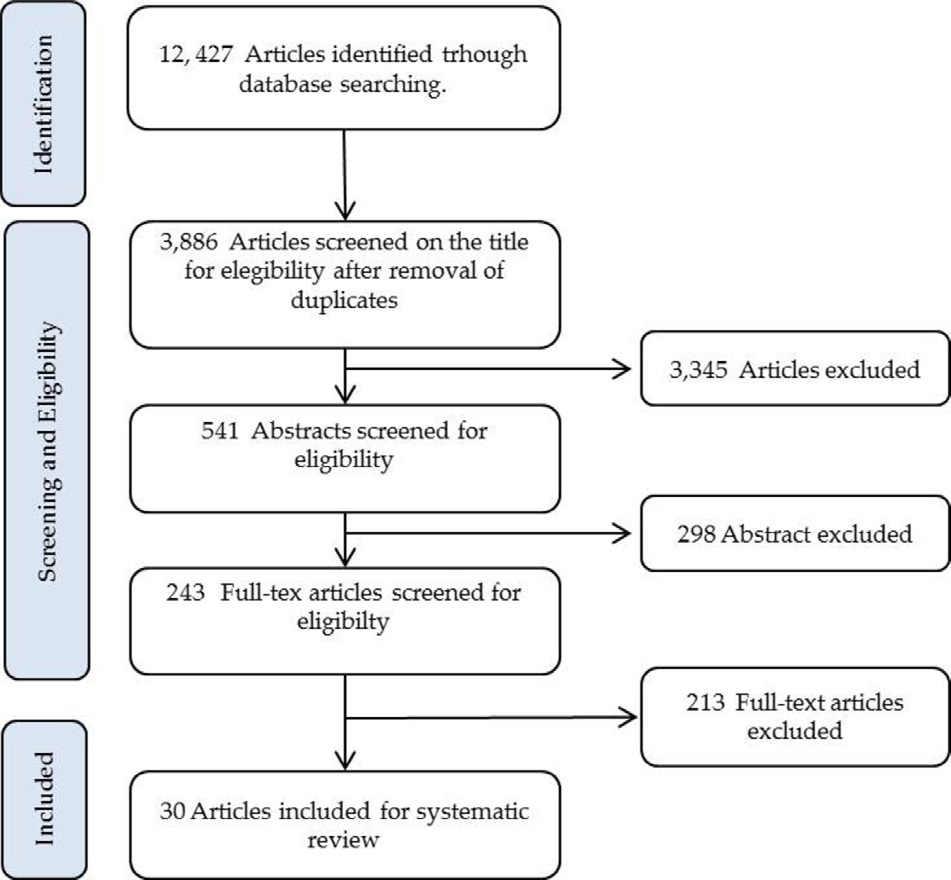
The study was conducted using the systematic review method proposed by Preferred Reporting Items for Sys- tematic Reviews and Meta-Analysis (PRISMA), as shown in Fig. 1.
C. Inclusion Criteria
Articles found after the previously described search were evaluated by analyzing the title and the abstract. The fol- lowing criteria was considered for final selection of articles: (i) Articles written in English; (ii) articles published from
7793
B. Rodríguez-Tapia et al.: Myoelectric Interfaces and Related Applications: Current State of EMG Signal Processing FIGURE 1. Flowchart of searching and screening strategy. 2014 to 2018; (iii) comprehensive initial search results that included journal articles only.
A. Study Selection
From the 12,427 results found in the databases, only 3,886 did not duplicate. From these, 3,345 were discarded after title screening. 541 works were selected to perform abstract review, resulting in the selection of 243 papers for full-paper review. After the full-paper review process, 30 papers were selected according to the fulfillment of the specifications shown in Table 1. It is important to note that although there is a significant amount of publications in the field, only a small number of publications address the specifications regarding the design of EMG signal acquisition systems.
All the applications found during the screening process are
Listed Below:
• Monitoring of muscular activation for rehabilitation, muscle activation plans, and identification of possible pathologies , , –.
• Support mechanisms based on the estimation of muscu- lar strength, known as exoskeletons , . • Electric control of wheelchairs , .
• Prosthetics control –. • Command control by means of myoelectric bracelets –.
• Handwriting recognition from EMG signals for control- ling computer peripherals and identification of patholo- gies as Parkinson’s disease and dysgraphia –.
• Surface EMG-based sketching recognition for the devel- opment of electronic sketching systems and computer- aided sketching systems , .
• Silent speech recognition by means of myoelectric sen- sors interface –. TABLE 1. Parameters considered during the reference scan process.
By
Hakonen into three categories: (1) Rehabilitative tech- nology, that includes activation of exoskeletons and moni- toring of muscle activation which is useful for the detection and prevention of health problems, as well as for activation and strengthening of muscular structures; (2) assistive tech- nology, involving the control of prosthetics and motorized wheelchairs by means of EMG signals; and (3) technology as an input device, which includes the use of myoelectric bracelets for the identification of gestures or sign language, myoelectric interfaces for writing interpretation and sketch- ing, and myoelectric sensors for silent speech recognition.
After the comprehensive review of the 30 selected papers, it was found that the requirements of the EMG signal acqui- sition system vary from one application to another. In this sense, the objective of the present review is to analyze these requirements to provide an adequate property classification and to define the recommended operational characteristics of the EMG signal acquisition systems for each of the previously listed applications.
Acquisition System
EMG systems are characterized for acquiring, analyzing and processing complex bio signals. These bio signals are small in amplitude but very rich in information, and given that they are controlled by the nervous system, they depend on the anatomy and physiological properties of the muscles .
The electrical characteristics of EMG signals reported in the reviewed works are listed in Table 2. In the table, it can
Volume 7, 2019
B. Rodríguez-Tapia et al.: Myoelectric Interfaces and Related Applications: Current State of EMG Signal Processing TABLE 2. Electrical characteristics of the EMG signal. TABLE 3. Harmful interferers that affect the recording of the EMG signal.
be identified that the amplitude in voltage of a muscular contraction can vary from 0 to 10mV and the energy is within the first 500 Hz in the frequency spectrum.
On the other hand, Table 3 presents a collection of harm- ful interferers that may affect the performance of the EMG system. Among the main interferences, the following were identified: moving artifacts affecting low frequencies, trans- mission line that can affect the frequency of 50 or 6OHz depending on the energy sub-ministered of each country, sat- uration of amplifier, physiological interference, specifically, the electrocardiogram and noise bio signal.
Due to the characteristics described above, EMG signals require specific treatment to take the full advantage of the information provided by them. Therefore, the design of the EMG signal acquisition system stages must be carried out in such a way that this specific treatment is effectively achieved.
In general terms, an EMG signal acquisition process requires two main activities: signal sensing and signal pre-processing. Several authors agree in dividing pre-processing of EMG sig- nals into three stages: amplification, filtering, and analog-to-
Digital Conversion , , , , . Hence, We Will
consider that EMG signal acquisition systems are comprised by four stages: (1) sensing, (2) amplifying, (3) filtering, and (4) analog-to-digital conversion.
As stated before, the main goal of this review is to clas- sify the application-specific properties of each stage of the EMG signal acquisition system and to draw recommenda- tions regarding the design requirements for the stages. In this sense, Table 4 abstracts the main properties identified for the sensing stage. The information in Table 4 was completed by identifying in each research article what type of technique was used, superficial or intramuscular, if only the EMG sig- nal was analyzed or in conjunction with another bio signal, how many channels were used, and the characteristics of the sensors used.
While Table 5 summarizes the properties related to the amplifying, filtering, and analog-to-digital conversion stages as well as the software and hardware used, both tables were constructed from the information extracted from the 30 reviewed articles.
A: Properties Of The Emg Sensor
In a myoelectric interface, electrodes are used to detect the biological potential that is generated due to muscle contrac- tion . EMG signals can be analyzed independently or along with other bio signals that are useful to the better understand- ing of the muscle’s movement. The number of implemented sensors is related to the type of movement that is analyzed, and the amount of information provided by each channel needs to be considered for further processing. Properties such as construction material, configuration and size are variables that need to be considered when designing and implementing the signal acquisition system for each specific application.
In this sense, the properties of the sensors considered in the 30 papers selected for this systematic review, were thoroughly analyzed. It is worth mentioning that the selected works cover most of the applications of EMG signals discussed in the previous section. It can be observed in Table 4, that 9 out of the 30 research works correspond to applications falling into the rehabilitation technology category, 10 out of the 30 works fall into the assistive technology category, and finally, 11 out of the 30 works belong to the technology as an input device category.
Intramuscular)
Bioelectrical activity inside the muscle of a human body is detected by means of EMG electrodes. There are two main types of EMG electrodes: superficial (skin surface electrodes) and intramuscular (needles and thin wires) .
From 30 works shown in table 4, 28 resorted to the superfi- cial technique for gathering the EMG data, one work consid- ered the intramuscular technique (sEMG), and one employed a fusion of both techniques (hybrid approach). Of the works that did not report using surface technique, one of the two researches used the intramuscular technique which is focused on EMG signal classification methods for identifying health problems . Signal classification method proposed in allows discriminating among normal, myopathy and Amy- otrophic Lateral Sclerosis (ALS) patients. On the other hand, the work that considered the hybrid approach addresses the problem of prosthetics control by means of signal classification .
C: Type Of Analyzed Signal
As stated before, it is possible that the sensors collect other bio signals along with the EMG signal. These bio signals may differ according to the application considered. The analysis of the signals used in the studies proposed in each of the 30 reviewed works, highlights that 21 works consider only EMG signals, while the remaining 9 publications consider
7795
B. Rodríguez-Tapia et al.: Myoelectric Interfaces and Related Applications: Current State of EMG Signal Processing TABLE 4. Properties of the sensors according to the application type (N=30). other signals as: strength, signals acquired by IMU sensors, electrocardiogram (ECG) signals, pressure, acceleration, space orientation, electrodermal activity (EDA), adaptive cruise control (ACC), illuminance (LUX), elbow movement, photo plethysmography (PPG), bioelectrical impedance anal- ysis (BIA) and position tracking.
In Table 4 it is remarked that the papers that involve the measurement of other bio signals in addition to the EMG signals are, in general, those that study signal classification methods for prosthetic control. This is mainly since these applications require knowledge regarding additional informa- tion as position, speed, rotation and force to improve the effi- ciency of parameters interpretation. The use of other sensors for monitoring different bio signals has also been reported, although they are not necessarily analyzed all together with the EMG signals.
D: Number Of Emg Channels
The number of channels used in an EMG signal acquisition system is related to the muscles intended to be analyzed.
Volume 7, 2019
B. Rodríguez-Tapia et al.: Myoelectric Interfaces and Related Applications: Current State of EMG Signal Processing TABLE 5. Pre-processing features according to the application (N=30).
7797
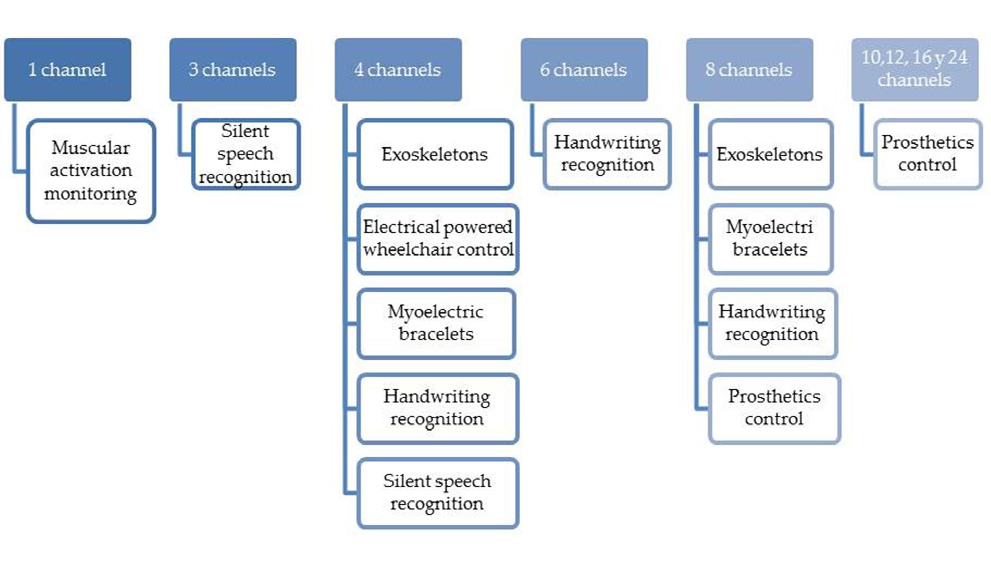
B. Rodríguez-Tapia et al.: Myoelectric Interfaces and Related Applications: Current State of EMG Signal Processing TABLE 5. (Continued) Pre-processing features according to the application (N=30). FIGURE 2. Number of channels used for each application. 1 channel , , , ; 3 channels ; 4 channels Exoskeletons , Electric powered wheelchair control , , Myoelectric bracelets , Handwriting recognition , Silent speech recognition ;
Myoelectric Bracelets , Handwriting Recognition ,
and , Prosthetics control , and and 10, 12, 16 y 24 channels , and –. This design parameter will directly affect the amount of infor- mation that needs to be processed during the classification and data interpretation stage of the myoelectric system.
From the analysis shown in the Table 4 is found out that the number of channels is directly related to the specific application of the EMG signal. Fig. 2 depicts the relation- ship between the numbers of channels used per application addressed in the thirty reviewed papers. Articles reported having used between 1, 3, 4, 6, 8, 10, 12, 16 and 24 channels.
At the bottom of the figure the reference is shown according to the channel number and its application. According to the information provided by the reviewed papers and Fig. 2, one single channel could be enough for transmitting the muscular activity data necessary for muscu- lar activation monitoring systems. However, if pattern recog- nition methods are going to be applied for identifying specific limb pathologies, then considering up to ten channels might be necessary .
For silent speech recognition applications, studies report that a considerable amount of words and phrases could be interpreted by using four channels . On the other hand, periodic expressions as chewing, talking, gargling, and temporary expressions as sadness, surprise, happiness, pout- ing and anger, could be recognized by employing a minimum of three channels .
The Number Of Channels Documented In Applications
for the interpretation of command gestures is four , . These applications are typically used in electrical powered wheelchairs to control functionalities as: mov- ing, stopping, moving forward and reversing. Also, four channels are used in applications for simple hand gesture recognition through myoelectric bracelets , , .
Common uses for these applications are virtual reality gam- ing, computer or mobile phones control, or sign language interpretation.
Works that address applications as writing recognition and exoskeleton activation have documented the use of, at least, six and eight channels. The number of electrodes used in the prosthesis can vary from 1 to 32 electrodes. The impor- tance of this configuration lies in its electro-accuracy control, production cost, computational load, the type and number of tasks to be achieved and degrees of freedom (DoFs) .
Material And Size)
According to the investigation reported in , there are three different sensor configurations: monopolar, bipolar and array/line electrodes. By analyzing the sensor configuration considered in each of the 30 reviewed works, it was observed that the bipolar configuration is the most used. Only 3 out of the 30 works consider the monopolar configuration, and none of them consider the array/line sensor configuration.
On the other hand, a desirable feature for data recording electrodes is their capability for avoiding overpotentials due to polarization. A silver chloride (Ag/AgCl) electrode com- plies with this feature . In this regard, 13 out of the 27 works that consider bipolar sensors, reported that the sen- sors were constructed using Ag/AgCl, while the remaining 14, do not specify the construction material of the sensors employed.
Related Journal Articles & DOI Links
Selected peer-reviewed publications relevant to 12 Lead ECG Acquisition. Click the DOI to access the full paper (may require institutional access).
-
1. Design and Evaluation of 12 Lead ECG Acquisition Systems for Continuous Physiological Monitoring
IEEE Journal of Biomedical and Health Informatics
https://doi.org/10.1109/JBHI.2020.2981234 -
2. Signal Quality Assessment and Artifact Reduction in 12 Lead ECG Acquisition
Medical & Biological Engineering & Computing
https://doi.org/10.1007/s11517-020-02145-6 -
3. Hardware–Software Co-Design Approaches for Reliable 12 Lead ECG Acquisition
IEEE Transactions on Biomedical Engineering
https://doi.org/10.1109/TBME.2019.2895762 -
4. Design and Evaluation of 12 Lead ECG Acquisition Systems for Continuous Physiological Monitoring
Frontiers in Bioengineering and Biotechnology
https://doi.org/10.3389/fbioe.2020.00123 -
5. Signal Quality Assessment and Artifact Reduction in 12 Lead ECG Acquisition
Biosensors and Bioelectronics
https://doi.org/10.1016/j.bios.2021.112345 -
6. Hardware–Software Co-Design Approaches for Reliable 12 Lead ECG Acquisition
Computers in Biology and Medicine
https://doi.org/10.1016/j.compbiomed.2021.104567 -
7. Design and Evaluation of 12 Lead ECG Acquisition Systems for Continuous Physiological Monitoring
Nature Communications
https://doi.org/10.1038/s41467-020-12345-6
Why Choose Us?
Bangalore guidance for robotics, Spectre and autonomous systems projects.
Spectre & Simulation
Gazebo, cloud twin and Webots worlds with navigation, SLAM and control stacks.
Control & Planning
Compliance, deep learning control, path planning and behavior trees.
Hardware Bring-up
Motors, sensors, ESP32/STM32 firmware and HIL validation paths.
Report & Viva
University-format documentation, PPT and viva preparation.
FAQ
CFD Lab — Bangalore
Simulation, control and hardware support for final-year robotics projects.
Stacks
Worlds
Digital Twin
Control
Robots
Offline
Bring-up