Condition Using Polar H7
Andrien Ivander Wijaya*1, Ary S. Prihatmanto*2, Rifki Wijaya*3
*School Of Electrical Engineering And Informatics
Institut Teknologi Bandung, Jalan Ganesha 10, Bandung 40132, Indonesia Abstract—Shesop is an integrated system to make human lives more easily and to help people in terms of healthcare.

Stress and influenza classification is a part of Shesop’s application for a healthcare devices such as smartwatch, polar and fitbit. The main objective of this paper is to create a proper application to implement the stress and influenza classification. The application use Android studio, XML and Java. Also, while creating this application, all design and program is considered to be available for future updates. The application needs an android smartphone with Bluetooth Low Energy technology (bluetooth v4.0 or above). SheSop application will accommodate data entry, device picker, data gathering process, result and saving the result. In the end, we could use the polar H7 and this application to get a real-time heart rate, Heart rate variability and diagnose our stress and influenza condition.

I. Introduction
Healthcare is a core of human’s life. Being healthy is one of the main objective of life ever since BC. According to Oxford’s English dictionary, health is the state of being free from illness or injury and that’s why for more than a thousand years, human always constantly seek the cure for all disease that spread among the world. Nowadays, everything based on mobility and application based. Smart accommodation, food, government, economy, education, payment and even smart health. More than 4 billion cell phones user from 7.4 billion population is a sign that more than half human is a cellphone user and it could reach more than 80% is the metropolis or huge city.
Recently, almost all cellphone, services and media provider recently launch their smart devices with their own application such as Apple watch, Samsung gear, LG Urbane, ASUS zenwatch, Motorola moto 360, Fitbit smartwatch and polar H7. Those devices always includes a heart rate sensor for the healthcare. Usually, the application will get the heart rate and step taken data from the user and show the result in numbers. The result could be HR graph, step remaining and some application determine whether you are sleeping. But, heart rate data can be used for determine more human’s behavior and that’s the reason why Shesop application for influenza and stress is created.

A. Heart Rate Attributes
Heart rate is a pulse beats (Ventricle Contraction) per certain time. Usually, we used 60 seconds to measure heart rate. Heart rate is a dynamic variable which changes over time. HR use bpm which can be measured by count the total beats in 1 minute period. Heart beats can be found in the chest, arm, neck, feet and many other places. We can extract IBI from RR interval (often called normal to normal NN).
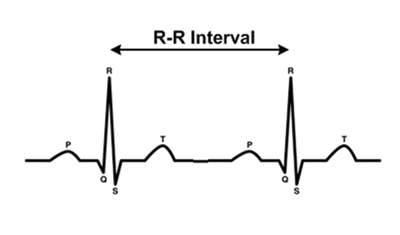
RR interval is the time difference between two R peaks in ECG signals. Ectopic beats is the abnormal heart beats that lead a sudden spike to ECG graph. If we ignore ectopic beats, we can assume that RRI equals to IBI.
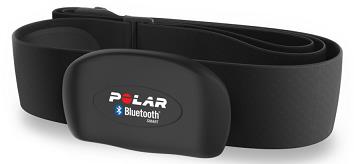
Image 1: Ecg Signal And Pqrst
There are more heart rate variance such as mean, standard deviation, Poincare attribute and entropy.
B. Devices And Software For Development
There are some devices which measure heart rate from chest, arm and ear. Technically, chest devices have some advantage than arm devices since it’s directly target the heart beats rather than target the veins contraction since veins contraction usually have 1-2 seconds delay from the heart beats. Also, chest strap have no missing data compared with arm wrist. But the arm devices also have some advantage such as easier to use, more comfortable and good mobility while chest devices is harder to use and less comfortable for certain people.
In this paper, we will use polar H7 devices because it’s more accurate to do research using chest devices and Polar devices is an open source. Below is the polar H7 device:
Image 3: Polar H7 Sketch
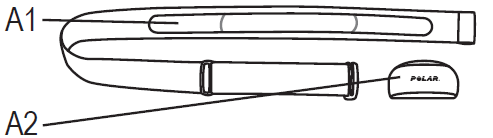
The strap includes ECG electrodes (Image 2 point A1) sensor that detect the heart rate by measuring the electrical activity of the heart to deliver continuous and resting heart rate data and then send the detection data to the module (Image 2 point A2). The module includes bluetooth low energy that send the data to our device such as phone/ tablet via application.
For the software engine, there is two powerful engine for android creation: Android Studio and Unity with to
Ui
Create from zero.
Table 1: Android Studio Vs Unity
Since the application need more UI based with button and text, need BLE plugin, prefer for less size and need lower battery cost rather than a complete feature such as animation and particle, Shesop application will created via android studio.
According To Sharp, Rogers And Preece (2011),
Interaction design is designing interactive products to support the way people communicate and interact in their everyday and working lives. Application design should give best user experience (UX). UX is something that user feels, could be immersive, happy, sad, smooth or even frustrating.
Application also must have good user interface (UI) such as nice button position, feedback response, simple color mixture and readable font. Interaction design should fulfill:
Things. Doing Wrong Things For A Long
time could be very ineffective.
Sop Or Guide, No Matter Its Right Or
wrong.
Least: We Have A Future Plan For These
thing.
Easy To Learn Even Without A Proper
tutorial.
Action:
pressing button, saving, time out, etc.
And
combinations of these.
Can Be Performed, Helps Prevent User
from selecting incorrect options.
Physical Objects Can Be Designed To
constrain things.
Color. It Will Lead To An Ambiguous
application and could be fatal.
Consistent
Consistent UI, consistent information.
User, Making Them More Prone To
errors.
Give An Attribute Of An Object That
allows people to know how to use it.
Vertical Scroll Will Lead To Up And
down moves.
Table 2: Interaction Design
Good design also need to be supported by good data. Data by itself is an indefinite or generic term that needs descriptors to modify and make clear its meaning. There’s so many example of data such as: employee data, salary data, purchase data, data on SD card or even data about our favorite video on YouTube. But what makes it good? British scientist William Thompson, Lord Kelvin is quoted as having said: “Until you can measure something and express
Understanding“. So, A Good Data Must Have A Good
background and specifications such as: What did we
Consistent Enough? Sample Is Valid Enough?
Good data also often linked to relevant, current, and trustworthy business information while bad data often linked with out-of-date, obsolete and low-value information. Good data should consider every simple but significant external factor such as weather, human’s mood, temperature, etc.
Also, we need to think how the data changed over time and most importantly: the data objective.
Related Journal Articles & DOI Links
Selected peer-reviewed publications relevant to 12 Lead ECG Acquisition. Click the DOI to access the full paper (may require institutional access).
-
1. Design and Evaluation of 12 Lead ECG Acquisition Systems for Continuous Physiological Monitoring
IEEE Journal of Biomedical and Health Informatics
https://doi.org/10.1109/JBHI.2020.2981234 -
2. Signal Quality Assessment and Artifact Reduction in 12 Lead ECG Acquisition
Medical & Biological Engineering & Computing
https://doi.org/10.1007/s11517-020-02145-6 -
3. Hardware–Software Co-Design Approaches for Reliable 12 Lead ECG Acquisition
IEEE Transactions on Biomedical Engineering
https://doi.org/10.1109/TBME.2019.2895762 -
4. Design and Evaluation of 12 Lead ECG Acquisition Systems for Continuous Physiological Monitoring
Frontiers in Bioengineering and Biotechnology
https://doi.org/10.3389/fbioe.2020.00123 -
5. Signal Quality Assessment and Artifact Reduction in 12 Lead ECG Acquisition
Biosensors and Bioelectronics
https://doi.org/10.1016/j.bios.2021.112345 -
6. Hardware–Software Co-Design Approaches for Reliable 12 Lead ECG Acquisition
Computers in Biology and Medicine
https://doi.org/10.1016/j.compbiomed.2021.104567 -
7. Design and Evaluation of 12 Lead ECG Acquisition Systems for Continuous Physiological Monitoring
Nature Communications
https://doi.org/10.1038/s41467-020-12345-6
Why Choose Us?
Bangalore guidance for robotics, Spectre and autonomous systems projects.
Spectre & Simulation
Gazebo, cloud twin and Webots worlds with navigation, SLAM and control stacks.
Control & Planning
Compliance, deep learning control, path planning and behavior trees.
Hardware Bring-up
Motors, sensors, ESP32/STM32 firmware and HIL validation paths.
Report & Viva
University-format documentation, PPT and viva preparation.
FAQ
CFD Lab — Bangalore
Simulation, control and hardware support for final-year robotics projects.
Stacks
Worlds
Digital Twin
Control
Robots
Offline
Bring-up