Exoway: An Exoskeleton On Actuated Wheels
D. Abruzzese, D. Carnevale, A. Monti, C. Possieri, S. Rossi,
Abstract
In this short work we present a low cost exoskeleton with actuated wheels that allows movements as well as skating-like steps. The simple structure and the actuated wheels allows to minimize the use of motors for locomotion. The structure is stabilized by an active control system that balances the structure and permit to be maneuvered by the driver whose commands are acquired by a dedicated hardware interface.
General Target
The main objective of the EXOWAY project consists in designing and proto- typing an advanced self-balanced EXOskeleton with actuated wheels, similarly to segWAY, simultaneously capable of high-velocity movement on flat surfaces and of climbing stairs/steps to significantly increase mobility of people with impaired lower limbs motor functions.
State Of The Art
Approximately 250 to 500 thousands people suffer from Spinal Cord Injury (SCI) every day, representing a global incidence of 23 cases per million . The most common causes of SCI are traffic accidents, gunshot injuries, knife injuries, falls and sports injuries , which cause a lesion of the neural components of the spinal cord, such as medulla, medullary cone and/or cauda equina . In SCI patients muscular recruitment and motor planning are compromised; thus, gait impairment represents one of the most critical disabilities and may cause the complete loss of voluntary control of the leg muscles . In addition, patients with SCI are subjected to secondary complications , such as psychological, cutaneous and cardiorespiratory problems . Moreover, the number of people that have limited capability of autonomous gait increase impressively if we in- clude stroke and Parkinson’s disease patients. The overall picture is expected to become even more critical in the very near future due to rapidly aging popula- tion. Canes, walkers or wheelchairs are useful devices that permit a certain level
Arxiv:2010.13393V1 [Cs.Ro] 26 Oct 2020
of mobility ; however, these traditional assistive devices do not allow patients to achieve a full social participation, since they limit their ability to perform daily activities and - especially concerning the case of wheelchairs - they can lead to muscle atrophy due to prolonged usage and do not provide a sufficient stimulation to the blood circulatory system. Innovative mobility devices have been developed in recent years, encompassing powered lower limb exoskeletons and powered wheelchairs . Among the former, ReWalkTM is the most widespread in both domestic and clinical contexts. ReWalk is an assistive de- vice that provides powered hip and knee motion, allowing patients with SCI to stand upright, walk, turn and ascend/descend stairs. Each step is generated by means of the measurement of user’s trunk movements gathered by a tilt sensor.
The major disadvantage is that the patient needs to use canes to stabilize the walk. This aspect requires patient training and use of upper limbs to permit locomotion, precluding to such patients all daily life/work activities that require the use of upper limbs. An additional limitation, shared also by similar devices (Indego, EksoGT, ExoAtlet, ecc..), is the limited (maximum) achievable walk- ing speed, that is critically low for the first self-balancing powered exoskeleton commercially available, namely the REX® . REX, equipped with motors and hardware dedicated to ensure self balanced walking, results in an heavy and bulky structure whose price overpasses alternative exoskeletons by more than 40k(approx.priceofexoskeletonsis70k).
Mechanical Design
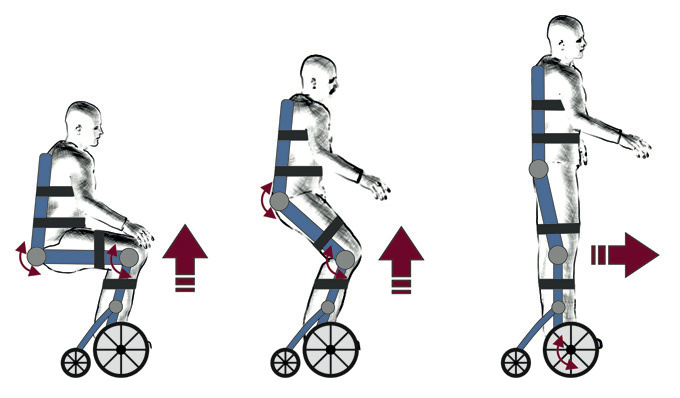
To address and circumvent the severe limitations discussed above, the EXOWAY is envisioned to suitably combine the features of a segway and of an exoskeleton (Figure 2).
Figure 1: Sketch of the EXOWAY mechanical structure and its motion with paired wheels.
Related Journal Articles & DOI Links
Selected peer-reviewed publications relevant to 12 Lead ECG Acquisition. Click the DOI to access the full paper (may require institutional access).
-
1. Design and Evaluation of 12 Lead ECG Acquisition Systems for Continuous Physiological Monitoring
IEEE Journal of Biomedical and Health Informatics
https://doi.org/10.1109/JBHI.2020.2981234 -
2. Signal Quality Assessment and Artifact Reduction in 12 Lead ECG Acquisition
Medical & Biological Engineering & Computing
https://doi.org/10.1007/s11517-020-02145-6 -
3. Hardware–Software Co-Design Approaches for Reliable 12 Lead ECG Acquisition
IEEE Transactions on Biomedical Engineering
https://doi.org/10.1109/TBME.2019.2895762 -
4. Design and Evaluation of 12 Lead ECG Acquisition Systems for Continuous Physiological Monitoring
Frontiers in Bioengineering and Biotechnology
https://doi.org/10.3389/fbioe.2020.00123 -
5. Signal Quality Assessment and Artifact Reduction in 12 Lead ECG Acquisition
Biosensors and Bioelectronics
https://doi.org/10.1016/j.bios.2021.112345 -
6. Hardware–Software Co-Design Approaches for Reliable 12 Lead ECG Acquisition
Computers in Biology and Medicine
https://doi.org/10.1016/j.compbiomed.2021.104567 -
7. Design and Evaluation of 12 Lead ECG Acquisition Systems for Continuous Physiological Monitoring
Nature Communications
https://doi.org/10.1038/s41467-020-12345-6
Why Choose Us?
Bangalore guidance for robotics, Spectre and autonomous systems projects.
Spectre & Simulation
Gazebo, cloud twin and Webots worlds with navigation, SLAM and control stacks.
Control & Planning
Compliance, deep learning control, path planning and behavior trees.
Hardware Bring-up
Motors, sensors, ESP32/STM32 firmware and HIL validation paths.
Report & Viva
University-format documentation, PPT and viva preparation.
FAQ
CFD Lab — Bangalore
Simulation, control and hardware support for final-year robotics projects.
Stacks
Worlds
Digital Twin
Control
Robots
Offline
Bring-up