PPG as a Bridge: Cross-Device Authentication for Smart Wearables
Weiqiang Wang, Ant Group, China
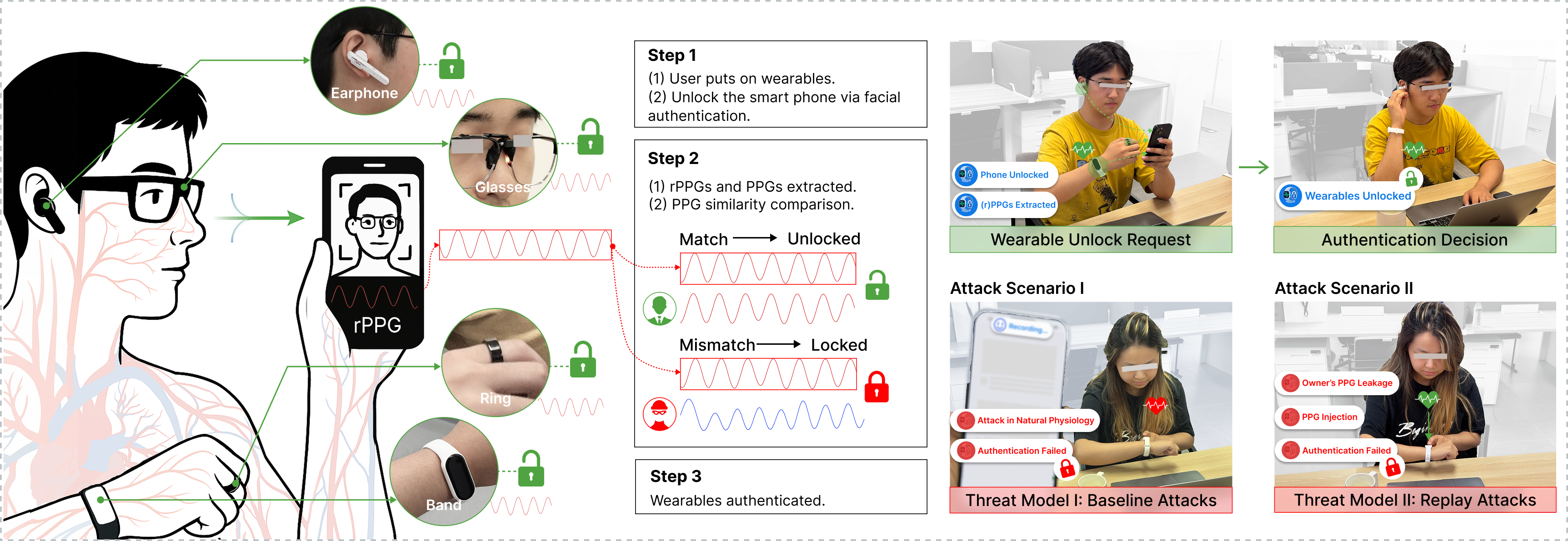
Fig. 1. System Overview of PPGTransID. PPGTransID is a cross-device authentication method that leverages the phys- iological consistency between rPPG signals captured by smartphones and PPG signals from smart wearables to transfer authentication status from the smartphone to co-worn devices. By doing so, it enables ubiquitous and unobtrusive authenti- cation, allowing users to authenticate multiple wearables during everyday smartphone use with minimal disruption.
∗Co-First Authors
†Corresponding author. Permission to make digital or hard copies of all or part of this work for personal or classroom use is granted without fee provided that copies are not made or distributed for profit or commercial advantage and that copies bear this notice and the full citation on the first page.
•
Trovato et al. As smart wearable devices become increasingly powerful and pervasive, protecting user privacy on these devices has emerged as a critical challenge. While existing authentication mechanisms are available for interaction-rich devices such as smartwatches, enabling on-device authentication (ODA) on interaction-limited wearables—including rings, earphones, glasses, and wristbands—remains difficult. Moreover, as users increasingly own multiple smart devices, relying on device- specific authentication methods becomes redundant and burdensome. To address these challenges, we present PPGTransID, a ubiquitous and unobtrusive cross-device authentication (CDA) approach that leverages the real-time physiological consistency of photoplethysmography (PPG) signals across the human body. PPGTransID utilizes the widely available PPG sensors on wearable devices to capture users’ physiological signals and compares them with remote PPG (rPPG) signals extracted from a smartphone camera, where robust face-based authentication is already established. In doing so, PPGTransID securely transfers the reliable authentication status of the smartphone to nearby wearable devices without requiring additional user interaction.
An evaluation (N=33) shows that PPGTransID achieves a balanced accuracy of 95.5% and generalizes across multiple wearable form factors. Robustness experiments (N=10) demonstrate resilience to variations in lighting, camera placement, and user behavior, while a real-time usability study (N=14) confirms reliable performance with minimal interaction burden.
CCS Concepts: • Human-centered computing →Ubiquitous and mobile computing systems and tools. Additional Key Words and Phrases: Authentication, Wearable Device, Smart Sensing, Photoplethysmography
Acm Reference Format:
Jiacheng Liu, Jiankai Tang, Guangye Zhao, Ruichen Gui, Songqin Cheng, Taiting Lu, Jian Liu, Weiqiang Wang, Mahanth Gowda, Yuanchun Shi, and Yuntao Wang. 2024. PPG as a Bridge: Cross-Device Authentication for Smart Wearables with Photoplethysmography. Proc. ACM Interact. Mob. Wearable Ubiquitous Technol. 1, 1, Article 1 (January 2024), 31 pages.
Introduction
Identity authentication is a fundamental requirement for the broader adoption of smart wearables in healthcare, communication, and payment. However, traditional On-device Authentication (ODA) — which typically requires template enrollment and on-device verification — can be difficult to deploy on wearables with constrained computation, sensing, and interaction. A promising alternative is Cross-device Authentication (CDA) , where identity verified on a trusted token device is seamlessly transferred to another device. Security is maintained by verifying that the token device and wearables are co-present on the same user. In other words, once the token device has authenticated the user through mature methods such as FaceID or fingerprint recognition, wearables only need to confirm shared user presence rather than perform full authentication themselves. A practical example is the Apple Watch: When users unlock their iPhone, the paired Apple Watch automatically unlocks without requiring any additional interaction.
Compared to traditional ODA, CDA eliminates per-device template enrollment and relies on real-time device-to- device communication to confirm co-presence. Consequently, CDA inherently offers stronger long-term reliability, avoiding the degradation faced by ODA systems due to changes in physiological or behavioral characteristics .
It also shifts the authentication burden from individual wearables to the token device, reducing the constraints imposed by wearables’ limited interaction and standalone authentication capabilities. However, existing CDA methods suffer from several inherent limitations. The first limitation lies in the choice of the token device. Prior research [15, 73] has not adequately justified the reliability or suitability of this source device. For instance, if a wristband is designated to unlock other devices, a feasibility issue arises when the band Copyrights for components of this work owned by others than the author(s) must be honored. Abstracting with credit is permitted. To copy otherwise, or republish, to post on servers or to redistribute to lists, requires prior specific permission and/or a fee. Request permissions from © 2024 Copyright held by the owner/author(s). Publication rights licensed to ACM.
Https://Doi.Org/10.1145/Nnnnnnn.Nnnnnnn
PPG as a Bridge: Cross-Device Authentication for Smart Wearables with Photoplethysmography
1:3
itself is difficult to unlock. Second, a gap remains in CDA methods that generalize across diverse wearables. Some approaches rely on IMU or motion data [15, 20, 40, 73], which can be reliable but are limited to certain wearables. In practical use, most wearable devices do not require specific motion patterns, nor do they frequently move in coordination with the trusted token device. This introduces unnecessary interaction overhead and deviates from natural user behavior. Third, systems that depend on proprietary device-level trust or manual user confirmation—such as Apple Watch’s proximity-based unlocking —are difficult to extend across brands, and manual confirmation adds user burden and potential security risks.
In this paper, we present PPGTransID, a PPG-based CDA method that enables ubiquitous and unobtrusive authentication for smart wearables. As shown in Figure 1, after a user initiates facial authentication to unlock their smartphone, the phone automatically captures a short facial video in the background while simultaneously collecting synchronized PPG signals from optical sensors embedded in co-worn wearables. PPGTransID extracts remote photoplethysmography (rPPG) from the facial video and correlates it with wearable PPG signals to make authentication decisions. Once verified, the authentication state can be maintained through mechanisms such as wear detection or continuous heart rate monitoring . In essence, PPGTransID allows users to authenticate all of their smart wearables at once with minimal disruption to everyday smartphone use.
PPGTransID is designed to address the limitations of existing methods. First, smartphones have established ma- ture unlocking mechanisms with strong privacy attributes, making them a reasonable choice as token devices . Second, smartphones are frequently used in daily life and can acquire rPPG signals from the front camera without introducing additional user interactions . Meanwhile, most wearables are already equipped with optical sensors that allow unobtrusive and implicit acquisition of PPG signals once worn . Third, the method relies on the consistency of real-time physiological features across different body sites rather than device-level trust, making it less susceptible to proximity attacks.
To evaluate the ubiquity and usability of PPGTransID, we posed the following research questions. • RQ1: Is PPGTransID applicable across various common smart wearables? • RQ2: Can PPGTransID effectively resist diverse attacks against CDA? • RQ3: Can PPGTransID remain robust under diverse environmental conditions and user behaviors? • RQ4: Does PPGTransID provide a favorable user experience? To address these questions, we conducted a user study with 33 participants to evaluate the system on three custom-built wearable devices (band, glasses, ring) and a commercial earphone, under both sitting and standing postures. With an XGBoost classifier and our preprocessing pipeline, the system achieved a balanced accuracy (BAC) of 95.5% without user calibration, while maintaining efficient memory usage (0.46 M parameters) and low inference latency (9.3 ms). The system also demonstrated robust performance across wearables, body postures, rPPG extraction methods, and environmental conditions, and exhibited resistance to replay attacks. Additionally, we explored potential use cases by evaluating performance on different token devices, unseen wearable devices, and shorter usage durations.
To further evaluate the system’s robustness to variations in lighting, head motion, and camera positioning, a user study involving 10 participants was conducted. The results indicate that these condition changes introduce no significant impact on the reliability of the approach.
To examine real-world applicability, we implemented a real-time demonstration of PPGTransID on an iPhone 15 and a laptop. A study with 14 participants simulated two scenarios: baseline attacks and authentication while scrolling the screen. The system achieved consistent BACs of 97.7% and 96.7%, respectively. Participants also reported favorable perceptions in the system’s usability and future applications. Taken together, these results are
•
Trovato et al. • Introduced PPGTransID, a ubiquitous and unobtrusive cross-device authentication approach that exploits the real-time physiological consistency between (r)PPG captured by the token device and wearable PPG signals for smart wearable authentication.
• Conducted comprehensive user studies to evaluate PPGTransID with respect to its resistance to defined threat models, ubiquity across diverse wearable devices, and robustness under non-ideal conditions. • Developed a real-time implementation of PPGTransID on an iPhone and a laptop, and validated its usability and acceptance through interactive demonstrations.
Cross-Device Authentication
CDA has been investigated in prior work as a way to extend authentication beyond a single device by securely transferring identity from one trusted device to others. Early work showed that signals observable across devices can provide such a basis. Examples include ambient RF noise , hand resonance , bodily electrical response , bone conduction , and heartbeat-based cross-modal keys . These studies demonstrated the feasibility of shared physical or physiological features for secure transfer, though most remained at the pairing or key-generation level.
More explicit forms of CDA leverage human motion to propagate authentication across devices. ShakeUn- lock employed synchronized shaking to transfer an unlocked status from a smartwatch to a smartphone. SAW enabled wristband-based authentication for desktop computers by matching motion patterns between wearable sensors and workstation interactions. Related work has also explored authentication transfer across heterogeneous systems using motion signatures captured during daily activities. For example, No-Need-to-Shake- It advanced implicit authentication by correlating motion patterns between a wristband and everyday objects equipped with inertial sensors, while Au-Id leveraged motion features extracted from sequential human activities using RFID for automatic user identification and authentication. These systems demonstrate that body motion can act as a transferable biometric across devices and sensing modalities. However, such approaches typically rely on explicit user movements, activity-dependent motion patterns, or additional sensing infrastructure, which limits their ubiquity and suitability for unobtrusive authentication.
Moreover, commercial systems, such as iPhone unlocking Apple Watch, rely on proximity-based transfer after FaceID, though such assumptions can be vulnerable . In contrast, our work departs from these paradigms by leveraging PPG—a sensing modality already embedded in smartphones and wearables—to enable ubiquitous and unobtrusive CDA without requiring explicit gestures, additional sensors, or proximity assumptions
Remote Photoplethysmography Algorithms
The advancement of rPPG now enables smartphones and other devices with mature authentication to serve as reliable token devices for PPG-based CDA. Traditional rPPG algorithms primarily rely on signal processing and color space analysis to extract blood volume pulse from facial videos. The seminal work of Verkruysse et al. demonstrated that plethysmographic signals can be captured remotely using ambient light and RGB cameras, establishing the foundation for this field. ICA-based methods such as Poh et al. improved robustness by separating pulse signals from noise, while CHROM enhanced color space projections for more stable heart rate estimation. To mitigate motion artifacts, the POS algorithm introduced a projection onto a plane orthogonal to the skin tone, significantly improving robustness under movement. More recently, Face2PPG proposed an unsupervised framework that extracts blood volume pulse signals without explicit supervision, highlighting progress toward real-world deployment. Despite these advances, most traditional methods assume steady illumination and limited motion, restricting their reliability in unconstrained environments.
PPG as a Bridge: Cross-Device Authentication for Smart Wearables with Photoplethysmography
1:5
Deep learning methods have been developed to overcome these limitations by learning spatio-temporal repre- sentations directly from video. Early neural approaches such as DeepPhys and PhysNet [35, 76] demonstrated the feasibility of end-to-end rPPG estimation. Transformer-based architectures including PhysFormer [36, 77] and RhythmFormer further improved accuracy by modeling long-range temporal dependencies. More recently, PhysMamba and MaKAN-Mixer advanced robustness by combining state-space or channel-mixing modules with temporal dynamics amplification. However, the majority of these methods are validated only on high-quality stationary videos, limiting applicability to everyday mobile use. In contrast, we deploy TN-rPPG , which leverages temporal neighborhood aggregation to enable reliable heart rate extraction from handheld smartphone videos with strong motion noise, and ME-rPPG , which provides real-time PPG waveform estimation for improved user experience in continuous monitoring scenarios.
Authentication On Smart Wearables
Wearable authentication has been studied across multiple device form factors, ranging from wristbands to earbuds and smart glasses. PPG-based approaches have been proposed for on-wrist wearable authentication, where commercial devices such as Samsung Gear and Empatica E4 have demonstrated continuous implicit authentication in daily life . Building on this, PPGPass employed dual-channel PPG with adaptive filtering to improve robustness, while M-PPG introduced motor-induced vibrations to enhance signal distinctiveness, though all remain tied to per-device enrollment. Moving from the wrist to the ear, EarPass explored in-ear PPG with a quality assessment for motion artifacts, and EarID advanced ear canal sensing, achieving 98.1% balanced accuracy but requiring specialized sensors. Extending further to head-mounted devices, SkullID leveraged through-skull sound conduction for smartglasses, achieving error rates below 3% with robustness to donning variations, yet still confined to glasses-specific acoustic hardware.
These studies reveal the rich potential of physiological and anatomical signals for wearable authentication, but they share fundamental limitations: device-specific design, template-based registration, and limited generaliz- ability across heterogeneous devices. In contrast, our work leverages PPG consistency between smartphones and wearables to transfer identity across devices, eliminating per-device enrollment while ensuring long-term reliability and low-burden user experience.
System Architecture
As illustrated in Figure 1, PPGTransID consists of three key components: (1) smart wearables equipped with PPG sensors, (2) a mobile phone registered to the legitimate user with mature facial authentication capability, and (3) a CDA process running on the smartphone or an external server.
The CDA process is triggered when the user unlocks the phone via facial authentication. During this process, the frontal camera captures a short facial video, which is used to extract rPPG signals for CDA. Since reliable PPG-based authentication requires a longer signal duration than conventional facial authentication, the camera remains active for several additional seconds to acquire rPPG signals of sufficient length. Meanwhile, synchronized PPG signals are collected from the embedded sensors on the wearable devices. The CDA process then preprocesses both signals and computes a correlation score between the rPPG and wearable PPG signals to verify device ownership.
In this work, we focus on four common types of wearables: smart earphones, smart glasses, smart rings, and smart bands. Unlike mobile phones and smartwatches, these devices typically have limited input interfaces, sensing capabilities, and immature authentication mechanisms. PPGTransID is designed to address this challenge by enabling a ubiquitous, form-factor-agnostic authentication mechanism across heterogeneous wearable devices.
•
Trovato et al.
Theory Of Operation
PPG, as a widely adopted and commercially mature sensing modality, naturally satisfies the key requirements of a unified and form-factor-agnostic CDA mechanism: (1) it remains consistent across different devices worn by the same user, (2) it preserves sufficient inter-user distinctiveness for reliable authentication, and (3) it exhibits transient, moment-to-moment variations that mitigate the risk of misuse from leaked or replayed signals.
Cross-device consistency. PPG is an optical signal that reflects changes in light absorption and scattering induced by cardiac-driven pulsatile blood flow. Although differences in hardware characteristics and local tissue properties introduce morphological variations and small temporal offsets in PPG waveforms captured at different body locations, synchronized cross-device PPG signals still exhibit high correlation. Prior studies have shown that these signals share common physiological features, such as heart rate and pulse rate variability, across devices worn by the same individual [4, 6, 43, 79].
Inter-user distinctiveness. PPG features exhibit substantial inter-user variability arising from physiological factors such as age, medical conditions, sex, and body mass index, which provides a natural basis for user discrimination [3, 42, 46]. Using the data collected in Study 1 (Section 5), we observe that synchronized cross- device PPG signals from the same user demonstrate significantly higher similarity than those from different users.
Specifically, synchronized intra-user PPG pairs achieve a higher Pearson correlation (mean = 0.830, SD = 0.070) and coherence similarity (mean = 0.743, SD = 0.071). In contrast, inter-user PPG pairs exhibit substantially lower correlation (mean = 0.501, SD = 0.007) and coherence similarity (mean = 0.326, SD = 0.053).
Temporal variations. Without the need for template registration, CDA approaches typically rely on transient, momentary features shared across devices to enhance security, such as IMU signals during device shaking or patterns induced by human–object interaction . While prior work on PPG-based ODA has demonstrated that PPG signals contain stable morphological characteristics over time [7, 45, 58, 63, 81], these signals also exhibit natural temporal variations driven by dynamic cardiac activity. This combination of temporal stability and short-term variability enables PPG to support secure CDA without explicit template registration. We further analyze this property in Section 4.4 and Section 5.8.
Threat Model
We consider an attacker A who has illegally obtained a wearable device W and aims to deceive the authentication system into believing that a legitimate user L is wearing and using W. In this work, we examine two threat models.
Baseline attacks (Threat Model I). A wears the stolen W and attempts to authenticate using their own physiological signals. Specifically, A wears W while the L unlocks their mobile phone and initiates the CDA process. This threat model evaluates whether the system can be fooled by cross-device signals originating from different users.
Replay attacks (Threat Model II). A obtains recorded PPG signals of L through unintended leakage or external monitoring. These recorded signals are subsequently injected into the stolen W while L unlocks the mobile phone and initiates the CDA process. This threat model assesses whether the system can be deceived using a legitimate user’s historical physiological data, a widely recognized risk in authentication systems that rely on biometric signals .
Assumptions and Non-considered Scenarios. Mimicry attacks, in which an attacker attempts to imitate a victim’s motion patterns or physiological states, have been discussed in prior CDA studies [15, 54, 73]. In our work, we assume that attackers cannot precisely and voluntarily control PPG signals, as PPG reflects involuntary cardiac activity. A potential strategy for partial mimicry is heart rate adaptation. To examine this possibility, we conducted an experiment with the participants in Study 3 (Section 6), where participants were instructed to align their heart rates with those of an experimenter using techniques such as deep breathing or light physical activity.
PPG as a Bridge: Cross-Device Authentication for Smart Wearables with Photoplethysmography
1:7
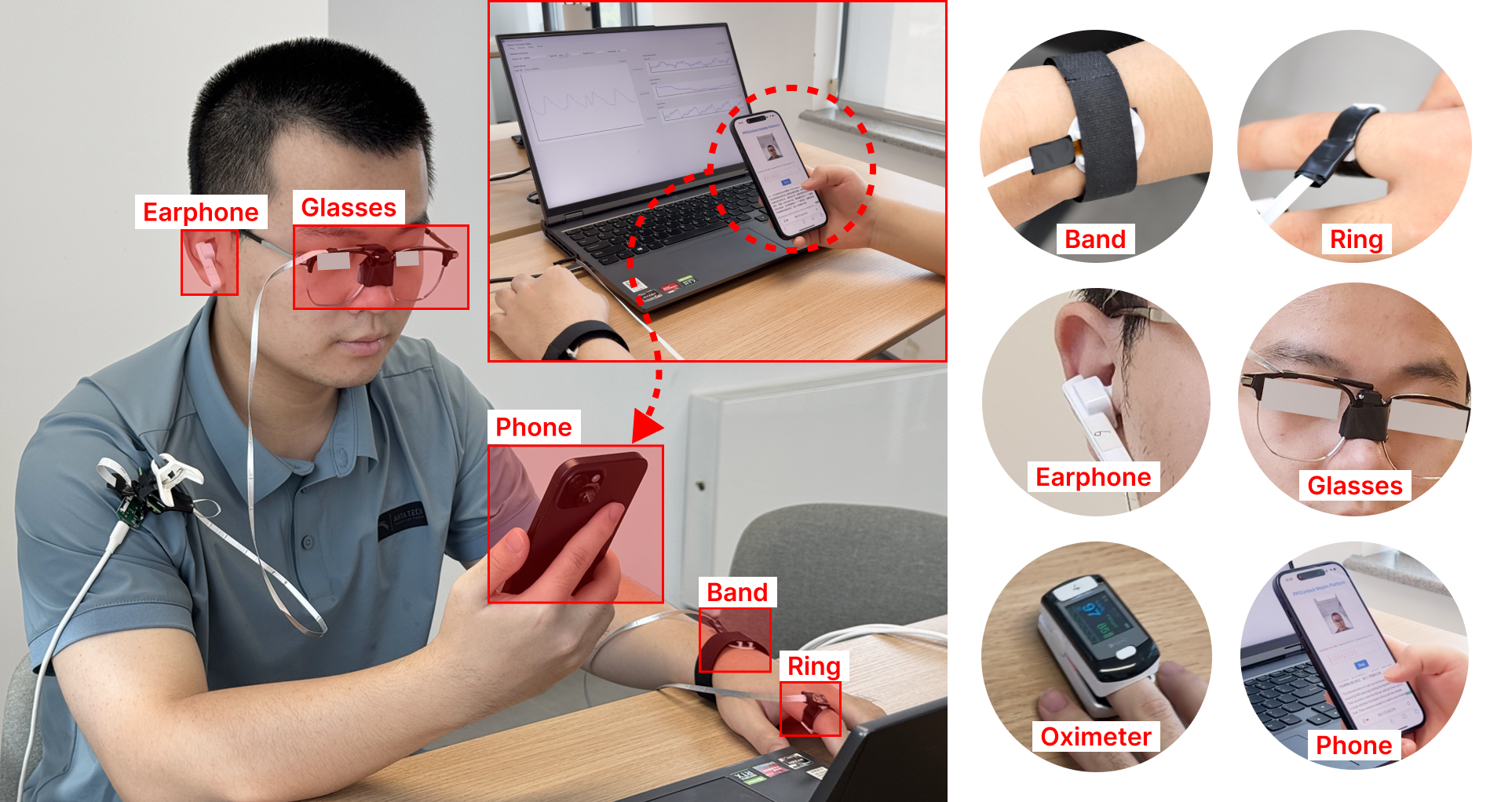
Fig. 2. Demonstration of Hardware Devices. Illustration of device wearable placement and usage (left) and close-up views of the hardware used in our studies (right). The results showed no statistically significant reduction in heart rate differences after adaptation. Participants reported difficulty in deliberately lowering their heart rates (P7, P8), while others noted that post-exercise heart rates often exceeded the intended targets (P2, P5), making accurate physiological mimicry impractical. We therefore do not consider precise PPG mimicry capabilities in our threat model.
Some CDA systems require explicit user confirmation, such as notification-based approval, to authorize device access. While effective, such mechanisms represent an orthogonal engineering solution that can be incorporated into a wide range of CDA approaches, rather than a property intrinsic to the CDA method itself. Moreover, explicit user confirmation may introduce additional interaction overhead, particularly when multiple devices need to be unlocked. As this work focuses on signal-based CDA without explicit user intervention, we do not consider such approaches.
Hardware Implementation
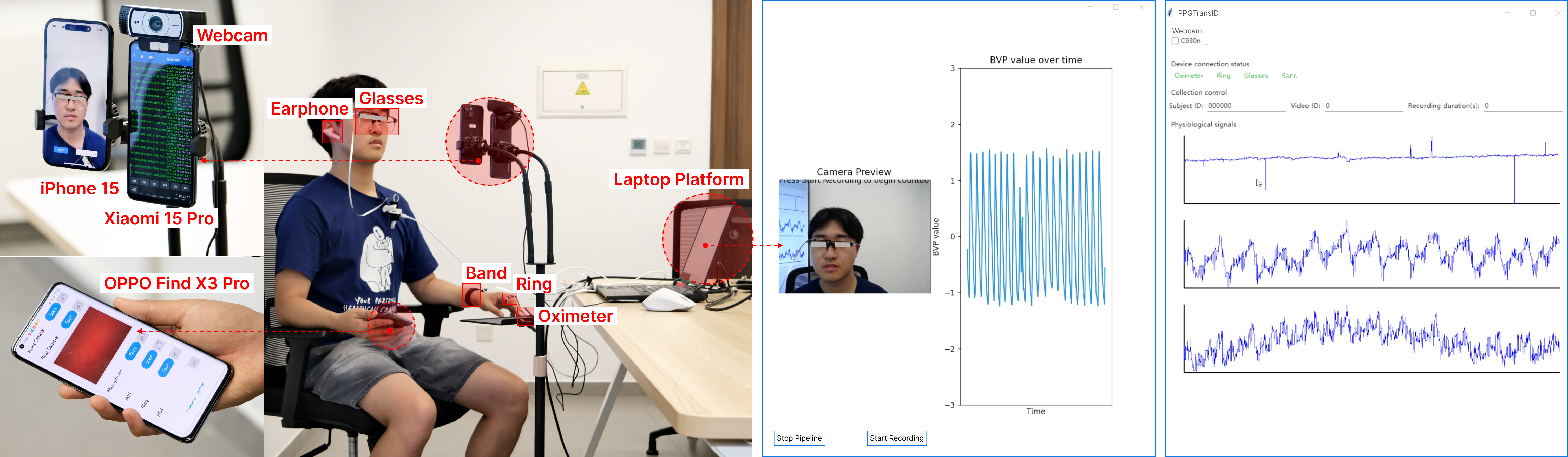
We developed three custom wearable devices (a ring, a band, and glasses), along with a commercial TH2318 PPG earphone, to support the study objectives. Additional equipment included a commercial CMS50E+ pulse oximeter, an OPPO A52 smartphone (for earphone data recording), an OPPO Find X3 Pro (for fingertip video capture), an iPhone 15 (for facial video capture), and an ASUS ROG Strix G15 G513QM laptop (for recording PPG signals from the custom wearables).
All custom devices shared the same electronic components but differed in mechanical design and configuration to optimize signal quality at their respective measurement sites. Each device employed an Analog Devices MAX30101 optical sensor, commonly used in prior work [24, 48]. To accommodate variations in skin and vascular properties across different body sites, LED drive currents were individually tuned to ensure sufficient signal amplitude. The sensors were driven by an nRF52832 microcontroller, which streamed PPG signals via USB to a laptop at 110 samples per second.
The custom devices were encased in 3D-printed, skin-safe thermoplastic polyurethane (TPU) enclosures designed to fit the anatomical contours of the measurement sites and maintain stable sensor–skin contact. As shown in Figure 2, the ring placed the sensor on the proximal phalanx of the index finger, the band positioned it
•
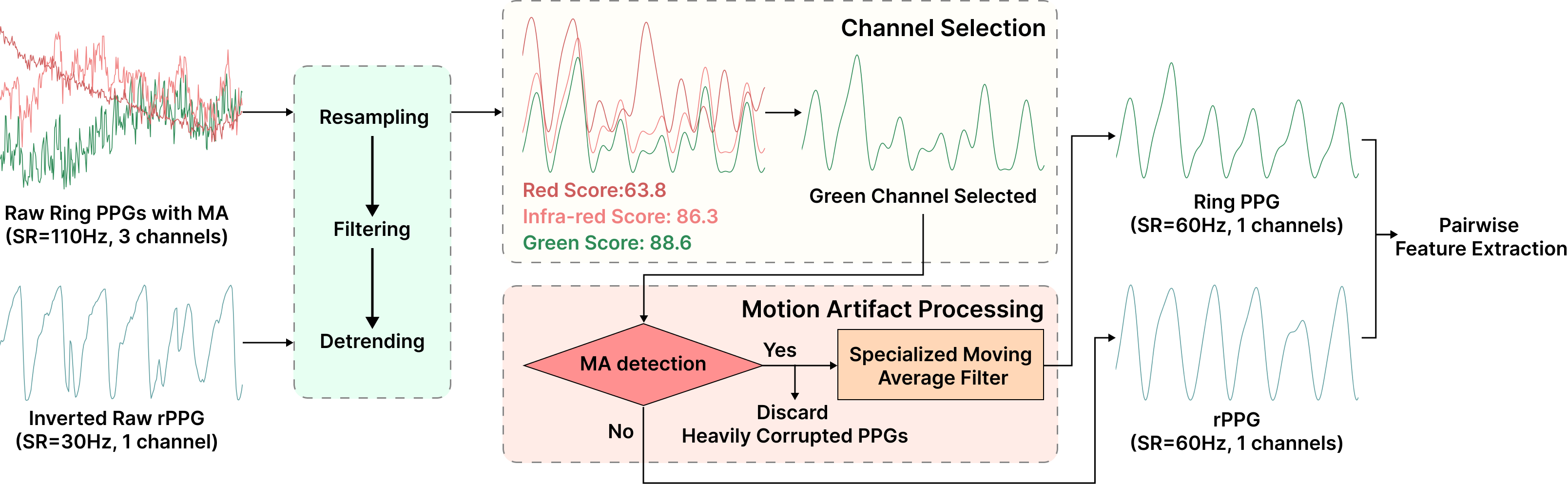
Trovato et al. Fig. 3. Preprocessing Pipeline. To normalize PPG signals across devices and sensing modalities, signals are resampled, filtered, and detrended. For multi-channel devices, a quality score is computed for each channel, and the best channel is selected. MA processing classifies signals as clean, weakly corrupted, or heavily corrupted; heavily corrupted signals are discarded, while weakly corrupted signals are mitigated using a specialized moving average filter. Pairwise features are then extracted from the cleaned PPG pairs.
on the dorsal forearm, and the glasses located it on the lateral side of the nasal bridge — the most commonly adopted site for PPG monitoring in glasses form factors [11, 51].
System Pipeline
PPG signals extracted from heterogeneous devices and sensing modalities differ in sampling rates, available signal channels, and susceptibility to motion artifacts (MA). To address these variations and enable reliable pairwise feature extraction, we propose a unified preprocessing pipeline that mitigates cross-source discrepancies among PPG signals and produces consistent pairwise features (Figure 3).
Rppg Extraction
We employed two complementary approaches to extract rPPG signals from facial videos. The first is a temporal normalization–based rPPG method (TN-rPPG ), which processes 160 consecutive frames to generate a continuous waveform. By leveraging long temporal context, it is robust to subtle head motion and hand tremors, making it suitable for benchmarking authentication accuracy in controlled settings.
To support real-time interaction, we additionally used a memory-efficient single-frame inference method (ME-rPPG ), which estimates rPPG signals in a streaming, frame-by-frame manner. Although initially less stable, its state-space design adapts over time and enables responsive real-time use in usability experiments.
Both methods follow a shared pipeline consisting of facial video capture, region-of-interest detection and cropping, frame preprocessing (36 × 36), model inference, and waveform output. For clarity, we refer to TN-rPPG as Video-based rPPG and ME-rPPG as Frame-based rPPG throughout the paper.
As both models are trained using an MSE loss to reconstruct transmission-mode PPG captured by a clip-based sensor, whose polarity is opposite to that of reflectance PPG from wearables , we invert the rPPG signals before further processing.
Cross-Device Signal Normalization
Different sensors, devices, and wearing positions lead to variations in PPG signal-to-noise ratio (SNR), waveform morphology, available channels, and sampling rates. To mitigate these differences, we apply a Butterworth PPG as a Bridge: Cross-Device Authentication for Smart Wearables with Photoplethysmography
1:9
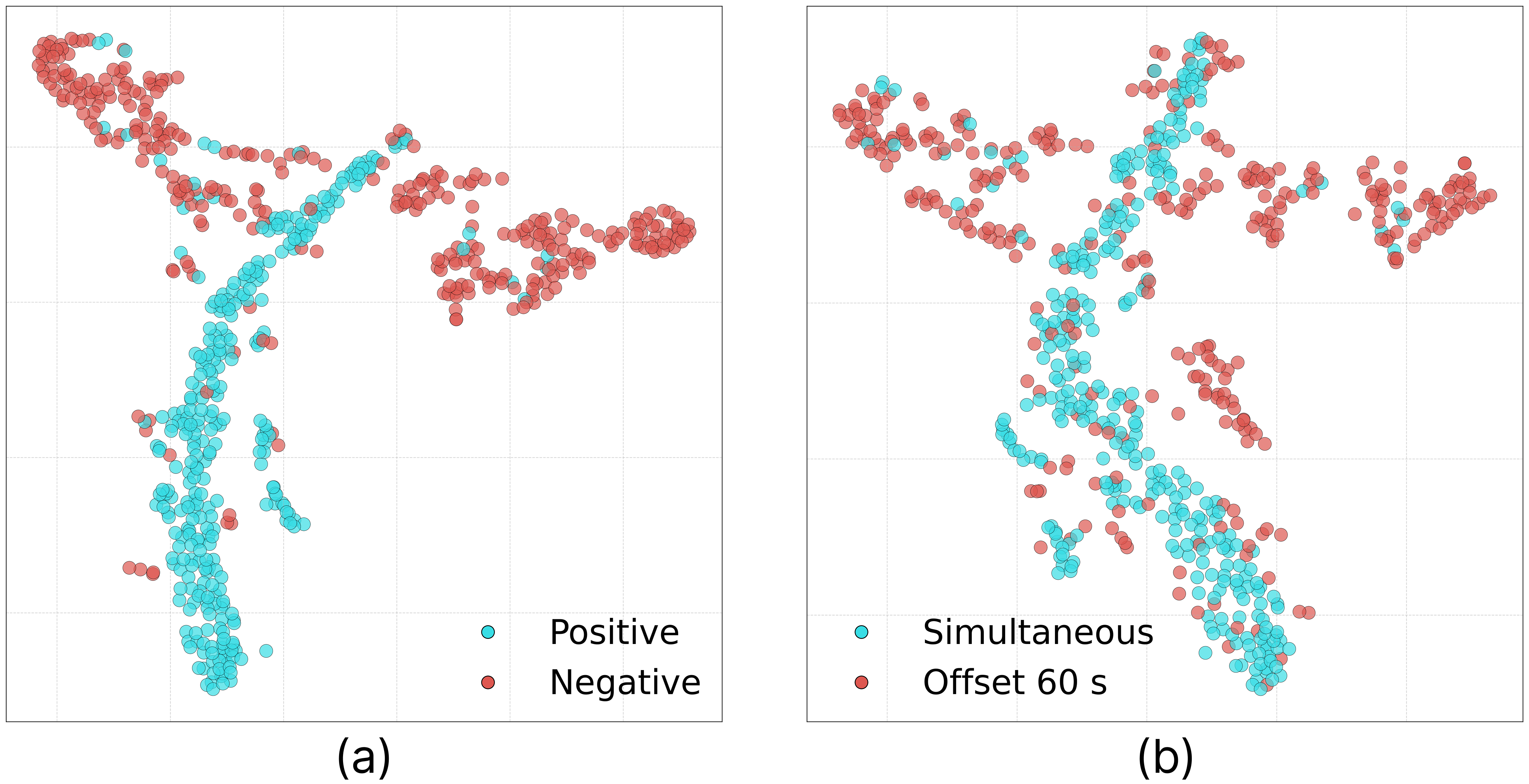
Fig. 4. t-SNE Visualization of Features. Features from 5 random subjects before classifier implementation. (a) Blue: signals synchronously collected on different devices from the same subject. Red: signals from different subjects on different devices. (b) Blue: same as (a). Red: pairs from the same subject but with a 60s temporal offset.
bandpass filter (0.5–2 Hz) to all PPG signals, covering the typical resting heart rate range (48–100 bpm). All signals are then resampled to 60 Hz, segmented into 12-second windows, and detrended using the DC-removal method proposed by Hung et al. .
As different wearable devices provide different numbers and types of PPG channels, we perform channel selection to select the channel with the best signal quality and unify the number of channels across devices. Prior studies have shown that skewness , kurtosis [7, 31], relative spectral power , and template matching [33, 44] are useful indicators for MA detection. However, we observe that the distributions of these metrics vary substantially across devices, making it difficult to define a single device-agnostic threshold.
To address this challenge, we compute a unified channel quality score for each PPG channel as:
(1)
where I(·) is an indicator function that equals 1 if the condition holds and 0 otherwise. We treat skewness and kurtosis as binary indicators, as long as they fall within empirically reasonable ranges, since their exact values do not reliably reflect signal quality across devices. Based on empirical observations, we set 𝜆𝑆= 𝜆𝐾= 0.1, and 𝜆𝑅= 𝜆𝑇= 0.4. The channel with the highest score is selected for subsequent processing.
Motion Artifact Processing
We categorize signal segments into three classes: clean, weakly corrupted, and heavily corrupted. Segments with a relative spectral power score above 0.4 and a template matching score above 0.95 are classified as clean. The remaining segments are further evaluated using three criteria: (1) the presence of multiple pulse cycles with high correlation confidence, (2) temporal stability of inter-beat (RR) intervals, and (3) physiological plausibility of heart rate. A segment is labeled as weakly corrupted if it contains at least two high-confidence pulse cycles, exhibits low relative variability in RR intervals, and all RR intervals fall within a predefined physiological range.
This rule-based screening retains segments with minor motion artifacts for mitigation using a specialized moving average filter , while discarding heavily corrupted segments. Signals passing MA processing are segmented into fixed 6-second windows. Each segment is standardized and smoothed with a 3rd-order Savitzky-Golay filter.
•
Trovato et al. Fig. 5. Devices and Experimental Setup in Study 1. Illustration of the experimental setup in Study 1, showing the wearing placements, device arrangements, and the platforms used on the smartphones and laptop.
Pairwise Feature Extraction
Signals are then paired according to study-specific rules. From each pair, 21 features are derived: 14 absolute differences (8 time-domain, 6 frequency-domain) and 7 similarity measures (6 time-domain, 1 frequency-domain). Full details of the extracted features are provided in Table 4 in Appendix A.1.
Feature selection followed a two-stage process: importance ranking (via XGBoost, Random Forest, and SVM) and ablation analysis. Removing any selected feature consistently degraded performance (e.g., BAC dropped from 95.5% to 95.3% in XGBoost when the least important feature is discarded), confirming their necessity.
Figure 4 visualizes the engineered features using t-SNE on 640 pairs from five randomly selected subjects. In (a), positive pairs (synchronous signals on different devices from the same subject) and negative pairs (different subjects and devices) form well-separated clusters, demonstrating strong discriminability. In (b), red points denote time-shifted pairs (60s offset) from the same subject, which deviate from simultaneous signals and align more closely with the negative class. This indicates that the system captures transient, time-varying features critical for CDA. Importantly, these plots only illustrate distribution trends of features before training; final performance is reported in Section 5.
Classification Algorithms
We compared six classification models: three traditional machine learning baselines (XGBoost, Random Forest, and SVM) and three deep learning models (Siamese-LSTM, Siamese-ResNet18, and Siamese-RAPID ).
4.5.1
Machine learning baselines. XGBoost was trained with 100 estimators, a maximum depth of 6, and a learning rate of 0.1. Random Forest used 100 estimators with unrestricted depth, and SVM employed an RBF kernel with default parameters.
4.5.2
Deep learning models. For the deep learning approach, we adopted a Siamese architecture , which is well suited for comparison tasks such as authentication [26, 30, 41, 73, 83], and is effective even with relatively small datasets. Each network processes paired inputs through shared backbones, and the absolute difference between representations is fed into a fully connected layer for binary classification. We explored three backbone variants: (1) a two-layer LSTM with a hidden size of 512, (2) a standard 1D ResNet18 producing a 64-dimensional representation, and (3) RAPID , a lightweight InceptionTime-style architecture with attention mechanisms designed for PPG processing. The RAPID backbone in our implementation contains 18 RAPID blocks, while following the paper’s recommended kernel-set size of 9 and output dimensionality of 128.
PPG as a Bridge: Cross-Device Authentication for Smart Wearables with Photoplethysmography
1:11
Prior to training, temporal difference and Welch transform were applied to generate three-channel inputs (original signal, temporal difference, and Welch spectrum). Models were optimized using binary cross-entropy with Adam (learning rate 1 × 10⁻⁴), trained for up to 30 epochs with early stopping (patience = 5).
Study 1
To address RQ1, RQ2, and RQ3, we conducted a controlled lab study with 33 participants, collecting rPPG and PPG signals in two static postures.
Platform Setup
To support the evaluation study, we developed three data collection platforms: one for laptops and two for smartphones (iOS and Android), as shown in Figure 5. The laptop platform was implemented in Python with a Tkinter-based interface. It automatically discovered and connected to the custom wearable devices (Section 3.4). The platform visualized incoming PPG signals in real time. PPG signals, IMU data, and Unix timestamps were continuously logged during data collection.
For smartphones, we implemented two dedicated video recording platforms. The iOS application recorded facial videos using the front-facing camera, while the Android application recorded fingertip videos using the back camera. We also experimented with Android phones for facial video recording (tested on Xiaomi 15 Pro and OPPO Find X3 Pro). However, the Android devices apply non-configurable video compression, which significantly degraded the rPPG signal quality compared to iPhones. For both platforms, each video frame was timestamped and synchronized.
Methodology
Data were collected in two static postures: sitting and standing, each lasting 10 minutes. We focused on these two conditions, as they represent the most common scenarios in which users interact with smartphones, aligning with the envisioned use cases of PPGTransID. Temperature and illuminance near the participant’s face were measured at the start of each experiment.
To synchronize timestamps across platforms (e.g., smartphones and the laptop), all devices were placed together in a box and subjected to three controlled drops prior to the experiment, allowing alignment via IMU peak detection. During data collection, an iPhone 15 and an external Logitech C930 webcam were positioned in front of participants for facial video capture. The ring, band, and oximeter were worn on the non-dominant hand, while the OPPO Find X3 Pro was held in the dominant hand, with its back camera covered by the participant’s fingertip.
Each session lasted approximately 35 minutes. Participants received compensation equivalent to 8.5 USD in
Demographics
We recruited 33 participants (16 male, 17 female) with a mean age of 22.7 years (SD = 3.28, range = 18–30), 32 of whom were right-handed. The inclusion criterion was the absence of any diagnosed cardiac disease; no other physiological conditions were restricted.
Evaluation Setup
We adopted a leave-one-subject-out (LOSO) validation strategy, where models were trained on data from all but one participant and tested on the held-out participant.
•
Trovato et al. rPPG signals were extracted from facial videos using both video-based and frame-based methods, and all PPG signals were then grouped into pairs for evaluation. Positive pairs consisted of signals from the same subject collected simultaneously on different devices, while negative pairs consisted of signals from different subjects and devices. Notably, non-simultaneous signals from the same subject were excluded from positive pairs (except in Section 5.8). In testing pairs, one PPG signal was always taken from a token device (e.g., smartphone, laptop, or band; smartphone with the video-based rPPG extraction by default), while the other was taken from a wearable.
For training, a 2-second overlap was applied for data augmentation. To balance the dataset, the number of negative pairs was matched to that of positive pairs. Approximately 22 k pairs were generated for testing in the sitting scenario and 15 k in the standing scenario. The exact counts varied depending on the specific evaluation setup.
We adopt balanced accuracy (BAC) as the primary evaluation metric, defined as the average of the true positive rate and true negative rate. For each evaluation, we select the decision threshold that maximizes BAC. We additionally report the Area Under the Receiver Operating Characteristic Curve (AUC) and the Equal Error Rate (EER). AUC captures the overall discriminative capability of the system across thresholds, while EER corresponds to the operating point where the false acceptance rate equals the false rejection rate. An ideal authentication system achieves BAC = 1.0, AUC = 1.0, and EER = 0. All metrics are computed as weighted averages across subjects, with weights proportional to the number of test pairs per subject.
Performance Of Different Methods
Table 1. Different Models’ Performance under Different Postures. Mean BAC of different methods under sitting (21,930 pairs) and standing (14,980 pairs) postures using LOSO validation on 33 subjects. XGBoost consistently achieved the highest accuracy across both conditions.
92.9 (3.05)
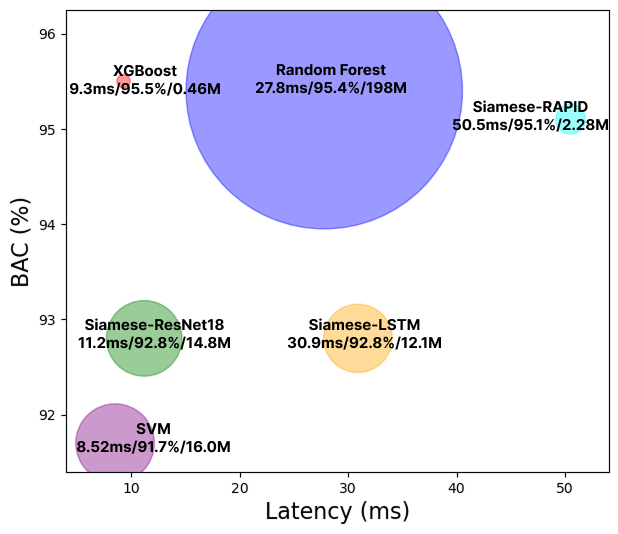
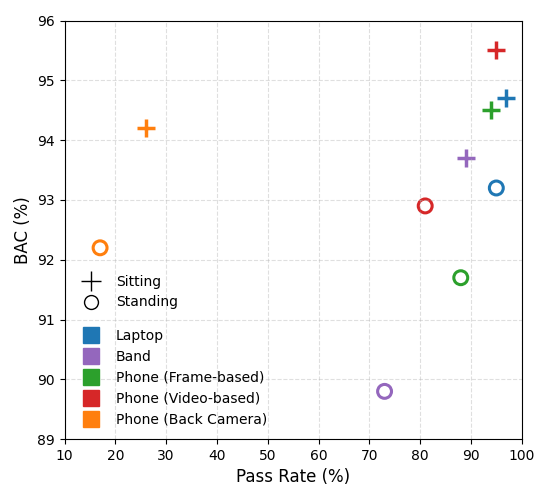
To compare the methods and assess PPGTransID’s resistance against baseline attacks, we used rPPG signals extracted from iPhone 15 facial videos as the token device signals. Detailed results are reported in Table 1. We further benchmarked inference latency and model size (parameters) on an Intel Xeon Gold 5218 CPU and an NVIDIA RTX 3090 GPU. The results are summarized in the bubble plot in Figure 6. Notably, feature extraction time was included for traditional machine learning models (i.e., XGBoost, Random Forest, and SVM).
XGBoost achieved the best overall trade-off, reaching the highest BAC in both postures (95.5% sitting, 92.9% standing) with only 0.46M parameters and a latency of 9.3 ms. Random Forest and Siamese-RAPID yielded comparable accuracy but required substantially higher complexity and slower inference. Siamese-LSTM and Siamese-ResNet18 delivered comparable BACs but required more memory and incurred longer latency. SVM lagged further behind with a ∼4% drop while having a larger model size.
We attribute the lower performance of deep learning models to two factors: the relatively small dataset size and the simplicity of the features required for this task, which traditional models can capture more effectively. PPG as a Bridge: Cross-Device Authentication for Smart Wearables with Photoplethysmography
1:13
Fig. 6. Trade-off among Model Performance, Latency, and Size. The y-axis shows mean BAC, the x-axis shows inference latency, and bubble size represents model size (number of parameters). XGBoost offered the best balance of accuracy, compactness, and speed.
Given this balance of accuracy, memory efficiency, and speed, we adopt XGBoost as the default model in subsequent evaluations. Its performance demonstrates that PPGTransID can effectively resist baseline attacks without subject-specific calibration (RQ2).
Performance Across Devices
Table 2. Performance of video-based and frame-based rPPG extraction across four wearable devices in sitting and standing postures.
91.7 (3.32)
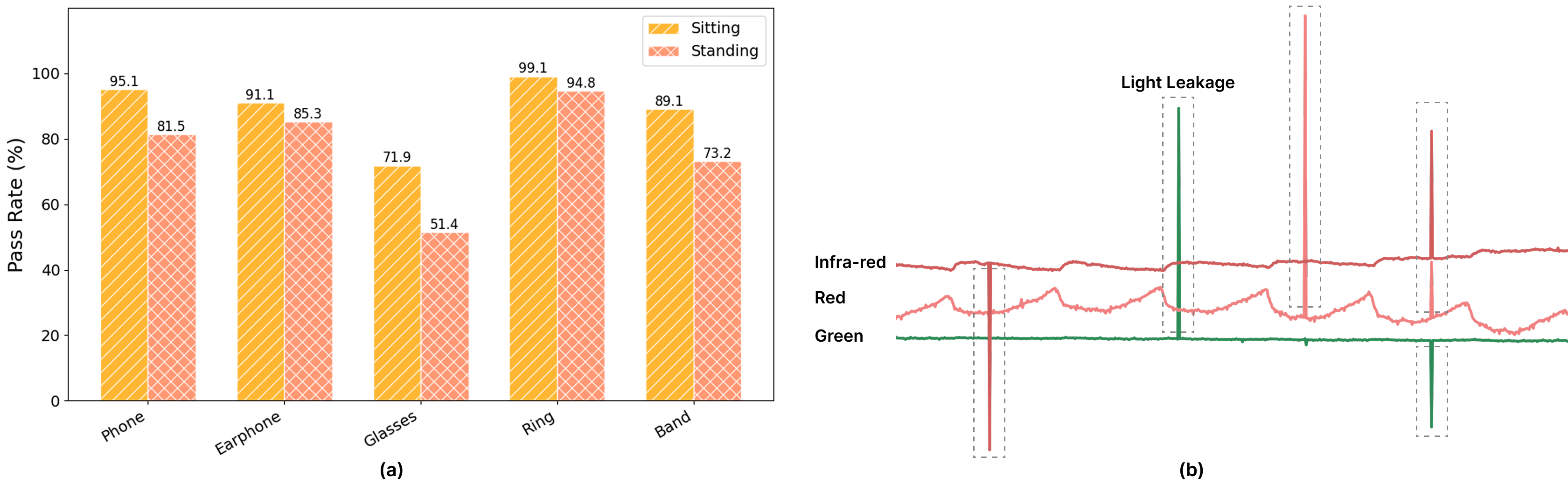
It is essential to evaluate whether the system remains reliable across different devices and to understand how user postures influence performance. We formed evaluation pairs between each wearable device and the smartphone, reporting both authentication performance (Table 2) and preprocessing pass rates (Figure 7 (a)).
•
Trovato et al. Fig. 7. Pass Rate across Wearables and Prototype Limitations. (a) Pass rates for smartphone, earphone, glasses, ring, and band under sitting and standing postures, where “Phone” denotes video-based rPPG extraction. (b) Example of light leakage observed during data collection with the glasses prototype.
All wearables achieve favorable accuracy with video-based rPPG extraction, with performance differences primarily driven by two factors. (1) PPG signal quality varies by body site: fingertip measurements yield the highest SNR, wrist signals are weaker and less stable, and ear-canal and nasal-bridge signals fall in between [5, 17, 60].
(2) The band, ring, and glasses are self-developed prototypes, and design constraints—such as imperfect skin contact, limited LED intensity, and light leakage—further affect signal quality. As shown in Figure 7 (b), severe light leakage in the glasses prototype results in a lower pass rate than other devices, which exceed 90% accuracy in the sitting condition.
We also observed a consistent performance drop across devices in standing compared to sitting. This degradation is likely posture-induced: peripheral sensing sites, including the wrist, fingertip, ear canal, and nasal bridge, exhibit reduced PPG amplitude and SNR in the standing posture, consistent with decreased perfusion under hydrostatic pressure [5, 34, 78]. The magnitude of this effect varies by device, with the band (–3.7%) and ring (–2.9%) showing the largest declines, consistent with their more distal vascular supply.
Overall, PPGTransID demonstrates robust cross-device performance with only modest degradation under standing posture (RQ3), supporting its applicability across diverse form factors (RQ1).
Influence Of Rppg Extraction Methods
Table 2 compares the performance of two rPPG extraction methods. A consistent accuracy drop was observed when using the frame-based approach, reflecting the reduced rPPG quality. As discussed in Section 4.1, the video-based method leverages temporal information across the entire window, yielding higher-quality rPPG signals. In contrast, the frame-based method supports online inference but at the cost of accuracy. Despite this trade-off, both methods have distinct application potential: video-based extraction suits scenarios prioritizing reliability, while frame-based extraction enables low-latency, real-time deployment.
Resistance Against Replay Attacks
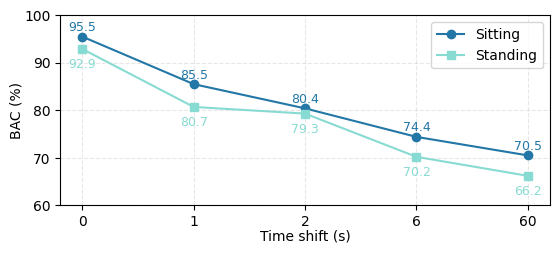
Prior work has shown that PPG contains temporally stable features and can therefore support ODA across sessions; this raises the question of whether leaked historical PPG could threaten the proposed system. To evaluate this, we constructed positive pairs using rPPG and PPG signals from the same subject but recorded at different time intervals, simulating realistic delays in replay attacks. Results are summarized in Figure 8.
PPG as a Bridge: Cross-Device Authentication for Smart Wearables with Photoplethysmography
1:15
Fig. 8. Performance under Temporal Offsets. BAC declines steadily with increasing temporal offsets between rPPG and PPG signals, highlighting the system’s reliance on instantaneous synchrony, indicating the system’s resistance against replay attacks .
Fig. 9. Trade-off between Performance and Signal Pass Rate across Token Devices. The y-axis shows BAC, while the x-axis indicates the pass rate after MA processing. Using the smartphone front camera for rPPG extraction achieves a favorable balance between accuracy, data utilization, and usability.
We observed a steady accuracy decline as temporal offsets increased. At a 60-second offset, performance dropped sharply to 70.4% (sitting) and 66.2% (standing), indicating that time-shifted pairs were increasingly misclassified as negatives. This suggests the system relies on transient, synchronized features rather than invariant physiological patterns, making replay signals ineffective.
In practice, replay attacks require multiple steps (e.g., interception, recording, injection), each introducing delays typically well above seconds to minutes. Our results show that such delays severely compromise attack feasibility. However, these results raise concerns about potential performance degradation caused by device- to-device latency. We examine this concern in Study 3 through a Local Area Network (LAN)-based real-time demonstration.
In summary, these findings demonstrate that PPGTransID provides resistance against replay attacks (RQ2), leveraging transient PPG dynamics that are inherently difficult to capture or reproduce.
Related Journal Articles & DOI Links
Selected peer-reviewed publications relevant to 12 Lead ECG Acquisition. Click the DOI to access the full paper (may require institutional access).
-
1. Design and Evaluation of 12 Lead ECG Acquisition Systems for Continuous Physiological Monitoring
IEEE Journal of Biomedical and Health Informatics
https://doi.org/10.1109/JBHI.2020.2981234 -
2. Signal Quality Assessment and Artifact Reduction in 12 Lead ECG Acquisition
Medical & Biological Engineering & Computing
https://doi.org/10.1007/s11517-020-02145-6 -
3. Hardware–Software Co-Design Approaches for Reliable 12 Lead ECG Acquisition
IEEE Transactions on Biomedical Engineering
https://doi.org/10.1109/TBME.2019.2895762 -
4. Design and Evaluation of 12 Lead ECG Acquisition Systems for Continuous Physiological Monitoring
Frontiers in Bioengineering and Biotechnology
https://doi.org/10.3389/fbioe.2020.00123 -
5. Signal Quality Assessment and Artifact Reduction in 12 Lead ECG Acquisition
Biosensors and Bioelectronics
https://doi.org/10.1016/j.bios.2021.112345 -
6. Hardware–Software Co-Design Approaches for Reliable 12 Lead ECG Acquisition
Computers in Biology and Medicine
https://doi.org/10.1016/j.compbiomed.2021.104567 -
7. Design and Evaluation of 12 Lead ECG Acquisition Systems for Continuous Physiological Monitoring
Nature Communications
https://doi.org/10.1038/s41467-020-12345-6
Why Choose Us?
Bangalore guidance for robotics, Spectre and autonomous systems projects.
Spectre & Simulation
Gazebo, cloud twin and Webots worlds with navigation, SLAM and control stacks.
Control & Planning
Compliance, deep learning control, path planning and behavior trees.
Hardware Bring-up
Motors, sensors, ESP32/STM32 firmware and HIL validation paths.
Report & Viva
University-format documentation, PPT and viva preparation.
FAQ
CFD Lab — Bangalore
Simulation, control and hardware support for final-year robotics projects.
Stacks
Worlds
Digital Twin
Control
Robots
Offline
Bring-up