Using Fmcw Radar
Sherif Abdulatif∗, Fady Aziz∗, Pelin Altiner, Bernhard Kleiner, Urs Schneider ∗These authors contributed to this work equally. Abstract—Non-contact vital sign detection is a required ap- plication nowadays in many fields as patient monitoring and static human detection. Within the last decade, radar has been introduced as a smart and convenient sensor for non-contact respiration monitoring. Radar sensors are considered suitable for such application for its capability to work through obstacles and in harsh environmental conditions. FMCW radar has been introduced as a powerful tool in this field for its capability of detecting both the breathing target position and his chest micro-motions induced due to breathing. Most of the presented techniques for using the radar for respiration detection is based on bandpass filtering or wavelet transforms on the required harmonics in either the range or Doppler dimension. However, both techniques affect the real-time capability of the monitoring and work on limited distances and aspect angles. A recognizable fluctuation effect is observed in the received range spectrum overtime due to respiration chest movements. The proposed technique in this paper is based on detecting and processing the power changes in real-time over different aspect angles and distances. Two radar modules working on different carrier frequency bands, bandwidths and output power levels were tested and compared.
Introduction
Human detection is a challenging research aspect that has been addressed in many research fields nowadays. Radar sensors proved to be feasible for human detection applications for its capability of detecting the velocity and range of a target. Accordingly, radar can be a used as a convenient sensor for detecting limbs motion distribution of a moving human subject . Moreover, radar can be useful for detecting static human targets based on either the human subject Radar Cross Section (RCS) or vital sign (respiration and heart beats) detection based on micro-motions induced in the chest of a static human . Accordingly, radar is investigated as a convenient non-contact vital sign detection sensor for patient monitoring compared to the traditional systems .
The radar capability of achieving the respiration monitoring with light weight, lower power and better accuracy allows the possibility of many applications in which human safety is highly required. One example is vital sign monitoring as an assistive tool for the car driver for fatigue detection . The radar has also been proved to be feasible for some applications like rescue missions that require detecting presence of a living human victim to provide critical health support. In such application, a high output power radar that can detect chest micro-motions on far distances and different aspect angles is required. Three types of radar were used for the non-contact vital sign monitoring which are the Continuous Wave (CW) radar, Ultra-Wide-Band (UWB) pulse radar and Frequency Modulated Continuous Wave (FMCW) radar.
CW Radar technique is based on detecting the reflected frequency echoes due to the chest wall motion. These frequen- cies can be extracted through signal processing analysis such as frequency mixing and filtering. Bandpass filters can be directly applied for the harmonic separation induced due to both the respiration and heart rates . Another techniques were used to extract heart beats with better accuracy by evaluating the wavelet coefficients in frequency band based on using wavelet transform . CW radar offers simplicity in design and operation, thus they have relatively low power consumption.
However, the target range data cannot be detected by CW radar and the vital sign signals is not differentiable from other received frequency echoes.
UWB Pulse radar has been recently introduced for non- contact respiration monitoring. The basic operation is sending a train of pulses towards the target and then the received signal can be visualized in the frequency domain which is not directly correlated with chest wall motion. To get an accurate estimation of vital signs, the delay profile in time domain is extracted using IFFT which is correlated to absolute amplitude of the chest movements. The UWB pulse radar can be used for higher spatial resolution, however, there are constraints on the pulse width and the radar peak signal intensity .
Fmcw Radar Has Both Advantages Of Identifying The
target range available in the UWB radar and CW radar robustness. These properties introduce the FMCW radar to be more convenient for the vital sign detection task especially in multi-targets scenario. Moreover, FMCW power consumption is low with relatively small compatible sizes. Basic technique for vital signs extraction relies on the use of band pass filters to extract harmonics related to chest micro-motions, these ways have a maximum distance of 2 m for detection .
More advanced techniques based on wavelet transforms and eigenvalue decomposition is used; however, such techniques are complex and affects the real-time capability .
In this work, we propose a real-time non-complex tech- nique for respiration monitoring at long distances and different aspect angles using FMCW radar. In the proposed technique, the power fluctuations in the range profile living target peak are observed to be correlated with the target respiration behavior.
This technique provides a simple platform for detecting chest micro-motions at different aspect angles and distances above 4 m. This can help in victim detection applications, in addi- tion to general safety applications where static human target detection is required.
A. Fmcw Operation
The operation of FMCW is based on sending continuous modulated chirps. During the chirp time, the chirp frequency increases linearly within the operation bandwidth. The received signal is down-converted with the radar carrier frequency for target range and velocity estimation. The velocity information is extracted from the frequency shifts due to the Doppler effect of the moving target. While the time delay can be used to get the target range information. The target range information is extracted through Fast Fourier Transform (FFT) that is directly applied on each received chirp. This transformation yields consecutive range profiles in which the detected targets appear as different peaks at different frequency shifts. Each shift represents a certain target range and the power values are correlated with the target RCS.
Varying environmental conditions and measuring at long distances may induce unwanted targets that appear as clutters in the analyzed range profiles by the radar. Thus, an adaptive Constant False Alarm Rate (CFAR) technique is used in removing the unwanted noises and clutter effects on real-time basis . The idea of operation is based on preserving a constant rate for the detection of false targets in the case of variable clutter and noise effects. In this paper, the Cell- Averaging (CA-) CFAR is used on range spectrum for its simplicity. The proposed technique is based on using a sliding window over the range profiles in which the average power of the window cells is computed. Within one sliding window anal- ysis, a possible peak is expected. Thus, the power averaging is computed without taking the middle cells into consideration.
Finally, a threshold is constructed to filter out the real peaks from noise and clutters. Depicted in Fig. 1, an extracted target in range spectrum based on CFAR thresholding.
Target
Fig. 1: Range profiles with peak at the detected target.
B. Respiration In Power Domain
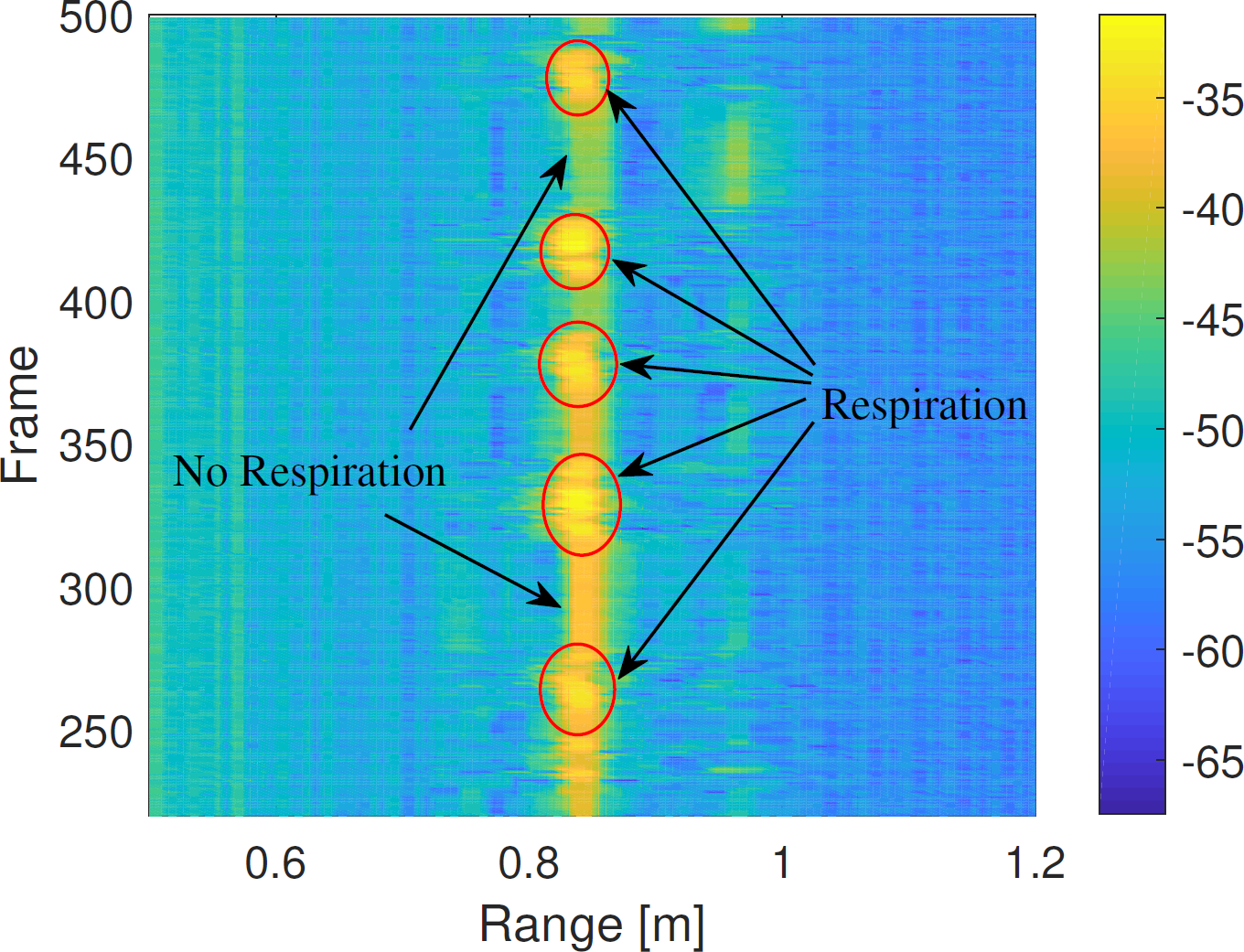
”Inhalation and exhalation” the two main respiration activ- ities, induce an observable chest movements. While person is sitting in front of the radar, it is seen that aforementioned chest motions cause changes in the range spectrum. The changes are particularly observed as range shifts in the target peak due to the chest micro-motions, but to detect such motions an accurate radar is needed. Moreover, fluctuations in the power value of such peaks is observed in the signal overtime. Such effect can be observed by concatenating consecutive range profiles overtime. As shown in Fig. 2, a 2-D range waterfall is used to analyse power of range spectrum over time. In this plotting, the third dimension representing power (colour) of detected target (single line) is observed to change during respiration instants.
Fig. 2: Range waterfall and high power as respiration instants. Two main effects can be observed in the filtered rang profile peaks. One effect is the target range and the other effect is the chest motion in both power and range dimensions. To remove the range aspect from our next computations, CFAR is used to filter out the target peaks of existing human subjects and analysis is done on each peak separately. Time domain reconstruction is applied using Inverse Fast Fourier Transform (IFFT) on the filtered peaks. The reconstructed time domain signal amplitude is highly correlated with the chest movements of the subject. Thresholding is applied to remove high random motions and false peaks not related to required activity. The reconstructed signals in the time domain yield consecutive impulses that represent an ECG-similar behaviour.
Envelope detection is then analysed on the output signals in the time domain to represent the respiration activity. The power-based technique shows clearly the detected irregular respiration activity as expected. Respiration is explained as a non-perfect periodic activity that differs through time and from one person to another. The respiration activity also changes with respect to the emotional level of the human .
Accordingly, the respiration pattern detection is very crucial for monitoring applications. The proposed technique in this paper achieves accurate respiration monitoring on real-time basis that represents the chest micro-motions as shown in Fig. 3
Normalized Amplitude
Fig. 3: Extracted Respiration activity.
Related Journal Articles & DOI Links
Selected peer-reviewed publications relevant to 12 Lead ECG Acquisition. Click the DOI to access the full paper (may require institutional access).
-
1. Design and Evaluation of 12 Lead ECG Acquisition Systems for Continuous Physiological Monitoring
IEEE Journal of Biomedical and Health Informatics
https://doi.org/10.1109/JBHI.2020.2981234 -
2. Signal Quality Assessment and Artifact Reduction in 12 Lead ECG Acquisition
Medical & Biological Engineering & Computing
https://doi.org/10.1007/s11517-020-02145-6 -
3. Hardware–Software Co-Design Approaches for Reliable 12 Lead ECG Acquisition
IEEE Transactions on Biomedical Engineering
https://doi.org/10.1109/TBME.2019.2895762 -
4. Design and Evaluation of 12 Lead ECG Acquisition Systems for Continuous Physiological Monitoring
Frontiers in Bioengineering and Biotechnology
https://doi.org/10.3389/fbioe.2020.00123 -
5. Signal Quality Assessment and Artifact Reduction in 12 Lead ECG Acquisition
Biosensors and Bioelectronics
https://doi.org/10.1016/j.bios.2021.112345 -
6. Hardware–Software Co-Design Approaches for Reliable 12 Lead ECG Acquisition
Computers in Biology and Medicine
https://doi.org/10.1016/j.compbiomed.2021.104567 -
7. Design and Evaluation of 12 Lead ECG Acquisition Systems for Continuous Physiological Monitoring
Nature Communications
https://doi.org/10.1038/s41467-020-12345-6
Why Choose Us?
Bangalore guidance for robotics, Spectre and autonomous systems projects.
Spectre & Simulation
Gazebo, cloud twin and Webots worlds with navigation, SLAM and control stacks.
Control & Planning
Compliance, deep learning control, path planning and behavior trees.
Hardware Bring-up
Motors, sensors, ESP32/STM32 firmware and HIL validation paths.
Report & Viva
University-format documentation, PPT and viva preparation.
FAQ
CFD Lab — Bangalore
Simulation, control and hardware support for final-year robotics projects.
Stacks
Worlds
Digital Twin
Control
Robots
Offline
Bring-up