Smart Insole: A Gait Analysis Monitoring Platform Targeting
Parkinson’S Disease Patients Based On Insoles
Dimitrios G. Boucharas, Christos Androutsos, George Gkois, Vassilis D. Tsakanikas, Vasileios C. Pezoulas, Dimitrios Manousos, Vasileios Skaramagkas, Chariklia Chatzaki, Stathis Kontogiannis, Christos Spandonidis, Alexandros K. Pantazis, Abstract— During the preceding decades, human gait analysis has been the center of attention for the scientific community, while the association between gait analysis and overall health monitoring has been extensively reported. Technological ad- vances further assisted in this alignment, resulting in access to inexpensive and remote healthcare services. Various assessment tools, such as software platforms and mobile applications, have been proposed by the scientific community and the market that employ sensors to monitor human gait for various purposes ranging from biomechanics to the progression of functional recovery. The framework presented herein offers a valuable digital biomarker for diagnosing and monitoring Parkinson’s disease that can help clinical experts in the decision-making pro- cess leading to corrective planning or patient-specific treatment.
More accurate and reliable decisions can be provided through a wide variety of integrated Artificial Intelligence algorithms and straightforward visualization techniques, including, but not lim- ited to, heatmaps and bar plots. The framework consists of three core components: the insole pair, the mobile application, and the cloud-based platform. The insole pair deploys 16 plantar pressure sensors, an accelerometer, and a gyroscope to acquire gait data. The mobile application formulates the data for the cloud platform, which orchestrates the component interaction through the web application. Utilizing open communication D.G. Boucharas, C. Androutsos, N.S. Tachos, G. Gkois, V.D. Tsakanikas, and V.C. Pezoulas, are with the Unit of Medical Technology and Intelligent D. Manousos is with the Institute of Computer Science, Foundation for Research and Technology Hellas (FORTH), GR-70013, Heraklion, Crete, Greece.
C. Chatzaki and M.Tsiknakis are with Biomedical Informatics and Crete, Greece and with the Institute of Computer Science, Foundation for Heraklion, Crete, Greece.
V. Skaramagkas is with the Institute of Computer Science, Foundation for Heraklion, Crete, Greece. S. Kontogiannis is with PD Neurotechnology Ltd., GR-45110, Ioannina, Greece.
C. Spandonidis is with Prisma Electronics SA, GR-17564, P.Faliro Athens, Greece. A.K. Pantazis is with the Microelectronics Research Group, Institute of Electronic Structure and Laser (IESL), Foundation for Research and Technology Hellas (FORTH), GR-70013, Heraklion, Crete, Greece.
Dimitrios I. Fotiadis is with Biomedical Research Institute, FORTH, GR-45110, Ioannina, Greece and with the Unit of Medical Technol- 45110, Ioannina, Greece. (corresponding author e-mail: protocols enables the straightforward replacement of one of the core components with a relative one (e.g., a different model of insoles), transparently from the end user, without affecting the overall architecture, resulting in a framework with the flexibility to adjust its modularity.
Index Terms— Gait analysis, plantar pressure data, Parkin- son’s disease, gait patterns, computer architecture
I. Introduction
The interest in human gait analysis has reignited during the last decades. The technological advances yielded a wide diversity of benefits for analyzing human movement that transformed enormous laboratories equipped with several video and infrared cameras, high-performance computers, and soaring-cost treadmills, force plates or walkways into low-cost, lightweight, and flexible; yet precise devices called sensors. Such devices allow individuals with limited or no access to public healthcare services to obtain a gait evalua- tion. Depending on the sensor placement, distinct motifs can be derived. Foot-based sensors such as pressure and Inertial Measurement Unit (IMU) sensors have been widely adopted in gait monitoring due to walking and running instabilities being heavily linked with chronic diseases, and, by extension, with overall health. Improper gait, in-addition, results in more strain on multiple body parts, which may lead to injuries.
Various assessment tools have been proposed by the sci- entific community and the market that exploit data derived from foot sensors. These tools have not only been utilized for sports science, biomechanics, and monitoring the progression of functional recovery, but have also expanded to be a valu- able digital biomarker for diagnosing and monitoring several neurological disorders such as Parkinson’s disease (PD).
Furthermore, they can be employed by the general population for preventing the progression of gait inconsistencies that might lead to severe issues, if left untreated. The results acquired from the imminent gait analysis might provide the clinical expert or the physician with the information needed for corrective planning and patient-specific treatment.
PD is a neurological disorder that affects the ability of patients to control their movement. The most common symptoms are tremors (e.g., hands, legs, and jaw), stiffness of muscles, movement slowness, and sudden loss of balance and coordination. The latter may lead to falls that are the
Arxiv:2212.00109V1 [Cs.Hc] 23 Nov 2022
leading cause of death related to injuries among 65-year- old adults , . As the disease progresses, patients face difficulties with walking and talking. Risk factors are yet to be discovered; however, it is proved that the prevalence increases with age . Currently, there is no cure for the disease, but treatments are available to relieve the patients from the symptoms and often drastically maintain, if not improve, their quality of life . Consequently, sensor-based gait analysis assessment tools can help doctors administer patient-specific therapy and corrective planning. On the other hand, patients will save time by avoiding long queues in healthcare facilities, money due to less frequent doctor visits, and energy as the data collection procedure occurs in their daily living without requiring additional effort at the clinical sites. Considering that monitoring can end up being long-term, it comes with tremendous advantages for the individuals involved.
A variety of platforms has also been proposed to offer a monitoring system that combines contextual information extracted from the Inertial Measurement Unit (IMU) and pressure sensors with information derived from gait metrics.
Architectures have been constructed and refined to yield more robust results, enabling several innovative features, such as cloud computing. Over the preceding years, the examination of the gait has been aided by cloud technology.
For healthcare purposes, cloud computing plays a vital role in processing large amounts of data using various decision- supporting methods. Researchers have recognized that plat- forms, as clinical tools, can lead to ideal gait analysis systems to observe abnormalities and identify the induced severity.
But their role is not limited to that, but further expanded to offering a complete view of the patients’ gait parameters by visualizing specific pressure diagrams and IMU graphical representations, among others. The approach, as described above, goes beyond the traditional healthcare approaches defining a new entry in the healthcare era named Telehealth .
Pressure sensors, accelerometers, and gyroscopes are the most widely deployed gait-based sensors, while their place- ment varies on different sites of the lower human body. For more reliable and accurate analysis, the sensors should be employed in the shape of shoes, insoles, or outsoles. The latter captures human motion and, by extension, movement patterns. The exploitation of cloud services further supports the analysis with efficient resource allocation, along with quick configuration and implementation. The collected raw data are transmitted, stored, and analyzed by a pool of Ma- chine Learning (ML) or Deep Learning (DL) algorithms in the cloud. The effectiveness of this procedure can potentially create a pathway for remote health monitoring that will allow healthcare professionals such as clinicians, physicians, and formal caregivers to continuously supervise and evaluate a person’s health data in real-time, even from distant locations.
Ii. Related Work
According to the literature, several gait analysis platforms have been developed, presented, and evaluated. Ziagkas et al. introduced a portable, yet low cost tool for gait analysis, in daily living by synthesizing a walking profile . The latter features several gait metrics based on data derived from a pair of smart insoles where integrated sensors are deployed. A summary of the gait analysis results is presented in a graphical manner on a platform utilizing an interme- diate bluetooth connection box. To validate the underlying architecture, a human motion-capturing ecosystem composed of high-resolution infrared cameras, a central unit that acts as a camera synchronizer, and a processing unit responsible for Vicon software execution was constructed. The results indicate that some divergence can be observed between the two systems, mainly affected by the low number of participants and the extracted gait parameters; however, the provided measurements are valid. Loukovitis et al. extended the previously described work by exploring the repeatability of the developed system . The findings, extracted from two distinct trials conducted by 22 participants, support the reliability of the system in analyzing gait parameters based on the intraclass correlation coefficient.
Chen et al. proposed a gait monitoring framework based on piezoelectric insoles focused on three distinct target groups suffering either from PD, stroke or diabetes .
These chronic diseases, along with their progression, could possibly result in functional gait inconsistencies. The devel- oped framework employs an Internet of Things approach to connect and exchange gait data between heterogeneous devices and systems over the Internet. In essence, the smart insole connects to the user’s computer via bluetooth, and the Center of Pressure (COP) data are uploaded to a cloud server from where a clinical institution can retrieve it for medical purposes. Consequently, the presented framework offers great convenience to both patients and doctors by avoiding frequent visits to the hospital, leading to a complete solution.
Tsiouris et al. synthesized a mobile healthcare platform that acts as a complete assistant targeting PD patients . The accelerometer, gyroscope, microphone, and pressure sensors were integrated into the proposed solution to capture a wide variety of gait parameters to evaluate the severity of symptoms caused by the disease. The sensors were placed on a commercial wrist, an insole pair, and a mobile device. The latter was also used to estimate the patient’s cognition, mental state, and diet through a series of tests that resulted in a review of motivations and obliging recommen- dations. Patient data was uploaded to the cloud encrypted, where Artificial Intelligence (AI) methods were recruited to estimate the symptoms and progression of the disease.
Another mobile application was designed and developed for direct access to patient data and real-time monitoring by clinicians. Clinicians might assess the information derived from the cloud-embedded algorithms to adjust the duration and dosages of the treatment accordingly. The system also included a mechanism to not only notify clinicians when new symptoms appeared or existing ones worsened, but also to suggest which course of medication modifications to take.
Pd Is Difficult To Diagnose Because, At Present,
1) it is based on a patient’s clinical evaluation ; 2) although there are some promising leads, there are no definitive biomarkers for PD, and all relevant research findings work supportively for the confirmation of the
Clinical Diagnosis;
3) the symptoms develop gradually, with a lengthy de- lay between the actual degeneration of dopaminergic neurons (70-80% loss) and the start of recognizable
Clinical Symptoms ;
4) the variety of symptoms and the heterogeneity of their onset and progression contribute to the complexity of
Pd Clinical Phenotypes ;
5) an extra challenge to the diagnosis is accumulated due to the fact that several syndromes mimic the symptoms of PD.
As a consequence, the evaluation of the disease severity, which plays a vital role in the progression, is also hard to be addressed, especially in the early stages fo the disease. To estimate the stages of PD, Balaji et al. compared several ML models that could help make an accurate diagnosis. Based on the Unified PD Rating Scale (UPDRS) and the Hohen and Yahr Scale (HY), a classification problem was devised .
The dataset was based on vertical ground reaction forces (VGRF) derived from PD patients scoring above 2.0 in HY scale.
The feature vectors were constructed with gait spatio- temporal parameters (e.g., cadence, step length, and swing time) and fed into four distinct classifiers. Feature selection techniques were employed to improve the performance and robustness of the developed models. The classifiers employed were Decision Trees (DT), Support Vector Machines (SVM), an Ensemble Classifier (EC), and a Bayes Classifier (BC), with DT producing the most promising results.
Lazzaro di Biase et al. attempted to summarize the dis- criminative gait features that might assist in distinguishing PD patients from healthy subjects, along with the PD stages . In early stages, gait observations exhibit increased disparity reflecting instability, a few spatio-temporal param- eters demonstrate some degree of deduction, such as the reduced step length, and dual-task sessions (e.g., walking and counting backwards) are hard to comprehend for the PD patients. In mild to moderate stages, body asymmetry diminishes. Accordingly, the double support time increases.
In more advanced stages of PD, the gait further worsens with increased frequency in freezing of gait (FOG), loss of balance and lack of coordination.
Targeting the ageing population, Garc´ıa-Villamil et al. proposed a wearable gait assessment device based on a 6- axis inertial sensor . The sensor data, collected across different surfaces such as indoor and outdoor flooring, were utilized to measure several gait parameters. The system in- cludes a mobile application that visualizes gait-related infor- mation for users. Device reliability was validated employing the intraclass correlation coefficient, which was found to be 0.69. The relationship between the gait characteristics obtained by the device and clinical tests was also explored.
Sequentially, a close connection was detected between some gait parameters (e.g., mean speed, cadence, and mean stride) and the short physical performance battery test, which com- bines gait speed, chair stand, and balance tests to produce a frailty score. The results showed that frailty and falls could be predicted accurately upon utilizing the score in the ageing population. To the same extent, Aspera et al.
examined the ability of gait parameters to approximate the levels of frailty (for example, frail, prefrail, robust) presented by the elderly population . Wireless inertial sensors were placed on various parts of the lower human body to record the corresponding gait data streams. Logistic models were recruited to explore associations between frailty and the gait parameters extracted. Receiver operating characteristic curves were employed to calculate the area under the curve for each parameter, while the Youden index was considered for the cut-off values. The results indicate that the gait pa- rameters could distinguish frailty levels, especially between frail and robust levels.
Iii. Our Contribution
To address the aforementioned needs, an advanced wear- able solution has been developed. The ’Smart Insole’ is an innovative digital ecosystem, consisting of a pair of smart insoles (integrating various sensors), a mobile application and a cloud-based platform. Specifically, 16 distinct plantar pressure sensors, an accelerometer, a gyroscope, and a mag- netometer were embedded to the insole for acquiring gait raw data. A mobile application was designed and developed to receive the insole data wirelessly (via BLE) and provide valuable gait-related information to the end user (PD patients and elders). The ’Smart Insole’ cloud platform encompasses the web services, the well-defined components, and their interaction. The developed and integrated web application is responsible for data ingestion, secure data storage, data cura- tion, and data integration, among other modules. The ’Smart Insole’ platform also incorporates an AI-based reasoning engine to provide decision support to the clinical experts. The work presented herein describes in detail the architecture and functionalities provided by the ’Smart Insole’ solution. The proposed solution serves as a supplemental expert support to align into a more reliable, accurate, and patient-specific decision-making process based on graphical representations, understandable motifs, and gait characteristics that are not limited to features derived from gait cycle phases from older individuals and patients with PD.
Iv. Architecture
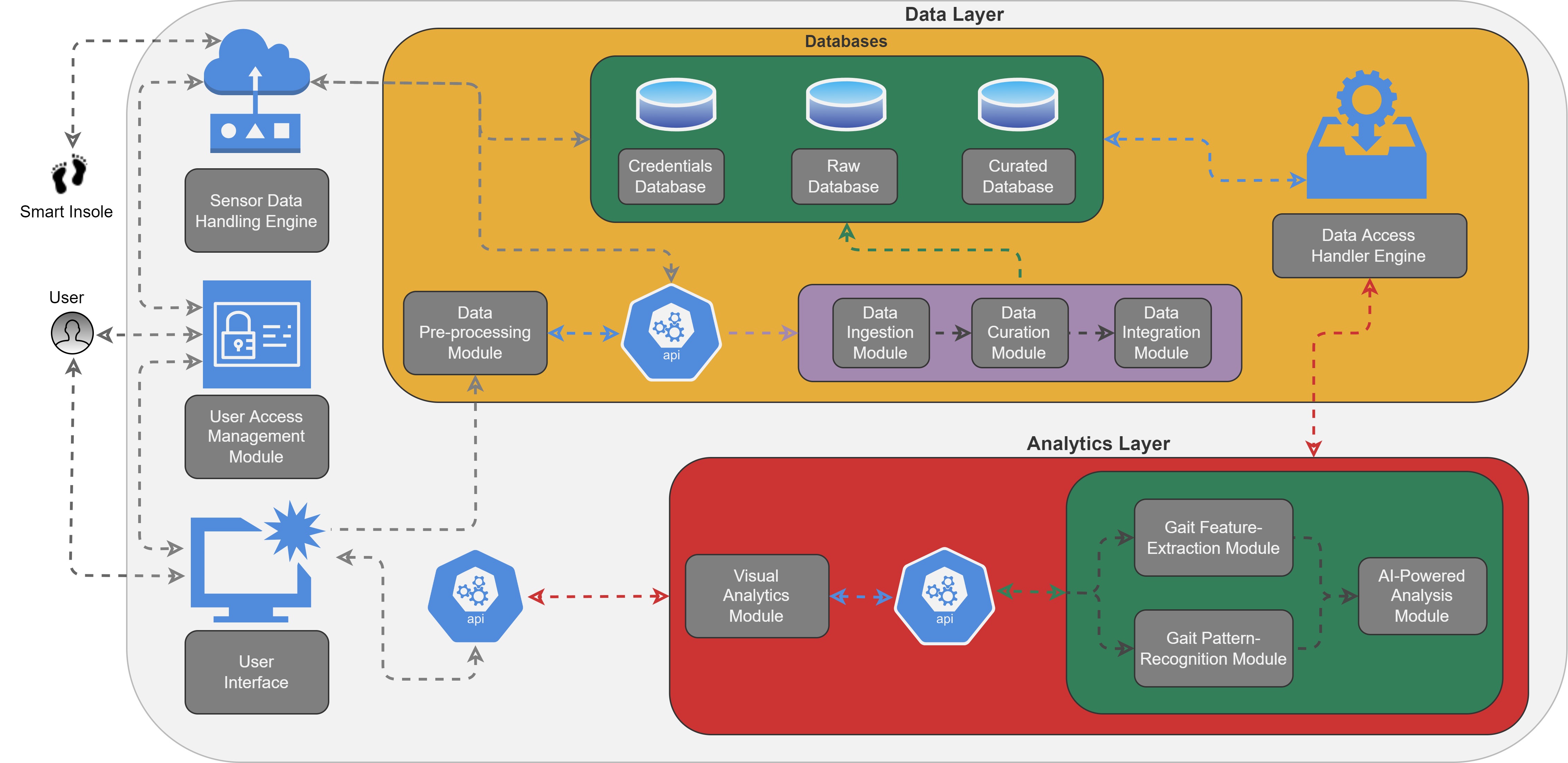
The proposed architecture, depicted in Fig. 1, contains three core components: the smart insoles, the cloud-based platform, and the mobile application. The system targets elderly population and patients with PD who can use smart insoles in their daily living, together with the corresponding mobile application to obtain informative gait-related reports.
It is worth mentioning that the proposed architecture was designed in order the system to be independent of the Smart Insole characteristics. The system can support third-party insoles on top of the developed ones, without compromising Fig. 1.
The ’Smart Insole’ Architecture
the performance of the whole system. Specifically, the sensor data handling engine is responsible for mapping the incoming raw data to the Smart Insole data model and performing any normalization to meet the specifications for the data analysis layer. The cloud-based application has as end users the healthcare professionals by providing to them rich and informative clinical reports for the gait analysis. These reports provide gait-related data, metadata visualizations, and comprehensive visual analytics, interlinked with gait patterns.
The architecture design encompasses all the vital elements that compose the web services and their interaction. The architecture can be hierarchically decomposed into user management-related modules, the sensor data handling en- gine, the data layer, and the analytics layer.
The user management-related module includes the security components (i.e., the SSL/TLS protocols and the OAUTH2 framework) that are invoked during user authentication and user access management procedures and use any necessary resources from the hardware infrastructure and software components, as well as from the private database of user credentials for user authentication.
The engine is designed as a three-node pipeline including the data ingestion, data curation, and data integration module. The sensor data handling engine is responsible for collecting the sensor data from the insoles and directing the data to the REST API where the pre-processing (e.g., curation) takes place.
Next, the data layer includes dedicated databases where the data storage occurs, from where the data access handler engine will enable the AI-powered analysis module. Data storage is characterized by various data storage technologies, including NoSQL, SQL, and a file storage system. AI- powered analysis module utilizes advanced AI models and algorithmic pipelines to assess data information extracting valuable decision support tools, such as graphs and metrics.
The visual analytics module will then attempt to visualize these graphs to the user interface through the rest API, once the end user logins successfully by providing the credentials.
REST APIs provide an interface to all available system functions and data. All data, either received or requested through the REST API, are passed to the data scheduler, which is responsible for forwarding to the corresponding functional components of the system.
A. The Smart Insoles
The insoles, as depicted in Fig. 2, are one of the main components of the system which provide the plantar pres- sures and inertial unit (IMU) data to monitor the gait spatio-temporal characteristics. The pair of insoles integrates a number of piezoresistive sensors to assess the pressure exerted by different parts of the foot plantar during the gait cycle. The IMU sensor includes an accelerometer, gyroscope, and magnetometer to capture the velocity and orientation of the end-user foot during the various gait phases. The insoles include an electronic component that acts as a communication gateway. This subsystem incorporates a microprocessor that collects data from the sensors and assigns them acquisition timestamps. The system connects wirelessly with a mobile device via a Bluetooth Low Energy (BLE) protocol to transfer the gait-related data. The Smart Insole prototype integrates 16 pressure sensors which are manufactured exploiting 3D printing technology.
B. The Mobile Application
In the ’Smart Insole’ system, a mobile device acts as a gateway to collect data from smart insole devices via BLE and send it to the cloud server for storage and analysis. A
Related Journal Articles & DOI Links
Selected peer-reviewed publications relevant to 12 Lead ECG Acquisition. Click the DOI to access the full paper (may require institutional access).
-
1. Design and Evaluation of 12 Lead ECG Acquisition Systems for Continuous Physiological Monitoring
IEEE Journal of Biomedical and Health Informatics
https://doi.org/10.1109/JBHI.2020.2981234 -
2. Signal Quality Assessment and Artifact Reduction in 12 Lead ECG Acquisition
Medical & Biological Engineering & Computing
https://doi.org/10.1007/s11517-020-02145-6 -
3. Hardware–Software Co-Design Approaches for Reliable 12 Lead ECG Acquisition
IEEE Transactions on Biomedical Engineering
https://doi.org/10.1109/TBME.2019.2895762 -
4. Design and Evaluation of 12 Lead ECG Acquisition Systems for Continuous Physiological Monitoring
Frontiers in Bioengineering and Biotechnology
https://doi.org/10.3389/fbioe.2020.00123 -
5. Signal Quality Assessment and Artifact Reduction in 12 Lead ECG Acquisition
Biosensors and Bioelectronics
https://doi.org/10.1016/j.bios.2021.112345 -
6. Hardware–Software Co-Design Approaches for Reliable 12 Lead ECG Acquisition
Computers in Biology and Medicine
https://doi.org/10.1016/j.compbiomed.2021.104567 -
7. Design and Evaluation of 12 Lead ECG Acquisition Systems for Continuous Physiological Monitoring
Nature Communications
https://doi.org/10.1038/s41467-020-12345-6
Why Choose Us?
Bangalore guidance for robotics, Spectre and autonomous systems projects.
Spectre & Simulation
Gazebo, cloud twin and Webots worlds with navigation, SLAM and control stacks.
Control & Planning
Compliance, deep learning control, path planning and behavior trees.
Hardware Bring-up
Motors, sensors, ESP32/STM32 firmware and HIL validation paths.
Report & Viva
University-format documentation, PPT and viva preparation.
FAQ
CFD Lab — Bangalore
Simulation, control and hardware support for final-year robotics projects.
Stacks
Worlds
Digital Twin
Control
Robots
Offline
Bring-up