Piero Giacomelli
Spac S.p.A.
Kista, Sweden
Abstract—3D printing has raised a lot of attention from fields outside the manufacturing one in the last years. In this paper, we will illustrate some recent advances of 3D printing technology, applied to the field of telemedicine and remote patient care.
The potentiality of this technology will be detailed without lab examples. Some crucial aspect such as the regulation of these devices and the need of some standards will also be discussed. The purpose of this paper is to present some of the most promising applications of such technology.
3D Printing; Telemedicine; Manufacturing In-
dustry; surgery.
I. Introduction
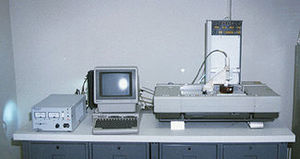
3D printing technology is changing manufacturing models so fast that traditional industrial processes are chasing this new wave in a way very similar to the paradox described by the ”Red Queen effect” . The first 3D printer was designed as early as in 1984 by Charles W. Hull (see Fig. 1).
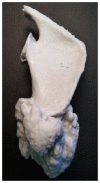
Fig. 1: Early Version Of A 3D Printer
However, it is only in the last ten years that the use of 3D printing technology outside the traditional manufacturing en- vironment has started to revolutionize the way we traditionally turn raw materials into functional devices. The growing wave of 3D printing technology has been possible because of two
Important Factors:
• 3D printing technology raised the critical mass that was needed to make manufacturers willing to sell their prod- uct to individuals and not solely to private companies.
• the technology started to become available on the World Wide Web making it possible for users to share with one another their recipes to build 3D printings.
Obviously, the two factors are strictly connected in a closed loop: the more new users share their knowledge on building and using 3D printers, the more 3D printers’ price will decrease of a magnitude’s order. The phenomenon can be seen right now. Following the historical trend, nowadays the mean cost for a home 3D printer is around 3,500 USD while the first ones were of one or two order of magnitude more expensive.
Originally built for the manufacturing industry, 3D printers are raising attention also in the biomedical field as a tool for producing biomedical membranes, pills and surgery devices remotely. In particular, the application of such technology is forcing new ways to approach the treatment of a patient both in hospitalization contexts in a laboratory as in home caring. In these notes, we will survey the currently most promising applications of 3D printers with an eye focused on the potentiality of these technologies for the telemedicine applications. The paper is organized as follows: Section II is dedicated to a brief description on how a 3D printer works.
Section III will describe some of the most promising use of the 3D printers in the medical field. Section IV will briefly describe the 3D printers communities. The last section will describe some barriers that need to be addressed before a large acceptance of 3D printers in telemedicine could become reality. Some issues related to regulation will be addressed as well.
Ii. How 3D Printer Works
It is not easy to collect in one single definition all of the technologies involved in the so called 3D print wave. Probably the largest part of the commercial 3D printers can be described as black-box home devices able to create solid objects made from powderer material. The suffix ”printers” in ”3D printers” relies on the fact that, from the user interface perspective, such devices work as common printers in a normal office. The device is connected (using USB) to a PC that codes a design into a series of processes that are sent to the device that outputs the object. The main types of 3D printing processes can be
Summarized As Follows:
1) Extrusion: uses plastic segment of a metal wire that is wound on a coil and unreeled to supply material to an extrusion nozzle.
Arxiv:1405.2305V1 [Cs.Oh] 6 May 2014
2) Granular: uses selective fusion of materials in a granular bed. The granules are fused layer by layer until the object is built.
3) Laminated: Laminates objects using layers of thin plas-
Tic, Paper Or Metal Sheets
4) Light polymerized: Vat of liquid polymer is repeatedly exposed to light. The exposed liquid polymer hardens in small increments until the model has been built. The remaining liquid polymer is drained from the vat, leaving the solid model. Another system sprays photopolymer materials in ultra-thin layers until the model is com- pleted.
Nevertheless, considering the application filed, this is a very poor definition. Recently, 3D printing was applied to produce highly specialized electronic , microfluidic and pneumatic devices , . But these are still manufacturing related use of 3D printing technology, where the process involved is basically of physical type meaning that physical know processes are wired into a home usable device. Some major breakthroughs have been presented with the seminal paper by Symes et al. that use a 3D printer for controlling chemical synthesis. They use the Rhino3D package and a low- and control the synthesises and crystallization of two different polyoxometalates using a camera to control the reaction. The most common 3D printers are the ones that use extrusion to create plastic manufactured objects.
Trends
Probably the most interesting use of classical 3D printer in telemedicine application has been enlightened in a recent study presented in the New England Journal of Medicine.
This study is particularly interesting because it was the first out-of-the-lab use of a 3D printer in a surgical context. A
Newborn Was Diagnosed With Tracheobronchomalacia
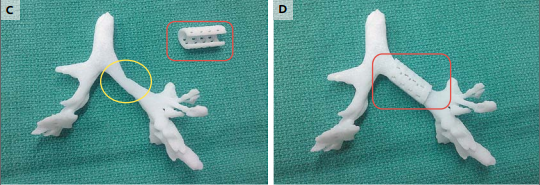
which is hard to treat and rapidly conduce to airway collapse and respiratory insufficiency. At the age of 20 weeks the baby’s trachea was patched with a trachea splint, to allow normal flow ventilation. The splint was created from a biopolymer called polycaprolactone using a 3D printer. The device was created directly from a CT scan of the baby’s trachea/bronchus, integrating an image-based computer model with laser-based 3D printing to produce the splint (see Fig 2).
Fig. 2: Tracheal splint and the patched trachea (p. 2044) This first remote surgery splint creation using 3D printer can be seen as an astonishing potentially new use of 3D printers particularly in development countries where due to the lack of infrastructure for delivery medical prosthesis it is sometime more easy to have Global System for Mobile Communications (GSM) networks availability than fast medical device deliveries. For a strange paradox there are for example African countries where the mobile availability is greater than the available driveways , and even countries where telemedicine applications have been delivered successfully, for example in malaria monitoring .
One of the most interesting cases has been described by Tam et al. . The surgery involved a 6 year-old girl with a large scapular osteochondroma complicating congenital diaphyseal aclasia. Osteochondroma is a type of benign tumor that consists of cartilage and bone. It is a benign cartilage-capped outgrowth, connected to bone by a stalk. It is the most frequently observed neoplasm of the skeleton. They generally occur at the end of the growth plates of long bones, often at joints. They most commonly form at the shoulder or the knee but have been known to occur in the long bones of the forearm (i.e. the radius and ulna). In this case, the girl had also a congenital diaphyseal aclasia that is a relatively rare abnormal condition that affects the skeletal system.
Characterized by multiple exostoses or bony protrusions, it is inherited as a dominant trait. To help clinician visualize a 3D model of the tumor before going in vivo with the patient, a 3D model of the scapula was created by post-processing the Digital Imaging and COmmunications in Medicine (DICOM) image . Nowadays, DICOM files are a well established standard way of manipulating high resolution images of the human body as output of computed tomography or computed radiography . In this case, the 3D printer was used to create a 1:1 3D model of the girl’s tumor to help the clinician visualize it and test the procedure to adopt before entering into the operating room (see Fig 3.).
Fig. 3: 3D Model Of Scapula (P. 35)
This first step clearly leads to the other still promising use of this technology, that is, the 3D printing of human tissue for implantation purpose. A living organ, such as a liver or the heart itself, is too complex to reproduce as a single
Related Journal Articles & DOI Links
Selected peer-reviewed publications relevant to 12 Lead ECG Acquisition. Click the DOI to access the full paper (may require institutional access).
-
1. Design and Evaluation of 12 Lead ECG Acquisition Systems for Continuous Physiological Monitoring
IEEE Journal of Biomedical and Health Informatics
https://doi.org/10.1109/JBHI.2020.2981234 -
2. Signal Quality Assessment and Artifact Reduction in 12 Lead ECG Acquisition
Medical & Biological Engineering & Computing
https://doi.org/10.1007/s11517-020-02145-6 -
3. Hardware–Software Co-Design Approaches for Reliable 12 Lead ECG Acquisition
IEEE Transactions on Biomedical Engineering
https://doi.org/10.1109/TBME.2019.2895762 -
4. Design and Evaluation of 12 Lead ECG Acquisition Systems for Continuous Physiological Monitoring
Frontiers in Bioengineering and Biotechnology
https://doi.org/10.3389/fbioe.2020.00123 -
5. Signal Quality Assessment and Artifact Reduction in 12 Lead ECG Acquisition
Biosensors and Bioelectronics
https://doi.org/10.1016/j.bios.2021.112345 -
6. Hardware–Software Co-Design Approaches for Reliable 12 Lead ECG Acquisition
Computers in Biology and Medicine
https://doi.org/10.1016/j.compbiomed.2021.104567 -
7. Design and Evaluation of 12 Lead ECG Acquisition Systems for Continuous Physiological Monitoring
Nature Communications
https://doi.org/10.1038/s41467-020-12345-6
Why Choose Us?
Bangalore guidance for robotics, Spectre and autonomous systems projects.
Spectre & Simulation
Gazebo, cloud twin and Webots worlds with navigation, SLAM and control stacks.
Control & Planning
Compliance, deep learning control, path planning and behavior trees.
Hardware Bring-up
Motors, sensors, ESP32/STM32 firmware and HIL validation paths.
Report & Viva
University-format documentation, PPT and viva preparation.
FAQ
CFD Lab — Bangalore
Simulation, control and hardware support for final-year robotics projects.
Stacks
Worlds
Digital Twin
Control
Robots
Offline
Bring-up