Abstract — Environmental Impact Assessment
Model coupled solid-fluid behaviour, groundwater effects and soil deformation using Abaqus geomechanical analysis. Analyze slope failure, soil instability and nonlinear deformation during geotechnical loading conditions. Simulate excavation processes, tunnel construction and soil relaxation using advanced Abaqus geomechanics methods.
Analytical & Numerical Modeling Methodology
Model nonlinear interaction between foundations, piles and surrounding soil under static and dynamic loading. Simulate blast loading, buried structures and soil response under extreme dynamic events. A complete Abaqus soil mechanics collection covering CEL large deformation analysis, soil plasticity, UMAT and VUMAT development, critical state models, consolidation, pore pressure analysis, soil-structure interaction, pipelines, foundations, tunnels and advanced geotechnical applications. The complete package provides a structured pathway from fundamental soil modelling to advanced research-level simulations.
Finite Element Results & Code Compliance
Do you think understanding soil behavior is easy?! Soil doesn’t act like a solid rock—it moves, settles, expands, and even turns to liquid during earthquakes. These behaviors make predicting soil response one of the most complex challenges in civil and geotechnical engineering. Understanding how soil reacts under various forces is key to building safe foundations, bridges, tunnels, and more.
Scope & Practical Applications
- High-rise building and spatial frame analysis under seismic & wind loading
- Finite element continuum modeling in ABAQUS for non-linear material plasticity
- Classical lamination theory (CLT) and failure prediction for composite structures
- Spatial hazard mapping, landslide susceptibility, and catchment terrain analysis in QGIS
- Detailed bar bending schedules (BBS), structural drawings, and calculation booklets
3D Frame Analysis
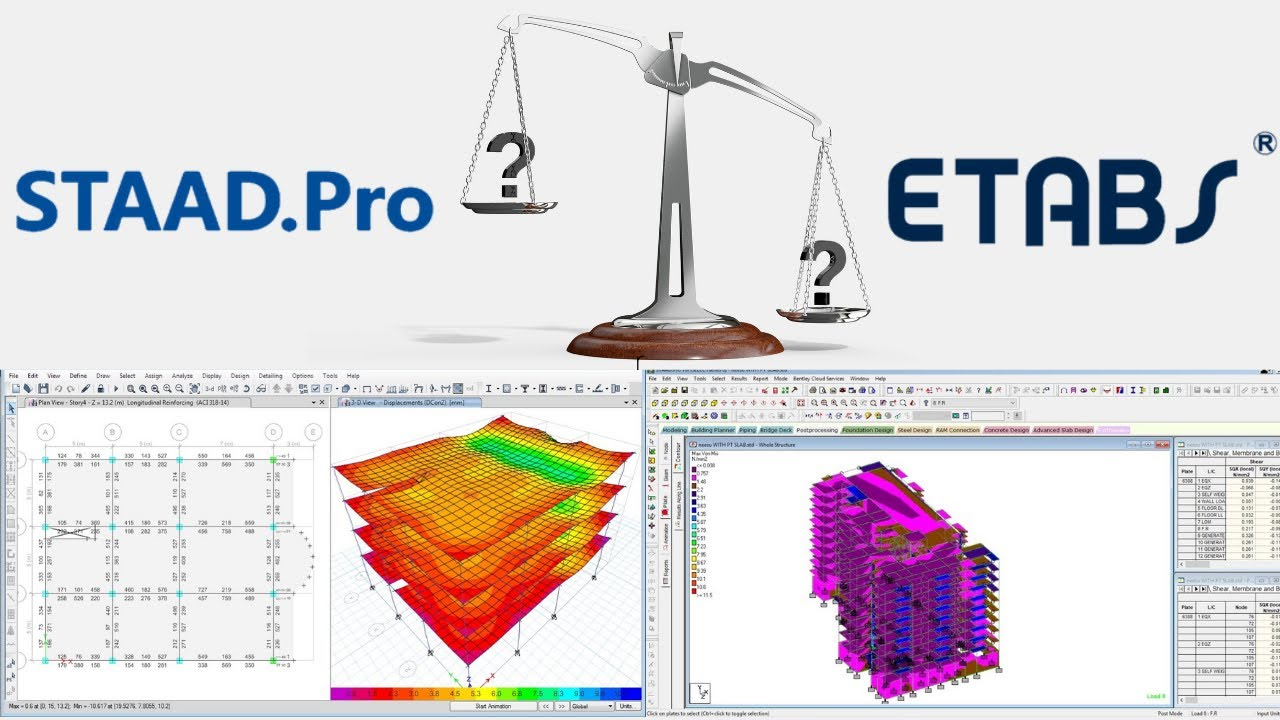
Spatial modeling in ETABS & STAAD.Pro
Non-Linear FEA
Constitutive damage models in ABAQUS
QGIS Geomatics
DEM terrain modeling & catchment maps
Stiffness Solver
Direct matrix assembly in MATLAB
Code Compliance
IS 456, IS 1893, ACI 318, Eurocodes
Stress Envelopes
Critical axial, shear & moment vectors
Engineering Software & Technologies
Built using industry-standard engineering analysis platforms, numerical code solvers, and geomatics tools.
| Software Platform | Analytical Function & Role | Engineering Tier |
|---|---|---|
| ETABS v21 | Multi-story building analysis, response spectrum, P-Delta, wind & seismic lateral loads | Structural Core |
| STAAD.Pro Connect | 3D space frame analysis, steel connection design, foundation reaction extraction | Steel & Concrete |
| ABAQUS Standard | Non-linear continuum mechanics, concrete damaged plasticity, composite lamina failure | Non-Linear FEA |
| QGIS Desktop | Digital Elevation Model (DEM) hydrological mapping, slope stability raster overlays | Spatial Geomatics |
| MATLAB R2024b | Global stiffness matrix assembly, modal eigenvalue extraction, composite ABD matrix calculation | Mathematical Solver |
Analytical Engineering Workflow
Systematic integration from CAD architectural geometry and GIS terrain mapping to finite element simulation and code validation.
Geometry & BIM
(Concrete/Steel/FRP)
Spatial Analysis
Non-Linear Mesh
& Foundation Coupling
& Detailing
Verified Structural Diagrams & FEA Stress Contours
Advantages of the Environmental Impact Assessment Project
Why this project delivers superior academic grades and provides high technical evaluation standing.
Multi-Software Cross-Validation
Integrates ETABS, STAAD.Pro, and ABAQUS modeling to verify results across both linear and non-linear finite element solvers.
Rigorous Code Compliance
Fully compliant with IS 456, IS 1893 (Seismic Criteria), IS 800 (Steel Design), ACI 318, and Eurocode provisions.
Non-Linear Material Plasticity
Captures crack propagation, yield surfaces, and post-peak softening behavior using ABAQUS Concrete Damaged Plasticity.
Composite Lamination Analysis
Evaluates Classical Lamination Theory (CLT), ABD matrices, and Hashin/Tsai-Wu failure envelopes for high-strength FRP laminates.
Spatial Geomatics Coupling
Combines high-resolution QGIS Digital Elevation Models with slope stability analysis for accurate terrain hazard zoning.
Deterministic Matrix Solvers
Custom MATLAB scripts assemble global stiffness matrices [K] and extract natural frequencies without relying purely on black-box GUIs.
Second-Order P-Delta Verification
Accurately assesses geometric non-linearity and sway amplification induced by gravity and lateral wind/seismic combinations.
Detailed Structural Detailing
Delivers complete Bar Bending Schedules (BBS), ductile detailing drawings per IS 13920, and steel connection drawings.
Direct Industry Relevance
Builds competencies demanded by top structural design consultancies, EPC contractors, and infrastructure developers.
Complete Turnkey Package
Includes full model files (.EDB, .STD, .CAE), MATLAB code, calculation sheets, IEEE-format report, and viva defense presentation.
Sample MATLAB Code, FEA Output & Member Schedules
Representative excerpts illustrating the finite element stiffness assembly, command solver output, and structural capacity envelopes.
[*] Initializing ETABS API Engine v21 & STAAD.Pro Analytical Space Frame... [✓] Dead Load (DL), Live Load (LL), Wind (WL), and Seismic (EQX/EQY) Loaded ──────────────────────────────────────────────────────────────────────── [MODAL ANALYSIS] Mode 1 (Translational X): T1 = 0.842 sec (Mass Part: 81.4%) [MODAL ANALYSIS] Mode 2 (Translational Y): T2 = 0.791 sec (Mass Part: 82.8%) [MODAL ANALYSIS] Mode 3 (Torsional Theta): T3 = 0.512 sec (T/Tx = 0.608 < 0.90 OK) [DRIFT CHECK] Max Inter-Story Drift: Δ = 0.0018 < 0.0040 (IS 1893 Clause 7.11.1 PASSED) [P-DELTA EFFECT] Maximum Stability Index θ: 0.041 < 0.10 (Secondary Moments Negligible) ──────────────────────────────────────────────────────────────────────── [✓] Design Envelope Complete: Zero Overstressed Members across 1.5(DL + LL) & 1.2(DL + LL ± EL)
[*] Generating critical member capacity envelope across factored combinations...
| Member Tag | Section Designation | Axial Pu (kN) | Bending Mz (kNm) | Shear Vy (kN) | Capacity Ratio | IS Code Status |
|---|---|---|---|---|---|---|
| Col C1-G1 | 450 x 450 mm M40 | 2,410.8 | 184.2 | 84.5 | 0.742 | PASSED |
| Col C2-G1 | 500 x 500 mm M40 | 3,180.4 | 218.6 | 112.4 | 0.814 | PASSED |
| Beam B101 | 300 x 600 mm M35 | 42.5 | 264.8 | 168.2 | 0.688 | PASSED |
| Beam B102 | 300 x 600 mm M35 | 38.1 | 295.4 | 182.1 | 0.762 | PASSED |
[✓] Structural Analysis Complete: Zero overstressed members. Design capacity factor > 1.0 throughout.
Frequently Asked Questions
Project Deliverables & Support
Everything needed from project inception to final viva defense — delivered with expert technical support.
Model Files
Input Decks
Scripts
Report
Slides
Drawings
Sheets
Q&A
Support
Extension