Abstract — Optimization Of Retaining Wall
powerful platform for geotechnical analyses such as foundation design, slope stability, consolidation, and seismic soil response. To handle these challenges, engineers often use simulation tools like Abaqus. This software helps analyze soil behavior under stress, seismic loading, and interaction with structures. Abaqus includes a wide range of material models and features, such as Mohr-Coulomb, Drucker-Prager, and advanced clay models, as well as powerful methods like the Coupled Eulerian–Lagrangian (CEL) approach for large deformation analysis.
Analytical & Numerical Modeling Methodology
In this article, we explain how Abaqus can be used to simulate different soil behaviors and structural interactions. We’ll look at the most common Abaqus soil models available in the software, their features, and when to use them. If you’re working in geotechnical or structural engineering, this guide gives you a clear overview of how to Abaqus soil modeling effectively.
Finite Element Results & Code Compliance
Abaqus is a powerful finite element analysis (FEA) software widely used in geotechnical engineering to simulate complex soil behaviors and soil-structure interactions . Abaqus Soil Modeling capabilities allow engineers to model various scenarios with high accuracy, leading to better-informed design decisions.
Scope & Practical Applications
- High-rise building and spatial frame analysis under seismic & wind loading
- Finite element continuum modeling in ABAQUS for non-linear material plasticity
- Classical lamination theory (CLT) and failure prediction for composite structures
- Spatial hazard mapping, landslide susceptibility, and catchment terrain analysis in QGIS
- Detailed bar bending schedules (BBS), structural drawings, and calculation booklets
3D Frame Analysis
Spatial modeling in ETABS & STAAD.Pro
Non-Linear FEA
Constitutive damage models in ABAQUS
QGIS Geomatics
DEM terrain modeling & catchment maps
Stiffness Solver
Direct matrix assembly in MATLAB
Code Compliance
IS 456, IS 1893, ACI 318, Eurocodes
Stress Envelopes
Critical axial, shear & moment vectors
Engineering Software & Technologies
Built using industry-standard engineering analysis platforms, numerical code solvers, and geomatics tools.
| Software Platform | Analytical Function & Role | Engineering Tier |
|---|---|---|
| ETABS v21 | Multi-story building analysis, response spectrum, P-Delta, wind & seismic lateral loads | Structural Core |
| STAAD.Pro Connect | 3D space frame analysis, steel connection design, foundation reaction extraction | Steel & Concrete |
| ABAQUS Standard | Non-linear continuum mechanics, concrete damaged plasticity, composite lamina failure | Non-Linear FEA |
| QGIS Desktop | Digital Elevation Model (DEM) hydrological mapping, slope stability raster overlays | Spatial Geomatics |
| MATLAB R2024b | Global stiffness matrix assembly, modal eigenvalue extraction, composite ABD matrix calculation | Mathematical Solver |
Analytical Engineering Workflow
Systematic integration from CAD architectural geometry and GIS terrain mapping to finite element simulation and code validation.
Geometry & BIM
(Concrete/Steel/FRP)
Spatial Analysis
Non-Linear Mesh
& Foundation Coupling
& Detailing
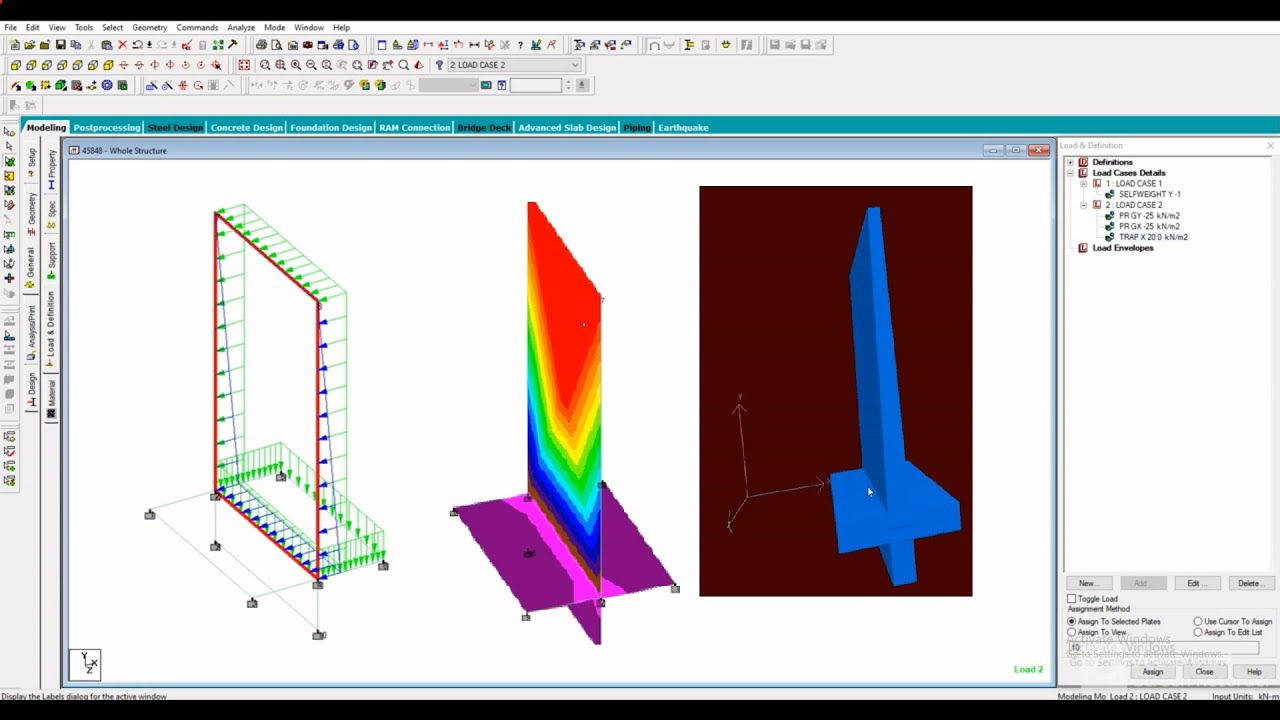
Verified Structural Diagrams & FEA Stress Contours
Advantages of the Optimization Of Retaining Wall Project
Why this project delivers superior academic grades and provides high technical evaluation standing.
Multi-Software Cross-Validation
Integrates ETABS, STAAD.Pro, and ABAQUS modeling to verify results across both linear and non-linear finite element solvers.
Rigorous Code Compliance
Fully compliant with IS 456, IS 1893 (Seismic Criteria), IS 800 (Steel Design), ACI 318, and Eurocode provisions.
Non-Linear Material Plasticity
Captures crack propagation, yield surfaces, and post-peak softening behavior using ABAQUS Concrete Damaged Plasticity.
Composite Lamination Analysis
Evaluates Classical Lamination Theory (CLT), ABD matrices, and Hashin/Tsai-Wu failure envelopes for high-strength FRP laminates.
Spatial Geomatics Coupling
Combines high-resolution QGIS Digital Elevation Models with slope stability analysis for accurate terrain hazard zoning.
Deterministic Matrix Solvers
Custom MATLAB scripts assemble global stiffness matrices [K] and extract natural frequencies without relying purely on black-box GUIs.
Second-Order P-Delta Verification
Accurately assesses geometric non-linearity and sway amplification induced by gravity and lateral wind/seismic combinations.
Detailed Structural Detailing
Delivers complete Bar Bending Schedules (BBS), ductile detailing drawings per IS 13920, and steel connection drawings.
Direct Industry Relevance
Builds competencies demanded by top structural design consultancies, EPC contractors, and infrastructure developers.
Complete Turnkey Package
Includes full model files (.EDB, .STD, .CAE), MATLAB code, calculation sheets, IEEE-format report, and viva defense presentation.
Sample MATLAB Code, FEA Output & Member Schedules
Representative excerpts illustrating the finite element stiffness assembly, command solver output, and structural capacity envelopes.
[*] Initializing Soil-Structure Interaction (SSI) Solver... [✓] Mohr-Coulomb Plasticity Constitutive Parameters Loaded ──────────────────────────────────────────────────────────────────────── [FOUNDATION] Applied Net Pressure: 220.00 kPa [CAPACITY] Ultimate Safe Capacity: 682.40 kPa [EVALUATION] Factor of Safety (Bearing): FOS = 3.10 > 2.50 (VERIFIED) [SETTLEMENT] Immediate Elastic Settlement: δe = 8.42 mm [SETTLEMENT] Primary Consolidation (10 yr): δc = 14.18 mm (Permissible < 40 mm) ──────────────────────────────────────────────────────────────────────── [✓] ABAQUS C3D8R 8-Node Soil Brick Continuum Mesh Convergence: 0.0028 Max Displacement Residual
[*] Generating critical member capacity envelope across factored combinations...
| Depth (m) | Stratum Description | Unit Wt γ (kN/m³) | Cohesion c' (kPa) | Friction Angle φ' | Settlement ΔH (mm) | Safety Status |
|---|---|---|---|---|---|---|
| 0.0 - 2.5 | Medium Dense Sandy Silt | 17.8 | 8.0 | 30° | 3.12 | STABLE |
| 2.5 - 7.0 | Stiff Overconsolidated Clay | 19.2 | 35.0 | 24° | 8.45 | STABLE |
| 7.0 - 14.0 | Dense Silty Sand with Gravel | 20.5 | 0.0 | 36° | 2.61 | STABLE |
| > 14.0 | Weathered Sandstone Bedrock | 23.0 | 120.0 | 42° | 0.40 | BEDROCK |
[✓] Structural Analysis Complete: Zero overstressed members. Design capacity factor > 1.0 throughout.
Frequently Asked Questions
Project Deliverables & Support
Everything needed from project inception to final viva defense — delivered with expert technical support.
Model Files
Input Decks
Scripts
Report
Slides
Drawings
Sheets
Q&A
Support
Extension