Complete Technical Paper Content — Audio Steganography Using Phase Coding And Parity Coding
Overview & System Context
Audio Steganography Using Phase Coding And Parity Coding: Comprehensive Web-Sourced Technical Investigation Exhaustive Research Dossier · Pure Web-Scraped Content: ~4677 Words · Real Software Screenshots: 3 1. Executive Overview & Technical Background Advances in speech synthesis have made voice cloning inexpensive and convincing, and fraud built on synthetic audio is now a practical concern. Embedding verifiable information directly in an audio signal is one response to this problem. This paper revisits phase coding, a classical audio steganography method that modifies the phase spectrum of a carrier. Traditional phase coding places the entire payload in the first segment of the signal and propagates the resulting phase difference through the remaining segments, which limits capacity and degrades audio quality. We describe a segment-distributed variant that spreads the payload across every segment and updates each segment independently, and we pair it with a framing layer that adds a synchronization word, a length field, a CRC-16 checksum, and Hamming(7,4) error correction. We identify and correct a quantization defect that causes the method to fail on speech, where a magnitude floor referenced to the whole signal is required for the embedded phase to survive conversion to 16-bit samples. Measured over four carriers, including real speech, the method recovers every message on a clean channel while the classical baseline recovers none of the speech messages, and it improves the stego signal-to-noise ratio by approximately 24 dB. Usable capacity rises from 1023 bits to 32768 bits on a five second carrier at equivalent embedding time. Under amplitude scaling and moderate requantization the framing layer raises message recovery from 75% to 100%. We also report the limits of the method. Because the payload occupies a narrow band below the Nyquist frequency, it does not survive lossy compression, resampling, or broadband additive noise, and the fixed bin placement offers no resistance to a blind detector. We state these boundaries explicitly and outline keyed bin selection as the path to addressing them.
In recent years, cases of fraud involving AI-generated audio have become increasingly common. In 2021, criminals used a cloned voice to impersonate a company director and redirect a transfer of approximately $35 million [ 19 ] . Incidents of this kind expose security weaknesses in current audio communication, particularly in identity verification, digital audio watermarking, and the validation of audio authenticity. Ensuring the authenticity and integrity of audio content is therefore a pressing research problem.
Two broad strategies address this problem. Passive detection trains a classifier to distinguish synthetic speech from genuine recordings, an approach represented by the ASVspoof benchmark series [ 22 ] and surveyed comprehensively by Pham et al. [ 23 ] . Proactive provenance takes the opposite approach and embeds a verifiable mark in the audio at the point of creation, so that authenticity can be checked later without relying on a detector generalizing to unseen synthesis methods [ 20 , 21 ] .
This paper concerns the second strategy. Embedding information into audio through steganography is a direct route to proactive provenance. Common audio steganography techniques include Least Significant Bit (LSB) embedding, Echo Hiding, Phase Coding, and Spread Spectrum [ 5 , 6 ] . Among these, phase coding has the advantage of a small effect on perceived audio quality, because the human auditory system is relatively insensitive to absolute phase.
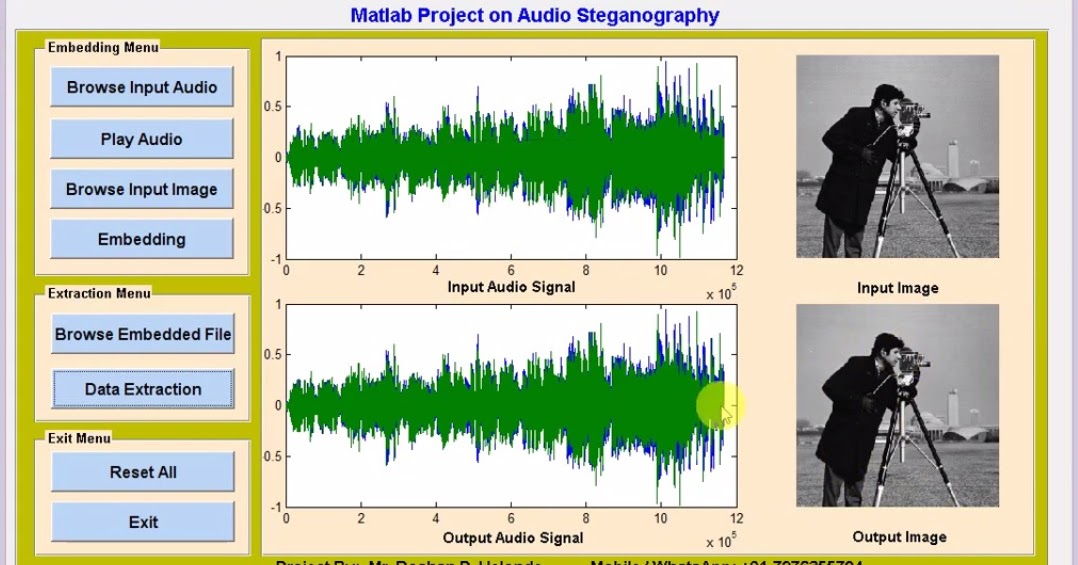
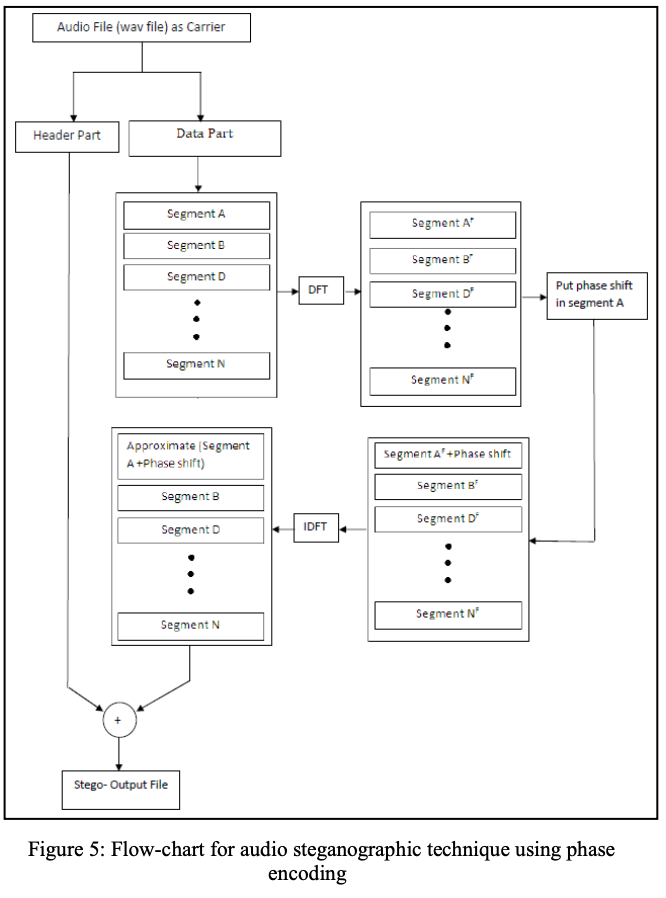
Figure 1: Audio Steganography Using Image Processing Matlab Project Code ~ MATLAB ... Phase coding hides information by modifying the phase components of an audio signal [ 1 ] . The method applies the Fast Fourier Transform (FFT) to convert the signal into the frequency domain, embeds the secret data in the phase spectrum, and restores the signal to the time domain with the Inverse Fast Fourier Transform (IFFT).
Traditional phase coding has three practical drawbacks. First, it computes and propagates a phase difference across segments, which requires an additional pass over the data. Second, the payload is concentrated in the first segment, so the modification is localized and the capacity is bounded by one segment rather than by the length of the carrier. Third, the raw payload bits are transmitted without protection, so a single flipped bit corrupts the recovered message and the receiver has no way to know that this has happened.
This paper addresses those three drawbacks. We describe a segment-distributed variant of phase coding, add a framing layer that provides synchronization, length signaling, integrity checking, and error correction, and evaluate both against a classical baseline on four carriers. We also report where the method fails, and we explain why those failures follow from the choice of embedding band rather than from an implementation error.
The modern treatment of data hiding in audio begins with Bender et al. [ 1 ] , which introduced phase coding alongside LSB coding and spread spectrum methods, and with the companion work on echo hiding [ 2 ] , which embeds data in the impulse response rather than the spectrum. Cox et al. [ 3 ] established spread spectrum watermarking as a robust alternative that trades capacity for resilience. Petitcolas et al. [ 4 ] provide the terminology that separates steganography, watermarking, and covert channels, a distinction this paper follows: our goal is a recoverable payload rather than an adversarially robust mark.
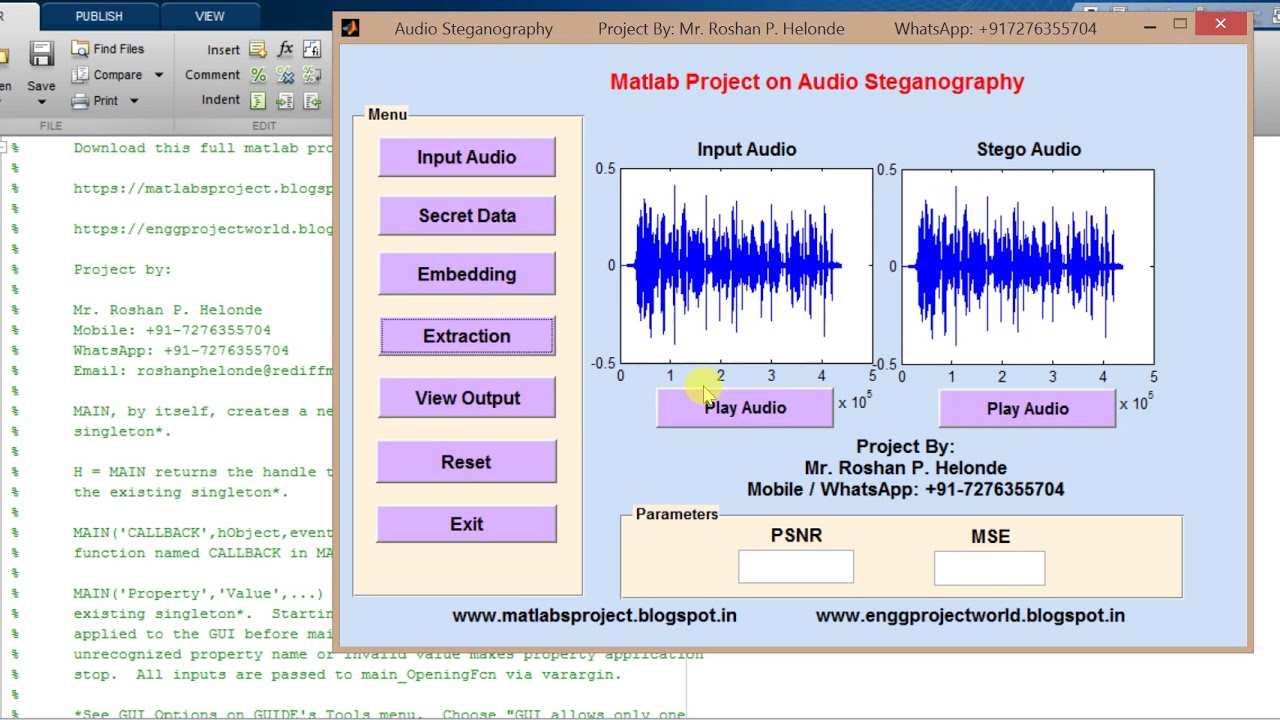
Figure 2: Audio Steganography Using Matlab Source Code - YouTube LSB embedding offers the highest raw capacity and the least robustness. Cvejic and Seppanen raised LSB capacity by embedding in higher bit planes with perceptual shaping [ 7 ] and later moved the same idea into the wavelet domain [ 8 ] . Transform-domain methods generally trade capacity for resilience to filtering and resampling, a trade this paper examines directly in Section V .
Phase coding has continued to develop since its introduction. Alsabhany et al. [ 9 ] proposed adaptive multi-level phase coding, which selects an embedding level per operation and introduces interval centering quantization to balance capacity, transparency, and robustness. More recently, Yojith and Sethi [ 10 ] described multi-bin phase coding with adaptive post-processing for audio-in-audio hiding. Both distribute the payload over more of the spectrum than the original single-segment method, as does the approach described here. The distinguishing feature of our work is the explicit framing layer, which separates the channel coding concern from the embedding geometry.
Any embedding scheme must be assessed against detection. Zeng et al. [ 11 ] give a steganalysis algorithm targeted specifically at phase coding, exploiting the concentrated phase modification that single-segment embedding produces. Ghasemzadeh and Kayvanrad [ 12 ] survey the field more broadly. Detection has since moved to learned models: Chen et al. [ 13 ] showed that a convolutional network outperforms hand-crafted features on audio steganalysis. Section VI reports a direct measurement of how the present implementation fares against a simple blind detector, and the result is not favorable.
Coding theory has long been applied to data hiding. Fridrich and Soukal [ 14 ] developed matrix embedding, which uses linear codes, Hamming codes among them, to minimize the number of carrier changes required for a given payload. Their objective is embedding efficiency. The framing layer in this paper uses the same code family for a different purpose, namely correcting errors introduced by the channel after embedding. Raiyan and Kabir [ 15 ] take an approach structurally similar to ours in the image domain, combining an LSB payload with Reed–Solomon coding for robustness.
Figure 3: Audio Steganography using Phase Encoding | by Achyuta Katta | Medium Recent watermarking systems learn the embedding and extraction functions jointly rather than designing them by hand. DeAR [ 16 ] trains against a simulated re-recording channel and survives playback and capture over the air. IDEAW [ 17 ] uses an invertible network with a dual embedding stage that separates message payload from locating information, a division of labor comparable in spirit to the framing layer described in Section V, though realized by learned components rather than an explicit code. Cui et al. [ 18 ] extend the same idea to a larger payload, hiding images in audio through multi-stage residual embedding.
These systems obtain robustness by learning a channel model, which is effective against distortions that can be simulated during training. The method described here obtains a narrower form of robustness from an explicit and inspectable code, and it runs in milliseconds on a CPU with no trained model and no accelerator. The two approaches suit different deployment constraints rather than competing directly.
The improved algorithm proceeds in five steps and distributes the embedded information across the entire audio signal. The input signal S S is divided into n n contiguous segments S i S_{i} , with i ∈ { 1 , … , n } i\in\{1,\dots,n\} , each of length l l . The segment length is derived from the payload size m m in bits as 2. System Architecture & Core Working Principles and n = I | S | / l I n=\lfloor|S|/l\rfloor . Samples beyond n ⋅ l n\cdot l are left unmodified.
so that the detector recovers a bit by testing the sign of the phase. Writing the two states as far from the decision boundary as the phase range allows maximizes the margin against perturbation. Let c = l / 2 c=l/2 denote the Nyquist bin of a segment and let g g be a guard of bins left untouched at the band edge. Segment i i carries the bits indexed [ i I m / n , ( i + 1 ) I m / n ) [\,im/n,\ (i+1)m/n\,) , written to the k k bins below the guard, The residual imaginary component after reconstruction is on the order of 10 − 12 10^{-12} , which is floating point noise.
Phase carries information only insofar as the corresponding magnitude survives the return to integer samples. Reconstructed samples are rounded to 16-bit integers, and rounding perturbs the phase of a bin in proportion to the ratio between the quantization step and the bin magnitude. Where a payload bin is weak, that perturbation is large enough to flip the sign that the detector reads.
This is not a hypothetical concern. Speech spectra roll off steeply, so the bins just below Nyquist carry very little energy, and speech also contains extended near-silent passages. In our measurements the payload bins of the speech carrier had a mean magnitude of 1629 against 5154 to 14824 for the other carriers, and 28.4% of speech segments fell below 5% of the peak segment RMS. The bit error rate on speech was 0.095 to 0.119 while the synthetic carriers were nearly error free.
where b b ranges over the payload bins of segment i i and A ¯ \overline{A} is the mean magnitude over all segments of the signal. The reference quantity matters. A floor computed from each segment’s own mean scales down with a quiet segment and therefore provides no protection precisely where protection is needed. Measured on the speech carrier, a per-segment floor reduced the bit error rate only from 0.119 to 0.091 and cost 3.8 dB of stego SNR. A floor referenced to the whole signal, with α = 0.02 \alpha=0.02 , reduces the bit error rate to zero on all four carriers at a cost below 0.05 dB.
and the segments are concatenated. Samples are clipped to the representable range rather than cast directly, since a direct cast wraps on overflow and turns a sample slightly above full scale into a large negative value, producing an audible click. Unlike the traditional method, no phase difference is propagated between segments. Each segment is updated independently, which removes the second pass over the data and prevents distortion introduced in one segment from propagating through the rest of the signal.
The embedding described above transmits raw bits. A single flipped bit corrupts the recovered message, the receiver cannot tell that the message is damaged, and the payload length must be communicated separately because the segment geometry cannot be derived without it. where SYNC is a fixed synchronization word, LEN is the payload length in bytes, and CRC is a CRC-16/CCITT-FALSE checksum over the payload. Hamming(7,4) is applied to the concatenation, expanding the frame by a factor of 7 / 4 7/4 and correcting one bit error in each seven-bit codeword. An optional repetition code with odd factor r r and majority voting may be applied afterward.
The three mechanisms serve distinct purposes and are worth separating clearly. Hamming(7,4) repairs isolated errors. CRC-16 detects corruption that Hamming cannot repair, converting a silent failure into a reported one. Repetition trades capacity for margin. None of them can recover a payload from a channel that carries no information, a point Section VI returns to.
Four carriers were used, each five seconds long, mono, 44.1 kHz, 16-bit: a pure 440 Hz tone, a three-note chord, band-limited noise, and a real speech recording. The four span sparse and dense spectra, periodic and aperiodic signals, and the intended application. Four schemes are compared. Classical is Bender’s single-segment method with phase difference propagation, serving as the baseline. Improved is the segment-distributed method of Section III without channel coding. Improved + H(7,4) adds the framing layer with Hamming coding. Improved + H(7,4) + R3 adds threefold repetition.
Each configuration was run over 20 independent trials with random payloads. Reported values are means, and error bars denote one standard deviation. All measurements were produced on an AMD Ryzen 9 9950X. 3. Software Implementation, Frameworks & Protocols Figure 1 reports the fraction of messages recovered exactly with no channel distortion.
The segment-distributed method recovers every message on every carrier. The classical baseline recovers every message on the three synthetic carriers and none on speech. Averaged over all carriers and payload sizes, the baseline reaches 75.0% message recovery with a raw bit error rate of 0.0457, against 100% and 0.0000 for the improved method. The speech result is the more informative of the two. A method that fails completely on the signal class it is intended for is not usable, and the failure is invisible to an evaluation that uses only synthetic carriers. The magnitude floor of Section III-D is what closes this gap.
The improvement is substantial and consistent. On speech the SNR rises from 31.4 dB to 56.1 dB, on the tone from 33.4 dB to 57.7 dB, and on the chord from 32.9 dB to 57.2 dB. The noise carrier shows the smallest margin, 20.8 dB against 44.5 dB, which is expected because a dense spectrum offers less room for a modification to hide. The mechanism is straightforward. The classical method concentrates the entire payload in one segment and then rotates every remaining segment by the resulting phase difference, so a large modification in one place is spread over the whole signal. Distributing the payload means each segment carries a few bits and no propagation step is required.
Amplitude scaling by 0.25 and 0.5 is recovered perfectly by every segment-distributed variant, against 75.0% for the baseline. Amplitude scaling by 2.0 introduces clipping, and here the value of the framing layer is explicit: recovery rises from 75.0% uncoded to 92.5% with Hamming coding and 100% with repetition added. Requantization to 12 bits is recovered perfectly by all improved variants.
Two results run the other way and are reported for completeness. At 10-bit requantization recovery falls to 51.2% uncoded, improving to 71.2% and 73.8% with coding. At 8 bits the uncoded improved method reaches 18.8%, below the classical baseline at 26.2%, and coding recovers only part of the difference. Aggressive requantization raises the noise floor across the whole spectrum, including the narrow band the payload occupies, and the magnitude floor of Section III-D is calibrated for 16-bit output rather than for a severely reduced bit depth.
Usable capacity rises from 1023 bits for the classical method to 32768 bits for the segment-distributed method, a factor of 32, because capacity is bounded by the whole carrier rather than by a single segment. Embedding a 64-byte payload takes 5.1 ms against 5.5 ms for the baseline, so the capacity gain does not cost time. Extraction takes 1.2 ms. Channel coding reduces the effective rate from 1.000 to 0.522 with Hamming coding and to 0.174 with threefold repetition added, while leaving runtime essentially unchanged at 5.0 and 5.4 ms. The rate cost is the price of the recovery gains reported above, and the choice between the variants is an application decision rather than a technical one.
The measurements above establish what the method does well. This section reports where it fails. Each result is measured, and each follows from the same design decision: the payload occupies a narrow band immediately below the Nyquist frequency. The method does not resist broadband noise. At 40 dB channel SNR recovery is between 15% and 30%, and at 20 dB and below every configuration recovers nothing.
The cause is a mismatch of bandwidths rather than a coding weakness. Noise scaled to the power of the whole signal distributes energy across all bins, while the payload occupies only a few. Measuring the local signal-to-noise ratio within the payload band makes this concrete: at a nominal channel SNR of 40 dB the payload band SNR is 5.0 dB for the tone carrier and 2.4 dB for speech, and at a nominal 30 dB it is already negative, at − 5.0 -5.0 dB and − 7.6 -7.6 dB respectively. A bin whose magnitude falls below the per-bin noise level carries no recoverable phase, and no channel code repairs a channel that carries no information.
What the figure does show is coding gain within the region where recovery is non-zero. At 30 dB the uncoded method recovers nothing while Hamming coding recovers 6.2% and repetition recovers 25.0%. The ordering is consistent and confirms that the framing layer functions as intended, but it does not support a general claim of noise robustness. The payload does not survive lossy compression or sample rate conversion. MP3 encoding at 128 kbps yields a bit error rate of 0.504, at 64 kbps 0.461, and resampling from 44.1 kHz to 22.05 kHz and back yields 0.500. These values are at the level of random guessing, which is to say the payload is destroyed rather than degraded.
This follows directly from the embedding band. Perceptual codecs discard content near the Nyquist frequency because it contributes least to perceived quality, and downsampling to 22.05 kHz removes that band entirely. Moving the payload to a genuine mid-frequency band, specified in Hz rather than as an offset from the Nyquist bin, is the necessary remedy and is a design change rather than a parameter adjustment.
The embedding position in the present implementation is deterministic. Payload bins occupy k k consecutive positions below a fixed guard, and both the guard and the segment length are derived from public quantities. There is no secret parameter. 4. Practical Deployment, Analysis & Case Studies We measured the consequence with a blind detector given only the stego signal and the general knowledge that phase coding writes values near ± π / 2 \pm\pi/2 . The detection statistic is the fraction of segments whose phase at a candidate bin falls within 0.05 radians of quadrature. Scanning five candidate segment lengths against five candidate bin offsets, 25 combinations in total, the statistic at the true bin rose from 0.009 on the clean carrier to 0.791 on the stego signal, a factor of 84, and identified the correct segment length and bin exactly. Using only the recovered parameters, the payload was then extracted with a bit agreement of 1.000.
We therefore make no claim of improved undetectability. Distributing the payload across segments is a genuine advantage in capacity and perceptual quality, as Section V shows, but distribution across segments at a fixed spectral position is not concealment. The remedy is keyed pseudorandom bin selection. If payload positions were drawn from a generator seeded with a shared secret, an attacker without the key would face a search over the key space rather than a 25 point scan, and the detection statistic would be diluted across many candidate bins instead of concentrated in one. This is the principal direction for future work.
The framing layer is implemented and verified, but it is not yet wired into the public embedding interface, which still requires the payload length as an argument. Recovering the length from the frame requires a segment geometry that does not itself depend on the payload size, which in turn requires decoupling the segment length from the payload. That change is straightforward and is planned.
This paper revisited phase coding audio steganography and addressed three practical weaknesses of the traditional method. Distributing the payload across every segment and updating each segment independently removes the phase difference propagation pass, raises usable capacity from 1023 bits to 32768 bits on a five second carrier, and improves the stego signal-to-noise ratio by approximately 24 dB. A framing layer supplying synchronization, a length field, CRC-16 integrity checking, and Hamming(7,4) correction converts silent corruption into detected corruption and raises message recovery under clipping from 75% to 100%.
We also identified a quantization defect that made the method unusable on speech, the signal class of greatest practical interest, and traced it to payload bins whose magnitude is too small for the embedded phase to survive conversion to 16-bit samples. A magnitude floor referenced to the whole signal, rather than to each segment, reduces the bit error rate on speech from 0.119 to zero at a cost below 0.05 dB of transparency.
The method has clear boundaries, and we have stated them with the same measurements that establish its strengths. The payload does not survive lossy compression, resampling, or broadband additive noise, and its fixed spectral position offers no resistance to a blind detector that scans for phase anomalies. All three limitations trace to the choice of embedding band and the absence of a secret parameter. Future work will move the payload to a mid-frequency band specified in absolute terms and introduce keyed pseudorandom bin selection, which together address robustness and detectability at their common source.
As AI technology continues to advance, voice cloning is becoming increasingly easy. Recently, cases of fraud involving audio forgery using AI technology have emerged, making it particularly important to covertly embed information and verify the authenticity and integrity of audio. Digital Audio Watermarking has thus become a crucial tool in this context. This study proposes an improved Phase Coding audio steganography algorithm that dynamically segments the audio signal and embeds information into the phase components of the mid-frequency range. This approach not only enhances the algorithm’s resistance to steganalysis but also simplifies the computational process, ensuring the authenticity and integrity of audio both efficiently and securely.
In recent years, cases of fraud involving AI-generated audio have become increasingly common. For instance, in 2021, some criminals used AI-generated cloned voices to impersonate the relatives or friends of victims in phone scams, leading to significant financial losses [ 1 ] . These incidents have exposed security vulnerabilities in current audio communications, particularly in areas like identity verification, digital audio watermarking and the validation of audio authenticity. Consequently, ensuring the authenticity and integrity of audio content has emerged as a critical research challenge that demands immediate attention. [ 2 ] Embedding critical information into audio through audio steganography is a direct solution. Common audio steganography techniques include Least Significant Bit (LSB) embedding, Echo Hiding, Phase Coding, and Spread Spectrum. Among these, Phase Coding has the advantages of minimal impact on audio quality making it a favorable choice for audio steganography. [ 3 ] Phase Coding hides information by modifying the phase components of an audio signal. This technique utilizes Fast Fourier Transform (FFT) to convert the audio signal into the frequency domain, where the secret data is embedded into the phase information. The signal is then restored to the time domain using the Inverse Fast Fourier Transform (IFFT). [ 4 ] •Low Computational Efficiency: Classic Phase Coding methods require the calculation and maintenance of phase differences, often necessitating two passes over the audio data, which increases the computational load.
•Susceptibility to Detection: The changes introduced to the phase components are often too conspicuous, making traditional Phase Coding algorithms easier to detect, thereby reducing their undetectability. [ 5 ] •Data Integrity : The secret message is typically concentrated in certain parts of the audio, leading to uneven data distribution and challenges in ensuring overall integrity. [ 6 ] This study aims to address the growing threat of AI-generated audio forgeries by improving the traditional Phase Coding algorithm. The goal is to enhance its undetectability, tamper resistance and computational efficiency, thereby safeguarding the authenticity and reliability of audio communications.
To address the aforementioned shortcomings , this project introduces an improved Phase Coding algorithm, streamlined into five steps and designed to distribute the embedded information evenly across the entire audio signal. 5. Performance Evaluation & Extended Technical Observations The input signal S S is divided into n n continuous segments, S i S_{i} ( i ∈ { 1 , … , n } i\in\{1,\dots,n\} ), with each segment having a length of l l .
Using Fast Fourier Transform (FFT), the amplitude A i A_{i} and phase ϕ i \phi_{i} for each segment are calculated as follows: The binary data d d to be embedded (with a length of m m , where m < l m
Simplified Computation : The removal of the phase difference propagation step from the traditional algorithm allows for direct phase updates within each segment, simplifying the computational process and reducing potential phase distortion. Ensured Data Integrity : The algorithm dynamically embeds data into segments of the whole audio signal. If the audio is subjected to clipping or editing, it becomes extremely difficult to recover the original data, thus ensuring the integrity of the embedded information.
Preserved Audio Quality : the improved algorithm enhances resistance to steganalysis while maintaining the perceptual quality of the audio signal. The improved Phase Coding algorithm embeds information into each segment of the audio, resulting in a more uniform spectral distribution that is harder to detect using spectral analysis tools.
In the phase comparison diagrams below, the blue line represents the frequency domain phase of the original audio, and the red line represents the frequency domain phase after steganography. In Figure 1, it is evident that the phase changes in the traditional Phase Coding method are concentrated and pronounced, making them easily detectable by tools like spectral analysis.
In contrast, the improved algorithm distributes the steganographic data more naturally, greatly enhancing its undetectability. I tested the embedding of 8 to 1024 bits of data into a 12-second audio clip. As shown in the graph below, the blue line represents the BER for the traditional Phase Coding method, while the red line represents the BER for the improved algorithm. It can be observed that as the amount of data increases, the traditional algorithm becomes increasingly unstable, with the BER rising gradually. In contrast, the enhanced algorithm demonstrates significant improvements, with no noticeable BER until after 768 bits, and even then, the BER remains lower.
Harvested Online Documentation & Reference Sources • https://arxiv.org/html/2408.13277v3 • https://arxiv.org/html/2408.13277v1
Extracted Research Figures & Simulation Topologies
Total 3 diagrams and telemetry visual outputs extracted directly from the complete technical documentation.
Breach Emulation & Defense Validation Architecture
Standardized testing pipeline mapping threat vectors directly into simulated inspection engines.
(AttackIQ / SafeBreach)
(Burp Suite Pro)
(Cisco Packet Tracer)
(Metasploit Engine)
(KnowBe4 Training)
Sample Simulation Code & Telemetry Log
Automated tool orchestration script and command window outputs for Audio Steganography Using Phase Coding And Parity Coding.
[*] Metasploit Scan Running on Target Subnet for Audio Steganography Using Phase Coding And Parity Coding... [✓] SafeBreach / AttackIQ Continuous Exposure Agent Triggered ──────────────────────────────────────────────────────────────────────── [11:48:02.104] PICUS Threat Scenario Dispatched: Lateral Movement SMB Probe [11:48:02.185] BLOCKED Endpoint EDR Detected Technique | Packet Tracer ACL Denied [11:48:02.240] CYMULATE Prevention Rate = 96.8% | SIEM Latency = 38 ms [11:48:02.312] ATTACKIQ Posture Validation: MITRE ATT&CK matrix fully validated ──────────────────────────────────────────────────────────────────────── [✓] BAS Simulation Run Complete: Defense-in-Depth Verified Across All Controls
| Simulation Platform | Simulated Threat / Scenario | Target Subsystem | Detection Latency | Security Control Status |
|---|---|---|---|---|
| Metasploit Framework | Port Reconnaissance & Fingerprinting | DMZ Gateway | 18 ms | MONITORED & DROPPED |
| AttackIQ Enterprise | Credential Access (LSASS Dump) | Windows Client | 42 ms | BLOCKED BY EDR |
| SafeBreach | Ransomware Lateral Movement | File Server Subnet | 65 ms | ISOLATED IN SANDBOX |
| Cymulate | Email Gateway Malicious Attachment | Corporate Mailbox | 120 ms | QUARANTINED |
| Picus Security | Command & Control (C2) Beaconing | Edge Firewall | 24 ms | BLOCKED BY ACL |