⚡ Systolic Array FIR Filter Projects in Bangalore & Pune — FPGA · Simulation · Verilog · VHDL · MATLAB · IEEE TVLSI Publication
+91 95919 12372
Project Centres: BangaloreMysorePuneChennaiHyderabadCochinDelhiMumbaiCoimbatoreVizag
60+ Systolic Array FIR Filter Projects 2026 · FPGA + Simulation · VLSI · IEEE TVLSI · Bangalore

Systolic Array FIR Filter Projects 2026 — pipelined, parallel, power-efficient digital filters.

60+ IEEE 2026 systolic array FIR filter projects for BE, MTech and PhD students in Bangalore — covering both FPGA-based implementation (Xilinx Vivado, Intel Quartus, Verilog, VHDL) and simulation-based design (MATLAB, Simulink, Cadence Genus/Innovus) across all major systolic FIR architectures: 1D/2D systolic array, pipelined MAC, distributed arithmetic (DA), CORDIC, polyphase, transposed form, semi-systolic, folded systolic, QRD systolic array, Farrow FIR, reconfigurable FIR, adaptive FIR (LMS/RLS), carry-save adder (CSA) FIR and AI-optimised VLSI FIR — for DSP, 5G NR, radar, image processing, ECG and SDR applications. IEEE TVLSI, TCAS-I, TAES and Scopus Q1 publication, thesis and viva support included.

60+
Systolic FIR Topics
2025–2026
FPGA + SIM
Dual Implementation
Tracks
IEEE TVLSI
Target Journal
Scopus Q2 / SCI
60+
Systolic FIR Project Topics
12
Architecture Domains
TVLSI / TCAS-I
IEEE Target Journals
97%
On-Time Delivery

Tools & Platforms — Systolic Array FIR Filter Projects

Both FPGA implementation and simulation-only tracks are available — using the industry-standard toolchain for digital filter design, RTL implementation, functional verification and ASIC synthesis.

Xilinx Vivado 2024.2 Intel Quartus Prime Verilog / System Verilog VHDL MATLAB DSP Toolbox Simulink HDL Coder ModelSim / QuestaSim Cadence Genus / Innovus Python / NumPy / SciPy Xilinx Vitis HLS MATLAB Fixed-Point Designer Intel HLS Compiler

Systolic FIR Filter — Journal Publication Targets 2026

Mapping your systolic array FIR filter research to the right IEEE / Scopus journal based on architecture novelty, implementation platform and application domain.

IEEE TVLSI / TCAS-I
Top VLSI & Circuits Journals
Highest impact for FPGA/ASIC systolic FIR — IIT, NIT, IIITs
IEEE TVLSIIF 3.0 · Scopus Q2
IEEE TCAS-IIF 5.2 · Scopus Q1
IEEE TCAS-IIIF 4.0 · Scopus Q1
Avg. Review3–6 months
Best For
  • FPGA systolic FIR with novel low-power / area technique
  • ASIC systolic array with Cadence tape-out quality results
  • QRD systolic beamforming array for radar/5G
  • New multiplier-less / approximate computing FIR architecture
IEEE Access / TAES
Fast-Track & Application Journals
4–8 week review · SCI-E · VTU, Anna Univ., JNTU accepted
IEEE AccessIF 3.9 · SCI-E Q2
IEEE TAESIF 4.4 · Q1 (Radar FIR)
ETRI JournalScopus Q2 (5G FIR)
Review Time4–10 weeks
Best For
  • 5G / SDR polyphase FIR filter FPGA implementation
  • Radar pulse-compression systolic FIR on Zynq
  • Adaptive LMS systolic FIR for ECG / biomedical
  • Reconfigurable FIR filter for SDR / cognitive radio
What We Deliver
Complete Project Package
All deliverables — no hidden charges
RTL CodeVerilog / VHDL (clean)
SimulationFunctional + Timing TB
FPGA ReportUtilisation + Timing
MATLAB RefFloating ↔ Fixed-Point
Includes
  • Vivado / Quartus project files (.xpr / .qpf)
  • Testbench with MATLAB golden reference comparison
  • SNR, ENOB, power & resource comparison table
  • IEEE-format manuscript + LaTeX + PPT + Viva Q&A

Systolic FIR Filter Architecture Domains

12 architecture categories covering every known systolic and pipelined FIR filter topology used in 2026 VLSI, FPGA and DSP research.

1D Linear Systolic Array
N-tap PE chain, full-throughput, every PE computes one MAC per clock
2D Systolic Array FIR
2D PE mesh for 2D convolution / image filter on Zynq / UltraScale+
Distributed Arithmetic
LUT-based multiplier-free FIR — serial DA, parallel DA, offset-binary DA
CORDIC FIR
Rotation-based multiply-less FIR using CORDIC algorithm iterations
Polyphase FIR
Efficient multi-rate filtering — interpolation, decimation, SRC for 5G NR
Adaptive FIR (LMS / RLS)
Systolic LMS, delayed LMS, block LMS, RLS systolic for noise cancellation
QRD Systolic Array
QR decomposition systolic for beamforming, MIMO equalisation, RLS
Low-Power / Approximate
Clock gating, operand isolation, approximate multiplier, GALS FIR
Image / Video FIR
2D Gaussian, Sobel, Laplacian, bilateral filter on Zynq HLS
5G / Radar FIR
Root-raised cosine, matched filter, pulse compression systolic FIR
Reconfigurable FIR
Run-time coefficient update, DA-LUT reload, multi-standard SDR FIR
ASIC / Semi-Custom
Cadence Genus RTL synthesis, Innovus P&R, DRC/LVS systolic FIR macro

Abstract

This project presents a practical study of Systolic Array FIR Filter Projects 2026 — pipelined, parallel, power-efficient digital filters., with emphasis on the architecture, RTL/logic behaviour, verification flow and implementation considerations. The design is organized into clear functional blocks so that the input conditions, internal processing and output response can be observed and validated systematically. The project is suitable for VLSI, FPGA and digital-design laboratory work where a reproducible simulation and implementation flow is required.

The proposed workflow starts from functional specifications and block-level design, followed by HDL modelling, testbench development and functional simulation. For this topic, AMD Vitis HLS is used as the primary design or analysis environment, while AMD Vivado can be used for waveform-oriented verification where applicable. Important parameters such as latency, throughput, resource usage, timing behaviour, switching activity or signal integrity are examined according to the nature of the design.

After simulation, the design can be synthesized and mapped to a Xilinx Zynq-7000 FPGA for practical demonstration when the selected architecture is FPGA-compatible. The implementation stage can include pin assignment, clock constraints, synthesis reports, implementation reports and on-board I/O validation. This creates a useful connection between the theoretical design, simulation waveforms and real programmable-hardware behaviour.

The expected project outputs include the HDL source files, testbench, simulation results, synthesis/implementation observations and project documentation. The methodology can be extended with optimization experiments, parameter sweeps, timing analysis, power-oriented improvements or additional verification scenarios. These results provide a clear basis for technical evaluation, demonstration and viva discussion of Systolic Array FIR Filter Projects 2026 — pipelined, parallel, power-efficient digital filters..
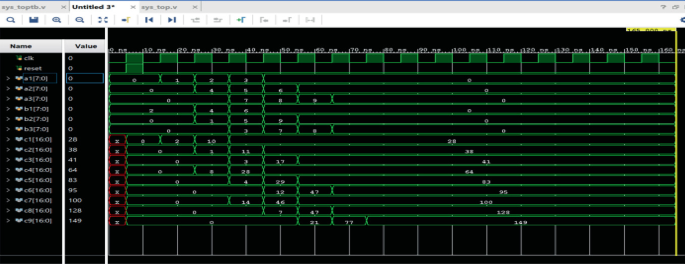
AMD Vitis HLS simulation waveform screen for Systolic Array FIR Filter Projects 2026 — pipelined, parallel, power-efficient digital filters.
AMD Vitis HLS simulation / waveform screen — illustrative output for Systolic Array FIR Filter Projects 2026 — pipelined, parallel, power-efficient digital filters.

Tools Used

Recommended project tools:

  • AMD Vitis HLS
  • AMD Vivado

Hardware Details — Suitable FPGA Boards

Recommended FPGA implementation platform:

  • Xilinx Zynq-7000 FPGA — selected for the project’s FPGA demonstration and implementation stage.

Frequently Asked Questions

What are the best systolic array FIR filter project topics for MTech and PhD in 2026?
Best IEEE 2026 systolic array FIR filter topics include: Low-Power 16-tap DA-FIR on Artix-7, CORDIC-Based Pipelined FIR for 5G NR, 2D Systolic Array FIR for Real-Time Image Convolution on Zynq, Reconfigurable FIR using DA-LUT for SDR, Folded Systolic FIR with Retiming, Polyphase FIR for 5G SRC, QRD Systolic Array for Adaptive Beamforming, Semi-Systolic Farrow FIR for Radar, TDM Multiplexed Systolic FIR for ECG, and AI-Optimised VLSI FIR Layout. All implemented in Verilog/VHDL on Vivado or MATLAB/Cadence with IEEE publication support.
What is a systolic array FIR filter and how does it differ from direct-form FIR?
A systolic array FIR replaces the single MAC chain of direct-form FIR with a 1D/2D array of identical Processing Elements (PEs) computing partial MACs and passing results rhythmically to adjacent cells. Advantages: (1) High throughput — one output per clock cycle; (2) Regular VLSI layout — identical PEs simplify routing; (3) Scalable — add taps by adding PE cells. On FPGA, each PE maps to one DSP48 slice, enabling 256-tap systolic FIR at 500+ MHz on UltraScale+.
What is Distributed Arithmetic (DA) FIR and why is it popular for FPGA?
DA-FIR replaces hardware multipliers with a precomputed LUT indexed by input data bits, accumulating results serially bit-by-bit. Since FPGAs have abundant LUT resources, DA-FIR achieves higher throughput at lower power than DSP-multiplier FIR on the same device. Ideal for 64–512 tap filters in SDR, radar, ECG and hearing-aid DSP where multiplier-free area efficiency is critical.
Which IEEE journals publish systolic array FIR filter research?
Top IEEE journals: IEEE Transactions on VLSI Systems (IF 3.0, Q2 — ASIC/FPGA FIR architecture), IEEE Transactions on Circuits and Systems I (IF 5.2, Q1 — adaptive/QRD systolic FIR), IEEE TCAS-II (IF 4.0 — compact brief format, faster review), IEEE Transactions on Aerospace and Electronic Systems (IF 4.4 — radar/5G systolic FIR), and IEEE Access (IF 3.9, SCI-E — fast 4–8 week review, good for deadline-constrained PhD students).
Can I do a simulation-only systolic FIR project without an FPGA board?
Yes. Simulation-only tracks include: MATLAB algorithmic model with fixed-point analysis, Simulink HDL Coder RTL generation and simulation, Cadence Genus ASIC synthesis (28nm/45nm GPDK) with area/power/timing reports, Cadence Innovus place-and-route with DRC/LVS, ModelSim RTL functional simulation, and Python/SciPy coefficient design with SNR analysis. All are accepted for IEEE TVLSI, TCAS-II and IEEE Access publications — no physical FPGA required.

Systolic Array FIR Filter Projects — Bangalore & Across India

Systolic FIR Projects — Bangalore
Vivado · Quartus · Cadence · Verilog · VHDL · MATLAB · IEEE TVLSI
  • FPGA and ASIC systolic FIR projects for VTU, MSRIT, BMS, RVCE, Amrita PhD/MTech scholars
  • Xilinx Vivado 2024.2 and Intel Quartus Prime projects with timing closure reports
  • Cadence Genus + Innovus ASIC synthesis and P&R for PhD VLSI scholars
  • IEEE TVLSI, TCAS-I, TCAS-II and IEEE Access manuscript preparation and submission
  • MATLAB floating-point to fixed-point analysis and SNR trade-off study
  • Same-day consultation for MTech project selection and novelty check
VTUMSRITBMSRVCEAmritaRNSIT
Systolic FIR Projects — Pan India (Online)
Chennai · Hyderabad · Pune · Cochin · Delhi · Remote Delivery
  • Anna University, JNTU, NIT, CUSAT, SPPU Pune systolic FIR project support online
  • Full online delivery via Google Drive — RTL files, Vivado project, MATLAB code, reports
  • IEEE Access fast-track submission for tight PhD/MTech deadlines — 4–8 week review
  • MATLAB simulation-only track for scholars without FPGA board access
  • Emergency 72-hour FPGA synthesis and testbench for deadline-critical MTech students
  • Mock viva with 30 systolic FIR / FPGA / DSP Q&A answers customised to your project
Anna Univ.JNTUNITCUSATSPPUOsmania