Enquire Now
Mechanical & Renewable Energy Fabrication Project

Levitating Frictionless Vertical Windmill.

Magnetically levitated vertical-axis wind turbine using permanent magnets for near-zero friction, spiral blades and axial-flux generator. Complete working model with fabrication, project report, PPT and viva support for BE, B.Tech, Diploma and MTech students.

12K+
Students Guided
100%
Fabrication Support
98%
Project Success

Levitating Frictionless Vertical Windmill Project Report

& Key Components & Technology

Core mechanical, magnetic and power-generation components used in the Levitating Frictionless Vertical Windmill fabrication project.

Supporting Frame Neodymium Magnets Spiral Blades Shaft / Rotor Axial Flux Generator Base Plate Copper Coils Magnetic Levitation
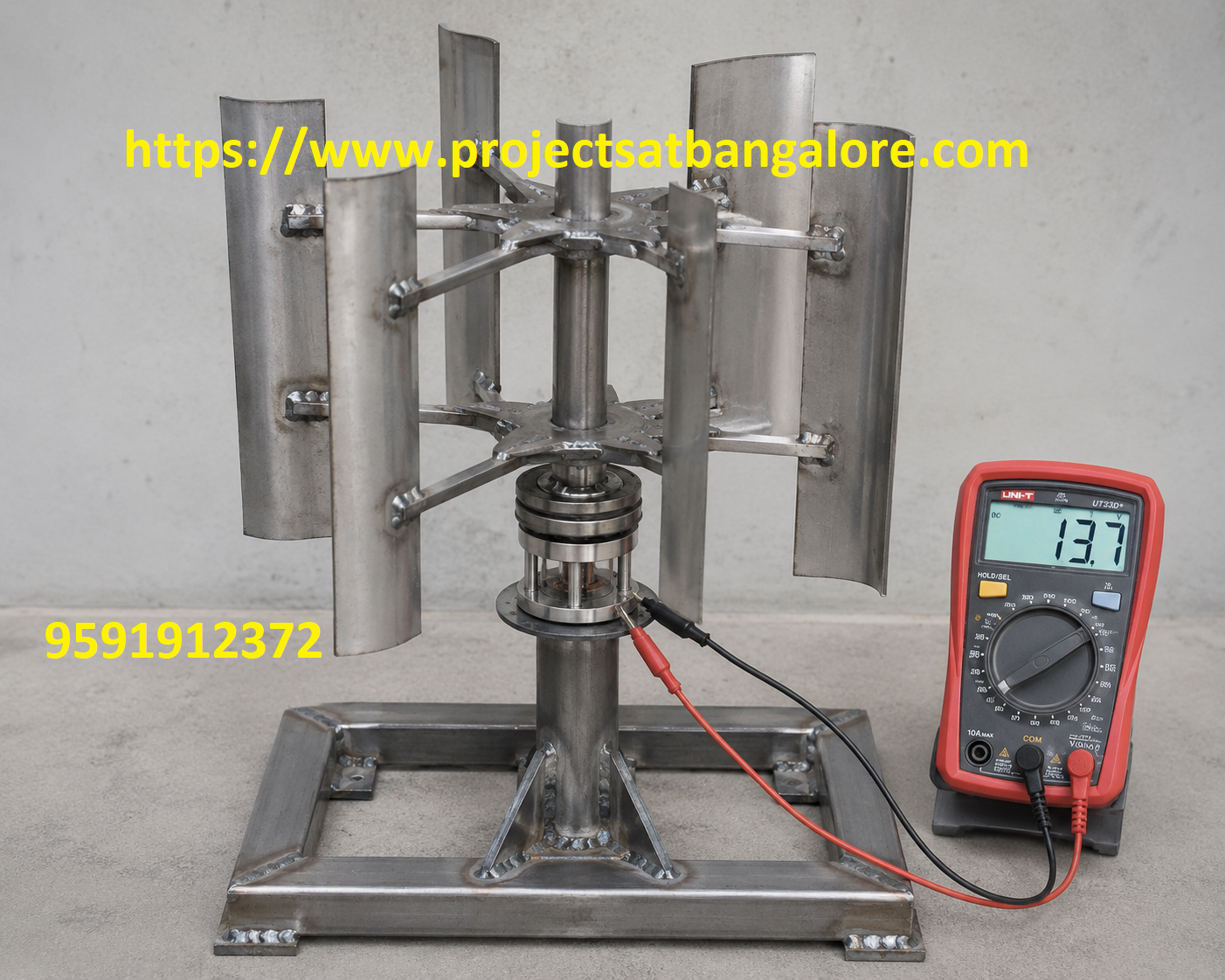
Levitating Frictionless Vertical Windmill Project fabrication setup

Levitating Frictionless Vertical Windmill Project

Mechanical & Renewable Energy fabrication final year project with complete documentation support.

Conventional wind turbines suffer from friction losses in bearings that reduce efficiency, especially at low wind speeds. Magnetic levitation eliminates physical contact, allowing the rotor to spin freely with near-zero friction.

This project fabricates a vertical-axis wind turbine whose rotor is suspended by permanent neodymium magnets. Spiral-shaped blades capture wind from any direction, while an axial-flux generator converts rotation into electricity. The design covers frame fabrication, magnet arrangement, blade mounting, shaft alignment and generator integration — ideal for Mechanical, Production, Manufacturing and Renewable Energy Engineering students.

Call: +91 95919 12372

Abstract

This project implements an alternate configuration of a wind turbine for power generation. Using the effects of magnetic repulsion, spiral-shaped wind-turbine blades are fitted on a rod for stability during rotation and suspended on magnets as a replacement for conventional ball bearings.

Power is generated with an axial-flux generator that incorporates permanent magnets and a set of coils. The aim is to design and implement a magnetically levitated vertical-axis wind turbine system capable of operating in both low and high wind-speed conditions (approximately 1.5 m/s to 40 m/s). Magnetic levitation reduces internal friction of the rotor, producing higher energy output while decreasing operational costs compared with traditional turbines.

It is an excellent final-year project for Mechanical, Production, Manufacturing, Industrial and Renewable Energy Engineering students, combining fabrication, magnetic levitation principles, power transmission and clean-energy concepts.


Working Principle

  • Permanent neodymium magnets create repulsive force that levitates the rotor, eliminating bearing friction.
  • Spiral or helical blades mounted on the vertical shaft capture wind from any direction.
  • Rotation of the levitated rotor drives an axial-flux generator consisting of permanent magnets and copper coils.
  • Generated electricity can be stored or used directly for demonstration loads.

Advantages

  • Near-zero friction enables start-up at very low wind speeds (≈ 1.5 m/s).
  • Operates effectively across a wide wind-speed range up to 40 m/s.
  • Compact vertical-axis design suitable for rooftops and urban installations.
  • Lower maintenance and higher efficiency compared with conventional bearing-based turbines.

Challenges

  • Precise magnet placement and polarity orientation for stable levitation.
  • Rotor balance and vibration control at higher rotational speeds.
  • Axial-flux generator design for adequate voltage and current output.
  • Structural rigidity of frame under varying wind loads.

Technical Specifications

Parameter Details
Levitation SystemPermanent neodymium magnets (repulsive configuration)
Blade TypeSpiral / helical vertical-axis blades (aluminium or composite)
Shaft / RotorLightweight non-magnetic material (e.g., Delrin or aluminium)
GeneratorAxial-flux permanent-magnet generator with copper coils
Base FrameFabricated mild-steel structure for stability
Wind Speed RangeApprox. 1.5 m/s to 40 m/s
Typical ApplicationLow-to-medium wind demonstration & educational power generation

What We Provide

ProjectsatBangalore offers complete support for the Levitating Frictionless Vertical Windmill Project including working fabrication, project report, PPT, block diagram, viva questions, and demonstration guidance for BE, B.Tech, Diploma, and MTech students in Bangalore.

Working Fabrication
Project Report
PPT Presentation
Block Diagram
Viva Support
Demo Guidance