Enquire Now
Pneumatic & Mechanical Fabrication Project

Pneumatic Operated Double Hacksaw Project.

Efficient dual-blade cutting machine powered by pneumatic cylinders for simultaneous or sequential metal and material cutting. Complete working model with fabrication, project report, PPT and viva support for BE, B.Tech, Diploma and MTech students.

12K+
Students Guided
100%
Fabrication Support
98%
Project Success

Pneumatic Operated Double Hacksaw Project Report

& Key Components & Technology

Core mechanical, pneumatic and structural parts used in the Pneumatic Operated Double Hacksaw fabrication project.

Pneumatic Cylinders Hacksaw Blades Reciprocating Frame Air Compressor Direction Control Valve Workpiece Clamp Base Frame Dual Cutting Action
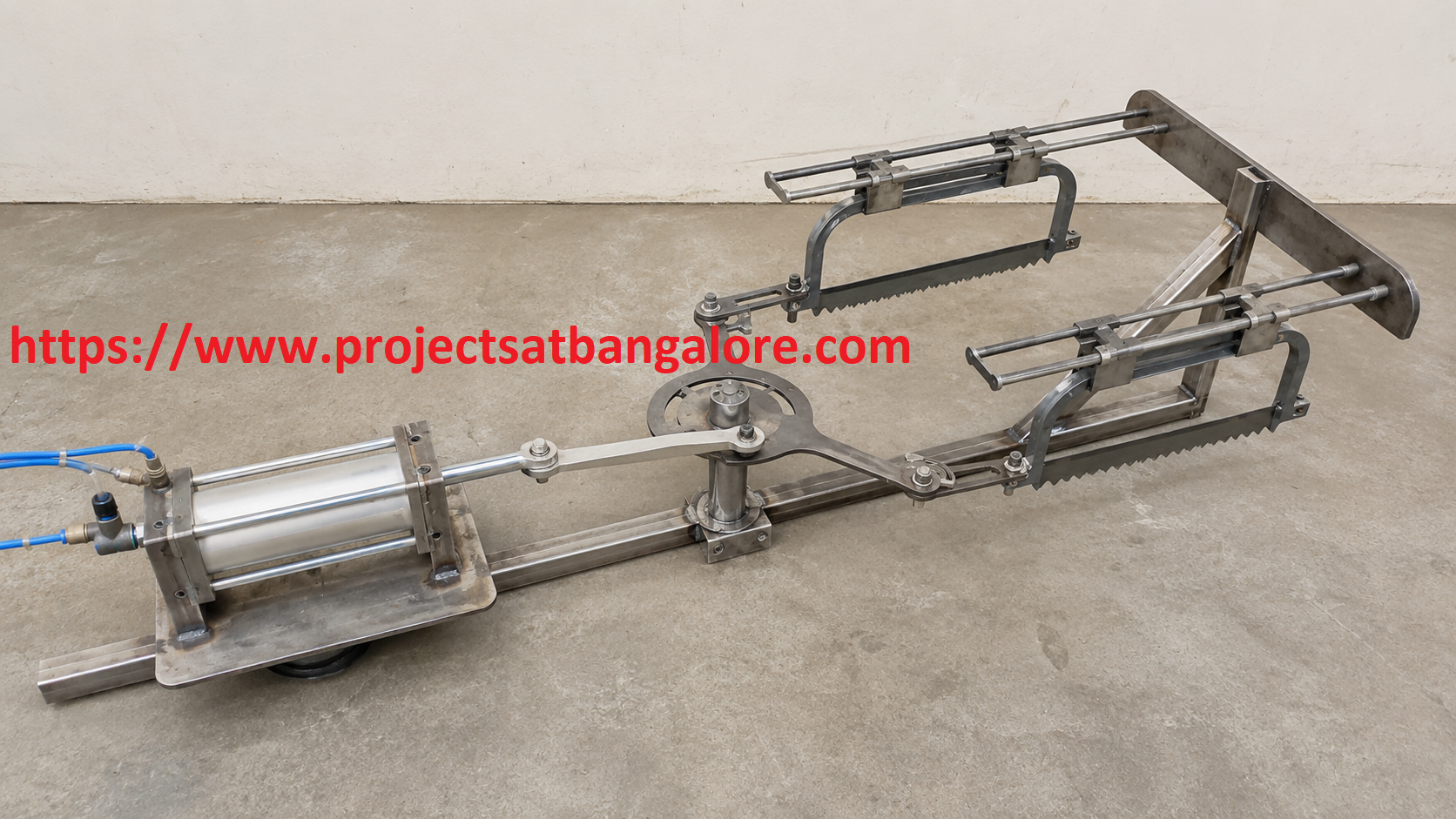
Pneumatic Operated Double Hacksaw fabrication setup

Pneumatic Operated Double Hacksaw Project

Pneumatic & Mechanical fabrication final year project with complete documentation support.

Conventional single-blade hacksaws are time-consuming for production cutting. A pneumatic double-hacksaw arrangement uses compressed air to drive two blades, significantly increasing cutting rate and productivity in workshops and small industries.

This project fabricates a robust double-hacksaw machine actuated by pneumatic cylinders. Direction control valves, flow control and a sturdy frame enable smooth reciprocating motion of both blades, demonstrating practical application of pneumatics in metal cutting machinery.

Call: +91 95919 12372

Abstract

Cutting operations form a major part of workshop and production activities. Manual or single-blade power hacksaws limit productivity. Pneumatic systems offer clean, reliable and controllable linear actuation ideal for reciprocating cutting tools.

This project presents the design and fabrication of a Pneumatic Operated Double Hacksaw Machine. Two hacksaw blades are mounted on a reciprocating frame driven by one or more double-acting pneumatic cylinders. A direction control valve sequences the forward and return strokes, while flow control valves regulate cutting speed. The dual-blade arrangement effectively doubles the cutting capacity compared with a conventional single-blade machine.

It is an excellent final-year project for mechanical and mechatronics students focusing on pneumatics, machine design and production engineering.


Working Principle

  • Compressed air from a compressor is supplied to a direction control valve.
  • The valve directs air alternately to both ends of the pneumatic cylinder(s).
  • Cylinder piston rod moves the hacksaw frame in a reciprocating motion.
  • Two blades cut the workpiece simultaneously or in coordinated strokes, increasing material removal rate.

Advantages

  • Higher productivity due to dual-blade cutting action.
  • Clean, spark-free operation compared with abrasive cutting.
  • Adjustable speed and force via pneumatic controls.
  • Simple construction, low maintenance and safe operation.

Challenges

  • Ensuring rigid alignment of both blades for uniform cutting.
  • Managing air consumption and compressor capacity.
  • Minimizing vibration and maintaining blade tension.
  • Providing effective workpiece clamping for different sections.

Technical Specifications

Parameter Details
ActuationDouble-acting pneumatic cylinder(s)
BladesTwo standard hacksaw blades mounted on reciprocating frame
Control5/2 or 4/2 direction control valve with flow control
Air SupplyCompressor (typically 6–8 bar working pressure)
FrameMild-steel fabricated base and guide assembly
Work HoldingManual or quick-clamp vice for rectangular / round stock

What We Provide

ProjectsatBangalore offers complete support for the Pneumatic Operated Double Hacksaw Project including working fabrication, project report, PPT, block diagram, viva questions, and demonstration guidance for BE, B.Tech, Diploma, and MTech students in Bangalore.

Working Fabrication
Project Report
PPT Presentation
Block Diagram
Viva Support
Demo Guidance