Enquire Now
Robotics & Mechanical Fabrication Project

Pneumatic Power Steering System.

Compressed-air assisted steering mechanism that reduces driver effort and provides smooth directional control. Complete working model with fabrication, project report, PPT and viva support for BE, B.Tech, Diploma and MTech students.

12K+
Students Guided
100%
Fabrication Support
98%
Project Success

Pneumatic Power Steering System Project Report

& Key Components & Technology

Core mechanical, pneumatic and control parts used in the Pneumatic Power Steering System fabrication project.

Air Reservoir Pneumatic Cylinder Directional Valves Pressure Regulator Steering Linkage Chassis Frame Air Compressor Assisted Steering
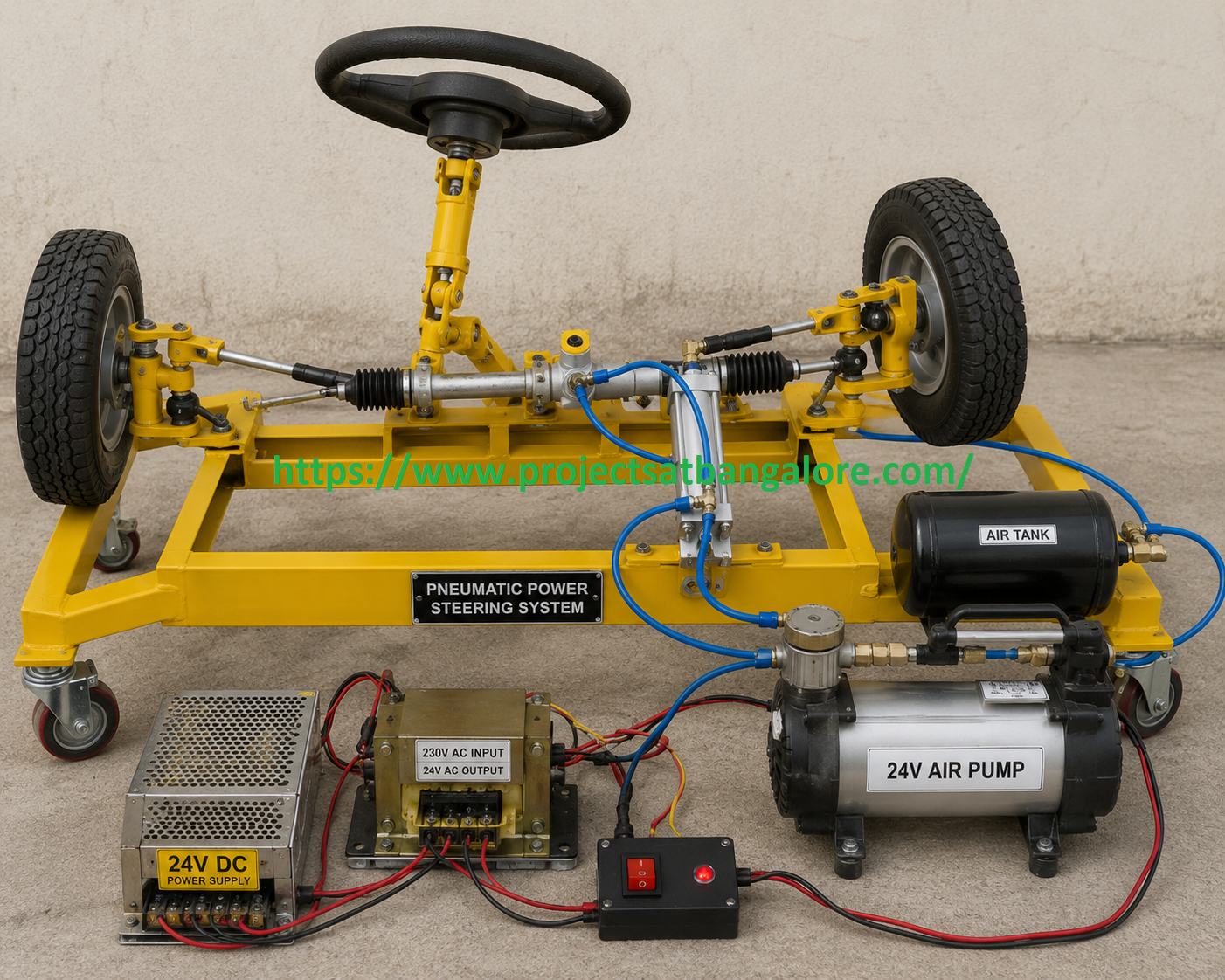
Pneumatic Power Steering System fabrication setup

Pneumatic Power Steering System

Mechanical & Pneumatic fabrication final year project with complete documentation support.

Conventional manual steering requires significant driver effort, especially at low speeds or with heavy vehicles. Power steering systems reduce this effort by providing hydraulic or pneumatic assistance.

This project fabricates a pneumatic power steering system that uses compressed air acting on a double-acting cylinder to assist the steering linkage. Directional control valves, regulated air supply and a mechanical feedback arrangement deliver smooth, proportional assistance — an excellent demonstration of pneumatics in automobile applications.

Call: +91 95919 12372

Abstract

Power steering systems significantly improve vehicle handling by reducing the effort required at the steering wheel. While hydraulic power steering is common in production vehicles, a pneumatic version offers a clean, easily controllable alternative suitable for laboratory demonstration and educational projects.

This project designs and fabricates a Pneumatic Power Steering System that employs a double-acting pneumatic cylinder, directional control valves, pressure regulator and air reservoir. Steering input opens the appropriate valve ports, allowing compressed air to assist the mechanical linkage and reduce driver effort.

It is an ideal final-year project for Mechanical and Automobile Engineering students, combining pneumatics, linkage design, force analysis and practical fabrication skills.


Working Principle

  • Driver turns the steering wheel, actuating a control valve or linkage.
  • Directional control valve routes compressed air to the appropriate side of the pneumatic cylinder.
  • Cylinder extends or retracts, applying force to the steering linkage.
  • Assisted motion reduces the torque required at the steering wheel.

Advantages

  • Significantly reduced steering effort compared with pure mechanical systems.
  • Clean and relatively simple pneumatic circuitry for laboratory use.
  • Proportional assistance possible with proper valve and regulator selection.
  • Excellent demonstration of pneumatics applied to automobile systems.

Challenges

  • Maintaining adequate air pressure and reservoir capacity during continuous operation.
  • Sealing and leak prevention in the pneumatic circuit.
  • Achieving smooth, proportional response without overshoot.
  • Integration of mechanical feedback for natural steering feel.

Technical Specifications

Parameter Details
ActuatorDouble-acting pneumatic cylinder
ControlDirectional control valve (manual or pilot-operated)
Air SupplyCompressor / Air reservoir with pressure regulator
Working PressureTypically 4–8 bar (adjustable)
LinkageMechanical steering linkage with cylinder mounting
FrameAluminium / Mild steel demonstration chassis

What We Provide

ProjectsatBangalore offers complete support for the Pneumatic Power Steering System Project including working fabrication, project report, PPT, block diagram, viva questions, and demonstration guidance for BE, B.Tech, Diploma, and MTech students in Bangalore.

Working Fabrication
Project Report
PPT Presentation
Block Diagram
Viva Support
Demo Guidance