Enquire Now
Robotics & Mechanical Fabrication Project

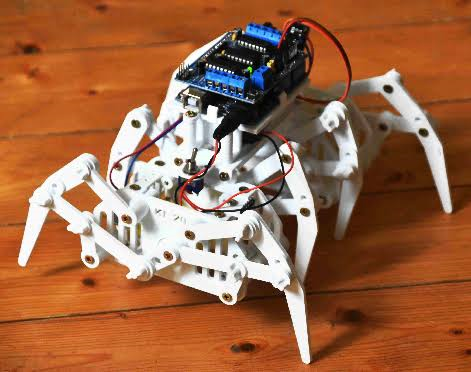
Six Legged Spider Bot Using Klann Mechanism.

Advanced mechanical walking robot featuring six Klann linkages for smooth hexapod gait, terrain adaptability and efficient locomotion. Complete working model with fabrication, project report, PPT and viva support for BE, B.Tech, Diploma and MTech students.

12K+
Students Guided
100%
Fabrication Support
98%
Project Success

Six Legged Spider Bot Using Klann Mechanism Project Report

& Key Components & Technology

Core mechanical, electronic and robotic parts used in the Six Legged Spider Bot Using Klann Mechanism fabrication project.

Klann Linkages DC / Servo Motors Crank & Rockers Microcontroller Chassis Frame Leg Assemblies Motor Drivers Hexapod Gait
Six Legged Spider Bot Using Klann Mechanism fabrication setup

Six Legged Spider Bot Using Klann Mechanism

Robotics & Mechanical fabrication final year project with complete documentation support.

Wheel-based robots struggle on uneven terrain, stairs and soft ground. Bio-inspired walking robots with multi-legged mechanisms offer superior stability and obstacle negotiation capability.

This Six Legged Spider Bot employs six synchronized Klann linkages driven by a common crankshaft or individual motors. The Klann mechanism converts rotary motion into a walking gait that lifts, swings and plants each leg, enabling smooth forward locomotion across varied surfaces — an outstanding demonstration of mechanical linkage design and robotics.

Call: +91 95919 12372

Abstract

The Klann linkage is a planar mechanism that produces an approximately straight-line walking path with a lifted recovery phase, making it ideal for multi-legged robots. This project designs and fabricates a six-legged spider-style robot that uses six identical Klann mechanisms arranged symmetrically around a central chassis.

A single central crankshaft (or paired motors) drives all six linkages in a coordinated phase relationship, generating a stable alternating tripod gait. The robot demonstrates efficient mechanical walking without complex servo sequencing, combining pure mechanism design with optional electronic speed control.

It is an excellent final-year project for Mechanical, Mechatronics and Robotics students, highlighting kinematics, linkage synthesis, fabrication accuracy and gait stability analysis.


Working Principle

  • Rotary motion from motor(s) is transmitted to a crankshaft that drives six Klann linkages.
  • Each Klann linkage converts rotation into a foot trajectory: lift → swing → plant → support.
  • Legs are phased (typically 120° or tripod groups) to maintain continuous body support.
  • Forward propulsion occurs as planted feet push backward relative to the chassis.

Advantages

  • Mechanical gait generation reduces electronic complexity compared to servo-based hexapods.
  • Excellent ground clearance and ability to traverse uneven terrain.
  • High load-carrying capacity relative to size due to multi-leg support.
  • Clear demonstration of classical linkage kinematics for academic evaluation.

Challenges

  • Precise fabrication and alignment of multiple identical linkages.
  • Minimizing friction and backlash in joints for smooth continuous motion.
  • Weight distribution and center-of-gravity control for stability.
  • Power transmission efficiency across six simultaneous mechanisms.

Technical Specifications

Parameter Details
MechanismSix identical Klann linkages (planar six-bar)
DriveDC Geared Motor(s) / Stepper with central crankshaft
ControllerArduino Uno / Mega (optional speed & direction control)
GaitAlternating tripod or wave gait via phase offset
Power Supply12V Li-ion / Lead Acid Battery
ChassisAluminium / Acrylic central body with six leg mounts

What We Provide

ProjectsatBangalore offers complete support for the Six Legged Spider Bot Using Klann Mechanism Project including working fabrication, project report, PPT, block diagram, viva questions, and demonstration guidance for BE, B.Tech, Diploma, and MTech students in Bangalore.

Working Fabrication
Project Report
PPT Presentation
Block Diagram
Viva Support
Demo Guidance