Enquire Now
Mechanical Fabrication Project

Motorized Chain Mechanism Hacksaw.

Electric motor driven chain mechanism that converts continuous rotary motion into precise reciprocating cutting action for efficient metal and material sawing. Complete working model with fabrication, project report, PPT and viva support for BE, B.Tech, Diploma and MTech students.

12K+
Students Guided
100%
Fabrication Support
98%
Project Success

Motorized Chain Mechanism Hacksaw Project Report

& Key Components & Technology

Core mechanical and drive components used in the Motorized Chain Mechanism Hacksaw fabrication project.

Chain Drive Electric Motor Reciprocating Link Hacksaw Blade Frame & Guides Sprockets Speed Reduction Cutting Action
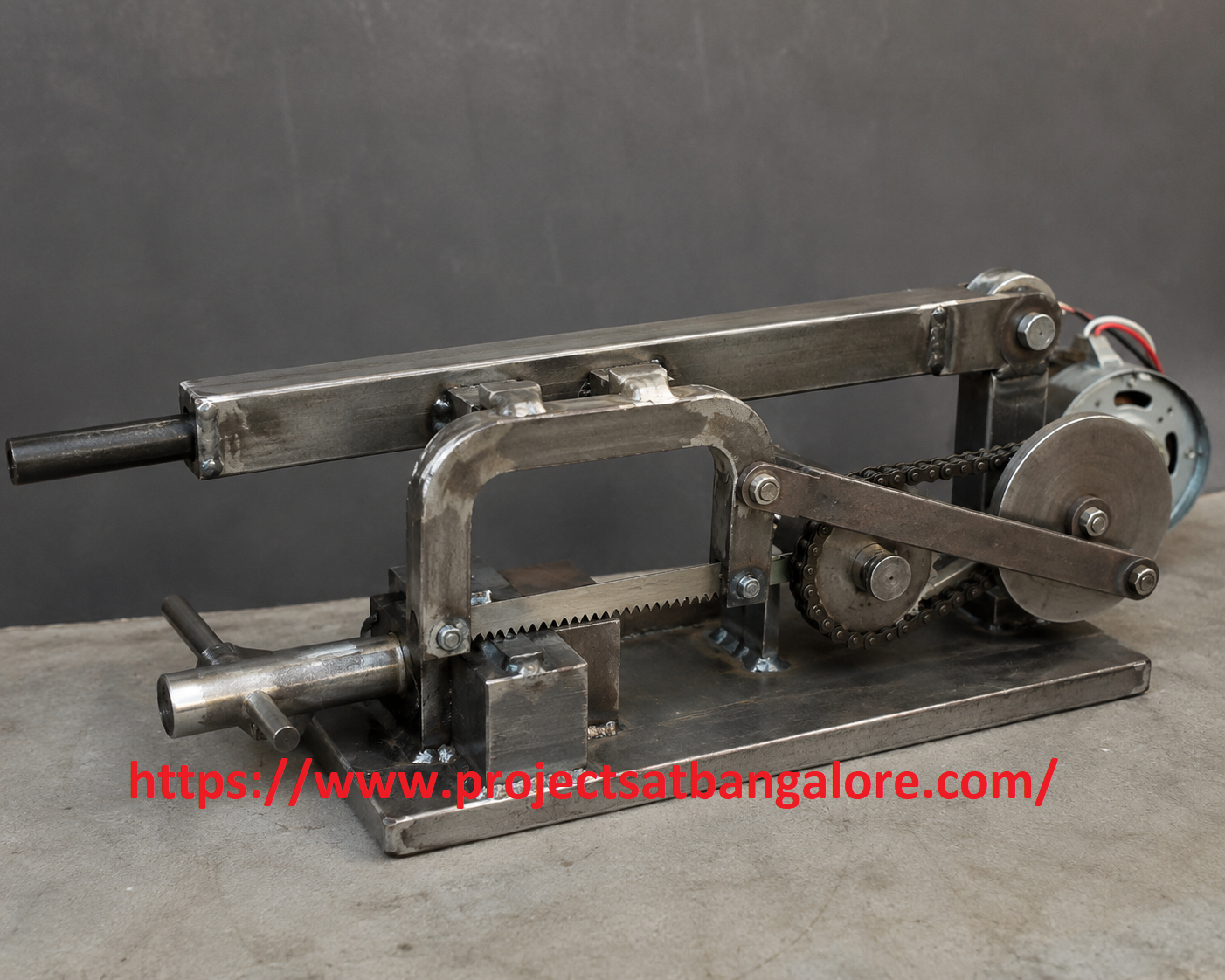
Motorized Chain Mechanism Hacksaw fabrication setup

Motorized Chain Mechanism Hacksaw

Mechanical fabrication final year project with complete documentation support.

Manual hacksaws require continuous physical effort and produce uneven cuts. A motorized chain-driven hacksaw automates the reciprocating motion, delivering consistent cutting force and improved productivity for workshop and laboratory use.

This project fabricates a compact motorized hacksaw in which an electric motor drives a chain-and-sprocket system. The continuous rotary motion is converted through a slider-crank or similar linkage into smooth reciprocating motion of the hacksaw blade, enabling efficient cutting of metal rods, pipes and bars.

Call: +91 95919 12372

Abstract

Cutting operations in workshops and fabrication shops often rely on manual hacksaws, which are labor-intensive and limited in consistency. Motorized alternatives improve speed, uniformity and operator comfort.

This project presents a Motorized Chain Mechanism Hacksaw that uses an electric motor coupled to a chain-and-sprocket drive. The rotary motion is transformed by a mechanical linkage into reciprocating motion of the blade, producing controlled and continuous cutting strokes.

The design is compact, economical and ideal for demonstrating power transmission, kinematics of mechanisms and practical fabrication skills to Mechanical Engineering students.


Working Principle

  • Electric motor rotates a driving sprocket connected via chain to a driven sprocket.
  • Driven sprocket is linked to a crank or eccentric that produces reciprocating motion.
  • The reciprocating link carries the hacksaw blade in a guided path.
  • Continuous motor rotation results in steady cutting strokes on the workpiece.

Advantages

  • Eliminates manual effort and provides consistent cutting force.
  • Chain drive offers positive transmission and easy speed reduction.
  • Simple, robust and low-cost fabrication suitable for student projects.
  • Clear demonstration of rotary-to-reciprocating motion conversion.

Challenges

  • Proper alignment of chain, sprockets and reciprocating guides.
  • Selection of motor speed and gear/chain ratio for optimal cutting rate.
  • Minimizing vibration and ensuring rigid frame construction.
  • Safe workpiece clamping and blade tension adjustment.

Technical Specifications

Parameter Details
Drive MotorSingle-phase AC / DC geared motor (½ HP typical)
TransmissionChain and sprocket drive
Motion ConversionCrank / slider-crank or eccentric linkage
BladeStandard hacksaw blade with tensioning provision
FrameMild steel / aluminium structural frame with guides
Work HoldingAdjustable vice or clamp for rods and bars

What We Provide

ProjectsatBangalore offers complete support for the Motorized Chain Mechanism Hacksaw Project including working fabrication, project report, PPT, block diagram, viva questions, and demonstration guidance for BE, B.Tech, Diploma, and MTech students in Bangalore.

Working Fabrication
Project Report
PPT Presentation
Block Diagram
Viva Support
Demo Guidance